A well-chosen monitor riser can make a video-editing desk more comfortable without requiring a full standing desk or monitor-arm installation. The right platform raises your screen to a healthier viewing height while creating useful space for drives, keyboards, speakers, and editing accessories.
This roundup compares 10 desktop monitor risers for video editing, including adjustable single-monitor platforms, dual-monitor shelves, standing desk converters, and storage-focused designs. Use the buying guide below to match capacity, dimensions, adjustability, and stability to your editing setup.
Best 10 Desktop Monitor Risers for Video Editing Picks for 2026
Best Adjustable Metal Riser
BoYata Height-Adjustable Monitor Stand

- Twist-knob height adjustment
- 33.1-pound metal load capacity
- Open storage space underneath
Best For: Editors wanting a sturdy, customizable single-monitor riser
Best Dual-Monitor Organizer
BONTEC Expandable White Monitor Riser

- Expands to 42.5 inches
- Swivel shelves for flexible layouts
- Three storage compartments and cable opening
Best For: Dual-monitor editing desks needing organization
Best Sit-Stand Upgrade
VIVO 32-Inch Manual Desk Riser

- 4.9-to-19.7-inch height range
- 32-inch surface for monitor setups
- Synchronized keyboard tray
Best For: Editors alternating between seated and standing work
Best Rustic Dual-Monitor Shelf

- Designed for two monitors
- Steel legs with wood top
- Under-stand storage space
Best For: Spacious editing desks favoring stable support and rustic styling
Best Connected Workstation Riser

- Supports one 35-inch or up to three 24-inch monitors
- Includes two AC outlets and two USB 3.0 ports
- Adjustable design with storage and cable pass-throughs
Best For: Multi-monitor editing desks with several connected peripherals
Best Glass Two-Pack
Hemudu Adjustable Monitor Risers

- Two tempered-glass risers with adjustable 3.4–4.9-inch height
- Supports up to 88 pounds and tilts forward up to 15 degrees
- Works for monitors, laptops, printers, or consoles
Best For: Dual-display setups needing separate adjustable platforms
Best Airflow Design
HUANUO Adjustable Metal Risers
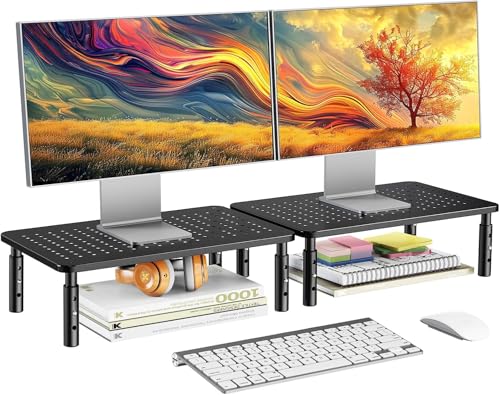
- Three height settings from 4.1 to 5.7 inches
- Perforated steel platforms promote airflow
- Two 44-pound-capacity risers assemble without tools
Best For: Compact editing workstations prioritizing airflow and storage
Best with Extra Features
WESTREE Adjustable Monitor Riser

- 27–39-inch adjustable length
- Rotating design for corner setups
- Three shelves plus a drawer
Best For: Dual-monitor editing desks needing storage and flexible placement
Best Heavy-Duty Dual-Screen Stand

- Expands from 32 to 40 inches
- Wood-and-metal construction
- Large under-shelf storage area
Best For: Wide dual-monitor editing stations with heavier equipment
Best Adjustable Metal Riser – BoYata Height-Adjustable Monitor Stand
For desktop monitor risers for video editing, the BoYata offers adjustable height in a compact metal design. Its open space underneath can help keep a keyboard, notebook, or other desk items organized while positioning a monitor more comfortably.
Best For: Editors who want a sturdy, individually height-adjustable riser with useful under-stand storage.
Pros:
- Twist-knob height adjustment supports personalized screen positioning.
- Metal construction supports up to 33.1 pounds.
- Open storage area helps reduce desktop obstruction.
- Includes a screwdriver for assembly.
Cons:
- It provides one monitor level rather than a dual-monitor shelf.
- Height adjustment requires manual knob changes.
The BoYata is a practical choice when stability and flexible monitor height matter more than built-in organization features or standing-desk functionality.
Best Dual-Monitor Organizer – BONTEC Expandable White Monitor Riser
Among desktop monitor risers for video editing, this BONTEC model stands out for dual-screen setups and desktop organization. Its expandable width and swivel shelves accommodate straight, angled, or corner arrangements while leaving storage compartments beneath.
Best For: Video editors using two monitors who want adjustable placement, accessory storage, and cable organization.
Pros:
- Expands from 31.5 to 42.5 inches for dual-monitor layouts.
- Swivel side shelves support straight, angled, or corner positioning.
- Three open compartments provide storage for peripherals and supplies.
- Includes a phone holder slot and cable-management opening.
Cons:
- The wooden design is less compact than a simple single-monitor riser.
- Its white finish may not suit every desk setup.
With a 44-pound load capacity and quick assembly, the BONTEC is well suited to editors prioritizing a tidy, adaptable two-screen workstation.
Best Sit-Stand Upgrade – VIVO 32-Inch Manual Desk Riser
For desktop monitor risers for video editing that also support posture changes, the VIVO provides a sit-to-stand workstation. Its 32-inch surface and synchronized keyboard tray create room for a monitor setup, while the pneumatic lift raises the platform from 4.9 to 19.7 inches.
Best For: Editors who want to alternate between seated and standing work without replacing their existing desk.
Pros:
- Raises from sitting height to standing height with lift assistance.
- 31.5-by-15.8-inch surface accommodates dual monitors or a laptop-monitor setup.
- Keyboard tray moves in sync with the desktop.
- Steel construction supports up to 26 pounds and includes a three-year warranty.
Cons:
- It is substantially heavier than a basic monitor riser.
- The 26-pound capacity is lower than some fixed risers in this selection.
- It occupies more desk depth than a simple shelf-style stand.
The VIVO is the strongest fit when ergonomic movement is central to your editing routine, though its larger footprint and lower weight rating should be checked against your equipment.
Best Rustic Dual-Monitor Shelf – WESTREE Wood and Steel Riser
This WESTREE stand is a straightforward option among desktop monitor risers for video editing, with space for two monitors and storage beneath. Its combination of steel legs and a rustic brown wood finish adds a furniture-like look while raising screens toward a more comfortable viewing level.
Best For: Editors who want a dual-monitor shelf with under-storage and a distinctive wood-and-steel appearance.
Pros:
- Designed to support a two-monitor setup.
- Thick steel legs provide a heavy-duty support structure.
- Under-stand space helps organize office supplies and accessories.
- Pre-drilled parts, tools, and instructions simplify assembly.
Cons:
- Unlike adjustable-height models, the notes do not specify a height range.
- Its 35.8-inch width requires adequate desk space.
- The rustic brown finish may not match minimalist workstations.
The WESTREE emphasizes stable dual-monitor support and storage rather than fine height adjustment, making it a useful choice for spacious desks with a warm, home-office aesthetic.
Best Connected Workstation Riser – HUANUO Dual Monitor Stand
For video editors building a multi-screen setup, this HUANUO stand is a versatile choice among desktop monitor risers for video editing. It supports one monitor up to 35 inches or as many as three 24-inch monitors, while its built-in power and USB ports help keep accessories connected.
Best For: Editors using multiple monitors who want integrated charging, cable-friendly storage, and space beneath the screens.
Pros:
- Supports up to three 24-inch monitors or one 35-inch monitor, with a 48.5-pound capacity.
- Built-in power strip includes two AC outlets and two USB 3.0 ports.
- Adjustable length and angle, plus tablet and smartphone slots with cable pass-throughs.
- Raises displays by 3.9 inches and creates storage space for a keyboard, laptop, or books.
Cons:
- The large 40.94-inch-wide design requires substantial desk space.
- Its multi-monitor setup may be more than needed for a single-screen workstation.
Choose this model when connectivity and broad monitor support matter as much as screen elevation. Its integrated outlets and USB ports are especially practical for an editing desk with several peripherals.
Best Glass Two-Pack – Hemudu Adjustable Monitor Risers
This two-pack is a flexible option for shoppers comparing desktop monitor risers for video editing. Tempered-glass platforms provide room for two displays, laptops, printers, or other equipment, while adjustable legs and a tilt function help fine-tune viewing height and angle.
Best For: Editors who want two separate risers with adjustable height, forward tilt, and generous weight capacity.
Pros:
- Includes two risers with height adjustment from 3.4 to 4.9 inches.
- Supports up to 88 pounds and uses 1/4-inch tempered safety glass.
- Offers 0–15-degree forward tilt for a more comfortable viewing position.
- Can also serve as a printer stand, laptop riser, desk shelf, or Xbox stand.
Cons:
- The clear glass surface may show fingerprints and desk clutter.
- Assembly requires attaching the stainless-steel legs with screws.
This set makes sense when you need two independently positioned platforms rather than one continuous stand. Its high stated load capacity and tilt adjustment add flexibility for mixed editing equipment.
Best Airflow Design – HUANUO Adjustable Metal Risers
For editors who want a simple two-screen setup, these HUANUO risers combine adjustable height with a perforated metal platform. They are a practical pick among desktop monitor risers for video editing, especially when airflow, under-platform storage, and quick assembly are priorities.
Best For: Home-office editors seeking two compact risers with adjustable viewing height and ventilation-friendly platforms.
Pros:
- Three height settings—4.1, 4.9, and 5.7 inches—support customized positioning.
- Perforated steel platforms improve airflow toward the device.
- Each platform supports up to 44 pounds and includes non-slip, anti-skid feet.
- Tool-free assembly takes about a minute, and the space below stores supplies.
Cons:
- Each platform is 14.5 by 9.1 inches, so larger monitors may have limited surface room.
- The set has three height choices rather than continuous adjustment.
This two-pack is a strong everyday option when you value ventilation and straightforward setup. The mesh surface and under-platform clearance are useful for keeping an editing desk cooler and more organized.
Best with Extra Features – WESTREE Adjustable Monitor Riser
For shoppers comparing desktop monitor risers for video editing, the WESTREE offers a broad, adjustable platform designed for two monitors. Its 27- to 39-inch length and rotating design can help accommodate larger workstations or corner setups.
Best For: Dual-monitor editing desks that need added shelf space and a storage drawer.
Pros:
- Adjustable length from 27 to 39 inches for two-monitor layouts.
- Rotating design can suit corner desk arrangements.
- Includes three shelves and a drawer for organizing desktop items.
- Raises screens toward eye level to support a more comfortable posture.
Cons:
- Requires assembly, although instructions and tools are included.
- The retro brown distressed finish may not match every editing setup.
This is a practical choice when your video-editing workspace needs dual-screen support plus visible storage. Its adjustable footprint is especially useful for desks that change between straight and corner configurations.
Best Compact Adjustable Pick – Klearlook Foldable Monitor Riser
The Klearlook is a flexible option among desktop monitor risers for video editing, particularly when desk space changes throughout the day. Its three width settings, foldable design, and storage features make it easy to adapt a workstation around a monitor, keyboard, tablet, and phone.
Best For: Single-monitor editors who want adjustable width, under-shelf keyboard storage, and a ready-to-use stand.
Pros:
- Adjusts to three widths: 16.5, 18.5, or 20.5 inches.
- Foldable design creates space for a full-size mechanical keyboard.
- Supports up to 55 pounds and uses non-slip legs for stability.
- Includes a hidden tablet/phone holder and storage drawer.
Cons:
- Its adjustable width is intended for a more compact setup than the dual-monitor risers here.
- The white ABS finish may show contrast with darker desk equipment.
With no assembly required, this Klearlook stand is convenient for editors who want a tidy, adjustable workstation without a permanent installation. It combines monitor elevation with useful everyday device storage.
Best Heavy-Duty Dual-Screen Stand – Adjustable 32–40-Inch Riser
For video editors using two screens, this large adjustable riser provides a 32- to 40-inch platform that can expand with the workspace. The wood-and-metal construction also leaves room underneath for a keyboard and other desk accessories.
Best For: Large dual-monitor editing stations that prioritize a wide, sturdy shelf and substantial load capacity.
Pros:
- Retracts from 32 to 40 inches for single- or dual-monitor layouts.
- Rated for approximately 70 pounds in the product description, with listed specifications showing an 80-pound load capacity.
- Four wood legs and an adjustable metal plate are designed for stability.
- Under-shelf space can hold a full-size keyboard and other office items.
Cons:
- Assembly is required using the included hardware.
- Its large footprint may be excessive for smaller desks.
- The black wood-and-metal design offers less finish variety.
This riser suits editors who need a broad, sturdy platform for two displays and want to reclaim the space beneath them. Its adjustable length also lets the stand contract when a single-screen arrangement is sufficient.
How We Picked the Best Desktop Monitor Risers for Video Editing
We focused on the practical requirements of editing workstations: stable support for one or two displays, useful height adjustment, adequate width and depth, accessible desk storage, and construction that can handle extended daily use. We also considered whether each design suits flat monitors, laptops, audio equipment, or mixed setups.
Because video editors often use large displays, speakers, control surfaces, and external drives, we favored risers that make efficient use of limited desk space rather than simply adding height. Adjustable-length and multi-level models can be especially helpful when a workstation changes over time.
Quick Comparison
| What to compare | Best fit |
|---|---|
| Single-monitor adjustable riser | Editors who want precise screen height and a compact footprint |
| Dual-monitor riser | Users running a timeline display plus preview or reference screen |
| Wide desktop shelf | Large monitors, speakers, keyboards, and editing accessories |
| Storage or drawer design | Small desks that need space for drives, controllers, and supplies |
| Standing desk converter | Editors who want to alternate between sitting and standing |
Key Buying Factors for Desktop Monitor Risers for Video Editing
Width, Depth, and Monitor Capacity
Measure the monitor bases, not just the screens. Dual-monitor users should check the total width and leave room for stands, cables, and speakers. A deeper platform is useful for large monitor feet, while a narrower riser may better suit a compact desk.
Height and Viewing Angle
Your primary screen should generally sit near eye level so you are not continually bending your neck. Look for multiple height settings if users or seating positions vary. A riser changes screen height but usually does not provide the same tilt and positioning range as a monitor arm.
Stability and Weight Capacity
Check the stated load rating and place heavier displays over the strongest support areas. Steel frames and broad feet typically provide better stability, but also inspect the surface for flex, non-slip pads, and wobble when typing or adjusting equipment.
Storage and Cable Management
Shelves, drawers, and open compartments can keep external SSDs, card readers, headphones, and keyboards organized. Make sure storage does not block ventilation or make power and display cables difficult to reach.
Who Should Buy Which Desktop Monitor Risers for Video Editing?
Choose a compact adjustable single-monitor riser if you edit on one display and want a simple ergonomic improvement. Pick a dual-monitor model when your workflow depends on a dedicated timeline, preview, bins, or reference screen. A wide riser is better for two larger monitors or a monitor-plus-speaker arrangement, while a drawer or multi-shelf design suits a crowded workstation.
If you want to change posture during long editing sessions, a standing desk converter is the more suitable option. Before buying, confirm your monitor sizes, desk depth, keyboard clearance, and cable routing. The best Desktop Monitor Risers for Video Editing are the ones that raise the display comfortably while leaving enough stable, usable space for the rest of your workflow.
