If you want to run several speaker pairs from one amplifier without overloading it, the right selector matters. A high power impedance matching speaker selector keeps your system safer while making multi-room audio simpler to manage.
Below, we’ve narrowed the field to 10 strong options for home audio setups, with a focus on power handling, channel count, and practical control features.
Best 10 High Power Impedance Matching Speaker Selector Picks for 2026
12-Zone High-Capacity Selector
Monoprice SS-Pro 12 Impedance Matching Speaker Selector

- Handles up to 12 speaker pairs or zones.
- Uses impedance-matching transformers for safer distribution.
- Front-panel push-buttons simplify zone control.
Best For: Large multi-zone home audio setups with many speaker pairs.
6-Channel Protected Distribution Box
Vaiyer 6-Channel Speaker Selector Switch Box

- Supports up to six speaker pairs from one amplifier.
- Built-in impedance protection helps prevent overloading.
- Steel chassis and spring terminals add durability.
Best For: Multi-room audio installs needing six protected speaker channels.
Compact 6-Channel Stereo Selector
PYLE PSS6 Home 6-Channel High Power Stereo Speaker Selector

- Routes one stereo system to up to six speaker pairs.
- Compact design suits small cabinets or racks.
- Simple controls keep setup and use easy.
Best For: Basic multi-room stereo switching in a compact package.
4-Zone Impedance-Protected Selector
OSD Audio ISS4 4-Zone Speaker Selector Switch
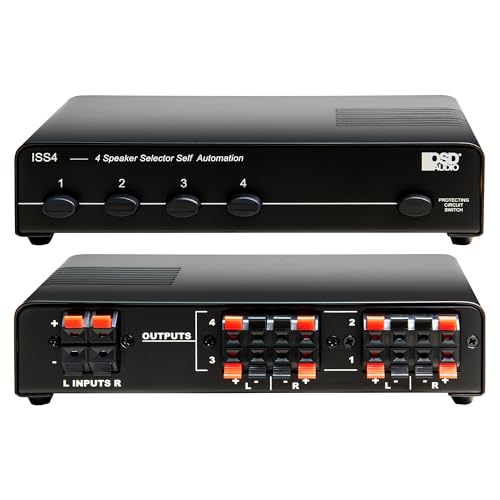
- Controls four listening zones with individual switches.
- Selectable impedance protection supports safer multi-speaker use.
- Phoenix connectors and screw-down terminals aid installation.
Best For: Smaller home audio systems needing four protected zones.
Automatic Protection Speaker Selector
Monoprice SSVC-6.1 6-Channel Selector

- Automatic impedance protection circuitry
- 6 zones with individual volume controls
- 100W/ch continuous, 200W/ch peak
Best For: Home multi-room setups needing safe amplifier matching
High Power 8-Zone Hub
Pyle PSS8 8-Channel Speaker Selector
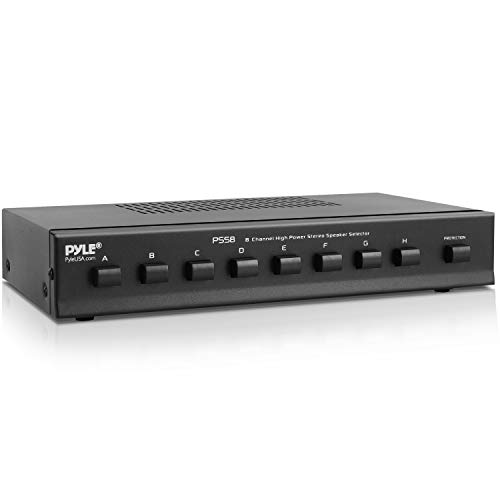
- 8-channel high power stereo selector
- Simple hub for multi-speaker distribution
- Works with amplifier and stereo systems
Best For: Large speaker layouts that need basic 8-zone switching
Impedance Matching 8-Channel Selector
Monoprice 108230 8-Channel Selector

- Built-in impedance-matching circuitry
- Up to 8 stereo speaker zones
- 100W/ch protected, 200W/ch unprotected
Best For: Home theater setups needing safe 8-zone speaker switching
Compact 4-Zone Switch Hub
Pyle PSS4 4 Pair Speaker Selector

- Supports up to 4 speaker pairs
- 100W per channel with 8-ohm minimum
- Accepts 14-gauge speaker wire
Best For: Simple four-zone speaker switching
Dual-Source Zone Controller
Vaiyer 6-Channel Selector with Volume

- Supports six speaker pairs
- Dual AMP A / AMP B inputs
- Per-channel volume controls
Best For: Larger multi-room systems with level control
Protected 6-Zone Selector
Monoprice SS-6 Impedance Protection Box
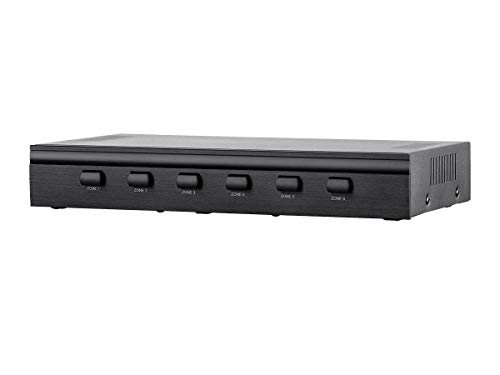
- Automatic impedance protection
- Six zones with on/off buttons
- Supports 12–16 AWG speaker wire
Best For: Safe multi-room switching with simple controls
12-Zone High-Capacity Selector – Monoprice SS-Pro 12 Impedance Matching Speaker Selector
If you need a high power impedance matching speaker selector for a large distributed audio setup, the Monoprice SS-Pro 12 is built to handle up to 12 pairs of speakers or listening zones from one system. Its front-panel push-buttons make zone control straightforward, while the impedance-matching transformers are designed to help safely distribute power across the whole setup.
Best For: Larger homes or multi-zone audio systems that need control over up to 12 speaker pairs from a single selector.
Pros:
- Supports up to 12 pairs of speakers or 12 listening zones.
- Uses audiophile-grade impedance-matching transformers for safer power distribution.
- Front-panel push-buttons make each zone easy to control.
- Includes 6 shingle clips and 2 spacers for installation support.
Cons:
- The feature set is geared more toward larger systems than small setups.
- Single-source switching is handled from the front panel, so it may be more selector than full controller.
This model stands out when you need broad zone coverage and built-in impedance matching in one unit. It is a practical choice for users who want a straightforward way to manage multiple speaker pairs without sacrificing amplifier safety.
6-Channel Protected Distribution Box – Vaiyer 6-Channel Speaker Selector Switch Box
The Vaiyer 6-Channel Speaker Selector Switch Box is a high power impedance matching speaker selector aimed at multi-room audio distribution from one amplifier. With built-in impedance protection, independent push-button controls, and support for up to six pairs of speakers, it is designed to keep a larger setup organized and safer to run.
Best For: Homes, restaurants, or offices that want six independently switchable speaker pairs from one amplifier.
Pros:
- Connects and manages up to six pairs of speakers from one amplifier.
- Built-in impedance protection helps safeguard the amplifier from overloading.
- Rated for up to 900W max / 450W RMS.
- Steel chassis and spring-loaded terminals add durability and secure connections.
Cons:
- Only supports six pairs, so it is not ideal for larger zone counts.
- No extra source-switching features are listed beyond channel control.
For users who want solid wattage handling and simple per-zone switching, this selector offers a balanced feature set. The impedance protection and rugged build make it especially appealing for everyday distributed audio use.
Compact 6-Channel Stereo Selector – PYLE PSS6 Home 6-Channel High Power Stereo Speaker Selector
The PYLE PSS6 is a high power impedance matching speaker selector for users who want to route one stereo system to up to six separate speaker pairs. It keeps the design simple and compact, making it a practical option when you want basic multi-room control without a bulky selector box.
Best For: Straightforward stereo systems that need simple switching for up to six speaker pairs.
Pros:
- Supports up to six separate speaker pairs.
- Compact size makes it easy to place in a small audio rack or cabinet.
- Works with high powered amplifiers and common AV brands listed in the notes.
- Simple stereo speaker selection keeps operation uncomplicated.
Cons:
- The listed power source is 100 watts, which is lower than some higher-capacity selector boxes.
- No detailed impedance-protection circuitry is called out in the supplied notes.
This is a no-frills option for buyers who mainly want basic multi-zone speaker switching. It fits best where simplicity and a compact footprint matter more than advanced protection features.
4-Zone Impedance-Protected Selector – OSD Audio ISS4 4-Zone Speaker Selector Switch
The OSD Audio ISS4 is a high power impedance matching speaker selector designed for four listening zones in a home audio system. It includes selectable impedance matching protection, screw-down phoenix connectors, and individual on/off controls, so it is built for users who want a clean, dependable way to share one amplifier across multiple pairs of speakers.
Best For: Smaller multi-room setups that need four zones with impedance protection and secure wiring.
Pros:
- Supports four listening zones with individual on/off selectors.
- Selectable impedance protection lets one amp safely power multiple pairs.
- Phoenix connectors and screw-down terminals help keep wiring secure.
- Low-profile steel enclosure fits well in a cabinet or equipment rack.
Cons:
- Only covers four zones, so it may not suit larger distributed audio systems.
- Manual protection mode may not be needed for simpler installations.
Among compact selector options, the ISS4 focuses on safe operation and tidy installation. It is a strong fit when you want four-zone control without giving up impedance protection or secure terminal connections.
Automatic Protection Speaker Selector – Monoprice SSVC-6.1 6-Channel Selector
Monoprice SSVC-6.1 Single Input 6-Channel Speaker Selector - With Volume Control, Black
Check Price On AmazonIf you need a high power impedance matching speaker selector for a multi-room setup, the Monoprice SSVC-6.1 is built to safely run multiple speaker pairs from one amplifier. Its automatic impedance protection circuitry, zone-level controls, and isolated grounds make it a practical pick for controlled home audio distribution.
Best For: Home audio users who want a 6-zone selector with volume control and built-in impedance protection.
Pros:
- Automatic impedance protection helps keep the amplifier load in a safe range.
- Supports up to 100 watts per channel continuous and 200 watts per channel peak.
- Individual zone on/off buttons and volume controls add useful control.
- Heavy-duty screw terminals support 12-18 AWG speaker wire.
Cons:
- Limited to 6 channels, so larger systems may need a bigger selector.
- At four 4-ohm speakers selected, minimum amplifier impedance is 4.6 ohms.
- At eight-ohm speakers, minimum amplifier impedance is 5.3 ohms.
Overall, this is a solid option when you want straightforward speaker switching with added protection and per-zone control. The noise-free switching and floating-ground compatibility make it especially useful for more careful amplifier matching.
High Power 8-Zone Hub – Pyle PSS8 8-Channel Speaker Selector
The Pyle PSS8 fits the high power impedance matching speaker selector category for users who want to distribute stereo sound across up to eight pairs of speakers. It is a simple selector hub for multi-channel amplifier setups where basic speaker switching is the main goal.
Best For: Users who want an 8-zone speaker switch hub for broad stereo distribution.
Pros:
- Supports 8 channels for larger speaker layouts.
- Designed as a high power stereo speaker selector.
- Works with amplifier and stereo system setups.
Cons:
- Supplied notes do not list impedance protection circuitry.
- No wattage ratings are provided in the supplied details.
- Very limited feature information compared with more detailed selectors.
In practice, this is the most basic option in the group: a straightforward 8-zone distribution box for speaker switching. If you want more advanced protection or per-zone control, compare it carefully against other models.
Impedance Matching 8-Channel Selector – Monoprice 108230 8-Channel Selector
For buyers searching for a high power impedance matching speaker selector, the Monoprice 108230 is designed to connect up to eight stereo speaker zones while keeping amplifier load under control. Its built-in protection circuitry and selectable power handling make it a practical home theater or whole-home audio component.
Best For: Home theater and multi-zone audio systems that need impedance-matching protection.
Pros:
- Built-in impedance-matching circuitry helps prevent the amplifier impedance from dropping below 5 ohms.
- Supports up to eight stereo speaker zones.
- Can handle up to 100 watts per channel with protection enabled.
- Up to 200 watts per channel is available with the protection circuit disabled.
Cons:
- No per-zone volume controls are listed in the supplied notes.
- Power handling depends on whether the protection circuit is enabled.
- Uses RCA connector details in the supplied data, which may not be what all buyers expect for speaker wiring.
This model is a strong fit if your priority is safe multi-zone speaker distribution with impedance control. The included zone labels and simple selector layout make it easier to organize a larger audio setup.
Compact 4-Zone Switch Hub – Pyle PSS4 4 Pair Speaker Selector
If you need a straightforward high power impedance matching speaker selector for a small multi-room or multi-zone setup, the Pyle PSS4 keeps things simple. It lets you connect up to four separate speaker pairs to one stereo system, with support for speakers at a minimum impedance of 8 ohms and up to 100 watts per channel.
Best For: Basic four-zone speaker switching with a compact, budget-friendly box.
Pros:
- Handles up to 4 separate speaker pairs from one stereo system
- Supports 100 watts per channel with 8-ohm minimum speaker systems
- Accepts speaker wires up to 14-gauge
- Compact black enclosure for simple placement
Cons:
- Designed around 8-ohm minimum impedance systems
- No per-zone volume control listed
- Fewer advanced controls than larger distribution units
For buyers who mainly want reliable switching without extra complexity, this box covers the essentials well. It is a practical fit when your priority is connecting multiple pairs cleanly and staying within its stated power and impedance limits.
Dual-Source Zone Controller – Vaiyer 6-Channel Selector with Volume
The Vaiyer 6-channel unit is a high power impedance matching speaker selector aimed at larger systems that need both routing and level control. It supports up to six pairs of speakers, lets you use AMP A and AMP B inputs, and adds independent rotary volume controls for each channel.
Best For: Larger multi-room installs that need dual-source switching and per-room volume control.
Pros:
- Controls up to six pairs of speakers from one or two amplifiers
- Independent volume knobs for each channel
- Impedance matching autoformer design helps protect amplifiers
- Heavy-duty metal chassis with spring-loaded terminals for 16–22 gauge wire
Cons:
- Larger and heavier than basic selector boxes
- More advanced than needed for simple single-room setups
- Specifications are tailored to installation use rather than portable use
This is the most feature-rich option in the group for whole-home or office audio distribution. If you want one unit to manage source switching, impedance protection, and room-level volume adjustments, it brings those functions together in a single chassis.
Protected 6-Zone Selector – Monoprice SS-6 Impedance Protection Box
The Monoprice SS-6 is a practical high power impedance matching speaker selector for setups that need safe multi-speaker switching. It supports up to six channel zones, includes automatic impedance protection circuitry, and is rated for 100 watts RMS per channel with individual zone on/off buttons.
Best For: Users who want impedance protection and clean zone-by-zone speaker control.
Pros:
- Automatic impedance protection circuitry
- Individual on/off buttons for six zones
- Supports 12–16 AWG speaker wire
- Heavy-duty screw-type connectors with isolated left/right grounds
Cons:
- Rated power is limited to 100 watts RMS per channel
- Requires attention to the listed minimum amplifier impedance
- No volume controls included
For buyers who want a well-documented selector focused on safe operation, this model stands out. It is a strong fit when you need reliable switching across multiple rooms without adding extra controls or complexity.
How We Picked These High Power Impedance Matching Speaker Selector Options
We focused on selectors that make sense for real-world home audio use: enough power handling for typical stereo amplifiers, reliable impedance protection, and channel counts that match common multi-room layouts. We also considered ease of wiring, source switching, volume control, and whether a unit is better suited to small rooms, larger homes, or expanded distribution systems.
Quick Comparison: What Matters Most
At a glance, the biggest differences are number of zones, whether the selector supports one or dual sources, and whether built-in volume control is included. Some models are best for simple speaker sharing, while others are better for larger systems where you need more flexible control across several rooms.
Key Buying Factors for a High Power Impedance Matching Speaker Selector
Channel Count and Expansion
Choose a selector that covers your current speaker zones with a little room to grow. If you plan to add outdoor speakers, a den, or a bedroom zone later, stepping up in channel count can save you from replacing the unit too soon.
Power Handling and Amplifier Match
Check the selector’s wattage rating against your amplifier output. A High Power Impedance Matching Speaker Selector should comfortably handle your system at your normal listening levels, but the amp and selector still need to be reasonably matched for best performance.
Impedance Protection
This is the feature that helps prevent the total speaker load from dropping too low when multiple pairs are active. If you are connecting several rooms to one amp, impedance protection is one of the most important safety features to look for.
Volume Control and Source Switching
Built-in volume control is useful when rooms have different listening needs. Dual-source support can also be helpful if you want to switch between two audio sources without rewiring.
Installation and Wire Compatibility
Look for clear labeling, solid terminals, and support for common wire gauges. A selector that is straightforward to install will usually be easier to live with, especially in retrofit or multi-room setups.
Who Should Buy Which High Power Impedance Matching Speaker Selector?
If you have a smaller home audio setup, a 4-zone or 6-channel model may be enough. For larger homes, outdoor areas, or more complex distribution needs, an 8-channel or 12-pair selector is a better fit. If you want more independent room control, prioritize volume controls; if your main goal is safe sharing from one amp, focus first on impedance matching and power handling.
In short, the best choice depends on how many speaker pairs you want to run, how much control you need per zone, and how much headroom your amplifier can provide. Matching those three factors will help you choose a selector that performs well and stays reliable over time.
