If your room is small, your desk is crowded, or your monitors need help reaching deeper lows, a compact active studio subwoofer can make a big difference.
The best picks add low-end extension without overwhelming the space, helping you hear bass decisions more accurately while keeping setup practical.
Best 10 Compact Active Studio Subwoofer Picks for 2026
PreSonus Pro-Low Foundation

- 10-inch front-firing woofer with bass-reflex port
- Variable crossover, highpass, polarity invert, and ground lift
- Footswitch bypass and flexible XLR/TRS/RCA connections
Best For: Home studios and pro mix rooms needing controlled, full-range low end
KRK Small-Room Reference

- 8-inch glass aramid woofer with 30 Hz bass extension
- Front-firing port and curved cabinet aid placement
- Footswitch control can bypass sub and crossover
Best For: Small studios and desktops needing compact wired bass support
ADAM Room-Friendly Low End

- 10-inch woofer reaches down to 28 Hz
- Downward-firing design helps with placement
- Adjustable crossover, phase, volume, and bypass
Best For: Nearfield studios, especially ADAM T-series monitor setups
IK Ultra-Compact Calibration
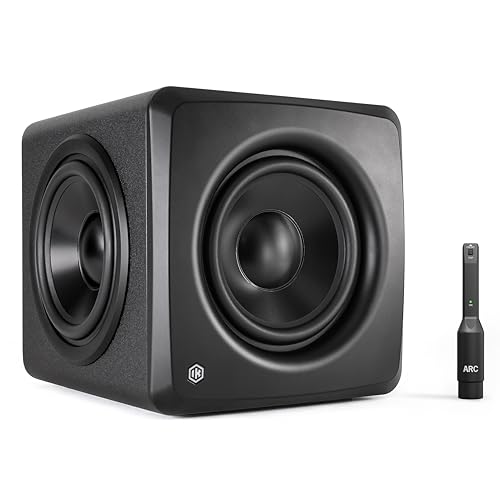
- Smallest pro sub in its class with 25 Hz bass
- ARC X auto-calibrates sub and monitors
- USB, Bluetooth, XLR, and RCA connectivity
Best For: Tiny studios that need deep bass and automatic room correction
Home Studio Bass Anchor

- 100 watts with a 10-inch copolymer woofer
- Down-firing bass reflex port for floor placement
- Variable low-pass control and speaker-level I/O
Best For: Small studios and wired stereo setups
Wireless Compact Monitor Match

- 8-inch front-firing subwoofer with 30 Hz low end
- Bluetooth 5.0 plus TRS, RCA, and front aux input
- Crossover controls help integrate with monitors
Best For: Compact studios needing Bluetooth and flexible inputs
Desktop Bass Booster

- 60W powered subwoofer with a 5.24-inch woofer
- Shelf-mount design suits compact desks
- Vibration pads help reduce resonance
Best For: Small desktops and gaming or studio workstations
Compact Desktop-Friendly Bass
Edifier T5s Powered Subwoofer, 70W RMS, Brown
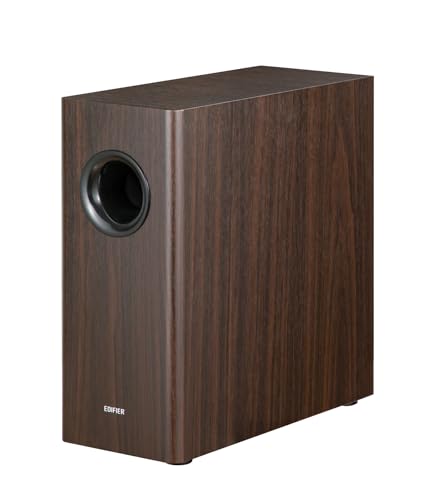
- 8-inch woofer reaches down to 35Hz with 70W RMS output
- Low-pass and phase controls help blend with speakers
- Slim MDF cabinet includes built-in amp and auto-standby
Best For: Small-room listeners who want easy RCA-based bass integration
Ultra-Compact Desktop Sub
Ortizan Compact 60W Active Subwoofer, White

- 5.24-inch woofer and 60W output suit smaller setups
- Tiny shelf-mount cabinet fits desktop and studio spaces
- Vibration pads help limit unwanted resonance
Best For: Compact gaming and studio desks needing a small bass upgrade
Slim High-Output Bass
Edifier T5s Powered Subwoofer, 70W RMS, Black
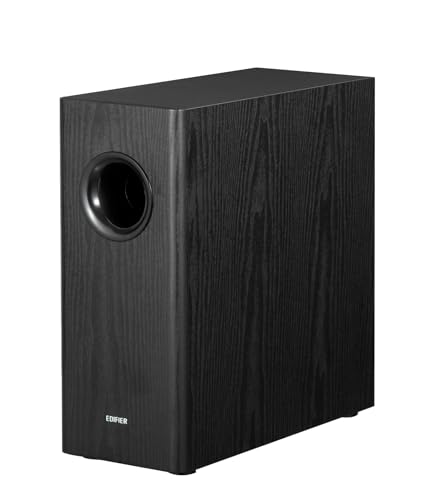
- 8-inch woofer and 70W RMS output deliver strong low-end
- Low-pass filter and phase control aid speaker matching
- Auto-standby and included cables make setup easy
Best For: Compact systems that need stronger bass with simple integration
PreSonus Pro-Low Foundation – PreSonus Eris Pro Sub 10
If you need a compact active studio subwoofer that can add serious low-end weight without taking over your mix, the PreSonus Eris Pro Sub 10 is built for that job. Its 10-inch front-firing driver, front port, and flexible filter controls make it a practical fit for home studios and professional production rooms alike.
Best For: Serious home studios and pro rooms that want a controlled low-end foundation with flexible monitor integration.
Pros:
- 10-inch front-firing design with a bass-reflex port for strong low-end output
- Continuously variable lowpass filter and switchable highpass filter for easier system tuning
- Includes a footswitch bypass for quick A/B checks of your mix
- Balanced XLR/TRS, unbalanced RCA, and pass-through outputs for flexible wiring
Cons:
- Larger and heavier than ultra-small desktop subs at 37 pounds
- No built-in wireless workflow for studio use
- May be more sub than tiny desktop setups need
Overall, the Eris Pro Sub 10 is a strong choice when you want depth, output, and control in one studio-friendly package. It focuses on extending the low end naturally rather than overpowering your monitors, which is exactly what many mix rooms need.
KRK Small-Room Reference – KRK S8.4 Powered Subwoofer
The KRK S8.4 is a compact active studio subwoofer aimed at small production spaces that still need meaningful bass extension. With an 8-inch glass aramid composite woofer, front-firing bass port, and Class D power, it suits desktop-oriented studio setups where placement flexibility matters.
Best For: Small studios and desktop setups that need a compact sub with straightforward wired integration.
Pros:
- 8-inch woofer with bass extension down to 30 Hz
- Front-firing bass port and curved cabinet for easier placement
- Lightweight 26.5-pound build with Class D amplification
- Footswitch control can disable the sub and crossover filter
Cons:
- Footswitch is not included
- XLR-only connectivity may be less flexible for some setups
- Smaller output and low-end reach than larger 10-inch subs
If your room is tight and you want a compact bass reference rather than a huge low-end machine, the S8.4 makes sense. It balances manageable size with studio-focused features that help you place and check it without much hassle.
ADAM Room-Friendly Low End – ADAM Audio T10S Subwoofer
The ADAM Audio T10S is a compact active studio subwoofer designed to extend low end while staying easy to integrate into a studio setup. Its 10-inch woofer, downward-firing design, and adjustable crossover controls make it a practical match for nearfield monitoring.
Best For: ADAM T-series users and studios that want an easy-to-place sub with adjustable calibration tools.
Pros:
- 10-inch woofer with response down to 28 Hz
- Downward-firing driver gives more placement flexibility
- Adjustable crossover, phase rotation, and dedicated volume control
- Sub bypass connection supports quick mix checks with or without the sub
Cons:
- Best matched to T5V and T7V monitors, so it is most compelling inside that ecosystem
- No wireless playback features
- RCA-focused connectivity may not suit every studio rig
For users who want reliable low-end extension and simple setup controls, the T10S is a smart studio companion. It is especially appealing when you want a sub that can be tuned to the room instead of just added to it.
IK Ultra-Compact Calibration – IK Multimedia iLoud Sub
The IK Multimedia iLoud Sub is built for buyers who want a truly compact active studio subwoofer with deep bass and modern calibration tools. With a 6.5-inch driver, dual passive radiators, and ARC X automatic correction, it is aimed at small studios where space and accuracy both matter.
Best For: Small studios, desktop rooms, and mixed-monitor setups that need automated calibration in a tiny footprint.
Pros:
- Compact cabinet with bass extension down to 25 Hz
- ARC X automatically calibrates the sub and connected monitors
- Time-aligns low end for tighter kicks and clearer bass detail
- Flexible XLR/RCA I/O plus USB and Bluetooth support
Cons:
- 6.5-inch driver and compact design may not suit larger rooms needing higher output
- App-based calibration adds extra setup steps
- More feature-heavy than a simple plug-and-play sub
For space-limited studios, the iLoud Sub stands out because it combines a very small footprint with room correction and deep extension. If your priority is precise bass in a tight workspace, it offers a lot of value in a minimal package.
Home Studio Bass Anchor – Samson MediaOne 10S
If you want a compact active studio subwoofer for a small monitoring setup, the Samson MediaOne 10S brings a simple, wired low-end boost with a 10-inch copolymer woofer and 100 watts of power. Its down-firing tuned bass reflex port and variable low-pass control make it straightforward to blend into a stereo or home studio system.
Best For: Small home studios, music listening setups, and desktop systems that need a straightforward wired subwoofer.
Pros:
- 100 watts of power with a 10-inch woofer for fuller low-end support
- Down-firing tuned bass reflex port for compact floor placement
- Variable low-pass frequency control helps match your main speakers
- Speaker-level inputs and outputs support stereo system connections
Cons:
- Wired RCA-based connectivity only, so it is not a wireless option
- Large 10-inch cabinet may be less ideal for very tight desk spaces
- Designed around basic subwoofer duties rather than advanced tuning features
The MediaOne 10S is a practical choice when you want solid bass extension without complicating a compact setup. It focuses on core studio subwoofer essentials, which makes it easy to integrate into music production, gaming, or general entertainment use.
Wireless Compact Monitor Match – PreSonus Eris Sub 8BT
The PreSonus Eris Sub 8BT is a compact active studio subwoofer built for users who want accurate low end with flexible connections. Its 8-inch front-firing design, Bluetooth 5.0 support, and crossover controls make it a strong fit for home production spaces where precision and convenience both matter.
Best For: Music production, compact monitor setups, and mixed-use listening spaces that benefit from Bluetooth and flexible inputs.
Pros:
- Compact 8-inch front-firing design fits smaller studio spaces
- Bluetooth 5.0 plus TRS, RCA, and front aux inputs offer flexible connectivity
- Highpass and lowpass crossover controls help integrate with main monitors
- 100 watts of power and response down to 30 Hz for deep bass support
Cons:
- Best matched with compact monitors, so it may not suit larger full-range systems as well
- Plastic/metal construction is more utilitarian than premium
- Wireless convenience may be unnecessary if you only use traditional wired monitoring
For buyers prioritizing a compact active studio subwoofer with modern connectivity, the Eris Sub 8BT offers a well-rounded balance. It is especially appealing if you want accurate bass management, easy device pairing, and enough connection options for both studio and casual use.
Desktop Bass Booster – Ortizan V8 Active Subwoofer
The Ortizan V8 is a compact active studio subwoofer aimed at desktop gaming and studio audio setups that need extra bass in a small footprint. With a 60W output, 5.24-inch long-throw woofer, Class D amplifier, and vibration pads, it is built for simple shelf-mount placement.
Best For: Desktop gaming, small studio desks, and compact audio setups where space is limited.
Pros:
- Small shelf-mount design keeps it workable in tight desktop setups
- 5.24-inch long-throw woofer adds deep bass extension for its size
- Class D amplifier supports efficient powered subwoofer operation
- Vibration pads help reduce unwanted desk resonance
Cons:
- 60 watts of maximum output is lower than larger studio subs
- Bluetooth connectivity is listed, but wired studio connection details are limited in the supplied notes
- Smaller woofer size may not satisfy users seeking stronger room-filling bass
If your priority is a compact active studio subwoofer that can sit near a gaming or production desk, the V8 keeps the footprint modest. It looks best as a nearfield bass helper rather than a high-output room subwoofer.
Compact Desktop-Friendly Bass – Edifier T5s Powered Subwoofer, 70W RMS, Brown
If you want a compact active studio subwoofer that adds real low-end without taking over your desk or media space, the Edifier T5s is built around that idea. Its 8-inch long-throw woofer, 70W RMS output, and 35Hz bass extension give it enough depth for home audio, bookshelf speakers, and light studio use while keeping the footprint relatively slim.
Best For: Desktop and small-room listeners who want controlled bass from a powered subwoofer with simple RCA integration.
Pros:
- 8-inch long-throw woofer with 35Hz deep bass and 70W RMS output
- Low-pass filter and 0°/180° phase selector help match different speaker setups
- Compact MDF cabinet with front-firing driver and right-firing port for cleaner bass
- Built-in amplifier, auto-standby, and included RCA cables support easy setup
Cons:
- RCA-based wiring means it is best suited to systems with compatible line-level connections
- Not a wireless subwoofer, so placement still depends on cable routing
- Its larger 8-inch design may still be more than some very tight desktop spaces can handle
The T5s stands out if you want a practical powered sub that is easy to integrate and tuned for clean, tight bass rather than excess boom. It is a solid fit for users who need compact bass support with straightforward controls and a tidy cabinet design.
Ultra-Compact Desktop Sub – Ortizan Compact 60W Active Subwoofer, White
The Ortizan compact active studio subwoofer is aimed at setups where space matters more than sheer size. With a 5.24-inch long-throw woofer, 60W output, and a small shelf-mount footprint, it is designed to add deeper bass to desktop gaming, studio monitoring, movies, and music without demanding much room.
Best For: Small desks and compact setups that need a modest active subwoofer for gaming, studio monitoring, and media playback.
Pros:
- Very small 10.91″ x 8.46″ x 8.46″ footprint for tight spaces
- 5.24-inch long-throw woofer with 60W output for added bass extension
- Vibration pads help reduce desk or shelf resonance
- Compatible with home theater receivers, studio monitors, PC soundcards, and gaming consoles
Cons:
- Smaller woofer size will not deliver the same low-end output as larger subs
- Connectivity details are limited to RCA protocol, so setup may depend on your gear
- Its focused desktop form factor is better for compact rooms than large listening spaces
As a compact active studio subwoofer, the Ortizan makes the most sense when you need bass support in a small footprint. It is a practical pick for desktop users who want a straightforward, space-saving sub for nearfield listening or casual entertainment.
Slim High-Output Bass – Edifier T5s Powered Subwoofer, 70W RMS, Black
If you want a compact active studio subwoofer with a little more headroom, the black Edifier T5s follows the same formula as the brown version: an 8-inch long-throw woofer, 70W RMS output, and 35Hz bass extension in a space-saving cabinet. It is built for users who want clean low-end support for home audio, bookshelf speakers, or desktop systems with RCA-friendly connections.
Best For: Listeners who want a compact powered subwoofer with adjustable controls and a clean, low-resonance cabinet.
Pros:
- 8-inch woofer and 70W RMS output provide substantial bass for its size
- Adjustable low-pass filter and phase selector simplify system matching
- Front-firing driver and right-firing port are designed to minimize resonance
- Built-in amplifier, auto-standby, and included cables support easy setup
Cons:
- RCA-only connectivity may not suit every modern audio setup
- No wireless communication, so cable management matters
- The cabinet is compact, but the 8-inch design still needs more room than mini subs
The black T5s is a good fit if you want stronger bass control in a tidy enclosure rather than a bulky home-theater sub. It is especially appealing for buyers who want a simple, powered solution that integrates cleanly with compatible speakers and amps.
How We Picked the Best Compact Active Studio Subwoofer
We focused on Compact Active Studio Subwoofer models that balance size, output, and integration quality. Priority went to accurate bass extension, usable crossover control, sensible connection options, and designs that fit real studio desks and small rooms. We also looked for features that help with placement and calibration, since low frequencies are heavily affected by the room.
Quick Comparison
For the cleanest nearfield monitoring, smaller subwoofers with straightforward controls are often the easiest to integrate. Larger 8- to 10-inch models usually offer more headroom and deeper extension, while ultra-compact units can be better when space is limited or you mainly need support below your monitors’ natural roll-off. Wireless and Bluetooth features may be convenient for casual listening, but wired inputs remain the better choice for most studio work.
Key Buying Factors for a Compact Active Studio Subwoofer
Driver Size and Room Match
A 5-inch to 8-inch sub is often enough for desktop setups and small rooms. A 10-inch model can deliver more authority, but it may require more careful placement and treatment to avoid boomy bass.
Crossover, Phase, and Level Controls
These controls matter more than raw wattage in many studios. A variable crossover helps blend the sub with your monitors, while phase adjustment can tighten the handoff and reduce low-end cancellation at the listening position.
Connection Type
Look for balanced XLR inputs and outputs if you are building a monitor chain. RCA can work well for simpler setups, but balanced connections are generally preferred in dedicated studio environments because they are less prone to noise.
Room Size and Placement
Even the best Compact Active Studio Subwoofer will sound better when placed with care. Start near the front wall, avoid corners if bass gets too heavy, and use test tones or familiar reference tracks to fine-tune the response.
Calibration and Convenience Features
Auto-calibration, DSP tuning, and app-based control can be useful if your room is difficult or your setup changes often. These extras are not mandatory, but they can save time and improve consistency.
Who Should Buy Which Compact Active Studio Subwoofer?
If you produce, mix, or edit in a small room, choose a compact model with precise crossover control and solid low-end definition. If your priority is maximum depth for music production or home theater crossover use, step up to a larger 8- or 10-inch sub with stronger output and better extension. If you mainly need budget-friendly desktop bass support, a smaller powered unit may be the most practical fit. For most buyers, the best choice is the Compact Active Studio Subwoofer that matches your monitors, room size, and listening goals rather than the biggest model available.
