If your TV, console, or streaming device sends sound through HDMI but your older sound system needs optical or analog audio, this Avedio Links 4K HDMI Audio Extractor review examines a practical bridge.
It is designed for 4K video passthrough, ARC/eARC-compatible setups, and separate audio output without requiring the display to be powered on.
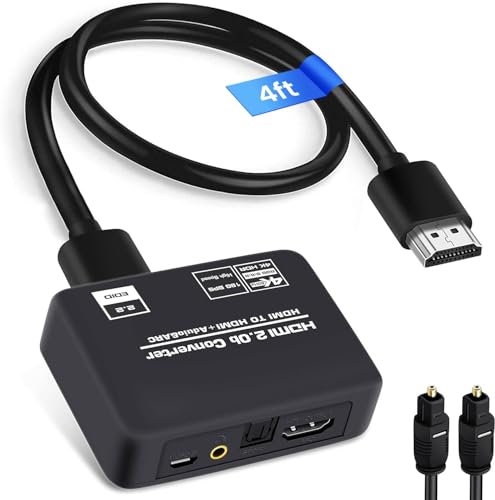
4K HDMI Audio Extractor Review Summary
The Avedio Links 4K HDMI Audio Extractor is worth considering when you need to route HDMI audio to a soundbar, amplifier, speaker system, or receiver while keeping the video signal connected to a TV, monitor, or projector.
Its strongest appeal is flexibility: the listing provides HDMI ARC, optical Toslink/SPDIF, and 3.5mm stereo output, with selectable TV, 2.0CH, and 5.1CH modes.
This is a good fit for a mixed home-theater setup where one device must accommodate both digital and analog audio equipment.
It also suits buyers who want 4K at 60Hz passthrough and HDR 10 support in the same compact connection path.
The main caution is that the product facts describe supported formats and ports, not a detailed installation guide for every television or receiver.
Buyers should confirm their TV has the required ARC/eARC interface and that their preferred audio format matches the selected output.
Review Scorecard
| Category | Editorial score | Buyer-focused rationale |
|---|---|---|
| Video passthrough | 9/10 | Supports up to 4Kx2K at 60Hz, HDR 10, HDCP 2.2, RGB 8:8:8, and 18 Gbps bandwidth. |
| Output flexibility | 9/10 | Offers HDMI ARC, optical Toslink/SPDIF, and 3.5mm stereo connections. |
| Audio format coverage | 8/10 | Optical output supports 2CH PCM, Dolby Digital, Dolby TrueHD, DTS-HD, and DTS according to the listing. |
| Setup value | 8/10 | The package includes optical and HDMI cables, a USB power adapter, and a manual. |
| Device compatibility | 8/10 | Intended for players, Fire TV, PlayStation, Xbox, computers, TVs, monitors, and projectors. |
| Analog audio support | 7/10 | The 3.5mm output is specified for 2-channel PCM/LPCM stereo rather than multichannel analog audio. |
Key Features and Specifications of 4K HDMI Audio Extractor
The product is best understood as an HDMI audio extractor and converter with video passthrough.
An HDMI source connects to the extractor, the HDMI output continues to the display, and audio can be sent separately to compatible equipment.
The listing names Blu-ray and DVD players, HD players, Amazon Fire TV devices, PS3, PS4, PS5, Xbox consoles, PCs, and laptops as possible HDMI input sources.
HDMI output compatibility includes full-HD TVs, monitors, and projectors.
Its headline video capability is 4Kx2K at 60Hz.
The listing also identifies HDR 10, HDCP 2.2, RGB 8:8:8, and maximum 18 Gbps bandwidth.
Those details make the unit more suitable for a modern 4K chain than a basic audio-only adapter, provided the rest of the connected equipment and cables support the same standards.
Audio routing is the central feature.
The HDMI-ARC extractor has three modes: TV, 2.0CH, and 5.1CH.
The optical SPDIF output is specified for 2-channel PCM, 5.1-channel Dolby Digital, Dolby TrueHD, DTS-HD, and DTS.
The 3.5mm output supports 2-channel PCM/LPCM stereo.
That distinction matters: optical is the more appropriate connection when your system needs supported multichannel digital formats, while the 3.5mm jack is aimed at conventional stereo speakers, headphones equipment, or an analog amplifier input.
ARC functionality is also more specific than a generic HDMI input/output arrangement.
The listing says ARC is supported with an HDTV input and is intended for an ARC/eARC interface.
In practice, this means buyers should map the extractor to the correct labeled HDMI port on the television rather than assume every HDMI socket will provide return audio.
The package includes one HDMI audio extractor converter, one digital optical cable, one USB power adapter, one HDMI cable, and one user manual.
Including both cable types improves the value of the bundle for a first installation, although the product still depends on the source, display, and audio system having compatible ports and settings.
Pros and Cons of 4K HDMI Audio Extractor
Pros
- Strong connection flexibility: HDMI ARC, optical Toslink/SPDIF, and 3.5mm stereo output cover several generations of sound equipment.
- 4K-friendly signal path: 4K at 60Hz, HDR 10, HDCP 2.2, RGB 8:8:8, and 18 Gbps support are useful for compatible sources and displays.
- Selectable audio modes: TV, 2.0CH, and 5.1CH settings give buyers a way to match the extractor to their system.
- Useful starter bundle: The included HDMI and optical cables, USB power adapter, and manual reduce the number of extra items needed for setup.
- Broad source list: The stated compatibility covers streaming devices, consoles, computers, and disc players.
Cons
- Not a universal surround solution: The 3.5mm output is limited to 2-channel PCM/LPCM stereo in the supplied specifications.
- ARC requires the right port: The ARC feature is tied to an HDTV’s ARC/eARC interface, so port selection and TV configuration remain important.
- Limited documented detail: The supplied product record does not provide dimensions, a full control layout, or troubleshooting guidance for particular TV brands.
- System compatibility still matters: 4K and HDR support on the extractor cannot make a non-compatible source, display, receiver, or cable support those standards.
Who Should Buy 4K HDMI Audio Extractor?
Buy it if you need to connect a modern HDMI source to a display while feeding audio separately into an optical-equipped soundbar, digital receiver, or compatible speaker system.
It is especially relevant for buyers combining a 4K TV or projector with older audio hardware, or for anyone who wants both digital SPDIF and analog stereo options available from one adapter.
It can also suit console and streaming-device owners who want a stated 4K/60Hz signal path and need to organize audio outside the TV.
The included cables make it a reasonable starting point for a straightforward setup based on the listed ports.
Skip it if your system requires an output not listed here, such as multichannel analog audio through the 3.5mm jack, or if your television lacks ARC/eARC and you specifically need ARC return audio.
Buyers seeking advanced switching, extensive format conversion, or detailed installation controls should compare a more specialized AV product instead.
HDMI Audio Extraction for 4K Home-Theater Systems
Choosing optical versus 3.5mm
Optical is the better match for the listed Dolby and DTS support, including 5.1-channel digital formats.
The 3.5mm connection is the simpler stereo route and is specified for 2-channel PCM/LPCM, so it should be chosen for a two-channel amplifier or powered speaker setup.
Planning the HDMI chain
A sensible connection plan is source to extractor, extractor to TV or projector, and separate audio output to the sound system.
Because the listing specifies 4K at 60Hz and 18 Gbps, buyers should check that the source, display, and cable choices are also appropriate for the desired resolution and HDR signal.
Understanding the mode switch
The TV, 2.0CH, and 5.1CH options are system-matching controls, not a promise that every connected device will produce every format.
The correct choice depends on whether the receiving equipment expects TV audio, stereo PCM, or supported multichannel digital audio.
Alternatives to 4K HDMI Audio Extractor
Consider the OREI HDMI Audio Extractor if you want to compare another established HDMI-extraction product line.
It may be a useful alternative for buyers who prefer a different brand ecosystem or need to compare port and format documentation.
The J-Tech Digital HDMI Audio Extractor is another credible option to investigate for HDMI-to-optical or analog routing.
Compare its supported resolutions, ARC behavior, and audio formats with your equipment before buying.
For buyers focused on console and 4K television connections, search the Prozor HDMI Audio Extractor range and check the exact model’s output modes.
Product variants can differ, so the port list matters more than the family name alone.
Is 4K HDMI Audio Extractor Worth It?
The Avedio Links 4K HDMI Audio Extractor is a sensible buy for a clearly defined connection problem: separating HDMI audio while preserving a 4K/60Hz video path.
Its best strengths are output choice, stated video support, and the included cables.
The decision is less compelling if you need guaranteed compatibility with an unusual receiver, broad analog surround output, or detailed system-management features.
For buyers whose equipment matches the listed HDMI ARC/eARC, optical, or stereo connections, this extractor is worth considering as a flexible bridge between newer video sources and varied audio hardware.
