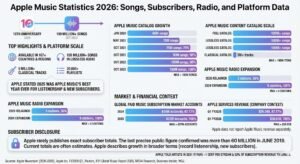
These Apple Music statistics show how the service has scaled since its 2015 launch. Apple Music now offers over 100 million songs, more than 100 million songs in lossless audio, over 30,000 playlists, more than 5 million classical tracks through Apple Music Classical, and six live global radio stations. Apple said 2025 was Apple Music’s best year ever for both listenership and new subscribers, although the company still does not publish a current exact subscriber total.
Max = 837M accounts. Widths: 2024 97.73%, 2025 100.00%
Apple Services revenue context
Label
Bar
Value
Q1 FY2025
$26.34B
Q1 FY2026
$30.01B
Max = $30.01B. Widths: Q1 FY2025 87.77%, Q1 FY2026 100.00%
Apple does not report Apple Music revenue separately, so Services revenue is best used as company context rather than as a direct Apple Music revenue figure.
Apple Music subscriber disclosure
One of the most important Apple Music facts is that Apple rarely publishes exact subscriber totals now. The last precise public figure the company confirmed was more than 60 million subscribers in June 2019. Since then, Apple has described Apple Music in broader terms, such as record listenership, record new subscribers, and continued platform growth, without attaching a fresh official subscriber number.
That means many recent Apple Music subscriber totals found around the web are estimates, model-based projections, or third-party interpretations rather than direct Apple disclosures. For a statistics roundup, it is useful to separate official platform numbers from outside estimates.
What these Apple Music statistics show
Apple Music continues to compete by deepening the premium side of music streaming rather than chasing a fully free ad-supported model. The platform’s growth has shown up in catalog expansion, lossless audio, curated radio, classical depth, and tighter integration across Apple devices and services.
At the same time, subscriber transparency is still limited. Apple clearly signals that Apple Music had a record 2025, but the company no longer gives regular official subscriber updates. So the strongest Apple Music statistics today are usually the ones Apple still publishes directly: catalog size, audio features, geographic footprint, radio expansion, and broader Services performance.
Sources
Apple Newsroom, Apple rings in new era of Services following landmark year, January 2020
Apple Newsroom, Apple Services now available in more countries around the world, April 2020
Apple Newsroom, Apple announces Apple Music radio, August 2020
Apple Newsroom, Apple Music announces Spatial Audio and Lossless Audio, May 2021
Apple Newsroom, Apple introduces the Apple Music Voice Plan, October 2021
Apple Newsroom, The music lives on, May 2022
Apple Newsroom, Celebrating 100 million songs, October 2022
Apple Newsroom, Apple Music launches new Replay experience; reveals 2022’s Top Charts, November 2022
Apple Newsroom, Apple Music Classical is here, March 2023
Apple Newsroom, Apple Music expands live global radio offering with three brand-new stations, December 2024
Apple Newsroom, Lossless audio and ultra-low latency audio come to AirPods Max, March 2025
Apple Newsroom, Apple Music celebrates 10 years with the launch of a new global hub for artists, June 2025
Apple Newsroom, 2025 marked a record-breaking year for Apple services, January 2026
Apple Inc. FY2026 Q1 Consolidated Financial Statements, January 2026
Reuters, Apple Music hits more than 60 million subscribers, trailing Spotify, June 2019
IFPI Global Music Report 2026 and Reuters coverage, March 2026
MIDiA Research, Music subscriber market shares 2024: Slowdown? What slowdown?, March 2025
Business Insider and The Wall Street Journal reporting on Apple Music artist payouts, April 2021
Harmonize your space with the 10 best wall-mounted acoustic panels that combine sound absorption and style, transforming your environment in unexpected ways.
Maximize your audio experience with the 10 best speaker angle alignment tools that promise to revolutionize your sound quality; discover the perfect fit for your setup.