Choosing the right DAC for active speakers can make a bigger difference than many buyers expect. The best models improve clarity, reduce noise, and add the connections you actually need.
Below, we focus on compact desktop units, balanced and unbalanced outputs, and features that matter most for real-world speaker setups in 2026.
Best 10 Dac for Active Speakers Picks for 2026
Best for Desktop Power

- High-resolution AKM/AKM-based desktop DAC
- RCA and sub-out suit active speakers
- USB, optical, and coaxial inputs add flexibility
Best For: Desktop listeners who want a compact DAC for powered speakers and subwoofer expansion.
Best for High-Resolution Desktop Audio

- PCM384kHz and DSD256 support
- XMOS XU208 with custom driver support
- Simple line-out setup for active speakers
Best For: Desktop users who want a compact hi-res USB DAC for powered speakers.
Best Budget DAC for Active Speakers
PROZOR 192KHz Optical to RCA DAC
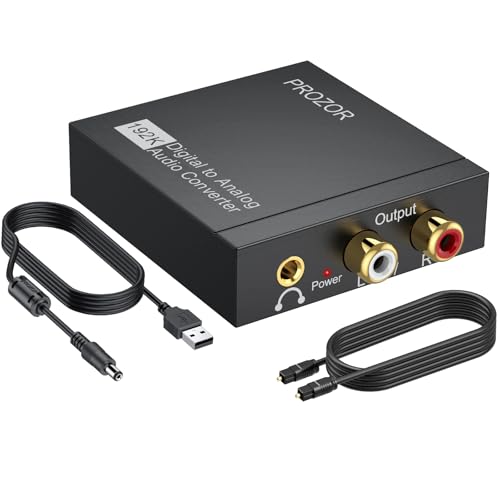
- Converts optical/coaxial digital audio to analog RCA and 3.5mm
- Supports up to 192kHz PCM/LPCM stereo playback
- Built-in amp chip helps with low output volume
Best For: Affordable stereo conversion for powered speakers, TVs, and game consoles.
Best for Compact Desktop Setups
SMSL D1 Hi-Res DAC for Active Speakers

- ROHM BD34352EKV chip for smooth, detailed sound
- Small aluminum chassis fits tight desk setups
- USB-C, optical, and coaxial inputs plus RCA output
Best For: Compact desktop or TV setups with active speakers that need simple, flexible connectivity.
Best for Desktop Speaker + Headphone Use

- Balanced output and clean True Native sound
- Hi-res PCM, DSD512, and MQA support
- Dual headphone outputs with PowerMatch and TrueBass
Best For: Desktop listeners who want one DAC for active speakers and headphones.
Best Wireless DAC Receiver
B3 Bluetooth Receiver with ESS DAC

- LDAC and aptX HD support for higher-quality wireless audio
- Built-in ESS DAC plus Qualcomm QCC5125 chipset
- RCA, optical, coaxial, and XLR outputs for powered speakers
Best For: People who want a Bluetooth DAC receiver for active speakers and pro-style output connections.
Best for Active Speakers
Douk Audio K5 USB DAC & Headphone Amp

- Works as a DAC, preamp, and headphone amp in one box
- USB and optical inputs plus RCA/optical outputs
- ESS9038Q2M, PCM 384kHz, and DSD256 support
Best For: People who want a compact all-in-one DAC for active speakers and desktop headphones.
Best for TV and Balanced Systems
Fosi Audio ZD3 Desktop DAC Preamp

- HDMI ARC, USB, optical, coax, and Bluetooth inputs
- Balanced XLR and RCA outputs for active speakers
- Remote control, OLED display, and 12V trigger support
Best For: Listeners building a compact active-speaker setup that also needs TV integration and balanced output options.
Best for Easy Setup
Fosi Audio Q4 DAC for Active Speakers

- USB, optical, and coaxial inputs
- RCA output for powered speakers
- Bass and treble tone controls
Best For: Users who want a simple, affordable DAC for powered speakers or a desktop setup.
Best Tube DAC for Active Speakers
Fosi Audio GR40 Tube DAC Preamplifier

- Bluetooth, USB, optical, and coax inputs
- ES9028Q2M DAC with 32-bit/384kHz and DSD256 support
- Bass and treble controls with headphone output
Best For: Listeners who want a compact DAC/preamp for active speakers with flexible inputs and a warmer tube character.
Best for Desktop Power – Fosi Audio Q6 Mini DAC
If you need a compact dac for active speakers, the Fosi Audio Q6 is a practical pick thanks to its USB, optical, and coaxial inputs plus RCA and sub-out output support. It is small enough for a desk setup, but still aimed at serious stereo listening with high-resolution playback and low distortion.
Best For: Desktop users who want a versatile DAC for powered speakers, TV audio, or a small stereo system with easy digital input switching.
Pros:
- AKM AK4493S chipset with XMOS XU316 and OPA1612 for high-resolution playback up to 32-bit/768kHz and DSD512
- RCA and sub-out outputs make it easy to connect to active speakers and add a subwoofer
- Compact aluminum housing keeps a desktop setup tidy and durable
- Wide compatibility with PCs, Macs, TVs, CD players, tablets, and streamers
Cons:
- No built-in volume or headphone controls mentioned, so it may depend on your speaker setup
- More features than a basic DAC, which may be unnecessary for very simple systems
For buyers comparing a dac for active speakers, the Q6 stands out as a flexible bridge between modern digital sources and powered monitors. It is a strong fit if you want clean sound, easy connectivity, and room to expand with a subwoofer later.
Best for High-Resolution Desktop Audio – Topping D10s USB DAC
If you want a clean, compact dac for active speakers, the Topping D10s is a practical step up from a motherboard audio output. It supports high-resolution PCM and DSD, uses the ESS ES9038Q2M chip, and pairs easily with powered speakers through its line out.
Best For: Desktop listeners who want a small, affordable USB DAC with strong format support and simple integration with active speakers.
Pros:
- Supports PCM up to 384kHz and DSD256 for modern hi-res playback
- XMOS XU208 USB interface with customized driver support for better compatibility
- Compact, no-fuss design that works well with active speakers or as a USB-to-digital bridge
Cons:
- No volume control, so you’ll rely on your speakers or upstream source
- Line-out focused design means it’s not ideal if you want headphone features
For a straightforward dac for active speakers, the D10s makes sense if you care more about sound quality and format support than extra controls. It’s a good fit for a tidy desktop setup where you just want better audio out of your PC.
Best Budget DAC for Active Speakers – PROZOR 192KHz Optical to RCA DAC
If you need a simple dac for active speakers, the PROZOR 192KHz converter is a straightforward way to turn optical or coaxial digital audio into analog RCA or 3.5mm output. It’s a practical pick for TVs, consoles, and streaming boxes when your powered speakers or older amp only accept analog inputs.
Best For: Buyers who want an affordable, no-frills digital-to-analog adapter for powered speakers, especially for TV and console setups.
Pros:
- Converts Toslink/SPDIF or coaxial audio to RCA and 3.5mm analog output
- Supports up to 192kHz sampling with PCM/LPCM input for clean 2-channel playback
- Built-in amplifier chip helps avoid weak output volume
- Easy hookup for TVs, PS3/PS4/PS5, Blu-ray players, and home audio gear
Cons:
- Does not decode 5.1 surround sound
- TV must be set to PCM/LPCM for proper output
- Volume control may need to be adjusted in the TV or source settings
For a budget dac for active speakers, this PROZOR model makes sense if you mainly need reliable stereo conversion without extra setup or advanced decoding features. It’s best suited to simple home audio chains where compatibility and low cost matter more than bells and whistles.
Best for Compact Desktop Setups – SMSL D1 Hi-Res DAC for Active Speakers
If you want a simple dac for active speakers that adds clean digital-to-analog conversion without taking up desk space, the SMSL D1 is a smart fit. It combines USB, optical, and coaxial inputs with RCA output, making it easy to connect a PC, TV, streamer, or mobile source to powered speakers.
Best For: Listeners who want a small, flexible DAC for desktop or TV audio setups with active speakers.
Pros:
- ROHM BD34352EKV chip aims for smooth, detailed playback.
- Compact aluminum design fits easily beside active speakers or a monitor.
- USB-C, optical, and coaxial inputs cover most common source devices.
- RCA output works well with powered speakers and integrated amps.
Cons:
- No balanced output for more advanced audio systems.
- Touch controls may be less convenient than a physical knob for some users.
- Best suited to simple setups rather than feature-heavy desktop rigs.
Overall, the SMSL D1 is a practical dac for active speakers if you value a small footprint, broad compatibility, and straightforward connectivity over extra outputs or desktop luxuries. It is especially appealing for clean, uncomplicated audio chains.
Best for Desktop Speaker + Headphone Use – iFi Zen DAC 3
The iFi Zen DAC 3 is a compact, feature-rich dac for active speakers if you also want a strong headphone amp in the same desktop unit. Its USB-C input, balanced output support, and high-resolution decoding make it a practical upgrade for cleaner playback from a laptop or desktop source.
Best For: Listeners who want one desktop DAC that can feed active speakers while also handling headphone listening with balanced and single-ended outputs.
Pros:
- Balanced output and Burr-Brown True Native chipset help deliver a clean, low-noise signal
- PCM 32-bit/768kHz, DSD512, and full MQA support cover a wide range of hi-res files
- Dual headphone outputs make it versatile for mixed speaker and headphone setups
- PowerMatch and TrueBass add useful tuning for different listening needs
Cons:
- Primarily a desktop unit, so it is not ideal for portable use
- Some buyers may not need the headphone-focused features if they only want speaker output
For buyers who want a dac for active speakers with extra flexibility, the Zen DAC 3 stands out as a well-rounded desktop option. It is especially appealing if you want high-end decoding and headphone support without moving up to a much larger stack.
Best Wireless DAC Receiver – B3 Bluetooth Receiver with ESS DAC
If you want a flexible dac for active speakers, the blafili B3 is built around wireless streaming rather than amplification. It combines LDAC and aptX HD support with a built-in ESS DAC, so it can feed powered monitors, PA speakers, or an audio mixer through multiple output options.
Best For: Users who want a Bluetooth receiver/DAC with RCA, optical, coaxial, and XLR output options for powered speaker setups.
Pros:
- Supports LDAC, aptX HD, aptX Low Latency, AAC, and SBC for higher-quality Bluetooth playback
- Built-in ESS ES9018K2M DAC and Qualcomm QCC5125 chipset for cleaner, low-noise output
- Multiple active outputs, including RCA, optical, coaxial, and XLR, make it easy to integrate
- Long-range wireless reception with a removable antenna for better placement
Cons:
- Not an amplifier, so it cannot power passive speakers directly
- RCA, coaxial, and XLR cables are not included
- Optical works only as an output, not an input
For a dac for active speakers, the B3 stands out if you want a compact Bluetooth bridge with serious codec support and enough output flexibility to fit mixed desktop, studio, or PA gear. It is less about all-in-one simplicity and more about giving powered systems a better wireless front end.
Best for Active Speakers – Douk Audio K5 USB DAC & Headphone Amp
If you need a DAC for active speakers that can also double as a compact desktop hub, the Douk Audio K5 is a practical pick. It combines USB and optical inputs with RCA and optical outputs, so it fits neatly between a computer and powered speakers while still giving you headphone amp functionality when needed.
Best For: Users who want one small box for active speakers, desktop headphones, and digital input switching.
Pros:
- USB and optical inputs make it flexible for PC, Mac, and TV-style setups
- RCA and optical outputs suit powered speakers and other digital gear
- ESS9038Q2M-based design with PCM 384kHz and DSD256 support
- Includes tone control, bypass mode, and high/low gain switching
Cons:
- Not as simple as a basic DAC-only box if you just need line-out
- Power output is aimed at desktop use rather than demanding full-size amps
- Best results depend on matching it with good powered speakers or headphones
The K5 stands out as a flexible dac for active speakers because it can handle both digital conversion and desktop headphone duties in one compact unit. If you want versatility, tone controls, and straightforward connectivity without moving up to a larger preamp, it is an easy model to shortlist.
Best for TV and Balanced Systems – Fosi Audio ZD3 Desktop DAC Preamp
If you want a flexible dac for active speakers, the Fosi Audio ZD3 stands out for its HDMI ARC support, balanced XLR/RCA outputs, and modern desktop-friendly design. It’s a strong pick when you need one hub for TV, USB, optical, coax, and Bluetooth sources without giving up remote control convenience.
Best For: Listeners building a compact active-speaker setup that also needs TV integration and balanced output options.
Pros:
- HDMI ARC plus USB, optical, coax, and Bluetooth inputs
- Balanced XLR and RCA outputs suit a wide range of active speakers
- High-end ES9039Q2M-based design with remote and OLED display
Cons:
- More feature-rich than simple plug-and-play DACs
- Best value comes when you’ll use the balanced outputs and ARC input
For buyers comparing a dac for active speakers, the ZD3 is especially compelling if you want one unit that can handle a TV and a desktop or stereo stack. It’s not the simplest DAC in the lineup, but it offers a lot of connectivity and control for the price class.
Best for Easy Setup – Fosi Audio Q4 DAC for Active Speakers
If you need a simple dac for active speakers, the Fosi Audio Q4 is an easy entry point. It adds USB, optical, and coaxial inputs, plus RCA and 3.5mm outputs, so it can slot into a PC, TV, or compact stereo setup without much fuss.
Best For: Buyers who want a plug-and-play DAC with basic tone controls for powered speakers or a desktop audio system.
Pros:
- USB, optical, and coaxial inputs cover most common source devices
- RCA output works well with powered speakers and home stereo amps
- Bass and treble knobs make quick sound adjustments easy
- Compact metal build with 24-bit/192kHz support
Cons:
- No microphone input
- More of a budget-friendly basic DAC than a high-end upgrade
For shoppers comparing a dac for active speakers, the Q4 stands out for convenience and versatility rather than audiophile extras. It is a practical pick if you want cleaner sound and easy hookups without spending much.
Best Tube DAC for Active Speakers – Fosi Audio GR40 Tube DAC Preamplifier
The Fosi Audio GR40 is a flexible dac for active speakers if you want one box that can handle Bluetooth, USB, optical, and coax sources while also adding a tube-style preamp stage. It’s a practical pick for desktop or living-room systems where you want straightforward switching, tone controls, and headphone support without adding extra gear.
Best For: Buyers who want a compact DAC/preamp for active speakers with Bluetooth and input flexibility, plus a warmer tube-flavored sound.
Pros:
- Multiple inputs: Bluetooth, USB, optical, and coaxial
- ES9028Q2M DAC with high-res USB support up to 32-bit/384kHz and DSD256
- Separate bass and treble controls with a compact, easy-to-place design
- Headphone output adds extra versatility for one-device setups
Cons:
- Tube-style sound may not suit listeners who want a fully neutral presentation
- 3.5mm headphone output is less robust than dedicated full-size amp options
- Feature-rich layout can be more than some simple speaker setups need
If you want a dac for active speakers that doubles as a preamp and headphone hub, the GR40 stands out for convenience and source flexibility. It’s a strong fit when you want better connectivity and tone shaping in a compact desktop-friendly unit.
How We Picked the Best Dac for Active Speakers
For this roundup of Dac for Active Speakers, we focused on models that are easy to integrate with desktop and home audio setups. Priority went to clean output stages, reliable USB and digital inputs, low-noise performance, and speaker-friendly outputs such as RCA or balanced XLR/TRS when available.
We also considered usability: simple controls, compact footprints, driver support, and whether the unit can serve as more than a basic converter, such as adding preamp control, Bluetooth streaming, or headphone output.
Quick Comparison
If you want the simplest path, choose a straightforward USB or optical DAC with RCA outputs. If your active speakers support balanced inputs, a balanced DAC can help with longer cable runs and lower hum. Bluetooth-capable models are convenient for casual streaming, while DAC/preamp combos are better if you want one box to manage volume and source switching.
Key Buying Factors for Dac for Active Speakers
Outputs and Speaker Compatibility
Make sure the DAC matches your speakers’ inputs. RCA is common and works well for short runs. Balanced XLR or TRS is preferable for noise rejection and cleaner connections in more demanding setups.
Input Types
USB is ideal for computers, optical is great for TVs and consoles, and coaxial can be useful for certain legacy sources. If you plan to connect multiple devices, choose a DAC with enough input flexibility to avoid swapping cables all the time.
Volume Control and Preamp Function
Some active speakers include their own volume knob, while others benefit from a DAC with preamp control. A DAC/preamp can simplify your desk and make level matching easier, especially if you switch between headphones and speakers.
Noise, Power, and Signal Quality
Look for low-noise designs and a stable power setup. In compact desktop systems, poor shielding or a noisy USB source can be more noticeable than raw spec sheets suggest. A well-designed DAC often sounds better than a higher-spec model with weak analog output.
Who Should Buy Which Dac for Active Speakers?
If you want a straightforward upgrade for powered bookshelf speakers, a basic USB/optical DAC with RCA output is usually enough. If your system is on a desk and you also use headphones, a DAC/headphone amp combo makes more sense. If you have premium active monitors or long cable runs, a balanced DAC is the strongest choice.
For wireless convenience, look at Bluetooth DACs with higher-quality codecs. And if you want warmer presentation or a more analog feel, a tube-buffered DAC/preamp can be appealing, though it is more about character than strict neutrality. The best Dac for Active Speakers is the one that matches your sources, speaker inputs, and daily listening habits.
