The right light meter helps workshop owners, technicians, electricians, photographers, and makers verify whether a workspace has enough usable illumination. It can also reveal uneven lighting, glare, and areas that may affect precision or safety.
We selected 10 handheld models spanning basic lux measurement, broad 200,000-lux ranges, foot-candle readings, rotating or split sensors, temperature functions, and more advanced lighting analysis. Use the guide below to narrow the list by your measuring needs, environment, and budget.
Best 10 Handheld Light Meters for Workshops Picks for 2026
Workshop Value Pick

- 0–200,000 lux measurement range
- Fast readings twice per second
- FC/lux switching and peak recording
Best For: General workshop and plant-light checks
LED Testing Specialist

- Up to 400,000 lux for white LEDs
- Supports multiple lamp technologies
- Min/max/average recall and data hold
Best For: Multi-source lighting diagnostics
Flexible Probe Choice
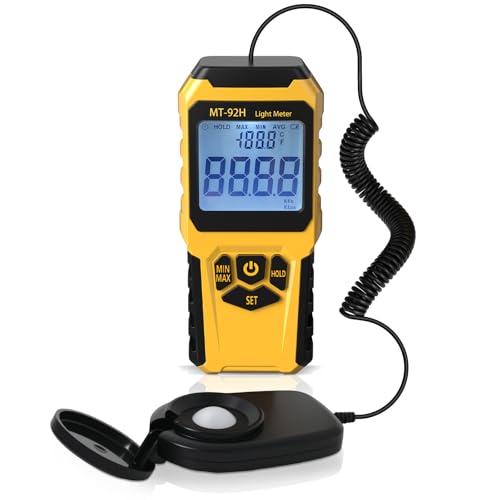
- 0–200,000 lux range with ±3% accuracy
- Separate sensor supports flexible placement
- Fast refresh and switchable backlight
Best For: Awkward-access and professional workshop measurements
Wide-Range Workhorse
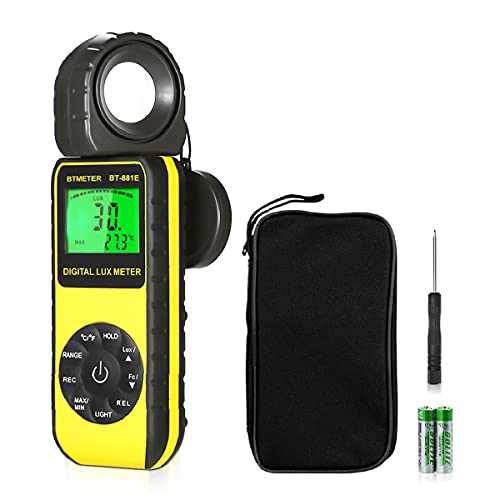
- 0.01–300,000 lux measurement range
- 270° rotating light sensor
- Stores 33 readings with relative mode
Best For: Comparative measurements across varied environments
Advanced Circadian Design Meter

- Measures six lighting metrics, including EML and mEDI
- Bluetooth app support for iOS and Android
- Compact, magnetic design with dual power options
Best For: Professional lighting and circadian-environment analysis
Wide-Range Workshop Meter

- Measures up to 200,000 lux and 20,000 foot-candles
- Backlit display includes an analog bar graph
- Hold, MAX/MIN, auto-off, and two-year warranty
Best For: General workshop and field illuminance checks
Simple High-Range Lux Tester
S8608 Digital Illuminance Meter

- Measures visible brightness up to 200,000 lux
- Switches between lux and foot-candle units
- Includes hold, MAX/MIN, backlight, and auto-off
Best For: Basic indoor and outdoor brightness inspections
Best All-Around Value
Compact 200,000-Lux Light Meter
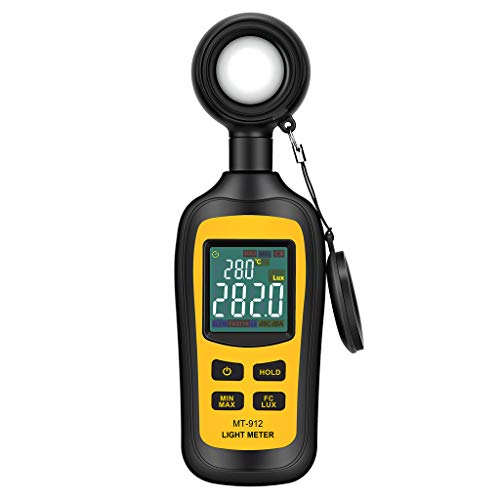
- 0–200,000-lux measurement range
- Ambient-temperature measurement
- Two-year warranty and compact build
Best For: General workshop and facility checks
Best for Reach and Fast Sampling
UNI-T UT383S Split-Probe Meter

- 55-cm lead for separated probe placement
- 0–199,900 lux and foot-candle modes
- 0.5-second sampling and auto range
Best For: Bright, narrow, or hard-to-reach areas
Best for Flexible Probe Positioning

- 360-degree rotating sensor
- 0–200,000-lux range with four settings
- Lux and foot-candle unit selection
Best For: Awkward angles and varied lighting inspections
Workshop Value Pick – Dr.meter 200,000 Lux Meter
For workshops needing a straightforward handheld light meter, the Dr.meter offers a broad 0–200,000 lux range, fast readings, and switchable lux/foot-candle units. Its compact ABS body and included 9V battery make it ready for indoor or outdoor measurements.
Best For: General workshop, office, factory, home, and plant-light checks.
Pros:
- Measures up to 200,000 lux.
- Refreshes readings twice per second.
- Includes FC/lux conversion and peak-value recording.
- Low-battery alert helps prevent unexpected downtime.
Cons:
- Uses a 9V battery rather than smaller AAA cells.
- Its peak function is specialized for brief high-intensity sources.
This is a practical choice when you want broad range and simple controls without adding features unrelated to basic illuminance testing.
LED Testing Specialist – Triplett LT80 Light Meter
The Triplett LT80 is a strong option among handheld light meters for workshops that work with LED fixtures. It measures white LED light up to 400,000 lux, while also supporting fluorescent, metal halide, high-pressure sodium, and incandescent sources.
Best For: Workshops testing multiple lighting technologies, especially LED installations.
Pros:
- Measures white LED sources up to 400,000 lux.
- Supports several common lamp types.
- Min/max/average recall helps compare readings.
- Data hold freezes the displayed result.
Cons:
- Its supplied notes do not list a separate sensor or split-probe design.
- It uses two AAA batteries.
Choose the LT80 when source compatibility and reading statistics matter more than a minimal feature set. Auto power-off can also help conserve its included batteries.
Flexible Probe Choice – MT-92H Split-Sensor Meter
The MT-92H suits workshops where the sensor needs to be positioned separately from the display. Its split-sensor design, 0.5-second refresh rate, backlit screen, and lux/foot-candle switching support measurements in awkward or changing light conditions.
Best For: Professional workshop measurements requiring flexible sensor placement and readable results.
Pros:
- Measures 0–200,000 lux with ±3% accuracy.
- Separate sensor allows flexible positioning.
- Refreshes every 0.5 seconds.
- Switchable backlight and lux/FC units improve usability.
Cons:
- Requires three AAA batteries.
- Its added temperature measurement range may be unnecessary for basic light checks.
For bench work, equipment bays, or other spaces where the meter and sensor cannot sit in the same spot, the MT-92H’s layout is especially useful.
Wide-Range Workhorse – BTMETER 881E Photometer
The BTMETER 881E is built for workshops that need an unusually wide measurement range. It covers 0.01–300,000 lux, responds in about 0.4 seconds, and lets you rotate the sensor 270 degrees while keeping the display facing you.
Best For: Workshops comparing light levels across fixtures, plants, aquariums, offices, and outdoor areas.
Pros:
- Wide 0.01–300,000 lux measurement range.
- Samples two to three times per second.
- Rotating sensor simplifies measurements from different angles.
- Stores 33 readings and includes relative measurement mode.
Cons:
- Specified accuracy varies by measurement range.
- Its data-memory features may be more than needed for occasional checks.
The 881E is a versatile pick when range, angle flexibility, and recorded comparisons are more important than the smallest possible handheld design.
Advanced Circadian Design Meter – EML & CCT Light Sensor
For workshops that involve architectural, interior, or lighting design, this is one of the more specialized handheld light meters for workshops. It measures standard illuminance alongside color temperature, EML, mEDI, contrast, and uniformity, with Bluetooth connectivity for app-based analysis.
Best For: Lighting professionals, architects, horticulturists, and workshop users evaluating both visual quality and circadian-lighting effects.
Pros:
- Measures six useful lighting factors, including illuminance, CCT, EML, mEDI, contrast, and uniformity.
- Connects to iOS and Android devices through the In. Licht pro-Lighting Meter app.
- Compact 40-gram design includes a magnet and lanyard hole for convenient placement.
- Supports either three AAA batteries or Micro-USB power.
Cons:
- Its specialized EML and mEDI features may be more than basic brightness checks require.
- App connectivity is needed for real-time data analysis.
This is the strongest choice when a workshop needs more than a simple lux reading. Its broader lighting metrics and app workflow make it particularly suitable for documenting and refining professional environments.
Wide-Range Workshop Meter – POROMETISTO 200,000-Lux Meter
POROMETISTO is a practical pick among handheld light meters for workshops when you need a broad measurement range and quick readings. It covers up to 200,000 lux, includes a backlit display with an analog bar graph, and adds hold and maximum/minimum functions for field work.
Best For: Workshops checking indoor, greenhouse, warehouse, photography, and outdoor lighting levels.
Pros:
- Measures 0–200,000 lux or 0–20,000 foot-candles with stated accuracy of ±(3% + 5 lux) under standard incandescent lamps.
- Backlit digital display and analog bar graph provide two ways to view readings.
- Data Hold and MAX/MIN recording help with hard-to-reach or changing light sources.
- Includes batteries, sensor cap, lanyard, manual, and a two-year warranty.
Cons:
- The stated accuracy specification is specifically given for standard incandescent lamps.
- Its feature set focuses on illuminance rather than advanced color or circadian metrics.
Choose this model for straightforward, high-range brightness testing. The fast sampling, readable display, and recording functions make it well suited to repeated workshop inspections.
Simple High-Range Lux Tester – S8608 Digital Illuminance Meter
The S8608 is a straightforward option for workshops that mainly need to measure visible brightness. As one of the simpler handheld light meters for workshops, it offers automatic range conversion, a large display, lux and foot-candle units, and readings up to 200,000 lux.
Best For: Basic brightness checks in schools, factories, hospitals, homes, indoor spaces, and outdoor areas.
Pros:
- Wide measurement range reaches 200,000 lux.
- Supports both lux and foot-candle units with automatic range conversion.
- Includes MAX/MIN, data hold, backlight, auto power-off, and low-battery indication.
- Comes with three AAA batteries.
Cons:
- The supplied notes do not specify an accuracy rating.
- It measures visible brightness without the advanced EML, CCT, or uniformity functions found on specialized meters.
This model makes sense when ease of use and a wide lux range matter more than detailed lighting analysis. Its basic controls cover common inspection and maintenance tasks without adding unnecessary complexity.
Best All-Around Value – Compact 200,000-Lux Light Meter
For workshops needing versatile handheld light meters for workshops, this compact model combines a broad 0–200,000-lux range with ambient-temperature measurement. Its color display and practical hold and min/max functions make routine checks straightforward.
Best For: General workshop, office, home, factory, and set-design measurements.
Pros:
- Measures light from 0 to 200,000 lux.
- Provides ambient temperature readings alongside illuminance.
- Includes min/max, data hold, auto power-off, and low-battery indication.
- Lightweight 6.7-ounce design with a two-year warranty.
Cons:
- Uses three AAA batteries.
- Accuracy specifications vary by illuminance range.
This is a sensible general-purpose choice when a workshop wants high range, simple controls, and a compact battery-powered format rather than a specialized probe design.
Best for Reach and Fast Sampling – UNI-T UT383S Split-Probe Meter
The UNI-T UT383S stands out among handheld light meters for workshops because its separated probe can be positioned away from the display and the user’s eyes. A 0.5-second sampling rate, auto-ranging, and selectable lux or foot-candle units support efficient measurements.
Best For: Narrow, elevated, or bright measurement areas where a 55-cm lead is useful.
Pros:
- Measures 0–199,900 lux or 0–18,500 foot-candles.
- 55-cm lead and 10-cm × 6-cm probe provide flexible positioning.
- Fast 0.5-second sampling with stated accuracy of ±(4%+8).
- Includes backlight, data hold, min/max, overload indication, and auto power-off.
Cons:
- At 10.4 ounces, it is heavier than some compact meters.
- The split-probe format adds a lead to manage during storage and use.
Choose this model when probe placement and quick readings matter more than the smallest possible handheld body. Its lux/foot-candle flexibility is also useful for varied workshop tasks.
Best for Flexible Probe Positioning – Rotating-Sensor Lux Meter
For handheld light meters for workshops that require precise sensor placement, the DANOPLUS DP-331 uses a 360-degree rotating sensor separated from the meter body. Four measurement ranges, switchable foot-candle units, and a compact 5.3-ounce design make it convenient for varied lighting checks.
Best For: Workshops, offices, schools, homes, and plant or lighting inspections requiring adjustable sensor orientation.
Pros:
- Offers 0–200,000-lux measurement across four ranges.
- 360-degree rotating sensor helps position the detector appropriately.
- Switches between lux and up to 20,000 foot-candles.
- Includes min/max, data hold, auto-ranging, and low-battery indication.
Cons:
- Accuracy is specified as ±4% ±10 digits.
- Requires two AAA batteries, although they are included.
The rotating sensor is the main reason to choose this meter: it can simplify readings around equipment, fixtures, and awkward angles while retaining a broad measurement range.
How We Picked the Best Handheld Light Meters for Workshops
We focused on meters that are practical for routine workshop checks rather than specialized laboratory instruments alone. Selection criteria included measurement range, lux and foot-candle support, sensor placement, display readability, refresh behavior, portability, and the usefulness of additional readings such as ambient temperature or color temperature.
A wide range is valuable when one tool must cover dim inspection areas and very bright task lighting. We also favored designs with a remote, rotating, or split sensor because they make it easier to take readings in tight spaces without blocking the light reaching the detector. The products span entry-level meters and more feature-rich instruments so buyers can match capability to application.
Quick Comparison
- Best for general workshop checks: Choose a straightforward digital lux meter with a clear display and broad range.
- Best for bright task lighting: Look for models rated to approximately 200,000 lux or 18,500 foot-candles.
- Best for awkward measurement points: A rotating or split sensor helps position the detector independently of the display.
- Best for lighting design work: Consider a meter with color temperature, contrast, uniformity, or related analysis functions.
- Best for mixed-unit work: Select a model that switches between lux and foot-candles.
Key Buying Factors for Handheld Light Meters for Workshops
Range and Resolution
Match the upper limit to your brightest expected source, including high-output LEDs, inspection lamps, and daylight near doors or windows. Resolution matters when comparing small changes between workstations, while a broad range reduces the need to switch instruments.
Sensor Design and Response
A remote or rotating sensor improves access around machinery, benches, and shelving. Faster refresh rates are useful when moving through a space or checking several fixtures quickly, but stable readings are more important for careful setup.
Display and Controls
Prioritize a large, high-contrast display, backlight if measurements are taken in dim areas, and controls that are easy to operate while wearing work gloves. Hold functions can help record readings without constantly watching the screen.
Units and Extra Measurements
Lux is common for many lighting specifications, while foot-candles may be required by certain industries or reference documents. Temperature, color temperature, contrast, and uniformity features are useful only if they support your workflow; otherwise, a simpler meter may offer better value.
Who Should Buy Which Handheld Light Meters for Workshops?
For occasional maintenance, home workshops, and basic safety checks, choose an affordable handheld model with a broad range, clear LCD, and dependable lux readings. For electricians, facility teams, and production supervisors, prioritize rugged handling, quick updates, unit switching, and a sensor that can reach around equipment.
Photographers, lighting designers, and architecture professionals may benefit from models offering foot-candle readings or more specialized color and uniformity measurements. If you routinely compare multiple benches or fixtures, favor a meter with a hold function, readable backlight, and consistent response. Before buying, confirm the stated accuracy, battery type, calibration options, and any included case or accessories.
