When it comes to achieving professional sound quality in your studio, choosing the right powered studio monitors is essential. In 2026, the market offers a range of impressive options that cater to various needs and preferences. From advanced amplification to versatile connectivity, these monitors are designed to enhance your mixing and monitoring experience. Let’s explore the top contenders that could elevate your sound game and help you make an informed choice.
YAMAHA Hs5 Powered Studio Monitor, Pair

If you’re a music producer or audio engineer looking for studio monitors that deliver exceptional sound quality, the Yamaha HS5 Powered Studio Monitor is an excellent choice. This 2-way bass reflex bi-amplified near-field monitor features a 5-inch cone woofer and a 1-inch dome tweeter, ensuring a frequency response from 54 Hz to 30 kHz. With a total of 70 watts power amplification, it emphasizes sonic purity without any coloration. Plus, the HS5 accepts balanced or unbalanced signals through XLR and TRS inputs, making it versatile for various audio applications. Experience high-performance audio with this reliable studio monitor pair.
Best For: Music producers and audio engineers seeking high-performance studio monitors that deliver accurate sound reproduction.
Pros:
- Emphasizes sonic purity with no coloration or alteration of the original sound.
- Versatile connectivity with XLR and TRS inputs for balanced or unbalanced signals.
- Powerful amplification with a total of 70 watts, ensuring clear audio across a wide frequency range.
Cons:
- Limited low-frequency response starting at 54 Hz, which may not satisfy bass-heavy music producers.
- Near-field design may not fill larger spaces effectively without additional speakers.
- Price point may be higher compared to entry-level studio monitors, making it a larger investment for beginners.
JBL 305P MkII 5″ Active Powered Studio Reference Monitors

The JBL 305P MkII 5″ Active Powered Studio Reference Monitors stand out for their exceptional audio quality, making them an ideal choice for both aspiring vloggers and seasoned producers. With patented Image Control Waveguide technology, you’ll enjoy precise, immersive sound across a wide sweet spot. The dual 41-Watt Class-D amplifiers deliver dynamic range and deep bass, thanks to the 5-inch woofer and Slip Stream port. Customization options, like Boundary EQ and HF Trim, let you tailor frequencies to your space. Built with durability in mind, these monitors are rigorously tested, ensuring reliable performance for all your audio needs.
Best For: The JBL 305P MkII 5″ Active Powered Studio Reference Monitors are best for aspiring vloggers and seasoned producers seeking high-quality audio performance in their studio setup.
Pros:
- Exceptional audio quality with patented Image Control Waveguide for immersive sound.
- Customization features like Boundary EQ and HF Trim allow for tailored audio settings to suit any room.
- Durable design backed by rigorous 100-hour reliability testing ensures consistent performance.
Cons:
- Size may be limiting for larger studio spaces or those requiring more powerful monitors.
- Active speakers require power outlets, which can limit placement options.
- Price point may be higher compared to entry-level monitors, making them less accessible for beginners.
PreSonus Eris 3.5 Studio Monitors (Pair)

For aspiring music producers and audiophiles seeking exceptional sound quality in compact spaces, the PreSonus Eris 3.5 studio monitors deliver a perfect blend of performance and versatility. These powered speakers feature woven-composite woofers for tight bass and crystal-clear sound, driven by 50 Watts of Class AB amplification. The 1-inch silk-dome tweeters guarantee a natural high-frequency response, enhancing your listening experience. With multiple connectivity options, including balanced TRS and RCA inputs, you can easily connect various devices. Plus, tuning controls allow you to customize the audio output to fit your space, making them ideal for any setup.
Best For: Aspiring music producers and audiophiles seeking exceptional sound quality in compact spaces.
Pros:
- Studio-quality sound with woven-composite woofers and silk-dome tweeters for clear audio reproduction.
- Multiple connectivity options including balanced TRS, RCA, and ⅛-inch TRS inputs for versatile device compatibility.
- Customizable audio output with high- and low-frequency tuning controls to optimize sound for different environments.
Cons:
- Limited low-frequency response without the optional subwoofer, which may not satisfy bass-heavy music genres.
- Compact size may not be suitable for larger studio setups requiring more powerful speakers.
- Power-saving mode may interrupt playback if inactive for 40 minutes, potentially affecting workflow.
Yamaha HS3 Powered Studio Monitor in Black, Pair (HS3 B)

Designed specifically for studio use, the Yamaha HS3 Powered Studio Monitor in Black delivers exceptional sound accuracy, making it an ideal choice for aspiring musicians and audio professionals alike. With a 2-way bass-reflex design, its 3.5-inch woofer and 0.75-inch tweeter guarantee a frequency response of 70 Hz to 22 kHz. You’ll appreciate the 26 W output power that fills your space with rich sound. Plus, room control and high trim response controls allow you to tailor the audio to your environment. The included stereo mini-RCA cable and anti-slip pad make setup easy, letting you focus on your creative work.
Best For: Aspiring musicians and audio professionals seeking accurate sound reproduction for studio use.
Pros:
- High sound accuracy ensures reliable monitoring for mixing and mastering.
- Compact design fits well in small studio spaces or home setups.
- Versatile input options (XLR/TRS, RCA, Stereo Mini) allow for easy connectivity with various audio sources.
Cons:
- Limited low-end response due to the smaller woofer size, which may not satisfy bass-heavy music genres.
- Output power may be insufficient for larger rooms or louder environments.
- No built-in Bluetooth connectivity, limiting wireless audio streaming options.
Mackie CR3.5 Powered Studio Monitors

Mackie CR3.5 Powered Studio Monitors are perfect for creators and casual listeners seeking studio-quality sound in a compact design. With 3.5″ drivers, these monitors guarantee clear audio for music production, gaming, and HiFi listening. You can easily connect them to various devices using TRS, RCA connectors, or a 3.5 mm input for PCs and consoles. The tone control knob lets you customize sound to boost bass or enhance highs, while the location switch optimizes performance for desktop or bookshelf use. For deeper bass, pair them with the CR8SBT subwoofer. Experience professional sound quality in any setting with the CR3.5s.
Best For: Creators and casual listeners seeking studio-quality sound in a compact and versatile design.
Pros:
- High-quality sound with clear audio reproduction for music production and gaming.
- Customizable sound with a tone control knob for adjusting bass and treble.
- Versatile connectivity options for various devices, including PCs and gaming consoles.
Cons:
- Limited low-end performance without a subwoofer for deeper bass.
- Compact size may not suit users looking for larger speaker systems.
- May require additional setup for optimal placement in different modes.
KRK RP5G5 ROKIT 5 Generation Five 5″ Powered Studio Monitor Pair

If you’re a budding music producer or an audiophile looking to elevate your sound quality, the KRK RP5G5 ROKIT 5 Generation Five studio monitors are an ideal choice. These monitors feature custom-designed Class D power amplifiers that enhance audio integrity while keeping temperatures low. With a new 1” silk dome tweeter, you’ll experience improved high-mid and high-frequency performance. The low diffraction baffle design minimizes distortion, enhancing stereo imaging. Plus, the included acoustic foam wedge isolation pads guarantee proper setup and reduce resonance. With XLR and 1/4” TRS combo inputs, they’re compatible with various audio devices, making them versatile for any setup.
Best For: Budding music producers and audiophiles seeking to enhance their sound quality with reliable studio monitors.
Pros:
- Custom-designed Class D power amplifiers ensure high audio integrity and low operating temperature.
- The 1” silk dome tweeter improves high-mid and high-frequency performance for clearer sound.
- Acoustic foam wedge isolation pads minimize resonance, supporting optimal setup positioning.
Cons:
- Limited low-frequency response due to the 5″ woofer size, which may not satisfy all bass-heavy genres.
- Some users may find the price point higher compared to entry-level studio monitors.
- The design may not appeal to everyone’s aesthetic preferences.
Yamaha HS4 Powered Studio Monitor in Black, Pair (HS4 B)

The Yamaha HS4 Powered Studio Monitor is an exceptional choice for home studio enthusiasts and professionals alike, thanks to its precise sound reproduction and compact design. With a 4.5-inch cone woofer and a 1-inch dome tweeter, it delivers a frequency response of 60 Hz to 22 kHz, ensuring you hear every detail in your mix. The 26 W output power drives clear sound while room control and high trim response controls let you tailor the audio to your space. Plus, it comes with essential accessories like a stereo mini-RCA cable and anti-slip pads, making setup a breeze.
Best For: Home studio enthusiasts and professionals seeking accurate sound reproduction in a compact design.
Pros:
- Excellent sound clarity and detail across a wide frequency range (60 Hz – 22 kHz).
- Versatile connectivity options including XLR/TRS combo inputs and RCA.
- Room control and high trim response controls allow for personalized audio adjustments.
Cons:
- Limited bass response due to the small 4.5-inch woofer size.
- Output power of 26 W may not be sufficient for larger studio spaces.
- The compact design may not provide the same depth of sound as larger monitors.
Edifier R1280T Powered Bookshelf Speakers
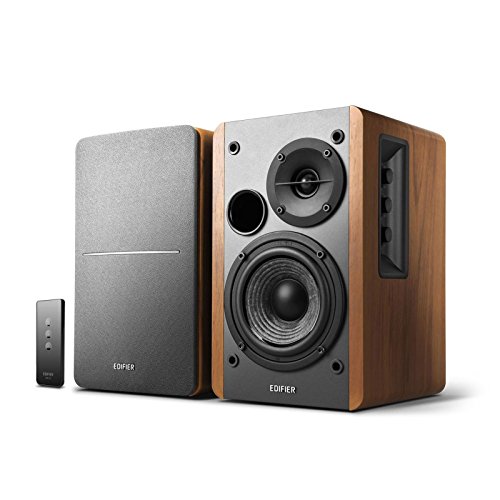
For anyone seeking an affordable yet high-quality audio solution, the Edifier R1280T Powered Bookshelf Speakers stand out as an excellent choice. With studio sound quality delivered through a 13mm silk dome tweeter and a 4-inch full-range unit, you’ll enjoy natural sound reproduction. The 42 watts RMS power guarantees clear audio at various volumes. Connectivity’s a breeze with two AUX inputs, allowing you to play from two devices simultaneously. Plus, the remote control and side panel adjustments make it easy to customize your listening experience. The classic wood finish adds a touch of elegance, complementing your home decor beautifully.
Best For: Those who desire an affordable, high-quality audio solution for home or studio use.
Pros:
- Studio sound quality with natural sound reproduction from the 13mm silk dome tweeter and 4-inch full-range unit.
- Convenient connectivity options with two AUX inputs, allowing simultaneous connection to multiple devices.
- Elegant design featuring a classic wood finish that complements various home decors.
Cons:
- Limited bass response compared to larger speakers or subwoofers.
- No Bluetooth connectivity, which may limit wireless streaming options.
- Remote control functionality may not include all features available on the side panel controls.
Ortizan C7 Dual-Mode Studio Monitors (Pair)

Designed with versatility in mind, the Ortizan C7 Dual-Mode Studio Monitors are perfect for musicians, gamers, and audio enthusiasts seeking high-quality sound in a compact package. With Bluetooth 5.3 for seamless pairing, RCA and AUX inputs guarantee compatibility with multiple devices. The built-in 24-bit DAC minimizes signal loss, while the 3.5-inch carbon fiber speaker and 0.75-inch silk dome tweeter deliver clear, balanced audio. Extensive lab tuning ensures a flat response curve, maintaining true-to-source sound. Plus, the front-panel headphone output and various input options make these monitors an ideal choice for any audio setup, enhancing your listening experience effortlessly.
Best For: Musicians, gamers, and audio enthusiasts seeking high-quality sound in a compact and versatile audio setup.
Pros:
- Bluetooth 5.3 technology allows for quick and easy pairing with smartphones and tablets.
- Extensive lab tuning provides a flat response curve for accurate audio reproduction across all frequencies.
- Multiple connectivity options including RCA, AUX, and TRS inputs make it compatible with various audio sources.
Cons:
- Limited low-end response due to the smaller 3.5-inch speaker size, which may not satisfy bass-heavy applications.
- No built-in subwoofer, potentially requiring additional equipment for users who need enhanced bass performance.
- Compact design may limit soundstage compared to larger studio monitors, affecting immersive listening experiences.
PreSonus Eris E5 2-Way 5.25″ Near Field Studio Monitor

With its 5.25-inch woven composite woofer, the PreSonus Eris E5 is perfect for those seeking accurate mix translation in a near field studio monitor. This 2-way speaker features an ultra-low-mass 1-inch silk-dome tweeter, delivering a balanced high-frequency response. With 80 watts of Class AB bi-amplification, you’ll enjoy ample volume and headroom, achieving a maximum continuous SPL of 102 dB. The front-firing acoustic port enhances bass reproduction, while acoustic tuning controls let you optimize sound for your space. Plus, you’ll benefit from versatile connectivity options and included Studio One Prime and Studio Magic plug-in suite, valued over $1000.
Best For: The PreSonus Eris E5 is best for audio professionals and musicians seeking precise sound monitoring in a compact studio environment.
Pros:
- Accurate sound reproduction with a 5.25-inch woven composite woofer and 1-inch silk-dome tweeter, ensuring balanced low and high frequencies.
- Versatile connectivity options including balanced XLR, 1/4-inch, and unbalanced RCA inputs for easy integration with various audio setups.
- Included software bundle featuring Studio One Prime and Studio Magic plug-in suite, valued over $1000, enhancing your production capabilities.
Cons:
- Limited bass response compared to larger studio monitors, which may not satisfy those seeking deep bass frequencies.
- Potential for over-amplification in smaller spaces, possibly leading to distortion at higher volumes.
- Front-firing acoustic port may require specific placement for optimal bass performance, limiting positioning flexibility.
Factors to Consider When Choosing Powered Studio Monitors
When choosing powered studio monitors, you’ll want to ponder several key factors to guarantee you get the best sound for your setup. Sound quality, connectivity options, and size are vital, along with how much power you’ll need and any customization features that might enhance your experience. Each of these elements plays a significant role in how well your monitors perform in your specific environment.
Sound Quality Importance
Sound quality plays a pivotal role in the effectiveness of powered studio monitors, impacting how accurately audio is reproduced. When you choose monitors with a flat frequency response, you get a more truthful sound representation, allowing you to make precise adjustments during mixing without unwanted coloration. High-quality drivers, like woven-composite woofers and silk-dome tweeters, enhance sound clarity and detail across a wide frequency range, creating an immersive listening experience. Features such as boundary EQ and high-frequency trim help tailor the sound to your room’s unique acoustics, boosting mix accuracy. Finally, consistent audio performance over time, backed by rigorous testing standards, guarantees reliability, giving you confidence in the sound you’re producing during your sessions.
Connectivity Options Available
How do you guarantee your powered studio monitors connect seamlessly to your audio setup? Start by checking the input options. Many monitors offer multiple connections, like XLR, TRS, RCA, and AUX. Balanced inputs, such as XLR and TRS, are especially beneficial since they reduce noise and interference, ensuring professional sound quality. If you need to monitor without disturbing others, look for models with front-panel headphone outputs. For added flexibility, consider monitors with Bluetooth capability, which lets you wirelessly pair with smartphones and tablets. Finally, customization features like Boundary EQ and HF Trim can help you tweak your audio settings based on your room’s acoustics, optimizing your listening experience.
Size and Placement Considerations
Choosing the right powered studio monitors involves more than just connectivity options; size and placement play a significant role in achieving optimal sound quality. Select monitor sizes based on your workspace dimensions—larger monitors can overwhelm small rooms with excessive bass. Near-field monitors, typically 3 to 8 inches in woofer size, excel in close placements, minimizing room acoustics interference.
Ensure that tweeters are at ear level while seated for maximum clarity and stereo imaging. Position your monitors and listening spot to form an equilateral triangle for the best soundstage. Finally, consider room acoustics; using acoustic treatment like foam panels can help reduce reflections and enhance overall sound quality, ensuring your monitors perform at their finest.
Amplification Power Requirements
When selecting powered studio monitors, understanding amplification power requirements is vital to achieving the best sound for your space. The power of studio monitors is typically measured in watts; higher wattage offers greater volume and dynamic range for accurate sound reproduction. For near-field applications, monitors with power ratings between 50 and 80 watts provide enough headroom without distortion. Bi-amplified designs separate low and high frequencies, giving you precise control and improved clarity. Also, make sure the output power matches your room size; larger spaces may need higher amplification to fill the area effectively. Finally, evaluate both RMS and peak power ratings—RMS indicates continuous power handling, while peak power shows maximum short-term output capability, essential for sound fidelity.
Customization Features Offered
After ensuring your powered studio monitors meet the right amplification power requirements, it’s time to explore the customization features that can enhance your listening experience. Many monitors offer high- and low-frequency tuning controls, letting you adjust audio output to match your personal preferences and room acoustics. Boundary EQ can adapt the monitors’ sound characteristics to different environments, ensuring accurate mixing and playback. Look for models with HF trim controls to fine-tune high-frequency response based on room placement. Advanced speakers may also provide desktop or bookshelf modes, optimizing sound dispersion for your setup. Additionally, versatile connectivity options like balanced XLR/TRS and unbalanced RCA inputs allow seamless integration with various audio equipment and sources.
