The best smart home control panels for scheduled routines make everyday automation easier to see, trigger, and adjust. Instead of relying only on phone apps or voice commands, a wall-mounted panel can put lighting, scenes, sensors, and compatible devices in one convenient place.
This roundup compares 10 options across Zigbee, Z-Wave, Wi-Fi, infrared, voice control, and touchscreen interfaces. Pay close attention to ecosystem compatibility, installation requirements, display size, and the types of routines you want to run.
Best 10 Smart Home Control Panels for Scheduled Routines Picks for 2026
Best All-in-One Hub

- Smart Life and Zigbee compatibility
- Built-in Alexa voice control
- 5-inch touchscreen for scenes
Best For: Smart Life users building scheduled routines with one central panel
Best Lighting Routine Starter Kit
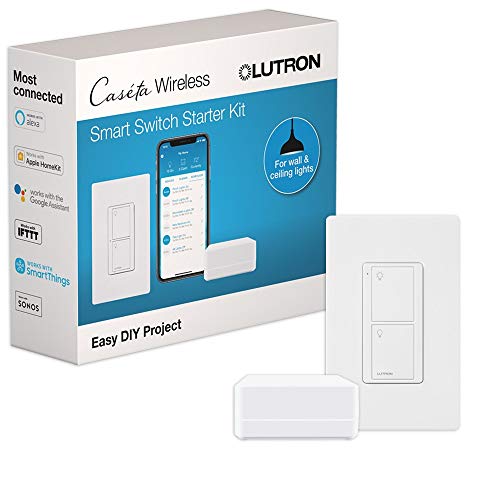
- Schedules, scenes, and timers in the app
- Hub works without Wi-Fi
- Broad smart-home platform support
Best For: Reliable scheduled lighting control
Best for Energy and Security Monitoring

- 4.7-inch touchscreen dashboard
- Energy-use and camera monitoring
- Customizable security modes
Best For: Homes needing routines plus monitoring features
Best for Large, Multi-Area Systems

- 7-inch touchscreen control panel
- 250 zones and 96 users
- Z-Wave Plus programmable scenes
Best For: Large homes and small businesses with multiple areas
Large-Screen Tuya Hub
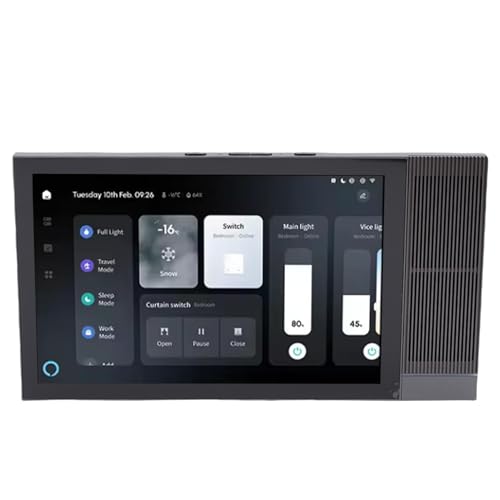
- 8-inch touchscreen for centralized control
- Tuya and Smart Life integration
- Touch, voice, and wall-mounted operation
Best For: Tuya households building scheduled scenes
Connected Monitoring Panel

- 4.7-inch display for home control
- Security modes with alerts and alarms
- Camera viewing and energy statistics
Best For: Homes combining routines with monitoring
Compact IR Scene Controller
3.5-Inch All-in-One Smart Panel

- Controls over 200 devices and scenes
- Built-in IR for compatible appliances
- Touch, buttons, voice, and app control
Best For: Compact mixed-device routine control
Flexible IR Control

- Supports over 110 device types
- Controls up to 12 infrared devices
- Compact touchscreen with adjustable indicator
Best For: Homes combining infrared appliances with smart devices
Tuya Scene Hub

- 4-inch HD multi-touch display
- Custom one-touch scenes and app control
- Three relays with dimming support
Best For: Tuya homes prioritizing scenes and lighting control
Thermostat Scene Control
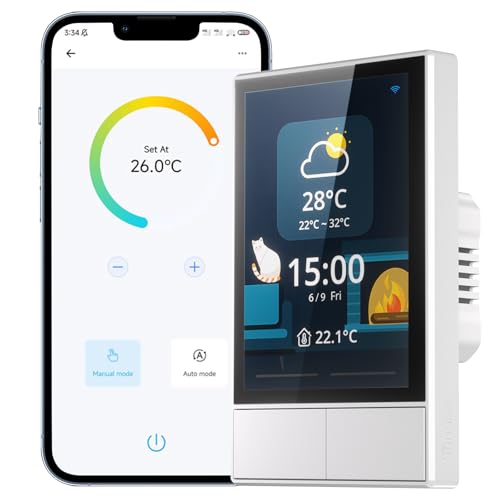
- Timed thermostat settings
- One-tap scenes and grouped SONOFF control
- Touch, app, voice, and switch operation
Best For: SONOFF users combining routines with temperature control
Best All-in-One Hub – MOES Smart Home Control Panel
The MOES Smart Home Control Panel is a practical option for building smart home control panels for scheduled routines, especially if your devices use the Smart Life ecosystem. Its touchscreen, built-in Alexa, and integrated Zigbee gateway bring device and scene control together in one wall-mounted-style interface.
Best For: Smart Life users who want touchscreen scene control, Alexa voice commands, and a built-in Zigbee hub.
Pros:
- Works with a broad range of Smart Life devices, including lights, switches, sockets, cameras, and locks.
- Built-in Alexa supports hands-free control of devices, scenes, and voice skills.
- Integrated Zigbee gateway can eliminate the need for a separate gateway.
- Supports wired or wireless networking and Type-C or circuit power connections.
Cons:
- The supplied details list generic 1 x 1 x 1-inch dimensions, so installation planning may require confirmation.
- Its strongest compatibility is centered on Smart Life devices and supported Zigbee products.
Choose the MOES if you want a compact control point for scheduled scenes and everyday commands without adding a separate Zigbee hub. Confirm device compatibility and installation requirements before purchase.
Best Lighting Routine Starter Kit – Lutron Caseta Smart Switch
The Lutron Caseta starter kit is designed for lighting-focused smart home control panels for scheduled routines. It combines a Caseta switch, hub, and wallplate, while the Lutron app adds scheduling, scenes, timers, geofencing, and smart-away features.
Best For: Homeowners who primarily want dependable scheduled lighting control with Alexa, Apple Home, Google Home, and other integrations.
Pros:
- The Lutron app supports scenes, schedules, timers, geofencing, and smart-away control.
- The hub operates without Wi-Fi for a more reliable smart-lighting connection.
- One switch can control multiple lights or fixtures, including existing bulbs.
- Supports integrations with Alexa, Apple Home, Google Home, Ring, Sonos, and Samsung.
Cons:
- A neutral wire is required for installation.
- The included switch is focused on on/off lighting rather than whole-home device control.
- Pico remote and wall-mount accessories are sold separately.
For scheduled routines centered on lights, Caseta offers a focused and well-supported approach. It is less suitable if you need a touchscreen dashboard or broad control of cameras, locks, and sensors from one panel.
Best for Energy and Security Monitoring – SONOFF NSPanel Pro 120
The SONOFF NSPanel Pro 120 combines smart home control with monitoring features, making it a flexible choice among smart home control panels for scheduled routines. Its 4.7-inch touchscreen can manage lighting and thermostats while also displaying energy statistics, camera feeds, and security alerts.
Best For: Users who want a touchscreen dashboard that combines device control, energy tracking, camera viewing, and basic home-security modes.
Pros:
- Controls lighting, thermostats, and other supported devices from a 4.7-inch touchscreen.
- Can track daily energy consumption over a week for devices with energy-statistics functions.
- Supports live viewing from four listed camera types.
- Customizable security modes can trigger an alarm and phone notification when a sensor is activated.
Cons:
- Camera viewing depends on compatibility with the supported camera types.
- Energy tracking applies only to devices that provide energy-statistics functions.
- The supplied details do not specify the full range of scheduling integrations.
The NSPanel Pro 120 is a strong fit when a routine controller should also serve as a household status display. Before buying, verify compatibility for your cameras, energy-reporting devices, and planned automation setup.
Best for Large, Multi-Area Systems – Aimee Technology PROA7-FA
The Aimee Technology PROA7-FA is a security and automation-oriented touchscreen for larger installations. Its Z-Wave Plus support, programmable scenes, 250-zone capacity, and four independently managed areas make it a capable choice for smart home control panels for scheduled routines across a home or small business.
Best For: Larger homes, small businesses, and multi-area setups that need centralized control for supported locks, lights, thermostats, and sensors.
Pros:
- 7-inch capacitive touchscreen combines control, communication, microphone, speaker, and audible signaling.
- Supports up to 250 zones and 96 users for scalable installations.
- Z-Wave Plus enables programmable scenes for supported lights, locks, thermostats, and other devices.
- Supports up to four independently managed partitions and Wi-Fi, LTE, and wireless RF connectivity.
Cons:
- Its broad zone and partition capabilities may be more than needed for a basic home routine setup.
- Compatible communication modules and wireless devices may be required for some integrations.
- The supplied notes specify a 9-volt power requirement, so installation planning is important.
The PROA7-FA stands out for scale rather than simplicity. It is worth considering when scheduled scenes must coexist with multi-area security and automation management, but smaller homes may prefer a less specialized panel.
Large-Screen Tuya Hub – Fabater 8-Inch Smart Panel
For shoppers comparing smart home control panels for scheduled routines, the Fabater panel is a wall-mounted option built around Tuya devices and the Smart Life app. Its larger touchscreen, voice control, and scene support make it suited to centralized daily automation.
Best For: Tuya households wanting a prominent wall panel for lights, switches, and scenes.
Pros:
- Integrates with Tuya devices through the Smart Life app for automation control.
- Combines an 8-inch 1280×800 touchscreen with touch and voice control.
- Includes dual microphones, dual 2W speakers, and support for wall-mounted installation.
Cons:
- Compatibility is specifically centered on Tuya devices.
- The IP20 rating indicates an indoor-oriented installation rather than weather exposure.
- Its larger wall-panel format may require more installation space than compact controllers.
The Fabater stands out when screen size and hands-free control matter. It is a practical choice for users already invested in Tuya and Smart Life, but buyers should confirm device compatibility and available wall space before installation.
Connected Monitoring Panel – SONOFF NSPanel Pro 120
The SONOFF NSPanel Pro 120 combines device control with monitoring features, making it a versatile choice among smart home control panels for scheduled routines. Its 4.7-inch display can manage lighting, thermostats, cameras, energy statistics, and security modes from one location.
Best For: Homes that want scheduled device control alongside cameras, energy tracking, and security alerts.
Pros:
- Controls lighting, thermostats, cameras, and other compatible home functions from its display.
- Supports customizable security modes with alarms and phone notifications when sensors trigger.
- Offers camera viewing, energy-use tracking, and saved webpage access in addition to control features.
Cons:
- Its 4.7-inch screen is smaller than the Fabater’s 8-inch display.
- The supplied notes do not specify supported device ecosystems or installation details.
- Camera viewing and energy tracking depend on compatible devices and functions.
This panel is a strong fit for buyers who want more than scene activation. It adds security, camera, and energy-monitoring tools, although shoppers should verify ecosystem compatibility and the requirements for their intended devices.
Compact IR Scene Controller – 3.5-Inch All-in-One Smart Panel
This compact controller is designed for shoppers seeking smart home control panels for scheduled routines across a broad mix of devices. It supports device, group, and scene control, while built-in IR and multiple input methods extend control to compatible appliances and home equipment.
Best For: Homes and offices needing compact scene control for smart and infrared devices.
Pros:
- Supports more than 200 devices and scenes, including lights, cameras, thermostats, and door locks.
- Built-in IR supports 12 categories of infrared device control.
- Offers touchscreen, physical buttons, voice assistant, and app control.
- Provides customizable home-page components for quickly accessing devices and scenes.
Cons:
- The 3.5-inch 480×320 display is compact, so on-screen controls may feel less spacious.
- Actual compatibility depends on the specific devices and scenes being connected.
- The supplied notes do not identify the included voice assistant or app ecosystem.
The panel’s small footprint and IR capability make it flexible for rooms with mixed smart and conventional appliances. It is especially appealing where quick scene access matters, but confirm platform support before building a larger routine system.
Flexible IR Control – Yunseity 3.5-Inch Smart Panel
The Yunseity panel is a practical option for smart home control panels for scheduled routines when you want a compact wall-mounted touchscreen with broad infrared coverage. It supports more than 110 device types and can control up to 12 infrared devices, while its multi-touch display and adjustable indicator support everyday use.
Best For: Homes combining infrared appliances with Sigmesh-enabled smart devices.
Pros:
- Supports over 110 types of smart devices.
- Controls up to 12 infrared devices with an embedded IR LED.
- Precise, interference-resistant capacitive multi-touch operation.
- Adjustable firefly indicator helps locate the panel in low light.
Cons:
- The 3.5-inch screen is smaller than the displays on some competing panels.
- The supplied notes do not specify compatibility with a particular mobile app or voice assistant.
Choose this model if device breadth and infrared control matter more than having a larger screen. Its durable lacquered finish and compact design also make it suitable for visible wall installation.
Tuya Scene Hub – T3E 4-Inch Zigbee Panel
The Tuya T3E is designed for smart home control panels for scheduled routines within the Tuya ecosystem. Its 4-inch touchscreen supports device control, lighting adjustments, custom scenes, and app-based remote access, making it useful for coordinating lights, curtains, blinds, and other compatible devices.
Best For: Tuya users who want one wall panel for custom scenes and lighting control.
Pros:
- 4-inch HD multi-touch display shows device controls, date, and clock information.
- Supports custom scenes and one-touch actions such as opening curtains or turning off lights.
- Works with Tuya-compatible lights, curtains, air conditioners, screens, and roller blinds.
- Includes three relay switches and supports dimming and color-temperature adjustments.
Cons:
- Designed around the Tuya ecosystem and Zigbee connectivity.
- Gateway cooperation is noted for multiple scene modes, so setup may require additional ecosystem hardware.
- The supplied notes do not identify compatibility with non-Tuya platforms.
This panel is a strong fit for a Tuya-based installation where scheduled or one-touch scenes are central to the buying decision. Its combination of relay switching, dimming, and app control adds flexibility beyond a basic wall switch.
Thermostat Scene Control – SONOFF NSPanel
The SONOFF NSPanel combines dual-channel switching, touchscreen scene control, and temperature management in one wall-mounted unit. For smart home control panels for scheduled routines, its built-in thermostat can set different temperatures by time of day and automatically trigger heating or cooling systems.
Best For: SONOFF and eWeLink users who want timed scenes plus integrated temperature control.
Pros:
- Supports one-tap scenes and grouped control for compatible SONOFF devices.
- Built-in thermostat supports different temperatures at different times of day.
- Can be controlled by touchscreen, app, voice, or dual-channel switches.
- Displays time, date, weather, and indoor and outdoor temperatures.
Cons:
- It is not compatible with SmartThings, according to the supplied notes.
- Phone setup requires a 2.4GHz Wi-Fi network and the eWeLink app.
- Its central device-control features are focused on SONOFF-compatible equipment.
The NSPanel stands out when temperature schedules are as important as lighting or scene control. It offers several control methods, but buyers should confirm that their existing devices fit the SONOFF and eWeLink ecosystem before purchasing.
How We Picked the Best Smart Home Control Panels for Scheduled Routines
We focused on the features that matter when a panel is used as an everyday automation hub: compatibility with popular smart-home protocols, support for scenes and schedules, control responsiveness, display usability, installation style, and included hardware. We also separated full control panels from simpler smart switches, since they serve different roles in a connected home.
Because compatibility varies by model and software version, confirm support for your specific lights, sensors, locks, thermostats, cameras, and voice assistant before buying. A panel that looks capable may still require a separate hub, app, subscription, or compatible gateway.
Quick Comparison
- Best for broad device integration: Choose a panel with Zigbee, Z-Wave, or multi-platform support if you use products from several brands.
- Best for lighting routines: A dedicated smart switch starter kit can be simpler and more dependable than a full touchscreen panel.
- Best for visual control: Larger displays are easier for scenes, dashboards, security status, and multi-room control.
- Best for compact installations: Smaller in-wall panels suit hallways, bedrooms, and entryways where space is limited.
- Best for existing ecosystems: Match the panel to your current Tuya, SONOFF, Lutron, Home Assistant, Alexa, or Z-Wave setup.
Key Buying Factors for Scheduled Routines
Protocol and Ecosystem Compatibility
Check whether the panel uses Wi-Fi, Zigbee, Z-Wave, infrared, or a proprietary platform. Zigbee and Z-Wave can be useful for local, low-power accessories, while Wi-Fi panels may be easier to configure but more dependent on cloud services. If you already use Home Assistant or Alexa, verify the exact integration rather than relying on general platform claims.
Routine and Scene Support
Look for time-based schedules, sunrise and sunset triggers, occupancy or sensor conditions, and multi-device scenes. A useful panel should let you start a routine quickly while still allowing detailed automation from its companion app.
Display, Controls, and Installation
Consider screen size, brightness, touch responsiveness, physical switches, wall-box depth, and wiring requirements. Some models replace a wall switch and may require a neutral wire; others need only power and function primarily as dashboards. Confirm electrical compatibility and use a qualified installer when necessary.
Privacy and Reliability
For panels with microphones, cameras, or voice assistants, review privacy controls and account requirements. Local control can reduce dependence on internet access, while cloud-based features may provide easier remote management. Stable Wi-Fi and dependable app support are equally important for scheduled routines.
Who Should Buy Which Smart Home Control Panels for Scheduled Routines?
Choose a full touchscreen control panel if you want a central dashboard for scenes, sensors, energy information, and multiple rooms. Choose a Zigbee or Z-Wave panel if your home already relies on compatible low-power devices. Choose a lighting-focused smart switch if your priority is reliable scheduled lighting with minimal setup. Choose a compact in-wall panel for a bedroom, hallway, or entry point where quick scene access matters more than a large dashboard.
