Sound can leak through surprisingly small gaps around a studio door, especially in large rooms where recording, mixing, or rehearsal volume is higher. The right seal can reduce drafts, light, and airborne noise without making the door difficult to operate.
These 10 studio door seals for large rooms include acoustic kits, adhesive weatherstripping, kerf-fit seals, and flexible silicone designs for different gap sizes and installation needs.
Best 10 Studio Door Seals for Large Rooms Picks for 2026
Large-Room Coverage Pick

- Treats up to four standard-size doors
- Includes two 50-foot seals and a 25-foot sweep
- Polyurethane components with easy installation
Best For: Multi-door studios and larger spaces
Budget Weatherproofing Option

- 33 feet of self-adhesive weather stripping
- Soft high-density brush construction
- Helps reduce noise, drafts, dust, and light leaks
Best For: Long runs with relatively narrow gaps
Single-Door Studio Pick

- Designed for one standard-size door
- Includes a 25-foot seal and 4-foot sweep
- Helps block sound through door gaps
Best For: Single-door studio and apartment applications
Large-Gap Flexible Pick

- Fits 5/16- to 15/32-inch gaps
- Hollow EPDM profile compresses and rebounds
- Self-adhesive, mesh-reinforced backing
Best For: Uneven doors with measured larger gaps
Flexible EVA Coverage

- 33 feet for extensive coverage
- Flexible foam fills larger gaps
- Self-adhesive and multipurpose
Best For: Large studio doors and irregular gaps
Grooved-Frame Fit
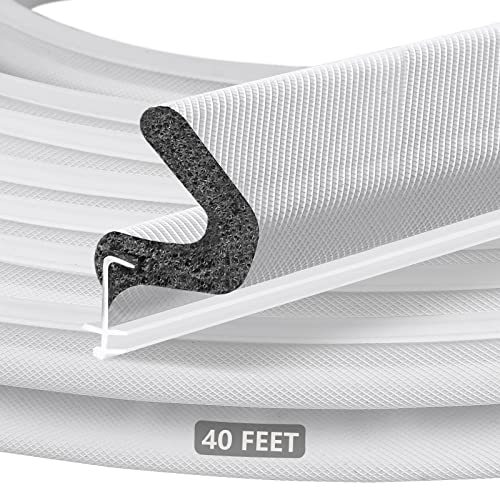
- 40-foot replacement roll
- Press-in fit for 1/8-inch kerfs
- Helps reduce drafts and noise
Best For: Studio doors with compatible kerf grooves
Secure Clear Seal
Benory T-Shaped Silicone Strip

- Two adhesive faces for stability
- Clear silicone blends with doors
- 20 feet of cut-to-fit coverage
Best For: Discreet adhesive sealing around studio doors
Best Multi-Use Coverage
Holikme 65FT Transparent Door Seal

- 65 feet across four rolls
- Peel-and-stick installation
- Also works for windows and shower doors
Best For: Multiple doors, windows, and varied sealing projects
Best for Kerf-Fit Studio Doors

- 26 feet of foam strip
- No adhesive required
- Blocks light, drafts, and noise
Best For: Doors with compatible 0.35–0.59-inch kerf slots
Best for Small Frame Gaps

- Fits 1/8- to 1/4-inch gaps
- Flexible silicone construction
- Peel-and-stick installation
Best For: Narrow gaps around studio doors and windows
Large-Room Coverage Pick – Audimute Large Door Seal Kit
Audimute Soundproofing Acoustic Door Seal Kit - Door Sweep and Seal - (Large Size)
Check Price On AmazonFor studio door seals for large rooms, this Audimute large kit is the strongest coverage option in the group. It includes two 50-foot door seals and a 25-foot door sweep, enough to treat up to four standard-size doors while helping block sound through gaps around the door.
Best For: Multi-door studios, apartments, and larger spaces where several standard doors need sealing.
Pros:
- Designed to treat up to four standard-size doors
- Includes two door seals and one door sweep
- Easy to install and made from polyurethane
Cons:
- Designed around standard-size doors rather than unusually large or custom openings
- The larger kit may provide more material than needed for a single door
Choose this kit when coverage matters more than minimizing leftover material. Its multi-door quantity makes it a practical starting point for studio or apartment projects with several sound-leaking doors.
Budget Weatherproofing Option – 33-Foot Gray Brush Seal
This 33-foot self-adhesive strip is a flexible choice for studio door seals for large rooms when you also want help with drafts, dust, and light leaks. Its soft brush-style material is intended for doors, windows, sliding doors, and other narrow gaps.
Best For: Long runs around doors or windows where a thin, self-adhesive brush seal is suitable.
Pros:
- Provides 33 feet of material for extended installations
- Self-adhesive design can be measured, cut, and applied
- Helps address noise, drafts, dust, rain, and energy loss
Cons:
- At 0.2 inches thick, it is intended for relatively narrow gaps
- Its felt and brush construction may not suit larger uneven door gaps
- Application requires a clean, dry surface
This is a versatile, economical option for lighter sealing work across a broad area. Measure the gap first, since the strip’s narrow profile is better suited to modest clearances than large openings.
Single-Door Studio Pick – Audimute Standard Door Kit
Audimute Soundproofing Acoustic Door Seal Kit - Door Sweep and Seal - (Standard Size)
Check Price On AmazonFor one studio entrance, this standard Audimute kit offers a focused approach to studio door seals for large rooms. It combines a 25-foot door seal with a 4-foot door sweep to help block sound traveling through gaps around one standard-size door.
Best For: A single standard-size studio, apartment, or room door requiring a straightforward seal-and-sweep setup.
Pros:
- Designed to treat one standard-size door
- Includes both perimeter seal and bottom sweep components
- Easy to install and made from polyurethane
Cons:
- Limited to one standard-size door
- May not provide enough material for multiple doors or unusually large openings
This kit is the more efficient Audimute choice when only one door needs attention. It covers the two main leakage areas without requiring the larger multi-door package.
Large-Gap Flexible Pick – White D-Shaped EPDM Seal
When studio door seals for large rooms must cover an uneven or sizable gap, this 20-foot D-shaped EPDM strip is worth considering. Its hollow profile is designed for gaps from 5/16 to 15/32 inch and compresses as the door closes.
Best For: Doors with measured, uneven gaps in the listed range where a flexible rubber profile is appropriate.
Pros:
- Fits larger 5/16- to 15/32-inch gaps
- Flexible EPDM rubber remains usable in hot and cold weather
- Mesh-reinforced adhesive backing supports a cut-and-press installation
Cons:
- Only 20 feet of material is included
- Requires careful gap measurement before ordering
- Adhesive needs a clean, dry surface and up to 24 hours to bond
This seal is a practical match for large or irregular gaps, especially where a compressible rubber profile is preferable to a thin brush strip. Confirm the closed gap and allow the adhesive curing time before regular use.
Flexible EVA Coverage – 33FT EVA Foam Door Seal
For studio door seals for large rooms, this 33-foot EVA foam weatherstrip offers flexible coverage for wider or irregular gaps. Its self-adhesive backing is designed for installation on clean door or window frames and can also provide sound, draft, and light-blocking benefits.
Best For: Large-room studio doors, windows, and other areas needing a cut-to-length adhesive seal.
Pros:
- 33 feet of material can cover multiple openings or larger frames.
- Flexible EVA foam helps fill comparatively large gaps while providing insulation and sound reduction.
- Upgraded mesh adhesive is designed for firm attachment and straightforward application.
- Can also be used for anti-collision, anti-friction, and light-blocking purposes.
Cons:
- Adhesive installation requires a clean, suitable surface.
- Its broad application range means the strip must be measured and cut carefully for a neat fit.
This is the most versatile option of the three for a studio requiring substantial, customizable coverage. It is especially practical when the door or surrounding frame has gaps that standard narrow foam strips may not fill.
Grooved-Frame Fit – Litaibai 40 ft Kerf Seal
When choosing studio door seals for large rooms, this 40-foot kerf seal is suited to doors with pre-cut grooves rather than flat adhesive mounting surfaces. It presses into 1/8-inch kerf slots and is intended for closed gaps measuring 1/4 to 1/2 inch.
Best For: Exterior, garage, or studio entry doors with compatible pre-cut kerf frames.
Pros:
- 40-foot roll can be cut for multiple doors or long frames.
- Press-in installation avoids relying on self-adhesive backing.
- PE-covered PU foam compresses and rebounds to maintain a snug seal.
- Helps reduce drafts, light leaks, outside noise, and heating or cooling loss.
Cons:
- It is not self-adhesive and requires a compatible 1/8-inch kerf slot.
- It is not suitable for frames without the required groove.
- Measuring the kerf and door gap is essential before ordering.
This is a strong choice for a studio door already designed with a kerf channel. Its long roll and replaceable press-in construction make it practical for worn or compressed seals, but compatibility must be confirmed first.
Secure Clear Seal – Benory T-Shaped Silicone Strip
For studio door seals for large rooms where a discreet appearance matters, the Benory T-shaped silicone strip uses two adhesive surfaces for added hold. Its 1.38-inch width can help close frame gaps while the clear material blends with different door colors.
Best For: Doors needing a low-visibility adhesive seal for drafts, dust, and outside noise.
Pros:
- Two adhesive faces attach along the door side and front for a more secure hold.
- Flexible clear silicone conforms to door gaps and blends with the door.
- 20 feet can be measured and cut for a tailored installation.
- Helps reduce drafts, indoor air loss, dust, and outside noise.
Cons:
- The 20-foot length provides less coverage than the 33- and 40-foot alternatives.
- Adhesive performance depends on a clean, dry mounting surface.
- Cold-weather installation may require warming the backing with a hair dryer.
This strip suits studios where appearance and a stable adhesive hold are priorities. Check the door gap and mounting surfaces carefully, especially if you need to seal a particularly large opening.
Best Multi-Use Coverage – Holikme 65FT Transparent Door Seal
For large rooms with several draft-prone openings, the Holikme 65FT Weather Stripping provides plenty of material for studio door seals for large rooms, windows, and other gaps. Its transparent, peel-and-stick design is simple to cut and install on clean surfaces.
Best For: Covering multiple interior doors, windows, and other small gaps when you want a long, versatile roll supply.
Pros:
- Four rolls provide 65 feet of total coverage.
- Helps block drafts, dust, smoke, insects, light gaps, and water infiltration.
- Can also be used on shower glass door bottoms and bathroom areas.
- Peel-and-stick installation requires only measuring, cutting, and pressing.
Cons:
- Designed for gaps of 0.8 inches or less.
- Adhesive installation requires a clean surface for proper bonding.
- Its flexible strip format may require careful alignment along wide studio doors.
This is the most flexible option for a large room or studio with multiple sealing projects. Its generous length and broad range of uses make it convenient, though accurate measurement is important before installation.
Best for Kerf-Fit Studio Doors – Ravinte Q-Shaped Foam Seal
The Ravinte Q-shaped seal is a strong candidate for studio door seals for large rooms when the door frame already has a compatible kerf or groove. Its push-in design avoids adhesive and helps create a light-blocking, draft-reducing seal.
Best For: Doors with slots measuring approximately 0.35 to 0.59 inches that need a removable, no-adhesive frame seal.
Pros:
- 26 feet of high-density foam weather stripping.
- Push-in installation leaves no adhesive marks.
- Helps block light, drafts, dust, water, and outside noise.
- Flexible material fits a range of compatible door slots.
Cons:
- Requires a suitable door groove or recess for installation.
- Slot dimensions should be checked before ordering.
- Supplied length is less than the Holikme option.
For a studio door with an existing kerf channel, this design offers a clean and secure alternative to adhesive strips. It is less suitable for flat door frames without the required slot.
Best for Small Frame Gaps – Silicone D-Shaped Door Seal
For smaller gaps around studio doors and nearby windows, this 20-foot silicone D-shaped strip offers a straightforward option for studio door seals for large rooms. It trims easily and installs with peel-and-stick adhesive after the surface is cleaned and dried.
Best For: Sealing narrow 1/8- to 1/4-inch gaps around door frames, windows, cabinets, and other smooth surfaces.
Pros:
- Flexible silicone compresses into small gaps.
- Helps reduce drafts, dust, moisture, light gaps, insects, and everyday noise.
- 20-foot roll can be cut to fit different projects.
- Includes an adhesive promoter for stronger bonding on smooth surfaces.
Cons:
- Recommended only for relatively narrow gaps up to 1/4 inch.
- Self-adhesive installation depends on a clean, dry surface.
- Provides less total coverage than the 65-foot Holikme pack.
This is a practical choice when the main issue is a small, consistent frame gap rather than a large opening. Measure first, since it is not intended for wider door clearances.
How We Picked the Best Studio Door Seals for Large Rooms
We focused on the factors that matter most around a studio entrance: the seal’s installation method, material, flexibility, coverage, and ability to close common door gaps. The selection includes complete acoustic kits as well as economical strips that can be combined around the jamb, head, and threshold.
Because doors and frames vary, no single product is ideal for every room. Adhesive foam is convenient for smooth surfaces, while kerf-fit weatherstripping is better for compatible routed channels. Silicone and rubber-style seals generally offer better resilience when the door is used frequently.
Quick Comparison
| Seal type | Best for | Installation | What to check |
|---|---|---|---|
| Acoustic door kit | Studios needing a coordinated perimeter and sweep | Usually hardware or adhesive-based | Door size and threshold clearance |
| Adhesive foam | Fast, low-cost gap sealing | Peel-and-stick | Surface cleanliness and compression |
| D-shaped silicone or rubber | Medium to larger perimeter gaps | Self-adhesive | Gap dimensions and door movement |
| Kerf-fit seal | Doors with an existing kerf channel | Push-in installation | Kerf compatibility and channel size |
| T-shaped seal | Specialized frame or channel installations | Slot or channel fit | Profile dimensions |
Key Buying Factors for Studio Door Seals for Large Rooms
Measure the Gap First
Measure the gap at several points with the door closed. A seal that is too thin may not block drafts or sound effectively, while one that is too thick can prevent the latch from engaging or make the door hard to close. Use the largest consistent gap as a guide, but account for uneven frames.
Choose the Right Installation Style
Self-adhesive strips are the simplest option for clean, smooth metal, wood, or painted frames. Remove dust and grease before installation, and press the strip firmly along the full length. Kerf seals provide a cleaner, more durable fit when the frame already has a compatible groove, but they are not a universal replacement for adhesive products.
Seal the Entire Perimeter
For meaningful noise reduction, treat the hinge side, latch side, and top of the door—not just the visible bottom gap. A door sweep or threshold seal is especially important because sound and air often pass beneath the door. Avoid compressing the seal excessively, which can damage the adhesive or strain the hinges.
Consider Durability and Room Use
Frequent-use studio doors benefit from flexible silicone, rubber, or purpose-built acoustic seals. Foam is affordable and easy to replace, but it can flatten over time. Longer rolls may be useful for oversized frames or double applications, while shorter kits can reduce leftover material and installation work.
Who Should Buy Which Studio Door Seals for Large Rooms?
- Choose an acoustic door seal kit if you want a coordinated solution that addresses both the door perimeter and bottom edge.
- Choose adhesive foam if you need an inexpensive, removable approach for small or moderate gaps.
- Choose a D-shaped silicone or rubber seal for a flexible option around uneven frames or larger gaps.
- Choose kerf-fit weatherstripping if your existing frame has the correct channel and you want a neat, mechanically secured installation.
- Choose a longer roll for oversized studio doors, wide frames, or layered sealing projects.
Before ordering, confirm the product’s width, thickness, total length, profile, and color. For the best results, pair perimeter sealing with a properly fitted door sweep and address other sound paths such as vents, thin walls, and untreated windows.
