Adding the right wall control makes ceiling speaker systems far more convenient, giving you easy level adjustment without reaching for an amp or app.
In this 2026 roundup, we focus on practical options that balance power handling, impedance matching, and simple installation for different home and commercial setups.
Best 10 Volume Control Wall Plate for Ceiling Speakers Picks for 2026
Impedance-Matching Rotary Pick
OSD Audio SVC100 100W Wall Control
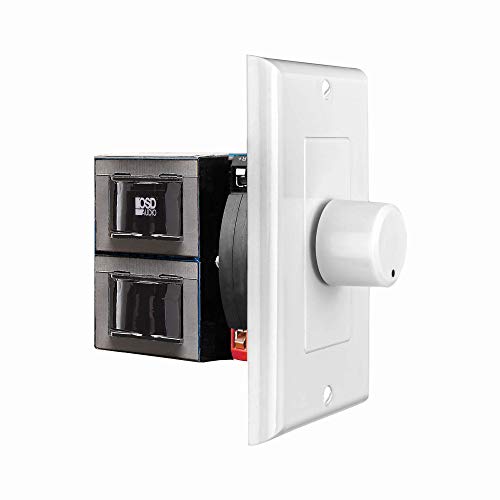
- 100W per channel with minimal bass roll-off
- Supports up to eight pairs of 8-ohm speakers
- Includes trim plates in white, ivory, and almond
Best For: Multi-room systems needing a rotary in-wall volume control
High-Power Slider Choice
Monoprice 300W Impedance Matching Volume Control

- Supports amplifiers up to 300 watts
- Impedance matching helps protect the amp
- Fits standard single-gang low-voltage boxes
Best For: Large speaker systems needing a 300W slider wall control
Flush Rotary Wall Plate

- Flush in-wall rotary adjustment
- Rated up to 100 watts
- Includes mounting hardware and decorative frame
Best For: Simple home theater or surround sound volume adjustment
Slider Zone Control
OSD Audio VMS100 100W In-Wall Volume Control
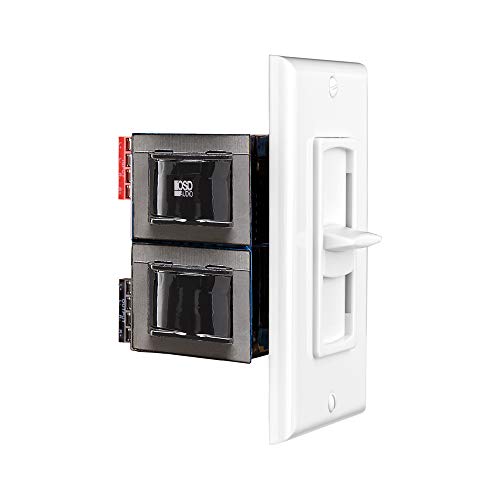
- 100W peak rating with minimal bass roll-off
- Supports up to eight pairs of 8-ohm speakers
- 12-step slider in a standard gang box
Best For: Whole-house audio zones that need slider-style control
Starter Zone Control
5-Step Rotary Wall Volume Control

- 5-step rotary knob includes Off
- Fits a standard electrical box
- Rated up to 100W for a speaker pair
Best For: Small rooms and simple speaker-pair volume control
High-Power Multi-Zone Pick
300W Impedance-Matching Wall Control

- 300W per channel with minimal bass roll-off
- Impedance jumpers support up to eight speaker pairs
- 12-step rotary control with included trim plates
Best For: Large home audio zones with multiple speaker pairs
Commercial Audio Value

- 11-step control with 30dB attenuation
- Supports 70V or 100V systems up to 35W
- Euro-block connectors and 1-gang fit
Best For: Commercial distributed audio systems
Whole-Home 100W Control
RECOIL VC-R100 100W Impedance Matching Wall Volume Control

- 100W per channel rating
- Supports up to 8 speaker pairs
- 12-step rotary in-wall knob
Best For: Multi-zone home or office audio with flush wall mounting
On/Off Zone Control
OSD Audio SVC205 In-Wall Volume Control with Switch
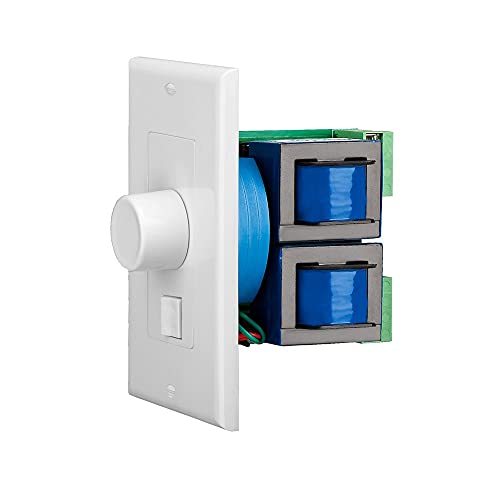
- On/off switch for full mute control
- Impedance matching for amp protection
- 12-step rotary knob in a single-gang plate
Best For: Dedicated audio zones that need both volume and power control
Impedance-Matching Rotary Pick – OSD Audio SVC100 100W Wall Control
OSD Audio 100W in Wall Volume Control Impedance Matching for Home Speakers, Rotary Knob White SVC100
Check Price On AmazonIf you want a volume control wall plate for ceiling speakers that can handle a whole-house audio setup, the OSD Audio SVC100 is built around impedance matching and a 12-step rotary knob. It’s designed to adjust one zone independently while helping stabilize the load back to your amp or receiver, which makes it a practical fit for multi-speaker systems.
Best For: Homes that need a rotary in-wall control for dedicated audio zones and multiple speaker pairs.
Pros:
- Rated at 100 watts per channel with minimal bass roll-off.
- Adjustable jumpers support up to eight pairs of 8-ohm speakers.
- Fits a standard gang box and accepts up to 14 gauge wiring.
- Includes white, ivory, and almond trim plates for easier matching.
Cons:
- Rotary knob offers 12 steps rather than a smooth continuous dial.
- Designed for wall mounting, so it is not a universal remote-style solution.
Overall, this is a strong choice if your priority is safe impedance matching and simple zone-by-zone volume control. The included junction box and trim options make it especially convenient for a clean in-wall install.
High-Power Slider Choice – Monoprice 300W Impedance Matching Volume Control
The Monoprice 300-Watt Slider Volume Control is a good volume control wall plate for ceiling speakers when you need a simple in-wall slider and impedance matching for multiple speaker pairs. It’s intended to raise the effective load to help protect the amplifier, while fitting standard single-gang low-voltage boxes or mounting brackets.
Best For: Bigger audio setups that need a 300-watt slider control in a standard wall opening.
Pros:
- Supports amplifiers with up to 300 watts of output power.
- Impedance matching helps protect the amplifier with multiple speaker pairs.
- Fits standard single-gang low-voltage junction boxes or mounting brackets.
- Slider format is straightforward for quick level adjustments.
Cons:
- Listed as a color kit/multi-color setup, so finish choice is less specific.
- Focuses on basic volume control rather than advanced zone features.
If your priority is higher power handling and a familiar slider layout, this Monoprice option keeps the install simple. It’s a practical pick for distributed audio systems where load protection matters as much as convenience.
Flush Rotary Wall Plate – Pyle PVC1 In-Wall Volume Knob
The Pyle PVC1 is a compact volume control wall plate for ceiling speakers and other home audio zones when you want a flush in-wall rotary adjustment. It’s rated for 100 watts, includes the mounting hardware and finishing frame, and is aimed at straightforward control for surround sound or home theater use.
Best For: Buyers who want a simple flush-mounted rotary volume control for home theater or surround sound setups.
Pros:
- Flush in-wall plate with a rotary-style adjustment.
- Rated for up to 100 watts speaker maximum output power.
- Includes mounting ring, wire nuts, decorative frame, and hardware.
- Compact size makes it easier to place in standard wall setups.
Cons:
- Uses a basic rotary control, not a slider or advanced interface.
- Product details list an unusual 1-ohm impedance value.
This model makes sense if you want a straightforward, low-profile wall control without extra features. The included installation parts are helpful, but it’s best suited to simpler setups where basic volume adjustment is the main goal.
Slider Zone Control – OSD Audio VMS100 100W In-Wall Volume Control
OSD Audio 100W in Wall Volume Control Impedance Matching for Home Speakers, Slider White VMS100
Check Price On AmazonIf you prefer a slider-style volume control wall plate for ceiling speakers, the OSD Audio VMS100 offers 12-step level adjustment and impedance protection for whole-house or dedicated audio zones. It’s built for clean in-wall installation and is aimed at systems where you want easy, pop-free volume changes across multiple rooms.
Best For: Home audio zones that benefit from a smooth slider control and load protection.
Pros:
- Rated at 100 watts peak with minimal bass roll-off.
- Adjustable jumpers support up to eight pairs of 8-ohm speakers.
- 12-step linear slider provides pop-free, easy level control.
- Fits a standard gang box with a 2.9-inch depth.
Cons:
- Only offers 12 fixed positions rather than continuous adjustment.
- Best suited to speaker-wire installations, not broader source switching.
For ceiling speaker systems where a slider feels more natural than a knob, this OSD Audio model is a solid fit. It combines practical impedance matching with a tidy in-wall design and trim plate options for common room finishes.
Starter Zone Control – 5-Step Rotary Wall Volume Control
If you want a straightforward volume control wall plate for ceiling speakers, this TNP in-wall knob is a simple way to manage one speaker pair from the wall. It fits a standard electrical box, gives you five positions including Off, and is aimed at home, office, or conference audio zones where easy local control matters.
Best For: Small audio zones that need quick wall-mounted volume adjustment and an Off setting.
Pros:
- 5-step rotary control includes Off for simple day-to-day use
- Rated for up to 100W and supports a pair of speakers
- Designed to fit a standard electrical wall box
- 20Hz–20kHz frequency response is listed for full-range use
Cons:
- Only 5 positions, so adjustment is less granular than higher-step models
- Lower power rating than commercial-grade alternatives
- Built for a pair of speakers rather than larger multi-zone loads
This is a practical pick if you value simple installation and basic zone control over advanced tuning. For a modest whole-home or office setup, it covers the essentials without adding complexity.
High-Power Multi-Zone Pick – 300W Impedance-Matching Wall Control
OSD Audio 300W in Wall Volume Control Impedance Matching for Home Speakers, Rotary Knob White SVC300
Check Price On AmazonFor a volume control wall plate for ceiling speakers in a larger system, the OSD Audio SVC300 stands out with 300W-per-channel handling and impedance matching. It’s built for dedicated audio zones, supports up to eight pairs of 8 ohm speakers with the adjustable jumpers, and uses a 12-step rotary design for broader listening control.
Best For: Larger home audio systems that need impedance matching and higher power handling.
Pros:
- Rated at 300W per channel with minimal bass roll-off
- Impedance-matching jumpers support up to eight pairs of 8 ohm speakers
- 12-step rotary knob offers wider volume adjustment
- Includes white, ivory, and almond trim plates
Cons:
- More complex than basic single-zone volume controls
- Overkill for small or low-power speaker setups
- Requires proper wiring and setup for impedance protection to be useful
This is the strongest choice here if your priority is protecting the amp while managing multiple speaker runs. It’s a better fit for serious whole-house audio than a basic wall knob.
Commercial Audio Value – 70V 11-Step Wall Attenuator
If your volume control wall plate for ceiling speakers is going into a commercial audio system, the Rockville VOL7035 is built for 70V or 100V setups and zones up to 35W. It uses an 11-step knob with 30dB attenuation and absolute off, plus Euro-block connectors and a standard 1-gang fit for straightforward installation.
Best For: Restaurants, offices, gyms, and other commercial 70V/100V audio zones.
Pros:
- 11-step attenuation with 30dB range and absolute off
- Works with 70V or 100V speaker systems up to 35W
- Fits standard 1-gang electrical boxes
- Euro-block connectors and 16-24 AWG input simplify wiring
Cons:
- 35W rating is intended for commercial zones, not high-power home systems
- Not positioned as a general-purpose residential wall control
- Less power headroom than higher-wattage in-wall controls
This model is the most commercial-focused option in the group and makes sense when your speakers are part of a distributed 70V or 100V system. It emphasizes clean installation and zone-by-zone control over raw power.
Whole-Home 100W Control – RECOIL VC-R100 100W Impedance Matching Wall Volume Control
If you need a volume control wall plate for ceiling speakers that can manage multiple zones, the RECOIL VC-R100 is built around a 100W-per-channel impedance-matching design. It uses a 12-step rotary knob and supports adding up to eight pairs of 8-ohm speakers, making it a practical fit for whole-house audio setups that need simple in-wall adjustment.
Best For: Home, office, or business audio systems that need a flush wall-mounted control for multiple speaker pairs.
Pros:
- Rated at 100 watts per channel with minimal bass roll-off.
- Impedance matching supports up to eight pairs of 8-ohm speakers.
- 12-step rotary knob offers straightforward volume adjustment.
- Includes white and ivory plates plus installation accessories.
Cons:
- Does not include advanced app or remote control features.
- Best suited to dedicated audio zones rather than portable use.
Overall, this is a solid choice if you want a simple in-wall control that keeps frequency response wide and installation tidy. It emphasizes multi-speaker compatibility and a clean decorative finish over extra features.
On/Off Zone Control – OSD Audio SVC205 In-Wall Volume Control with Switch
The OSD Audio SVC205 is a volume control wall plate for ceiling speakers when you want both level adjustment and a hard on/off switch. It uses impedance matching, a 12-step rotary knob, and a single-gang wall plate design, so it fits neatly into a standard wall box for dedicated audio zones.
Best For: Users who want a wall-mounted speaker control with a built-in power switch for complete mute control.
Pros:
- Built-in on/off switch lets you shut sound off completely.
- Impedance matching helps stabilize load for the amp or receiver.
- 12-step rotary knob supports precise volume setting.
- Fits standard gang boxes and accepts up to 14-gauge wiring.
Cons:
- Rated power is listed as 100 watts per channel in the notes, despite the 300W product title.
- Designed for dedicated zones, not a wireless or smart system.
For a straightforward in-wall speaker control, this model stands out because it combines volume adjustment with a true off switch. It is a practical pick for installations where you want simple day-to-day control from the wall.
Flexible 100W Zone Knob – Herdio 100W Flush In-Wall Volume Control Knob
If you are comparing a volume control wall plate for ceiling speakers, the Herdio model focuses on simple in-wall adjustment with a 12-position knob and support for up to eight speakers. Its flush wall design, standard mounting approach, and included replacement panels make it a versatile option for home audio spaces that need easy control and clean installation.
Best For: Home audio installs that need a flush-mounted speaker volume knob with broad compatibility.
Pros:
- 100W design can drive up to 8 speakers in parallel setups.
- 12-position adjustment provides precise volume control.
- Standard mounting holes or pins support easy installation or replacement.
- Includes terminals, replacement panels, screws, and an instruction manual.
Cons:
- No on/off switch is mentioned in the supplied notes.
- Less feature-heavy than models that add dedicated power control.
This is a practical pick if you want a no-fuss wall control for multi-speaker audio and value compatibility. The included accessory pack also makes it easier to complete or refresh an installation.
How We Picked the Best Volume Control Wall Plate for Ceiling Speakers
We prioritized models that are commonly used with ceiling speaker systems, support the right load type for multi-speaker wiring, and offer a clean in-wall installation. We also considered power rating, compatibility with standard electrical boxes, and whether the control is better suited to home audio or 70V commercial systems.
Quick Comparison
Most buyers will choose between rotary and slider controls, plus impedance-matching or 70V designs. Rotary units are compact and familiar, while sliders can make fine adjustment faster. If you are wiring a whole-home listening area, impedance matching matters more than a simple on/off volume knob.
Key Buying Factors for a Volume Control Wall Plate for Ceiling Speakers
Power Handling and Speaker Load
Match the control’s wattage rating to your amplifier and speaker setup. Underrating the control can create distortion or failure, while oversizing usually adds cost without much benefit.
Impedance Matching
For most home systems, a Volume Control Wall Plate for Ceiling Speakers should include impedance matching so multiple speakers do not overload the amp. This is especially important in multi-room or multi-speaker zones.
Rotary Vs. Slider
Rotary knobs are space-saving and simple. Sliders are easier to read at a glance and can feel more precise for frequent adjustments. Either style can work well if the rest of the specs fit your system.
Installation and Form Factor
Check that the unit fits a standard 1-gang electrical box and that the faceplate style matches your wall hardware. If you want a cleaner look, choose a flush-mount design with straightforward wiring terminals.
Special Features
Some buyers may want an on/off switch, dust protection, or support for commercial 70V systems. Those extras are useful, but only if they match your actual audio setup.
Who Should Buy Which Volume Control Wall Plate for Ceiling Speakers?
Home theater and distributed audio users should lean toward impedance-matching controls with enough wattage headroom for the amp. Buyers with commercial paging or background music systems should look at 70V-compatible options. If you want the simplest everyday adjustment, a standard rotary wall control is usually the most practical choice. If you expect frequent level changes, a slider may be the better fit.
