If you need a simple way to connect a TV, console, or disc player to analog speakers or headphones, this PROZOR 192kHz DAC review examines the practical details that matter.
The PROZOR Digital to Analog Audio Converter accepts Toslink or coaxial PCM input and provides simultaneous RCA and 3.5mm output.
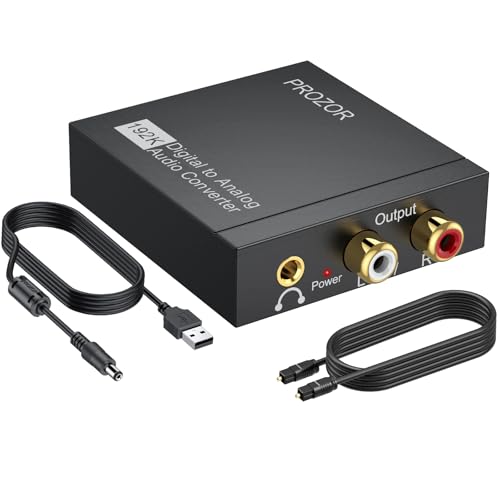
PROZOR DAC Review Summary
The PROZOR 192KHz Digital to Analog Audio Converter is aimed at buyers whose source device has digital audio output but whose amplifier, powered speakers, or headphones need an analog connection.
It is a good fit for a straightforward two-channel setup because it supports both optical and coaxial input, offers left/right RCA plus 3.5mm output, and includes a built-in audio amplifier chip intended to address low output volume.
Buy it when you need reliable PCM conversion and flexible analog connections; skip it if you need surround-sound decoding or a fully self-contained power solution.
Review Scorecard
| Category | Score | Editorial assessment |
|---|---|---|
| Connection flexibility | 9/10 | Toslink and coaxial inputs feed RCA and 3.5mm outputs simultaneously. |
| Two-channel compatibility | 8/10 | Supports uncompressed 2-channel LPCM/PCM across several listed sample rates. |
| Setup simplicity | 9/10 | The connection layout is uncomplicated, provided the source is set to PCM. |
| Output practicality | 8/10 | RCA suits home audio while 3.5mm works with common headphones and powered speakers. |
| Signal cleanliness | 8/10 | The USB cable includes a ferrite core to help minimize electromagnetic and RF interference. |
| Power convenience | 6/10 | USB power is straightforward, but a certified 5V 1A wall adapter is required and not included. |
| Surround-sound capability | 3/10 | This model is for uncompressed two-channel PCM, not 5.1 decoding. |
Key Features and Specifications of PROZOR DAC
The central job here is digital-to-analog conversion.
The converter accepts one Toslink/optical/SPDIF input or one coaxial input, then sends the converted analog signal through two RCA channels and a 3.5mm jack.
Both output types are available at the same time, which makes the unit useful when a setup needs either a conventional stereo connection or a headphone-style plug.
The listing supports sampling rates of 32, 44.1, 48, 96, and 192kHz, along with a 24-bit SPDIF incoming bit stream on left and right channels.
Those figures are most relevant to buyers who want the converter to accommodate common digital PCM sources without forcing a sample-rate choice in advance.
They do not turn the unit into a surround processor: the stated format is uncompressed two-channel LPCM/PCM.
The most important setup requirement is also the easiest to overlook.
Set the TV or source device’s digital audio output to PCM or LPCM. The listing warns that an incompatible output format can cause distortion, because this converter is not intended to decode compressed or multichannel formats.
Optical output volume may also bypass the ordinary TV remote volume control.
Depending on the television, volume may need to be adjusted in the TV’s sound settings or on the connected output device.
The converter uses a built-in audio amplifier chip, which the manufacturer says is intended to help with low output volume and provide clean, crisp sound.
That is a useful design choice for basic analog connectivity, although it should be understood as part of a compact converter rather than a replacement for a full stereo amplifier.
Power comes through the supplied 5.5mm USB power cable.
A power adapter is not included, and the listing specifically recommends a certified 5V 1A wall adapter.
The cable has an integrated ferrite core, which is intended to reduce electromagnetic interference and radio-frequency interference during transmission.
Buyers should plan the power connection before ordering, especially if the source device or TV does not offer a convenient USB port.
The physical connection options are clear: one optical input, one coaxial input, two RCA outputs, and one 3.5mm output.
Gold-plated RCA connectors are included for the analog side, and the design allows users to choose their own RCA cables according to the rest of their system.
The broad compatibility examples include HD TVs, TV boxes, DVD or Blu-ray players, PS3, PS4, PS5, home audio systems, AV amplifiers, and headphones, as long as the source delivers a supported PCM signal.
Pros and Cons of PROZOR DAC
Pros
- Flexible input and output selection: Optical and coaxial inputs cover the two most common digital connections, while RCA and 3.5mm outputs serve different analog systems.
- Simultaneous analog outputs: The RCA and 3.5mm connections can be used together, which is helpful when routing audio to more than one compatible destination.
- Broad listed PCM support: The converter supports several sampling rates up to 192kHz and 24-bit SPDIF input for two-channel audio.
- Simple installation: A short signal path and clearly identified connection types make it approachable for a living-room audio upgrade.
- Interference-conscious cable design: The ferrite core on the USB power cable is intended to help reduce unwanted EMI and RF interference.
- Useful output-stage design: The built-in audio amplifier chip is intended to address the low-volume problem that can affect some digital-to-analog adapters.
Cons
- PCM/LPCM is mandatory: Buyers must change the source audio format when necessary; unsupported output settings can lead to distortion.
- No 5.1 decoding: This is a two-channel converter, so it is the wrong choice for a home theater system that needs multichannel decoding.
- Power adapter excluded: The USB power cable is supplied, but the recommended certified 5V 1A wall adapter must be provided separately.
- Optical volume may require adjustment elsewhere: A TV remote may not control optical output volume unless the TV supports that feature.
- Not a complete amplifier: It converts and outputs analog audio, but it does not replace an AV receiver, powered speaker system, or headphone amplifier designed for a demanding setup.
Who Should Buy PROZOR DAC?
This converter suits someone with a newer TV and older analog equipment.
For example, a television with optical output can feed an analog stereo amplifier, powered speakers, or headphones through the PROZOR unit.
It also makes sense for a console or disc player that provides optical or coaxial digital audio while the available audio equipment accepts RCA or 3.5mm.
It is particularly practical for buyers who value connection choice.
The RCA outputs fit a conventional left/right stereo system, while the 3.5mm jack can connect to compatible headphones or powered desktop speakers.
Having both output formats available at once gives the setup more room to change later.
Skip this model if your main requirement is Dolby, DTS, or 5.1 decoding. The supplied evidence describes support for uncompressed two-channel PCM, not surround processing.
Also look elsewhere if you want included mains power, automatic format conversion, or volume control built into the converter itself.
Those needs point toward a more specialized DAC, soundbar interface, or AV receiver.
Using PROZOR DAC in a TV and Stereo Setup
Configure the source first
The most important part of installation is selecting PCM or LPCM in the TV, console, or player audio menu.
This is a format requirement, not an optional tuning step.
If the source remains on an incompatible multichannel or compressed setting, the listing warns that distortion may result.
Choose the output that matches the system
Use RCA when connecting to a stereo amplifier or another component with left/right analog inputs.
Use the 3.5mm jack for compatible headphones or powered speakers.
Because both analog outputs are provided, the converter gives a small system more flexibility than an adapter with only one output type.
Plan volume control and power
Optical audio may not respond to the television’s normal remote volume buttons.
Check the TV’s audio settings or adjust volume on the connected device.
For power, use the supplied USB cable with a certified 5V 1A adapter; the adapter is not part of the package described in the listing.
Keep expectations aligned with two-channel audio
The PROZOR DAC is best viewed as a focused stereo bridge.
Its supported rates and 24-bit SPDIF specification are useful for compatible PCM sources, but they do not imply surround decoding.
A buyer who wants a clean path from digital stereo to analog hardware should find that focus helpful; a home-theater buyer may find it limiting.
Alternatives to PROZOR DAC
If you need a similar optical-to-analog connection, compare the FiiO D03K digital-to-analog converter, which is a recognizable compact DAC line for basic stereo conversion.
For a budget-oriented optical and coaxial converter, the Tendak digital audio converter is another product line to investigate, especially when you want to compare included cables and power accessories.
If your priority is a headphone-focused digital interface rather than RCA flexibility, consider the Schiit Modi DAC line.
It represents a different kind of setup and may be a better comparison for a dedicated desktop listening system.
Buyers who need actual surround processing should search for a 5.1 digital audio decoder instead of a basic two-channel PCM converter.
Check format support carefully, since the PROZOR model reviewed here is not described as a 5.1 decoder.
Is PROZOR DAC Worth It?
The PROZOR 192KHz Digital to Analog Audio Converter is worth considering when the problem is straightforward: a digital optical or coaxial source needs to connect to analog RCA or 3.5mm equipment.
Its strongest advantages are the broad connection layout, simultaneous analog outputs, multiple listed PCM sample rates, and a ferrite-core USB power cable.
For a TV-to-stereo, console-to-headphone, or similar two-channel connection, it offers a focused and practical feature set.
The buying decision depends on whether its limitations match your system.
You will need a compatible 5V 1A power adapter, PCM/LPCM source configuration, and a separate plan for volume control when optical output bypasses the TV remote.
If you need surround decoding or an all-in-one home-theater component, choose a different category.
For supported two-channel PCM audio, however, the PROZOR DAC is a sensible bridge between modern digital sources and familiar analog gear.
