Choosing the right light meter can make field inspections, photography, workplace assessments, and grow-light checks faster and more consistent. The best handheld light meters for field use combine a readable display, practical measuring range, dependable sensors, and controls that are easy to operate on location.
This roundup compares 10 options across basic illuminance testing and more advanced light analysis, so you can match features and accuracy to the work you actually do.
Best 10 Handheld Light Meters for Field Use Picks for 2026
Bluetooth Field Favorite

- 0–199,900 Lux and 0–18,500 FC range
- Bluetooth app data recording and export
- Compact, backlit, and fast sampling
Best For: Portable lighting checks with app-based data management
Spectrum Analysis Specialist
Portable 340–1000nm Light Spectrometer

- Analyzes 340–1000nm wavelengths
- Real-time CCT, CRI, PAR, and PPFD data
- 23g body with Android and PC support
Best For: Spectral testing of LEDs, grow lights, and commercial lighting
All-Around Field Meter

- 0.1–200,000 Lux and 0.1–20,000 FC
- 180° rotating probe and backlit display
- Adds temperature and humidity measurements
Best For: General lighting, plant, workplace, and vehicle inspections
High-Range LED Tester
Triplett LT80 Illuminance Meter

- Up to 400,000 Lux or 40,000 FC
- Works with multiple common light sources
- Min/Max/Avg and data-hold functions
Best For: High-output LED and commercial lighting measurements
Advanced Circadian Analysis

- Measures EML, m-EDI, CCT, contrast, and uniformity
- Bluetooth app support for iOS and Android
- 40g portable design with dual power options
Best For: Lighting professionals assessing performance and circadian considerations
Wide-Range Field Testing
BTMETER BT-881D Illuminance Meter
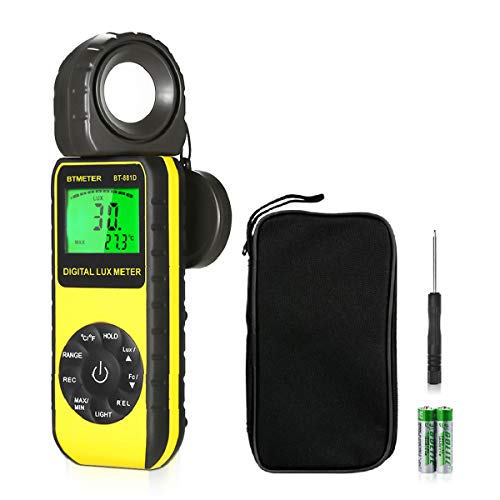
- Measures up to 400,000 lux
- 270-degree rotating sensor simplifies angle changes
- Stores 33 readings with relative mode
Best For: Indoor and outdoor light-intensity checks across varied brightness levels
Simple Everyday Readings
Digital 200,000-Lux Light Meter
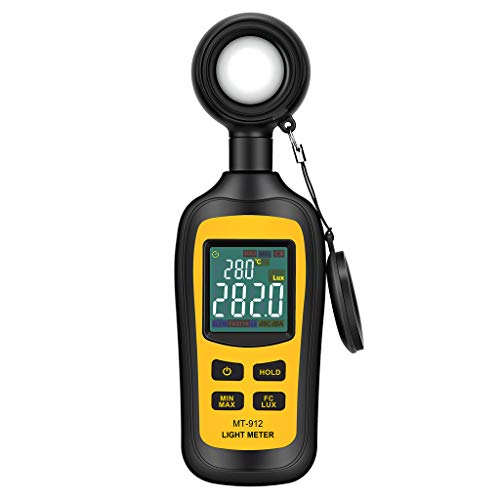
- Measures up to 200,000 lux plus ambient temperature
- Color LCD with min/max and data hold
- Compact battery-powered design with two-year warranty
Best For: General-purpose workplace, set, home, and factory measurements
Wide-Range Workhorse
200,000-Lux Digital Light Meter

- 0–200,000-lux range with automatic conversion
- LUX/FC switching plus MAX/MIN and data hold
- Lightweight body with backlight and included batteries
Best For: General indoor/outdoor brightness checks and plant or photography lighting
Field-Ready Precision Pick

- 0–200,000 lux with stated ±(3% + 5 lux) accuracy
- Backlit digital/bar-graph display with fast sampling
- Includes hold, MAX/MIN, lanyard, batteries, and two-year warranty
Best For: Grow lights, studio setups, warehouse checks, and outdoor lamp inspections
Flexible Sensor Choice
AS803 Rotating-Sensor Light Meter
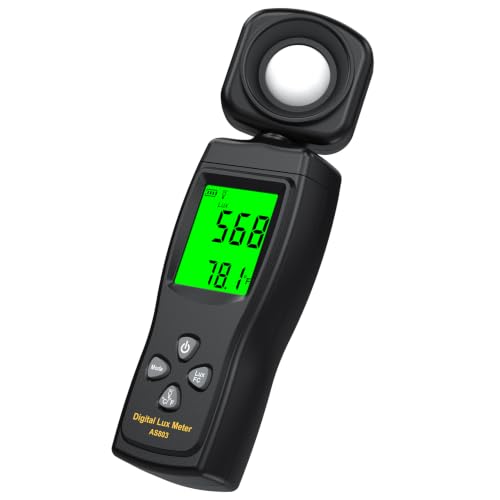
- 0–200,000-lux range with stated ±4% + 10 accuracy
- 180-degree rotating sensor and backlit LCD
- Adds temperature readings, fast sampling, and MAX/MIN modes
Best For: Angled measurements, plant environments, photography, and indoor evaluations
Bluetooth Field Favorite – UNI-T UT383BT Lux Meter
For straightforward handheld light meters for field use, the UNI-T UT383BT combines Lux and foot-candle readings with a compact design and optional Bluetooth data management. Its broad range suits general lighting checks, photography, offices, agriculture, and outdoor projects.
Best For: Users who want portable illuminance readings plus app-based recording and analysis.
Pros:
- Measures 0–199,900 Lux and 0–18,500 foot candles.
- Bluetooth transfer to the iENV app supports recording, storage, export, and analysis.
- 0.5-second sampling, backlit display, data hold, and Max/Min functions.
Cons:
- App compatibility is listed for iOS and Android, but the supplied notes do not detail setup requirements.
- Accuracy is specified as ±(4%+8), which may be less suitable for applications needing tighter tolerances.
The UT383BT is a practical choice when portability and digital recordkeeping matter as much as basic light-level measurement.
Spectrum Analysis Specialist – Portable 340–1000nm Light Spectrometer
This handheld spectrometer takes field use beyond basic brightness readings by analyzing light across a 340–1000nm wavelength range. It is designed for users evaluating color, plant lighting, LEDs, and other specialized sources while working with Android devices or PC software.
Best For: Lighting professionals, researchers, and growers who need spectral, CCT, CRI, PAR, or PPFD analysis.
Pros:
- Broad 340–1000nm range covers UV through near-infrared measurements.
- Measures CCT, CRI, PAR, and PPFD in real time.
- Very small 23g design with USB Type-C Android connectivity and PC PDF reporting.
Cons:
- iOS devices are not supported.
- It requires a compatible Android device or PC for the app and software experience.
Choose this model when spectral detail is more important than a simple Lux or foot-candle display; its compact size is particularly useful for on-site testing.
All-Around Field Meter – TopTes TS-710 Light Meter
The TopTes TS-710 is a versatile option among handheld light meters for field use, with a rotating sensor, broad Lux and foot-candle ranges, and a large backlit screen. It also adds temperature and humidity measurements for broader site checks.
Best For: Home, office, plant, workshop, farm, and vehicle-lighting inspections requiring flexible positioning.
Pros:
- Measures 0.1–200,000 Lux and 0.1–20,000 foot candles.
- 180° rotating probe and 0.5-second sampling help with varied measurement angles.
- Includes temperature and humidity readings, Max/Min, data hold, and a soft case.
Cons:
- The temperature sensor adapts to new environments over time.
- Auto shutoff occurs after 10 minutes of inactivity, which may interrupt longer unattended checks.
With its rotating probe and extra environmental readings, the TS-710 is a well-rounded choice for routine inspections where convenience matters.
High-Range LED Tester – Triplett LT80 Illuminance Meter
The Triplett LT80 is built for high-intensity measurements, supporting white LED sources up to 400,000 Lux or 40,000 foot candles. Its silicon photodiode sensor and Min/Max/Avg functions make it useful for comparing readings across different lighting installations.
Best For: High-output LED and commercial lighting checks where averaging and peak readings are useful.
Pros:
- Measures white LED light up to 400,000 Lux or 40,000 foot candles.
- Supports fluorescent, metal halide, high-pressure sodium, and incandescent sources.
- Min/Max/Avg recall, data hold, and a 9,999-count LCD support practical comparisons.
Cons:
- The supplied notes do not mention Bluetooth or app-based data export.
- Its feature set is focused on illuminance rather than spectral analysis.
The LT80 stands out when measurement range is the priority, especially for bright LED installations and other high-output lighting sources.
Advanced Circadian Analysis – Pro Handheld EML Light Meter
For professionals seeking handheld light meters for field use, this compact EML meter adds health-focused lighting data alongside standard illuminance measurements. It measures EML, m-EDI, color temperature, contrast, and uniformity, with Bluetooth connectivity for app-based analysis.
Best For: Architects, lighting designers, horticulturists, and users optimizing lighting for comfort, productivity, or circadian considerations.
Pros:
- Measures six lighting metrics, including EML, m-EDI, CCT, contrast, and uniformity.
- Connects to iOS and Android devices through the In. Licht pro-Lighting Meter app.
- Lightweight 40-gram design includes a magnetic body and lanyard hole.
- Runs on included AAA batteries or a Micro-USB cable.
Cons:
- App and Bluetooth connectivity are needed for real-time data analysis.
- Its specialized EML and m-EDI features may be more than needed for basic lux checks.
This is a specialized field option for evaluating both visible lighting performance and potential circadian impact. Choose it when advanced metrics and portability matter more than a simple standalone lux readout.
Wide-Range Field Testing – BTMETER BT-881D Illuminance Meter
When comparing handheld light meters for field use, the BTMETER BT-881D stands out for its broad measurement range and quick response. Its 270-degree rotating sensor makes it easier to measure light from different angles without turning the meter itself.
Best For: Indoor and outdoor checks of offices, schools, gardens, plants, and LED or grow-light installations.
Pros:
- Measures from 0.01 to 400,000 lux, or 0.01 to 40,000 foot-candles.
- Provides a stated accuracy of ±4% at 10,000 lux and ±5% plus 10 digits at 400,000 lux.
- Samples two to three times per second for a 0.4-second response.
- Stores 33 readings and includes relative measurement and temperature testing modes.
Cons:
- At 6.6 ounces, it is less lightweight than the most compact field meters.
- The broad range comes with a lower stated accuracy at the highest readings.
The rotating sensor and extensive range make this a practical choice for varied measurement positions and bright environments. It is especially useful when you need memory functions and coverage beyond ordinary indoor lighting levels.
Simple Everyday Readings – Digital 200,000-Lux Light Meter
For straightforward handheld light meters for field use, this digital illuminance meter combines a 200,000-lux range with a color LCD and ambient-temperature measurement. Its compact battery-powered design suits set, workplace, factory, office, and home checks.
Best For: Users who want a simple general-purpose meter with min/max readings, data hold, and a clear display.
Pros:
- Measures illuminance from 0 to 200,000 lux and also measures ambient temperature.
- Offers stated accuracy of ±3% below 10,000 lux and ±4% above 10,000 lux, with specified digit tolerances.
- Includes a four-digit color LCD, min/max readings, data hold, auto power-off, and low-battery indication.
- Lightweight, compact design comes with a two-year warranty.
Cons:
- It does not list Bluetooth, app connectivity, or stored-reading memory.
- It uses three AAA batteries, adding a battery requirement for field work.
This meter is a sensible everyday option when clear lux readings and basic convenience features are the priority. Its 200,000-lux ceiling covers many common indoor and outdoor checks without adding specialized analysis functions.
Wide-Range Workhorse – 200,000-Lux Digital Light Meter
For shoppers comparing handheld light meters for field use, this S8608 offers a broad 0–200,000-lux measurement range in a compact 4.6-ounce body. Automatic range conversion, LUX/FC switching, and a large display make it a straightforward option for checking brightness indoors or outdoors.
Best For: General-purpose brightness checks, plant lighting, facilities, schools, hospitals, photography, and outdoor measurements.
Pros:
- Measures up to 200,000 lux and supports both LUX and foot-candle readings.
- Includes MAX/MIN, data hold, backlight, low-battery indicator, and auto power-off functions.
- Compact and lightweight, with three included AAA batteries.
Cons:
- The supplied notes do not specify a numerical accuracy rating.
- Its feature set is focused on illuminance rather than additional environmental measurements.
This is a practical pick when you want wide-range light readings and essential hold and recording functions without adding extra sensors or complexity.
Field-Ready Precision Pick – POROMETISTO LT01 Light Meter
The POROMETISTO LT01 is a strong choice among handheld light meters for field use when you want a wide range plus a stated accuracy specification. Its pocket-sized design, backlit display, and rapid sampling support quick checks in greenhouses, warehouses, studios, and outdoor locations.
Best For: Grow-light placement, photography studios, office and warehouse checks, and outdoor lamp inspections.
Pros:
- Measures 0–200,000 lux or 0–20,000 foot-candles with stated accuracy of ±(3% + 5 lux) under standard incandescent lamps.
- Dual digital and analog bar-graph display samples twice per second and includes a green backlight.
- Data hold, MAX/MIN recording, low-battery indication, and 10-minute auto power-off add field convenience.
- Includes a sensor cap, lanyard, two batteries, manual, and a stated two-year warranty.
Cons:
- The supplied details list the included batteries as two AA cells, while the package description does not clarify runtime.
- The stated accuracy qualification is specifically given for standard incandescent lamps.
Choose this model if readable live changes, portability, and a published accuracy figure matter more than having extra environmental sensors.
Flexible Sensor Choice – AS803 Rotating-Sensor Light Meter
For field users who need to measure from awkward angles, the Ohcans AS803 combines a 0–200,000-lux range with a 180-degree rotating sensor. It also adds a backlit LCD, fast 0.5-second sampling, and temperature readings, making it useful for mobile plant, photography, and indoor-environment checks.
Best For: Growers, photographers, interior or facilities professionals, and anyone measuring light in tight or changing positions.
Pros:
- Measures 0–200,000 lux with stated accuracy of ±4% + 10.
- 180-degree rotating sensor supports flexible positioning, while the backlight helps in low-light conditions.
- 0.5-second sampling, data hold, MAX/MIN recording, and three measurement modes support quick field work.
- Also tracks temperature in Celsius or Fahrenheit and works with LED, fluorescent, halogen, and HID lighting.
Cons:
- Its stated accuracy is less precise than the numerical accuracy listed for the POROMETISTO model.
- The supplied notes do not specify a warranty period.
The rotating sensor and temperature function give this AS803 an advantage when measurement angle and surrounding conditions are important alongside brightness readings.
How We Picked the Best Handheld Light Meters for Field Use
We focused on meters suited to portable, on-site measurements rather than laboratory-only equipment. Selection factors included lux and foot-candle range, sensor positioning, display readability, portability, measurement functions, and the usefulness of features such as data hold, maximum/minimum readings, automatic ranging, temperature measurement, Bluetooth, and backlighting.
Because these products serve different users, we also separated straightforward illuminance meters from specialized instruments that measure attributes such as color temperature, CRI, spectrum, PAR, or PPFD. A wide range alone does not guarantee a better meter; usability and the type of light you need to evaluate matter just as much.
Quick Comparison
| Meter type | Best suited to | Features to prioritize |
|---|---|---|
| Basic lux meter | Indoor inspections and brightness checks | Wide range, clear display, hold function |
| Rotating-sensor meter | Ceilings, cabinets, and awkward angles | Flexible sensor head, backlight, auto range |
| Connected meter | Repeated surveys and logged readings | Bluetooth, app support, memory |
| Spectrum or horticultural meter | LED, grow-light, and color analysis | CCT, CRI, PAR, PPFD, spectral range |
Key Buying Factors
Measurement Range and Units
Check whether the meter covers the environments you will test. Indoor offices may require only moderate lux readings, while sunlight, architectural lighting, and high-output fixtures can exceed 100,000 lux. Foot-candle support is useful when working from lighting specifications that use imperial units.
Sensor Design and Field Handling
A 180- or 270-degree rotating sensor can help you position the detector without twisting your wrist or blocking the light. Look for a compact body, protective sensor cap, stable controls, and a display that remains visible in the expected lighting conditions.
What the Meter Actually Measures
Standard lux meters measure illuminance, not every characteristic of light. If you need to evaluate LED color quality, plant lighting, or spectral output, choose a model that specifically supports CCT, CRI, PAR, PPFD, or spectrum readings. These functions usually matter more than simply having the highest lux range.
Readability, Logging, and Power
Backlit or color displays can be valuable in dim rooms, while data hold and maximum/minimum modes simplify one-person inspections. For repeated surveys, Bluetooth or onboard memory can reduce manual note-taking. Also check battery type, automatic shutoff behavior, and whether replacement batteries are readily available.
Who Should Buy Which Handheld Light Meters for Field Use?
Choose a basic digital illuminance meter if you need affordable checks of rooms, workspaces, displays, or fixtures. A rotating-sensor model is a better fit for maintenance technicians and inspectors who regularly measure from difficult positions. Bluetooth-enabled equipment suits professionals who need repeatable readings or digital records.
For horticulture, stage lighting, architectural specification, or LED quality work, select a specialized handheld spectrometer or advanced light meter with the relevant color and photon measurements. Before buying, confirm the instrument’s stated accuracy, calibration requirements, and measurement units match your reporting standards.
