If you want to send HDMI video to a TV while pulling audio to a soundbar, receiver, or DAC, an HDMI audio extractor with optical out is a simple fix.
The best models preserve picture quality, support the right audio formats, and make setup easy across streaming boxes, consoles, and Blu-ray players.
Best 10 Hdmi Audio Extractor with Optical Out Picks for 2026
4K 60Hz Multi-Output Pick
HDMI 2.0b Audio Extractor with Optical Out

- 4K@60Hz, HDR10, HDCP 2.2 support
- Optical SPDIF, 3.5mm, and ARC/eARC audio
- Includes HDMI, optical cable, and USB power
Best For: 4K home setups needing flexible audio extraction
Pass-Through HDMI Extractor
HDMI to Optical Audio Extractor 4K 60Hz

- 4K@60Hz pass-through with HDCP 2.2
- Optical SPDIF and RCA L/R outputs
- Three audio modes: PASS, 2CH, 5.1CH
Best For: HDMI sources that need optical or RCA audio out
TV ARC/eARC Converter
eARC/ARC to Optical Audio Extractor

- Turns TV ARC/eARC into optical output
- Supports PCM 2.0, Dolby 5.1, DTS 5.1
- USB powered and includes cables
Best For: Older optical soundbars and headphone bases
Budget Basics Pick
Amazon Basics HDMI to Optical Extractor
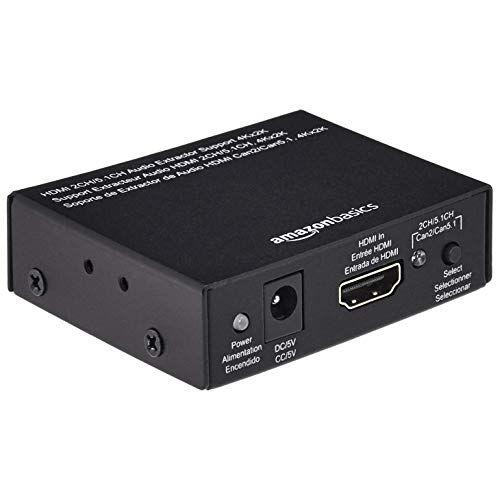
- Up to 4K@30Hz video support
- SPDIF optical plus stereo output
- Compact metal housing
Best For: Budget setups that do not need 4K@60Hz
Dual-Device ARC Upgrade
Neoteck HDMI ARC Audio to Dual Optical Extractor

- Dual optical outputs for two devices
- Supports PCM 2.0, Dolby 5.1, and DTS 5.1
- Plug-and-play with LED format indicators
Best For: Sharing TV audio between a soundbar and wireless headphones
4K Pass-Through Splitter
OREI 4K@60Hz HDMI Audio Converter Extractor

- Passes video up to 4K@60Hz with HDR
- Optical output supports Dolby Digital 5.1 and DTS
- Includes 3.5mm output and metal housing
Best For: 4K source devices connected to an optical surround system
ARC-Friendly 4K Extractor
J-Tech Digital HDMI Audio Extractor 4K 60Hz
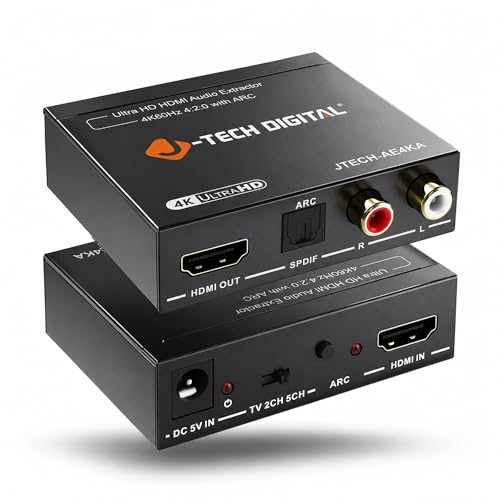
- HDMI-to-optical and HDMI-to-RCA conversion
- ARC support plus 3 EDID modes
- Optical supports stereo and 5.1Ch audio
Best For: Mixed AV setups that need optical, RCA, and ARC support
Compact 4K Budget Pick

- Optical and 3.5mm outputs
- 2.0CH, 5.1CH, and PASS modes
- 4K@30Hz HDMI 1.4 support
Best For: Budget setups that need basic optical audio extraction
High-Refresh 4K Choice
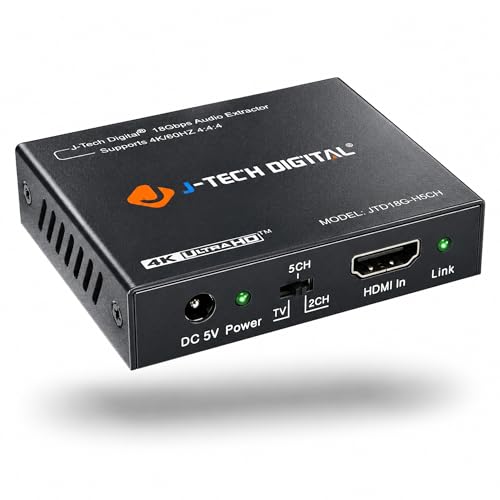
- HDMI 2.0 with 4K@60Hz support
- SPDIF optical plus 3.5mm output
- Dolby Digital and DTS passthrough
Best For: 4K 60Hz systems needing optical audio passthrough
4K 60Hz Multi-Output Pick – HDMI 2.0b Audio Extractor with Optical Out
If you want an HDMI audio extractor with optical out that can also handle ARC/eARC setups, this Avedio Links unit covers a lot of ground. It splits HDMI video to a TV, monitor, or projector while sending audio to a soundbar, amplifier, or speaker through optical SPDIF or 3.5mm, with support for 4K@60Hz, HDR10, and HDCP 2.2.
Best For: Buyers who want a flexible extractor for 4K/60 systems with optical, 3.5mm, and ARC/eARC support.
Pros:
- Supports up to 4K@60Hz with HDR10 and HDCP 2.2.
- Offers three audio modes: TV, 2.0CH, and 5.1CH.
- Includes optical cable, HDMI cable, and USB power adapter.
- Works with HDMI sources like PS5, Fire TV, Blu-ray players, and PCs.
Cons:
- ARC function is limited to HDTV input and ARC/eARC interfaces.
- 3.5mm output is stereo only, not surround.
- Requires external USB power.
This is a strong pick if you need one box for modern 4K video and multiple audio output options. It is especially useful when you want optical audio plus ARC/eARC compatibility in a single adapter.
Pass-Through HDMI Extractor – HDMI to Optical Audio Extractor 4K 60Hz
This HDMI audio extractor with optical out is built for users who want to pull audio from an HDMI source while keeping the video signal passed through to a TV or display. It supports 4K@60Hz, HDMI 2.0, HDCP 2.2, and multiple audio formats, and it sends sound to optical SPDIF or RCA L/R outputs.
Best For: People who need HDMI pass-through with optical or RCA audio extraction for a living room or gaming setup.
Pros:
- Supports 4K@60Hz, 1080P@144Hz, and HDMI 2.0.
- Provides optical SPDIF plus RCA L/R stereo output.
- Includes three audio modes: PASS, 2CH, and 5.1CH.
- Compatible with consoles, streaming devices, Blu-ray players, and PCs.
Cons:
- Does not support ARC function.
- Remote control does not adjust volume.
- RCA output is stereo only.
This model is a practical fit when you want a straightforward extractor for modern HDMI sources and don’t need ARC. Its pass-through design and broad format support make it useful for mixed entertainment setups.
TV ARC/eARC Converter – eARC/ARC to Optical Audio Extractor
If your main goal is converting TV audio from eARC or ARC to optical, this eSynic extractor is a focused solution. It is designed specifically for HDTVs with ARC/eARC ports and outputs a clean Toslink signal to a soundbar, headphone base, or home theater system that only accepts optical input.
Best For: TV owners with an eARC or ARC port who need a simple optical connection for older audio gear.
Pros:
- Converts eARC/ARC TV audio to optical only.
- Supports PCM 2.0, Dolby 5.1, and DTS 5.1.
- USB powered and marketed as plug-and-play.
- Includes optical cable, HDMI cable, and USB power cable.
Cons:
- No CEC volume control through the TV remote.
- Requires a TV port labeled ARC or eARC.
- Does not include extra analog outputs.
This is a good choice if you want to reuse an optical-only soundbar or headphone base with a newer TV. It stays narrowly focused on ARC/eARC to optical conversion, which can make setup simpler if that is all you need.
Budget Basics Pick – Amazon Basics HDMI to Optical Extractor
This Amazon Basics HDMI audio extractor with optical out is a simple way to split audio from an HDMI source when you do not need 4K@60Hz. It supports HDMI-to-HDMI video pass-through and offers SPDIF optical plus stereo audio output, making it a basic utility box for TVs, players, and consoles.
Best For: Budget buyers who only need dependable HDMI audio extraction with optical output for 4K@30Hz or lower.
Pros:
- Supports up to 4K@30Hz in a metal housing.
- Provides SPDIF optical and stereo audio output.
- Works with a wide range of HDMI source devices.
- Simple, compact design from a familiar brand.
Cons:
- Limited to 4K@30Hz, not 4K@60Hz.
- No advanced audio mode options listed.
- Older feature set than newer extractor models.
For straightforward audio extraction at a lower refresh rate, this is an uncomplicated option. It makes sense when you want optical output without paying for extra features you may not use.
Dual-Device ARC Upgrade – Neoteck HDMI ARC Audio to Dual Optical Extractor
If you need an HDMI audio extractor with optical out for a modern TV setup, this Neoteck model is built around ARC/eARC audio extraction and splitting. It takes audio from a TV’s ARC/eARC HDMI port and sends it to two optical Toslink devices at once, making it a practical fit for shared rooms and legacy audio gear.
Best For: Homes that want to run a soundbar and wireless TV headphones at the same time from a TV’s ARC/eARC output.
Pros:
- Dual optical outputs let two devices play from the same TV audio feed.
- Supports PCM 2.0, Dolby Digital 5.1, and DTS 5.1.
- Handles up to 24-bit/192kHz digital audio.
- Plug-and-play setup with status LEDs for 2.0CH and 5.1CH.
Cons:
- Must connect to a TV HDMI port labeled ARC or eARC.
- ARC TVs require HDMI-CEC to be enabled.
- TV remote CEC volume control is not supported over optical audio.
This is a sensible choice if your goal is to keep an existing optical sound system in service while adding a second listening path. It is less about source switching and more about cleanly distributing ARC/eARC TV audio to two optical endpoints.
4K Pass-Through Splitter – OREI 4K@60Hz HDMI Audio Converter Extractor
This HDMI audio extractor with optical out is a straightforward option when you want to keep 4K video moving to a display while tapping audio from the HDMI source. The OREI unit passes video up to 4K@60Hz and sends supported audio formats to optical plus 3.5mm outputs, which makes it useful for home theater gear that still relies on SPDIF.
Best For: 4K source devices feeding an optical-capable surround system without ARC needs.
Pros:
- Video pass-through up to 4K @ 50/60Hz with HDR support.
- Optical output supports LPCM 2CH, Dolby Digital 5.1, and DTS.
- Also includes 3.5mm audio output for extra flexibility.
- Metal housing and HDCP 2.2 compliance for modern AV setups.
Cons:
- Does not support ARC.
- Does not support 1440@120Hz, 4K@30Hz, 1080P@120Hz, or 1080P 3D@60Hz.
- Optical output is limited to the supported surround formats listed by the manufacturer.
Choose this if your priority is clean HDMI audio extraction from a source device rather than TV ARC integration. It is a solid fit for players, consoles, and streaming boxes where 4K passthrough matters as much as audio output.
ARC-Friendly 4K Extractor – J-Tech Digital HDMI Audio Extractor 4K 60Hz
For shoppers comparing an HDMI audio extractor with optical out, this J-Tech Digital model stands out because it combines optical extraction, RCA output, and ARC support in one box. It handles 4K signals with specific resolution requirements and gives you a practical way to route audio from HDMI sources or a smart display to an external sound system.
Best For: Users who want HDMI-to-optical extraction plus RCA output and ARC support in one unit.
Pros:
- Works as both an HDMI to RCA converter and HDMI to optical converter.
- Optical output supports stereo and 5.1Ch audio.
- Includes ARC audio extractor functionality for smart displays.
- Three EDID modes help match TV, 2CH, or 5CH sources.
Cons:
- Does not support eARC.
- 4K@60Hz requires 4:2:0 output; otherwise lower to 4K@30Hz or 1080P.
- RCA output does not downmix 5.1Ch audio.
This is the most flexible of the three if you need both optical and analog audio options, but the resolution and format rules matter. It makes the most sense for mixed setups where ARC, EDID control, and multi-output audio are all useful.
Compact 4K Budget Pick – VPFET HDMI Audio Extractor
If you need an HDMI audio extractor with optical out for a simple TV, console, or player setup, this VPFET model keeps the job straightforward. It pulls audio from HDMI and sends it to optical or 3.5mm output, with three modes to help match your source and playback gear.
Best For: Budget-minded buyers who want basic HDMI audio extraction for optical or analog audio without extra complexity.
Pros:
- Offers optical output plus 3.5mm AUX for flexible audio connections.
- Includes 2.0CH, 5.1CH, and PASS modes for different setups.
- Supports 4K at 30Hz over HDMI 1.4 with HDCP 1.4.
- Low-power design only needs a 5V USB connection.
Cons:
- Does not support ARC or eARC.
- Optical output is limited to DTS 5.1, while 3.5mm is PCM 2.0 only.
- Not suited for 7.1-channel audio.
This is a practical pick if you mainly want a simple HDMI-to-optical audio split without paying for features you may not use. Just note the mode requirements and source limitations before buying.
High-Refresh 4K Choice – J-Tech Digital JTD18G-H5CH
For shoppers looking for an HDMI audio extractor with optical out and stronger video support, this J-Tech Digital unit stands out with HDMI 2.0 and 4K 60Hz capability. It also adds a 3.5mm output, but the analog side depends on your source being set to PCM.
Best For: Users who want a higher-spec extractor for 4K 60Hz setups and Dolby Digital/DTS passthrough.
Pros:
- Supports HDMI 2.0, HDCP 2.2, and 4K at 60Hz.
- Includes SPDIF optical and 3.5mm analog output.
- Passes Dolby Digital and DTS audio formats.
- Also supports 1080p high-refresh modes up to 144Hz.
Cons:
- Does not decode Dolby Digital/DTS for the analog output.
- Analog output requires the HDMI source to be set to PCM.
- Not compatible with some older HDMI 1.2 devices and certain set-top boxes.
This is a strong option if you want better compatibility with modern 4K displays and higher-refresh video. It is especially useful when optical audio passthrough matters more than analog convenience.
Flexible Multi-Output Pick – avedio links HDMI Audio Extractor
If you want an HDMI audio extractor with optical out plus extra connection options, this avedio links unit is built for flexibility. It can route HDMI audio to SPDIF, RCA L/R, or 3.5mm via the included adapter cable, making it easier to match different speakers, amplifiers, and sound systems.
Best For: Buyers who need multiple audio output choices for mixed home theater and speaker setups.
Pros:
- Provides optical SPDIF, RCA, and 3.5mm-style output options.
- Includes PASS, 2CH, and 5.1CH audio modes.
- Supports 4K at 30Hz, 1080p at 60Hz, and HDMI 1.4b.
- Comes with a 5V/1A power adapter and RCA-to-3.5mm cable.
Cons:
- Does not support ARC.
- Limited to 4K at 30Hz rather than 60Hz.
- Warranty coverage is only one month.
This model makes sense when you want more than just optical out and need a few ways to connect older or mixed audio gear. Its broader port set is the main reason to choose it over more basic extractors.
How We Picked the Best Hdmi Audio Extractor with Optical Out
We focused on practical features that matter most in real setups: HDMI version support, optical output quality, ARC/eARC compatibility, format support, and reliable pass-through at common resolutions. We also favored models with straightforward power options, broad source compatibility, and output choices that fit both modern and older audio gear.
Quick Comparison
When comparing an Hdmi Audio Extractor with Optical Out, the big differences usually come down to video bandwidth and audio flexibility. Some units are best for 4K at 60Hz with HDR, while others are more limited but still perfectly fine for 4K at 30Hz or 1080p use. If you need Dolby Digital or DTS over optical, check that the extractor explicitly supports those formats rather than assuming all of them do.
Key Buying Factors for Hdmi Audio Extractor with Optical Out
Video Resolution and Refresh Rate
Match the extractor to your source device and display. For current streaming boxes, game consoles, and UHD players, 4K@60Hz support is the safest choice. If you only need older TV or office playback, a 4K@30Hz model may be enough.
Audio Format Support
Optical out typically handles PCM stereo and compressed surround formats like Dolby Digital and DTS, but not full-bandwidth lossless audio. If you rely on surround sound, confirm the extractor supports the codec your system uses and that your soundbar or receiver can decode it.
ARC, EARC, and CEC Needs
Some units are designed for ARC or eARC extraction from a TV, while others work as standard HDMI source-to-audio breakouts. If your goal is to route TV apps back to speakers, ARC/eARC compatibility matters more than extra output ports. If you want a simple source splitter, standard HDMI input and optical output may be enough.
Output Options and Compatibility
Many buyers choose an Hdmi Audio Extractor with Optical Out because it also adds 3.5mm stereo, RCA, or dual optical outputs. Extra outputs can make it easier to connect legacy speakers, monitors, or mixed audio setups without additional converters.
Who Should Buy Which Hdmi Audio Extractor with Optical Out?
Choose a 4K@60Hz extractor if you use modern consoles, streaming devices, or HDR video and want to avoid bottlenecks. Pick an ARC/eARC-focused unit if your TV is the audio source and you want sound sent back to a soundbar or receiver. If you only need basic optical audio for a simpler living room or bedroom setup, a budget-friendly 4K@30Hz or stereo-focused model can save money without sacrificing the core job.
For most shoppers, the best choice is the model that matches both your video standard and your audio system first. Once those two pieces line up, the rest is mostly about connector preference and convenience.
