If you need to share one speaker, amplifier, soundbar, or recorder between several sources, an audio switcher can keep the setup simple and tidy.
This guide highlights the best options for analog audio, from 3.5mm AUX to RCA stereo, so you can match the switcher to your gear and input count.
Best 10 Audio Switcher for Multiple Inputs Picks for 2026
Simple RCA AV Switch

- 4-way A/V switching for RCA devices
- Mechanical push-button operation
- Metal enclosure with no power needed
Best For: Older consoles, DVD players, and TV setups with RCA connections
3.5mm Audio Selector

- 4-in/1-out or 1-in/4-out 3.5mm routing
- Includes volume control and selector knob
- Plug and play with no power supply
Best For: Desktop audio users who need easy source switching and level control
High-Capacity RCA Switch

- 8 RCA A/V inputs routed to one output
- Mechanical push-button operation
- Metal enclosure with no power needed
Best For: Large RCA-based entertainment setups with many sources
Compact Bidirectional Switch

- 2-in/1-out or 1-in/2-out operation
- One-press switching with no power needed
- Includes 1m cable and metal casing
Best For: Small setups that only need to toggle between two 3.5mm devices
8-Way RCA AV Selector
8-Port RCA Switch for TV and Consoles

- Supports up to 8 RCA A/V inputs
- No-power, plug-and-play operation
- Metal enclosure for stability
Best For: People with multiple RCA devices and a TV
Compact Bidirectional AUX Switch

- Bidirectional 2-in-1-out or 1-in-2-out use
- No-power plug-and-play setup
- Compact aluminum build with cable included
Best For: Compact 3.5mm setups with a few devices
4-Way Stereo Selector
4-Port 3.5mm Audio Switch with Volume
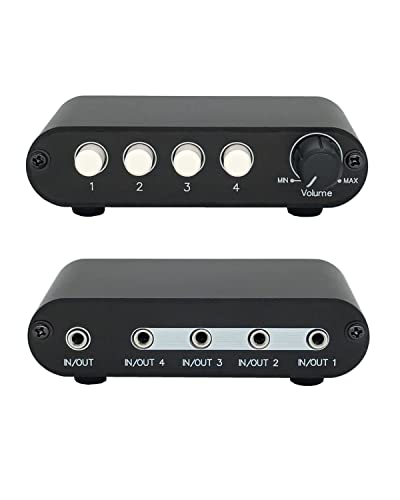
- 4-in-1-out and 1-in-4-out support
- Passive plug-and-play operation
- Built-in volume controller
Best For: Passive 3.5mm setups needing source and output routing
Gulfmew Flexible Selector

- Bidirectional 4-in-1-out or 1-in-4-out switching
- Supports both 3.5mm AUX and RCA L/R devices
- Passive metal design with included 5 ft RCA cable
Best For: Mixed AUX and RCA home audio setups
BolAAzuL Clean-Signal Switcher

- 4-in-1-out or 1-in-4-out bidirectional switching
- Supports flexible 3.5mm and RCA combinations
- Passive, plug-and-play design with no power needed
Best For: Gamers and AV users who want simple analog routing
FlyroadUp Compact Selector
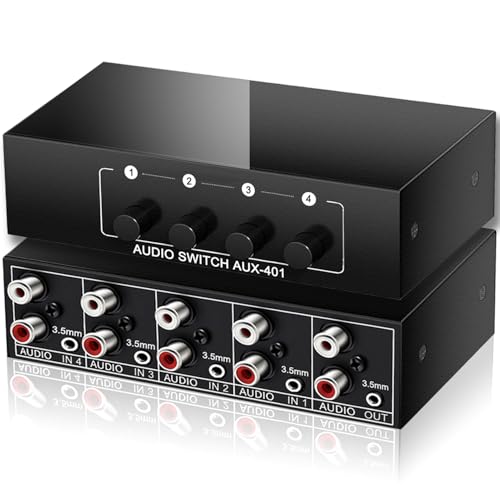
- 4 sources to 1 output or 1 source to 4 outputs
- Flexible 3.5mm AUX and RCA L/R compatibility
- Passive, compact metal build with push-button control
Best For: Compact analog setups with mixed AUX and RCA devices
Simple RCA AV Switch – 4-in/1-out RCA Selector
If you need an audio switcher for multiple inputs with simple RCA gear, this Panlong 4-way AV switch keeps things straightforward. It lets you connect four composite A/V sources to one TV input, with mechanical push-button switching and no external power supply required.
Best For: Small setups with a few DVD players, game consoles, or set-top boxes using yellow-white-red RCA connections.
Pros:
- Switches 4 A/V sources to 1 output with simple button selection
- Metal enclosure adds stability and durability
- No power supply or software needed
- Supports clean video and audio over RCA connections
Cons:
- Works only with devices that use A/V RCA connections
- Limited to four inputs
This is a practical pick if you want a low-fuss RCA selector for older AV devices. It focuses on reliability and ease of use rather than extra features.
3.5mm Audio Selector – 4-Port Volume-Control Switch
For anyone shopping for an audio switcher for multiple inputs on a 3.5mm setup, this LiNKFOR selector is built to route several sources to one output or one source to several outputs. It supports plug-and-play use, includes volume control, and is aimed at desktop audio, headphones, speakers, and similar gear.
Best For: Users who want a compact 3.5mm switch for PCs, phones, laptops, and speakers with manual source selection.
Pros:
- 4-port 3.5mm selector supports 4-in/1-out and 1-in/4-out modes
- Built-in volume control on the switcher
- Plug and play with no power supply required
- Compatible with many 3.5mm audio sources and outputs
Cons:
- Not a splitter in normal use; only one input plays at a time
- Does not support four-segment headphones
This is a flexible option if you want a manual 3.5mm hub for a desk or small entertainment area. The added volume knob makes it more practical than basic switch-only boxes.
High-Capacity RCA Switch – 8-in/1-out AV Selector
If you need an audio switcher for multiple inputs and have a larger stack of RCA devices, this Panlong 8-way AV switch is designed to keep everything centralized. It offers eight A/V inputs into one output, uses simple push-button switching, and does not require external power or software.
Best For: Bigger retro or legacy AV setups with several DVD players, game consoles, or cable boxes feeding one TV.
Pros:
- Handles up to 8 A/V sources into 1 output
- Simple mechanical push-button switching
- Metal enclosure for stability and longevity
- No extra power supply or software drive needed
Cons:
- Requires RCA A/V connections
- Larger footprint than smaller switchers
This model is the better fit when four ports are not enough and you want a straightforward way to manage multiple RCA devices. It keeps the same easy operation as the smaller version, just with more inputs.
Compact Bidirectional Switch – 2-Port AUX Audio Selector
If you want a compact audio switcher for multiple inputs or outputs on a simple 3.5mm setup, this bidirectional cooidea model is designed for quick one-press switching. It can work as 2-in/1-out or 1-in/2-out, making it a small but useful desktop selector for speakers, headphones, and source devices.
Best For: People who need a tiny 3.5mm switch for swapping between two sources or two playback devices.
Pros:
- Bidirectional 2-port design supports 2-in/1-out or 1-in/2-out use
- One-press switching with no power supply required
- Includes a 1-meter audio cable
- Metal CNC/aluminum alloy body for a compact, durable build
Cons:
- Only two ports, so it is not for larger multi-source setups
- Does not support microphone function
This is the simplest option in the group, and that is the point: it is small, portable, and easy to drop into a desk or travel setup. If you only need to toggle between two devices, it stays out of the way while doing the job.
8-Way RCA AV Selector – 8-Port RCA Switch for TV and Consoles
If you need an audio switcher for multiple inputs in a simple home AV setup, this 8-way RCA selector is built for exactly that. It lets you connect up to eight composite A/V devices and switch between them with a push button, making it a practical choice when you want clean audio and video without constant cable swapping.
Best For: Users with several RCA-equipped devices who want a basic, no-power selector for TVs and older game consoles.
Pros:
- 8 in 1 out design supports up to eight A/V sources
- Plug-and-play operation with no external power supply needed
- Metal enclosure adds stability and durability
- Works with DVD players, gaming consoles, and TVs
Cons:
- RCA/composite only, so it is not for 3.5mm audio setups
- Manual push-button switching only
For older systems that rely on RCA connections, this is a straightforward way to consolidate multiple inputs. It focuses on simplicity and stability rather than extra features, which makes it a solid fit for basic entertainment centers.
Compact Bidirectional AUX Switch – 2-Port 3.5mm Audio Selector
This compact audio switcher for multiple inputs is designed for 3.5mm stereo setups where you want to move between sources or outputs without unplugging cables. It supports bidirectional switching, so you can use it as 2-in-1-out or 1-in-2-out, and it works as a simple plug-and-play solution with no power supply required.
Best For: Small desks or mixed 3.5mm audio setups with headphones, speakers, laptops, and phones.
Pros:
- Bidirectional design supports 2-in-1-out or 1-in-2-out use
- One-click manual switching keeps operation simple
- Compact aluminum shell is durable and space-saving
- Includes a 3.3-foot audio cable
Cons:
- Only two ports, so it is not meant for larger source counts
- Manual switching may not suit users who want automation
If your priority is a small and easy way to manage a couple of 3.5mm devices, this model keeps the setup clean and straightforward. It is best when convenience and size matter more than having many input options.
4-Way Stereo Selector – 4-Port 3.5mm Audio Switch with Volume
For anyone looking for an audio switcher for multiple inputs on a 3.5mm system, this 4-way selector gives you more flexibility than a basic two-port box. It supports up to four audio source inputs in 4-in-1-out mode, and it can also work in 1-in-4-out mode, making it useful for setups where you want to route one source to several outputs.
Best For: Users who need a passive 3.5mm switch with both source selection and multi-output routing.
Pros:
- Supports 4-in-1-out and 1-in-4-out switching
- Passive, plug-and-play design requires no power supply
- Built-in volume controller adds extra control
- Solid aluminum CNC chassis for a durable feel
Cons:
- Manual button switching only
- 3.5mm auxiliary use only, not RCA
This unit makes sense if you want one box that can handle both multiple sources and multiple outputs in a compact form. The included volume control and passive design make it especially useful for simple desktop audio setups.
Gulfmew Flexible Selector – 4 in 1 Out Audio Switcher
If you need an audio switcher for multiple inputs that can handle both 3.5mm AUX and RCA gear, this passive selector keeps things simple. It lets you route four sources into one speaker or headphones, or send one source to four outputs, with no power required and no software to set up.
Best For: Home users who want a flexible, no-power switch box for mixed AUX and RCA audio devices.
Pros:
- Supports 4-in-1-out and 1-in-4-out bidirectional switching.
- Works with both 3.5mm AUX and RCA L/R connections.
- Includes a 5 ft RCA cable for easier setup.
- Metal casing and built-in low-power chip are designed for stable transmission.
Cons:
- Only one channel works at a time; simultaneous output is not supported.
- Each port uses either 3.5mm or RCA, not both at once.
This is a practical pick if you want straightforward source switching for everyday TV, gaming, or CD player setups. The included cable and passive design make it easy to place in a media cabinet without adding another powered device.
BolAAzuL Clean-Signal Switcher – 4-Way Passive Stereo Switcher
As an audio switcher for multiple inputs, this passive 4-way selector is built for simple source management without adding noise or latency. It connects four devices into one speaker path, or reverses direction to route one source to four outputs, while supporting flexible 3.5mm and RCA combinations.
Best For: Gamers, home theater users, and desktop setups that need clean passive switching across AUX and RCA devices.
Pros:
- Bidirectional 4-port design supports 4 sources to 1 output or 1 source to 4 outputs.
- Flexible 3.5mm and RCA combinations for phones, PCs, TVs, consoles, and more.
- Passive mechanical design is described as lossless with zero signal loss or latency.
- Metal housing and push-button switching make it durable and easy to use.
Cons:
- Only one output plays at a time.
- Not intended for simultaneous playback across multiple outputs.
This model stands out if you want a compact, plug-and-play switch box for clean analog routing. Its no-power design and straightforward buttons make it a good fit for everyday AV and gaming setups.
FlyroadUp Compact Selector – 4×1 RCA + 3.5mm Switcher
This audio switcher for multiple inputs is designed for quick source changes between four devices without unplugging cables. It supports free combinations of 3.5mm and RCA L/R connections, and its passive mechanical layout is aimed at preserving clear stereo sound for music, movies, and gaming.
Best For: People who want a compact, no-power switch box for mixed AUX and RCA home audio gear.
Pros:
- Routes 4 audio sources to 1 speaker or 1 source to 4 outputs.
- Supports flexible 3.5mm and RCA L/R combinations.
- No power required and uses push buttons for easy switching.
- Compact metal enclosure is built for durability.
Cons:
- Only one of the four outputs works at a time.
- Designed for analog stereo routing, not more advanced switching features.
If you want a straightforward selector for a desk or media cabinet, this one focuses on convenience and simple analog compatibility. It is a practical choice when you need to move between multiple devices while keeping the setup compact.
How We Picked the Best Audio Switcher for Multiple Inputs
We focused on practical features that matter in real setups: the number of inputs and outputs, connector type, passive operation, bidirectional support, and ease of use. We also favored models that suit common home, office, gaming, and small studio connections without adding unnecessary complexity.
Because an Audio Switcher for Multiple Inputs is usually chosen for convenience and signal routing, we prioritized straightforward manual switching, solid build quality, and compatibility with both 3.5mm AUX and RCA L/R devices.
Quick Comparison
If you mostly use portable devices, laptop audio, or desktop speakers, a 3.5mm switcher is usually the easiest choice. If you are connecting DVD players, game consoles, receivers, or older AV gear, an RCA L/R switcher is often the better fit. Bidirectional models are especially useful when you want one source to feed multiple destinations or when you need flexible routing in both directions.
Key Buying Factors for Audio Switcher for Multiple Inputs
Input and Output Count
Choose a switcher with enough ports for your current setup plus one extra if you expect to expand later. A 4-way model suits modest systems, while 8-way options make more sense for larger AV racks or shared entertainment setups.
Connector Type
Match the switch to your existing cables. 3.5mm units are common for phones, PCs, and powered speakers. RCA L/R units are better for stereo components, TVs, and older media devices. Some products support both, which can simplify mixed-source systems.
Passive Vs. Powered
Most of the models here are passive, meaning they do not need external power. That makes them simple and reliable, but they may not offer gain or signal boosting. If your cables are long or your source output is weak, keep signal loss in mind.
Bidirectional Operation
Many buyers want a switcher that can work as either a selector or splitter. Bidirectional designs offer more flexibility, but they still work best when you understand whether you are routing multiple inputs to one output or one input to multiple outputs.
Who Should Buy Which Audio Switcher for Multiple Inputs?
If you want the simplest desktop or headphone-style setup, choose a compact 3.5mm selector. If you are building a living room or retro AV stack, an RCA switcher is usually the better long-term fit. If you need flexibility between two-way routing and shared playback, a bidirectional Audio Switcher for Multiple Inputs is the smartest all-around choice.
For the best experience, buy the smallest model that meets your needs, verify cable compatibility first, and make sure the switcher matches your intended use case before you commit.
