Choosing the right XLR switch box for microphones can make routing, muting, and source comparison far simpler without adding unnecessary noise or complexity.
In this roundup, we focus on practical switching features, balanced signal handling, and the setup styles that matter most for studios, podcasts, and live use.
Best 10 Xlr Switch Box for Microphones Picks for 2026
Balanced Source Selector
DoukAudio 3-In-1-Out XLR Switcher

- Connects 3 balanced XLR sources to 1 output
- Passive design needs no external power
- Gold-plated ports in shielded aluminum housing
Best For: HiFi and studio users comparing balanced sources
Stage Mic Mute Pedal
Radial HotShot DM1 Microphone Mute Footswitch

- Hands-free mic muting via floor footswitch
- XLR connector for stage signal routing
- 14-gauge steel build for durability
Best For: Live performers needing quick microphone mute control
Mini A/B Selector
Douk Audio KN102 2-In-1-Out XLR Switcher

- Passive 2-in-1-out XLR switching
- Includes MIX, A/B, and mute functions
- Mini aluminum body with gold-plated ports
Best For: Compact balanced setups needing switch, mix, and mute control
Reversible A/B Switch Box
WisWinDa Pro XLR A/B Switch Box

- Reversible A/B routing for flexible use
- Passive design needs no extra power
- Supports XLR and 1/4" TS/TRS connections
Best For: Flexible balanced routing in home, studio, or conference setups
Passive A/B Switcher
2 Way XLR Balanced Stereo Audio Switcher
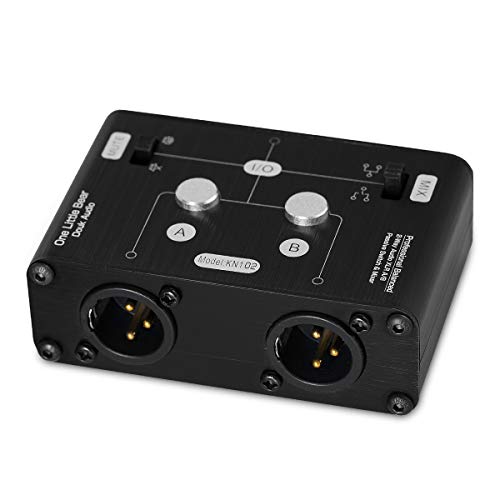
- 1-in-2-out passive XLR switcher
- A/B, Mix, and mute controls
- Aluminum shell with gold-plated ports
Best For: Comparing two balanced XLR sources in a compact passive box
3-Channel Selector Box

- 3-channel passive XLR switching
- Interchangeable 3-in-1-out or 1-in-3-out
- Gold-coated connectors and aluminum shell
Best For: Routing multiple balanced XLR sources in a passive selector
Balanced/RCA Hybrid Selector
MC3 Balanced Audio Splitter Box

- Passive XLR and RCA switching/conversion
- Supports source and amplifier comparison
- Mini desktop-friendly design
Best For: Mixing balanced XLR and unbalanced RCA gear in one passive box
Passive A/B Router
Pro XLR TS/TRS Balanced Switcher

- No external power required
- Reversible 1-in/2-out or 2-in/1-out use
- XLR and 1/4" TS/TRS support
Best For: Simple passive routing in studios, theaters, and conference rooms
Reversible Selector

- No-power passive routing
- Works as 1-in/2-out or 2-in/1-out
- XLR and 1/4" TRS/TS compatibility
Best For: Comparing microphones and routing balanced audio between two paths
Multi-Output Switcher

- Routes one source to five outputs
- Passive with MUTE option
- XLR and 1/4" input support
Best For: Sending one microphone or audio source to multiple destinations
Balanced Source Selector – DoukAudio 3-In-1-Out XLR Switcher
If you need an xlr switch box for microphones or other balanced gear, this passive 3-in-1-out selector is built for simple source comparison and clean signal routing. It lets you connect up to three balanced stereo XLR sources to one output, making it easy to swap between DACs, CD players, streamers, mixers, or studio devices without adding extra power or complexity.
Best For: Comparing multiple balanced XLR sources in a desktop HiFi or studio setup.
Pros:
- 3-in-1-out balanced XLR switching for multiple source comparison
- Pure passive design requires no external power
- Gold-plated XLR connectors help maintain stable contact
- Shielded aluminum housing helps reduce outside interference
Cons:
- Designed for switching, not for adding microphone features like mute or gain control
- Best suited to balanced XLR systems rather than general-purpose unbalanced gear
Overall, this is a straightforward option if you want a passive balanced selector with a sturdy build and easy source management. Its main strength is transparent, no-power signal routing for HiFi and studio users who compare equipment often.
Stage Mic Mute Pedal – Radial HotShot DM1 Microphone Mute Footswitch
This microphone signal muting footswitch is a practical stage tool when you need hands-free control during a performance. The Radial HotShot DM1 uses an XLR connector and floor-mounted footswitch design to toggle mic signal routing, making it useful for quick muting or split-style stage workflows where simple on-off control matters.
Best For: Performers who need hands-free microphone muting on stage.
Pros:
- Footswitch control keeps microphone muting hands-free
- Stage-friendly floor mount design
- Uses XLR connectivity for mic routing
- Built from 14-gauge steel for durability
Cons:
- Focused on mute/toggle use rather than full source selection
- Mono-style mic workflow is more specialized than a general switch box
If your priority is fast mic control rather than multi-input switching, this pedal-style unit is a focused solution. It is best viewed as a performance utility for live muting, not as a studio selector for multiple sources.
Mini A/B Selector – Douk Audio KN102 2-In-1-Out XLR Switcher
For a compact xlr switch box for microphones or other balanced equipment, this KN102 unit offers a simple passive way to compare or route sources. The 2-in-1-out layout is meant for users with multiple XLR balanced outputs, and the MIX, A/B selection, and one-key mute functions add flexibility in a very small desktop-friendly enclosure.
Best For: Small setups that need compact A/B switching, mixing, or mute control.
Pros:
- 2-in-1-out passive XLR switching in a mini format
- MIX mode, A/B selection, and one-key mute add versatility
- All-aluminum shell helps reduce outside noise
- Gold-plated XLR ports support reliable signal contact
Cons:
- Limited to a compact 2-source workflow
- Best suited to balanced XLR gear rather than broad multi-format use
This model makes sense when space is tight and you still want passive switching with more than basic toggle behavior. It is especially appealing for listeners or creators who want a small, portable selector with mute and mix options.
Reversible A/B Switch Box – WisWinDa Pro XLR A/B Switch Box
This xlr switch box for microphones and other balanced gear is designed for flexible A/B routing in either direction, which makes it useful in a variety of audio setups. It supports XLR and 1/4″ TS/TRS connections, works passively without extra power, and uses an aluminum alloy enclosure for durable everyday use.
Best For: Users who want reversible A/B switching across XLR and 1/4-inch balanced setups.
Pros:
- Reversible operation supports source-to-output or output-to-source use
- Passive hot-swap design requires no power supply
- Supports both XLR and 1/4″ TS/TRS connections
- Aluminum alloy box suited to home, studio, and conference use
Cons:
- Not as specialized for microphone muting as a dedicated footswitch
- More of a general balanced switch box than a dedicated multi-input selector
For buyers who need flexibility more than a fixed one-way layout, this box stands out for its reversible switching design. It is a solid choice when you want one passive unit to handle different balanced audio routing needs without extra power.
Passive A/B Switcher – 2 Way XLR Balanced Stereo Audio Switcher
If you need an xlr switch box for microphones or other balanced sources, the KN102 is a simple passive option for comparing two sound paths. This 1-in-2-out version lets you switch between A and B, or use Mix mode to send both at the same time, while the one-key mute function adds quick control for desktop setups.
Best For: Users who want a compact passive XLR switch box for comparing two balanced sources or routing one input to two outputs.
Pros:
- Passive 1-in-2-out design with A/B selection and Mix mode.
- One-key mute function for quick silence control.
- Aluminum shell and gold-plated XLR ports for durable connections.
- Mini size makes it easy to place and carry.
Cons:
- Only covers the 1-in-2-out version listed here.
- Passive design means no extra features beyond switching and mute.
For straightforward balanced audio switching, this model keeps the setup compact and focused. It is a practical choice when you want to compare sources without adding power requirements or unnecessary complexity.
3-Channel Selector Box – Pro XLR 3Pin Switching Box
For a more flexible xlr switch box for microphones and other balanced gear, the MS-XLR-0301 gives you three-channel switching in either direction. It comes in interchangeable 3-in 1-out or 1-in 3-out versions, making it useful when you want to route multiple XLR sources or send one source to several destinations in a passive setup.
Best For: Buyers who need a passive 3-channel XLR selector with interchangeable input/output layouts.
Pros:
- Supports both 3-in 1-out and 1-in 3-out configurations.
- Passive hot-swap design requires no extra power supply.
- Aluminum shell and gold-coated copper XLR connectors.
- Compact and includes an EVA non-slip mat.
Cons:
- In the 1-in-3-out setup, the three outputs cannot work simultaneously.
- Larger footprint than mini two-way switch boxes.
This is a good fit if your setup needs more routing options than a basic A/B switch. Its passive design keeps the signal path simple, while the interchangeable layouts make it adaptable to different audio systems.
Balanced/RCA Hybrid Selector – MC3 Balanced Audio Splitter Box
If you want an xlr switch box for microphones and a simple way to work between balanced and unbalanced gear, the MC3 combines switching and conversion in one passive desktop unit. It supports multiple XLR and RCA connections, letting you compare sources or amplifiers and convert between XLR and RCA without adding power or changing the sound path.
Best For: Users who need both source switching and XLR-to-RCA conversion in a passive box.
Pros:
- Passive design with no power supply required.
- Handles both XLR and RCA connections.
- Can switch among sound sources or amplifiers for comparison.
- Mini size is suited to desktop and home use.
Cons:
- More of a converter/selector than a dedicated XLR-only switch box.
- Product notes describe multiple I/O options, which may require careful matching to your setup.
This model stands out when your setup mixes balanced and unbalanced components. It is a practical all-in-one choice if you want passive routing plus conversion in a small format.
Passive A/B Router – Pro XLR TS/TRS Balanced Switcher
If you need an xlr switch box for microphones and balanced audio gear, this passive A/B switcher is built for simple source routing without adding external power. It supports XLR input along with XLR and 1/4″ TS/TRS output, and its reversible design lets you use it as either a 1-in/2-out or 2-in/1-out box depending on your setup.
Best For: Home studios, conference rooms, and small recording setups that need simple passive A/B routing.
Pros:
- Passive, hot-swap design requires no power supply.
- Reversible operation works for both source switching and destination switching.
- Supports balanced XLR plus 1/4″ TS/TRS connections.
- Aluminum shell suits studio, theater, and live-use environments.
Cons:
- As a passive mechanical switch, it may produce a pop during switching.
- Best suited to straightforward routing rather than advanced signal control.
Overall, this is a practical pick if you want a no-power xlr switch box for microphones and other balanced audio sources. Its strength is flexibility: one box can handle different routing needs while keeping the setup compact and easy to use.
Reversible Selector – Pro XLR Passive A/B Box
This xlr switch box for microphones is designed for flexible A/B routing when you want to compare sources or send one balanced signal to two destinations. It works passively with no external power and supports both XLR and 1/4″ TRS/TS connections, making it a straightforward tool for studio and live audio setups.
Best For: Comparing microphones, switching monitors, or routing one signal to two destinations.
Pros:
- Reversible 1-in/2-out and 2-in/1-out operation.
- Passive, lossless design with no power required.
- Supports XLR and 1/4″ TRS/TS gear.
- Compact aluminum alloy chassis with a waterproof toggle switch.
Cons:
- A pop may occur during switching due to DC offset.
- Mechanical switching is best handled with brief muting during use.
If your priority is clean signal routing without extra hardware, this box fits the bill well. It is especially appealing for users who need a simple, durable switcher for microphones, monitors, mixers, or recording interfaces.
Multi-Output Switcher – Pro XLR501 1-in 5-Out Box
If you need an xlr switch box for microphones that can route one source to multiple outputs, this passive selector is built for exactly that kind of job. It supports 1-in/5-out or 5-in/1-out operation, includes a combined XLR and 1/4″ input interface, and uses a rotary knob plus MUTE option for quick selection.
Best For: Users who need one microphone or audio source routed to up to five destinations.
Pros:
- Passive design requires no external power.
- Supports 1-in/5-out and 5-in/1-out reversible operation.
- Combined XLR male and 1/4″ input interface adds flexibility.
- MUTE option helps reduce popping before live use.
Cons:
- More specialized than a basic A/B box if you only need two-way switching.
- Switching workflows may require careful setup before performances.
This is the most expansion-friendly option in the group when you need several output paths from one mic or audio source. The passive, compact build keeps it simple, while the five-output layout makes it a better fit for more complex routing scenarios.
How We Picked the Best Xlr Switch Box for Microphones
We looked for an Xlr Switch Box for Microphones that prioritizes clean signal path design, balanced connectivity, reversible routing where useful, and durability. We also favored models that fit real-world use cases, from simple A/B comparison to multi-channel selection and mute control.
Quick Comparison
In this group, the main differences come down to channel count, directionality, and intended use. Some units are best for simple 2-way switching, while others support 3-way or 5-way routing, duplex operation, or mic muting. If you only need one microphone going to one of two destinations, a compact A/B box is usually enough. If you need to choose among several mics or sources, a multi-position selector is more practical.
Key Buying Factors for Xlr Switch Box for Microphones
Signal Type and Compatibility
Make sure the box matches your gear: standard XLR microphones, balanced line-level devices, or hybrid setups that may include TRS or RCA. A mismatch here can create noise, level issues, or extra adapters.
Switching Direction
Some boxes are 1-in-2-out, others 2-in-1-out, and some are reversible. Choose the layout that matches whether you are splitting one mic to multiple destinations, selecting between sources, or routing in both directions.
Passive Design
Most microphone selector boxes are passive, which means they do not need power. That keeps setup simple, but you should still confirm whether the unit is intended for mic signals and whether it supports true balanced operation.
Noise, Shielding, and Build Quality
For microphones, clean switching matters. Look for solid metal housing, good shielding, tight connectors, and a design that avoids pops, hum, or accidental signal loss during changes.
Use Case
A live performer may want a mute or footswitch-style option, while a studio user may prefer a desktop selector for fast monitoring comparisons. Content creators often benefit most from straightforward A/B boxes that keep workflows simple.
Who Should Buy Which Xlr Switch Box for Microphones?
If you need basic, no-fuss routing, a two-way selector is the easiest choice. If your workflow involves multiple microphones, recording chains, or speaker comparisons, step up to a 3-channel or 5-channel selector. If you want quick control during performance, a mute footswitch can be the better fit. For anyone shopping for an Xlr Switch Box for Microphones, the best model is the one that matches your exact routing needs with the fewest adapters and the cleanest signal path.
