The right processor can transform a capable audio system by adding precise crossover control, equalization, delay, routing, and protection. These speaker management processors for audiophiles span compact USB units, rack-mount loudspeaker processors, matrix systems, and car-audio DSPs.
We compare their connectivity, processing flexibility, control options, and intended use so you can choose a practical match for your speakers, amplifiers, listening space, and installation.
Best 10 Speaker Management Processors for Audiophiles Picks for 2026
Best All-in-One PA Control

- Accurate automatic EQ
- Enhanced feedback suppression
- App-based setup and control
Best For: DJs and PA users seeking guided loudspeaker optimization
Best for Custom DSP Tuning

- 400MHz DSP with broad processing tools
- Analog, USB, and TOSLINK inputs
- Stores four listening presets
Best For: DIY speaker builders and home theater enthusiasts
Best for Speaker Protection
- 24-bit/96kHz processing
- Limiters on every output channel
- Adjustable input and output delays
Best For: Professional loudspeaker setups needing protection and timing control
Best for Matrix Routing

- 16 inputs and 16 outputs
- High-capacity audio matrix design
- Built for complex routing needs
Best For: Larger installations requiring extensive audio connectivity
Flexible Digital Crossover Control

- 2 inputs and 6 outputs
- 24-bit/96 kHz conversion
- Dynamic and parametric EQ
Best For: Multi-amplifier systems needing extensive analog routing
Hi-Res Wireless Tuning

- 96 kHz/24-bit Hi-Res processing
- Six analog and one coaxial input
- Eight outputs with Bluetooth app control
Best For: Advanced car-audio systems requiring digital input and mobile tuning
Deep Multi-Channel Car Tuning
- 32-bit/96 kHz DSP processing
- 79-band EQ per channel
- Four inputs and eight outputs
Best For: Complex car systems with multiple amplifiers and subwoofers
Rack-Ready DSP Control
DP-26 Professional Audio Processor

- 2-in/6-out architecture with extensive routing
- Integrated EQ, crossover, limiter, and delay
- USB, RS485, and RS232 control options
Best For: Complex rack-based speaker and line-array systems
Eight-Channel Car Tuning
- Eight independent crossover outputs
- 15-band EQ plus 12 sound presets
- Sequencer with remote-trigger connection
Best For: Multi-amplifier car-audio installations
Compact Four-Channel DSP

- Four independent crossover outputs
- 15-band EQ with 12 presets
- Compact one-pound car-audio chassis
Best For: Smaller multi-channel vehicle sound systems
Best All-in-One PA Control – DriveRack PA2
For audiophiles managing a live sound or DJ setup, the dbx DriveRack PA2 is a practical choice among speaker management processors for audiophiles. Its guided wizard, automatic EQ, and feedback suppression simplify setup while retaining rack-mount flexibility.
Best For: DJs, PA systems, and users who want app-controlled loudspeaker optimization.
Pros:
- Fast, accurate Auto EQ algorithm
- Enhanced feedback elimination with AFS
- Step-by-step setup wizard
- Android and iOS control
Cons:
- Designed primarily for PA and DJ applications
- Requires corded power
The PA2 stands out when convenience and automated system tuning matter most. Its 2-channel design and rack-friendly form make it a focused solution for complete PA management rather than a broad home-audio processor.
Best for Custom DSP Tuning – miniDSP 2×4 HD
miniDSP 2x4 HD Digital Audio Signal Processor, Analog, USB, Toslink Audio Source, 4 Presets Stored
Check Price On AmazonThe miniDSP 2×4 HD is a flexible pick for speaker management processors for audiophiles who enjoy tailoring a system themselves. It combines USB DAC functionality with a 400MHz DSP and supports multiple audio sources, filters, delays, and stored presets.
Best For: Speaker builders, DIY audio enthusiasts, and home theater users who want detailed signal-shaping options.
Pros:
- Two inputs and four outputs
- Supports PEQ, crossovers, delays, meters, and FIR/IIR filters
- Accepts analog, USB, and TOSLINK sources
- Stores up to four presets
Cons:
- Its broad feature set may require more hands-on setup
- Limited to four output channels
With extensive processing blocks and several input options, the 2×4 HD is well suited to methodical system building. It is a particularly strong fit for listeners who value configurable DSP over automated PA-oriented setup.
Best for Speaker Protection – Ultradrive Pro DCX2496
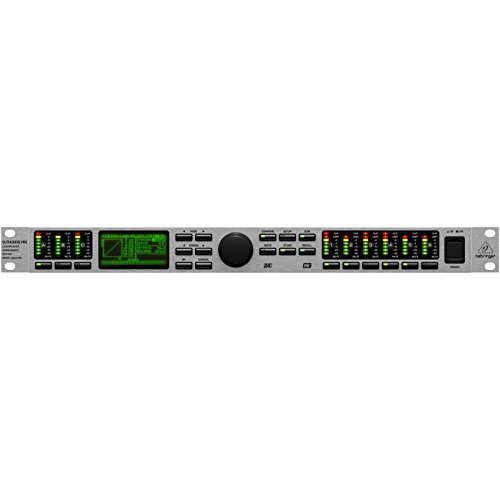
The Behringer Ultradrive Pro DCX2496 is a rack-style option for speaker management processors for audiophiles who prioritize output protection and timing correction. Its 24-bit/96kHz design includes output limiters and adjustable delays across inputs and outputs.
Best For: Users needing speaker protection and delay adjustment in a professional loudspeaker-management setup.
Pros:
- 24-bit/96kHz digital processing
- Limiters on all output channels
- Adjustable input and output delays
- Supports phase and arrival-time correction
Cons:
- Its larger rack-oriented footprint may not suit compact systems
- Supplied notes do not specify app or wireless control
The DCX2496 makes the most sense when reliable output limiting and timing control are central requirements. It offers a focused professional feature set for managing loudspeaker behavior rather than a compact desktop listening solution.
Best for Matrix Routing – Allen & Heath AHM-16
The Allen & Heath AHM-16 is a straightforward choice among speaker management processors for audiophiles who need substantial routing capacity. Its 16-in/16-out matrix format is designed for systems requiring numerous audio inputs and outputs.
Best For: Larger audio installations and users who need extensive matrix connectivity.
Pros:
- Provides 16 inputs and 16 outputs
- Designed as an audio matrix processor
- Suitable for systems with extensive routing requirements
Cons:
- Large, heavy form factor
- Supplied notes do not list specific EQ, delay, or limiter functions
The AHM-16 is best evaluated as a high-capacity routing platform. Its 16×16 architecture gives it an advantage in complex installations, though buyers seeking detailed processing specifications should confirm those capabilities before purchase.
Flexible Digital Crossover Control – Behringer DCX2496LE
For audiophiles building a multi-amplifier speaker system, the Behringer ULTRADRIVE DCX2496LE is a versatile choice among speaker management processors for audiophiles. Its two analog inputs, six analog outputs, 24-bit/96 kHz conversion, and configurable equalization provide extensive control for routing and system tuning.
Best For: Audiophiles who need flexible analog routing, multiple outputs, and detailed crossover or EQ control.
Pros:
- Provides 2 analog inputs and 6 analog outputs for flexible system configuration.
- Uses 24-bit/96 kHz A/D and D/A converters with a stated 113 dB dynamic range.
- Includes dynamic EQs and selectable parametric EQs for inputs and outputs.
Cons:
- Its feature set may be more extensive than necessary for a simple two-channel setup.
- The supplied details describe analog connectivity rather than modern wireless control.
The DCX2496LE stands out when output count and hands-on signal shaping matter most. It is a practical system-management hub for enthusiasts comfortable configuring a dedicated digital loudspeaker processor.
Hi-Res Wireless Tuning – Hertz SPL Show S8 DSP
Hertz SPL Show S8 DSP Compact Digital Interface Processor 6 in + Digital in & 8 outputs
Check Price On AmazonThe Hertz SPL Show S8 DSP combines high-resolution processing with flexible vehicle-system integration, making it a compelling option among speaker management processors for audiophiles. It supports six analog inputs, a digital coaxial input, eight outputs, and wireless parameter control through its Bluetooth-enabled app.
Best For: Car-audio enthusiasts who want Hi-Res processing, digital input support, and convenient mobile tuning.
Pros:
- Processes audio at 96 kHz/24-bit resolution and carries Hi-Res certification from the Japan Audio Society.
- Offers 6 high/low-level analog inputs, 1 digital coaxial input, and 8 output channels.
- Supports wireless configuration through an Apple and Android app using Bluetooth 5.0.
Cons:
- Its design and inputs are oriented toward specialist car-audio installations.
- The supplied information does not specify supported software updates.
With both analog and coaxial digital connectivity, the S8 DSP is well suited to complex in-car systems. Its app control is especially useful when frequent tuning adjustments are part of the installation process.
Deep Multi-Channel Car Tuning – Banda Audiopart X8AiR DSP
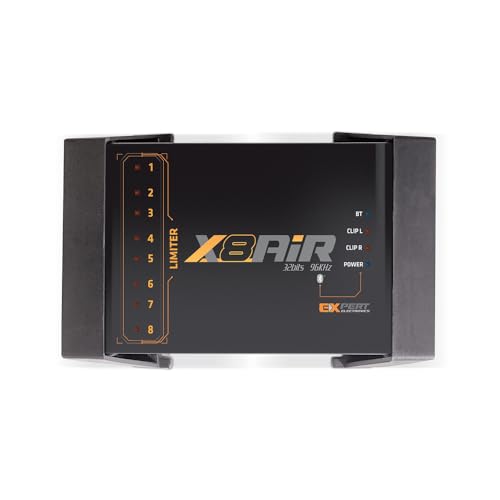
The Banda Audiopart X8AiR targets detailed vehicle-system tuning with 32-bit/96 kHz processing, four inputs, and eight outputs. For shoppers comparing speaker management processors for audiophiles, its 79-band-per-channel equalizer, time alignment, crossover controls, and app-based Bluetooth adjustment offer unusually broad control.
Best For: Car-audio enthusiasts managing multi-amplifier, component-speaker, and subwoofer systems.
Pros:
- Uses 32-bit/96 kHz DSP processing for multi-channel tuning.
- Provides 79 EQ bands per channel plus crossover, time-alignment, phase, and limiter controls.
- Offers 4 inputs, 8 outputs, and wireless app control for complex installations.
Cons:
- The extensive controls may require more setup time than a simpler processor.
- Its supplied specifications identify it specifically as a car-audio processor.
- The notes do not state a supported software-update date.
The X8AiR is the strongest fit here for listeners who want granular control over every section of a vehicle audio system. Its channel count and adjustment tools make it especially capable for carefully balancing speakers, amplifiers, and subwoofers.
Rack-Ready DSP Control – DP-26 Professional Audio Processor
For audiophiles building a flexible rack system, the DP-26 is one of the more comprehensive speaker management processors for audiophiles. Its 2-in/6-out design combines crossover, equalization, limiting, delay, filtering, mixing, and effects in a single 1U chassis.
Best For: Home or professional audio setups that need extensive routing, crossover, EQ, and delay control in a rack-mountable unit.
Pros:
- Combines crossover, equalizer, limiter, delayer, and filter functions in one processor.
- Offers 96 kHz sampling, a 32-bit DSP processor, and 24-bit A/D and D/A conversion.
- Provides six outputs, configurable filters, phase control, and delays up to 1000 ms.
- Supports USB, RS485, and RS232 connectivity, with storage for 12 user programs.
Cons:
- The feature set may be more extensive than needed for a simple stereo system.
- Its 1U rack-mount format and 10.08-pound weight suit fixed installations better than portable setups.
The DP-26 stands out when system alignment and routing flexibility matter most. Its detailed filter, delay, and connectivity options make it a strong choice for complex speaker arrays or multi-amplifier configurations.
Eight-Channel Car Tuning – PRV AUDIO DSP 2.8X
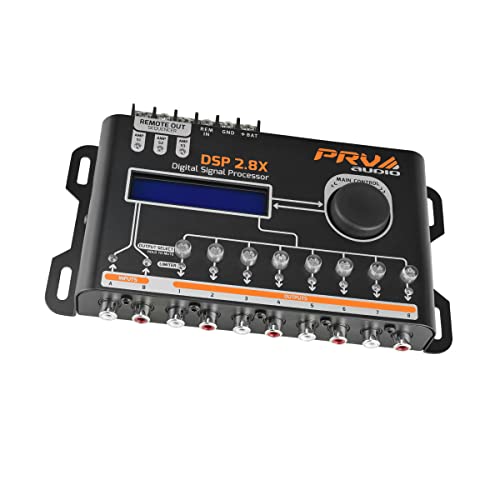
The PRV AUDIO DSP 2.8X is a compact option among speaker management processors for audiophiles who are tuning a vehicle system. It provides two selectable inputs and eight independently configurable outputs, along with graphic and parametric equalization controls.
Best For: Car-audio enthusiasts who need eight-channel output control, source selection, crossover adjustment, and system sequencing.
Pros:
- Provides eight independent crossover outputs from two inputs.
- Includes a 15-band graphic equalizer and 12 built-in sound presets.
- Offers parametric EQ with gain, frequency, and bandwidth adjustment.
- Includes an LCD interface and remote-trigger sequencer connection.
Cons:
- Its car-audio design is less suited to conventional home hi-fi racks.
- The LCD display is compact at 16 x 2 characters.
With eight outputs in a small one-pound chassis, the DSP 2.8X is aimed at multi-amplifier vehicle systems. It is particularly useful when independent channel control and sequential equipment triggering are priorities.
Compact Four-Channel DSP – PRV AUDIO DSP 2.4X
The PRV AUDIO DSP 2.4X offers a streamlined approach to speaker management processors for audiophiles working with smaller car-audio systems. Its two inputs feed four independent crossover outputs, while onboard graphic and parametric EQ support detailed system tuning.
Best For: Compact car-audio systems requiring four-channel crossover control, source selection, equalization, and remote sequencing.
Pros:
- Routes two inputs to four independently controlled crossover outputs.
- Includes a 15-band graphic equalizer and 12 selectable presets.
- Provides parametric EQ with adjustable gain, frequency, and bandwidth.
- Uses a compact one-pound chassis with an LCD control interface.
Cons:
- Four outputs provide less expansion capacity than the DSP 2.8X.
- Its car-audio focus may not match typical home speaker-management needs.
The DSP 2.4X is a practical choice when four outputs are sufficient and space is limited. It retains the core tuning and sequencing features of the larger model in a compact format.
How We Picked These Speaker Management Processors for Audiophiles
We focused on processors that provide meaningful control over a multi-speaker system rather than basic tone adjustment alone. Our selection considers crossover capabilities, input and output counts, equalization, delay, presets, routing, limiter or protection features, software and app control, and installation format.
The list includes models suited to different environments. Some are designed for home audio and desktop experimentation, while others target professional PA systems, commercial installations, or vehicle sound systems. Because those categories have different connection standards and workflows, compatibility with your existing equipment is more important than any single specification.
Quick Comparison
| Best For | What to Prioritize | Typical Advantage |
|---|---|---|
| Home or desktop systems | USB, optical, flexible EQ, compact design | Easy tuning with minimal rack equipment |
| Active speakers and subwoofers | Independent outputs, crossover control, delay | More accurate integration between drivers |
| PA and live sound | Balanced I/O, limiters, presets, remote control | Reliable system protection and repeatable setup |
| Installed audio | Matrix routing, network control, scalable I/O | Flexible distribution across zones |
| Car audio | Vehicle-level inputs, app control, remote accessories | Detailed tuning in a compact installation |
Key Buying Factors
Inputs, Outputs, and Signal Compatibility
Count the sources, amplifier channels, subwoofers, and speaker drivers you need to manage. Verify balanced or unbalanced connections, digital inputs, USB support, and maximum input and output levels. A processor with insufficient outputs can prevent independent crossover or delay adjustment later.
Crossover, EQ, and Time Alignment
Look for adjustable crossover slopes and frequencies, parametric EQ, polarity control, and per-output delay. These features help match subwoofers to mains, align multiple drivers, and correct room or installation-related problems. Higher sample rates can be useful, but practical filter control and a stable setup workflow matter just as much.
Control, Presets, and Protection
Computer, mobile, Bluetooth, or network control can make tuning easier, particularly when the processor is mounted out of reach. Presets are valuable for multiple listening modes or venues. Limiters and output protection are especially important when the processor feeds expensive drivers or high-powered amplifiers.
Format and Installation
Rack-mount PA processors suit permanent systems and touring rigs, while compact units may be better for desktop, home, or hidden installations. Confirm power requirements, ventilation, mounting hardware, and whether the included software works with your operating system or mobile device.
Who Should Buy Which Speaker Management Processors for Audiophiles?
Choose a compact USB or optical-capable model if you are tuning a home setup, desktop system, or small active-speaker rig. Select a rack-mount loudspeaker management processor if you need robust balanced connections, several outputs, repeatable presets, and amplifier or driver protection for a PA or studio system.
Matrix processors are the better choice for distributed audio, multiple zones, or installations that require flexible routing. Car-audio DSPs are appropriate only when their vehicle-oriented inputs, outputs, controls, and wiring match the installation. Before buying, map your complete signal chain and leave spare outputs if you expect to add subwoofers, additional amplifiers, or speakers later.
