A well-chosen patch panel makes Ethernet installations easier to organize, troubleshoot, and expand. The right model depends on your cable category, rack space, termination method, and whether you prefer punch-down or passthrough connections.
This roundup compares 10 network patch panels for home networks, offices, server racks, and compact wall-mounted installations, with options for Cat6, Cat6A, 10Gbps networking, and flexible keystone layouts.
Best 10 Network Patch Panels Picks for 2026
Best Overall
Cable Matters 24-Port Cat6 Patch Panel

- 24 Cat6 RJ45 ports with 10GbE support
- Supports PoE, PoE+, and PoE++
- Includes rack hardware and cable-management accessories
Best For: High-capacity 1U Ethernet installations
Best Customizable
TRENDnet 24-Port Blank Keystone Panel
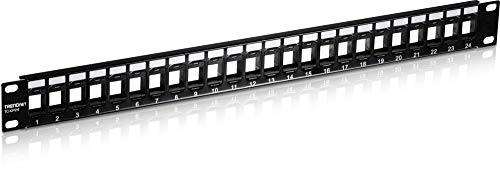
- 24 blank openings for standard keystone modules
- Supports Cat6, audio, video, and data applications
- Sturdy 1U SPCC steel rackmount design
Best For: Modular installations using replaceable keystone jacks
Best Shielded
Cable Matters Cat6A 24-Port Patch Panel

- Cat6A 24-port design supports up to 10Gbps
- Individual shielding helps reduce EMI and RFI
- Includes cable-management and rack-mount hardware
Best For: High-speed, interference-sensitive 10GbE installations
Best Toolless Installation
Rapink 24-Port Cat6 Pass-Through Panel

- Preloaded couplers enable tool-free installation
- Supports Cat6, Cat5e, Cat5, and stated 10G speeds
- Removable back bar helps manage cable strain
Best For: Quick DIY installs and easy port replacement
Best Plug-and-Play Pick
Jadaol 24-Port Pass-Through Panel

- Tool-free RJ45 feed-through design
- 24 couplers plus one spare
- Cat6 support up to 10Gbps
Best For: Pre-terminated Ethernet cables in home, office, or rack installations
Best Flexible Keystone Option
Cable Matters 24-Port Keystone Panel

- Accepts many standard keystone jacks
- Supports mixed multimedia cabling
- Includes removable cable-support bar
Best For: Structured cabling systems using Ethernet and other media types
Best Compact Punch-Down Choice

- 12-port punch-down layout
- Supports Cat6, Cat5e, and Cat5
- Compact 10-inch, 1U format
Best For: Small home or wall-mounted networks using permanent Ethernet cabling
Best Tool-Free Organization
24-Port Cat6A RJ45 Passthrough Panel

- Toolless 24-port installation
- Reusable smart cable management
- Fits standard 19-inch racks
Best For: Fast, tidy home and office rack installations
Best Value Cat6 Setup
24-Port Cat6 Coupler Patch Panel

- No punch-down installation
- Up to 10Gbps Cat6 performance
- Steel chassis with removable back bar
Best For: Organized home and office network racks
Best Shielded 10G Option

- Shielded 1U rack-mount design
- Supports up to 10Gbps
- Toolless modular couplers
Best For: Cat6A and higher-speed rack installations
Best Overall – Cable Matters 24-Port Cat6 Patch Panel
For organized home, office, or enterprise wiring, this network patch panel combines 24 RJ45 ports with Cat6 support and compatibility with Cat5e and Cat5 cabling. Its 1U rackmount design, PoE support, and included cable-management accessories make it a practical choice for upgrading a structured Ethernet installation.
Best For: High-capacity 1U rack installations needing Cat6 connectivity, PoE support, and straightforward cable organization.
Pros:
- Supports 24 ports, Cat6 cabling, and up to 10-Gigabit Ethernet networks.
- Compatible with PoE, PoE+, and PoE++ devices such as cameras and wireless access points.
- Includes numbered ports, T568A/T568B diagrams, D-rings, and cable ties.
- UL listed and designed for standard 19-inch racks, cabinets, or wall-mount brackets.
Cons:
- Unshielded construction may be less suitable for areas with substantial electromagnetic interference.
- Uses fixed RJ45 ports rather than replaceable keystone modules.
This is a well-rounded network patch panel for conventional copper Ethernet deployments. It offers useful installation guidance and cable-management hardware while leaving room for 10GbE and modern PoE equipment.
Best Customizable – TRENDnet 24-Port Blank Keystone Panel
This network patch panel is built for installations where flexibility matters more than preloaded ports. Its 24 blank keystone openings accept standard-size modules, allowing you to configure the panel for Cat6, audio, video, or other supported connections as your system evolves.
Best For: Custom rack builds that use interchangeable keystone jacks and require a sturdy 1U metal chassis.
Pros:
- Provides 24 blank keystone positions for a customizable installation.
- Works with standard-sized Cat6 keystone jacks for Gigabit and 10G copper applications.
- Sturdy SPCC steel construction is designed for 19-inch, 1U rack mounting.
- Pre-numbered ports and supplemental labels simplify cable identification.
Cons:
- Keystone jacks are sold separately, so it is not ready to connect out of the box.
- Its blank design requires additional planning and component selection.
The TC-KP24 is a strong option for modular network patch panels. Choose it when you want to mix or replace keystone connections rather than commit to a fixed RJ45 layout.
Best Shielded – Cable Matters Cat6A 24-Port Patch Panel
For higher-performance network patch panels, this 24-port Cat6A model adds shielding at each port to help limit electromagnetic and radio-frequency interference. It combines 10Gbps capability, PoE support, a cable-management bar, and included rack hardware for a more complete rack installation.
Best For: 10GbE and PoE deployments where interference protection and organized rack cabling are priorities.
Pros:
- Supports Cat6A networking with data rates up to 10Gbps.
- Individual port shielding helps protect against EMI and RFI.
- Supports PoE, PoE+, and PoE++ applications.
- Includes a management bar, cable ties, hook-and-loop ties, screws, and cage nuts.
Cons:
- Shielded Cat6A construction may be more than needed for basic Gigabit networks.
- Its 1.9-pound metal design is heavier than simpler patch-panel options.
With shielding, Cat6A support, and a broad accessory package, this is a compelling choice for demanding network racks. The replaceable keystone-style sockets also provide flexibility if your connection needs change.
Best Toolless Installation – Rapink 24-Port Cat6 Pass-Through Panel
This Rapink network patch panel uses preloaded inline couplers instead of requiring punch-down termination. That pass-through design can speed installation and simplify repairs, while the removable back bar helps support incoming cables in a 19-inch, 1U rack or wall-mounted setup.
Best For: DIY and small-network installations where quick, tool-free connections and easy port replacement are important.
Pros:
- Preloaded couplers allow tool-free pass-through connections.
- Supports Cat6, Cat5e, and Cat5 cabling with stated 10G capability.
- Removable back bar helps reduce cable strain and connector movement.
- Couplers can be replaced or adapted for other connection types, according to the supplied notes.
Cons:
- Pass-through couplers may be less suitable for installers who prefer punch-down termination.
- The product is intended for indoor use despite the listing also mentioning outdoor usage.
This panel prioritizes convenience and serviceability. It is particularly useful when you want to avoid punch-down tools or expect to replace individual couplers during future network changes.
Best Plug-and-Play Pick – Jadaol 24-Port Pass-Through Panel
For shoppers comparing network patch panels, the Jadaol 24-port model is a straightforward choice when your Ethernet cables already have RJ45 connectors. Its feed-through design avoids punch-down work while supporting Cat6 connections up to 10Gbps.
Best For: Home networks, offices, and racks that use pre-terminated Ethernet cables and need a tool-free installation.
Pros:
- Plug-and-play RJ45 pass-through design requires no crimping or punch-down.
- Includes 24 removable couplers plus one spare module.
- Supports up to 10Gbps with Cat6 cables.
- Fits standard 19-inch racks and can also be wall mounted; a rear cable-management bar is included.
Cons:
- Not compatible with bare wires that need to be punched down.
- Requires pre-terminated Ethernet cables with RJ45 connectors.
This is a practical network patch panel for quick, tidy installations, but it is best avoided if you need to terminate in-wall cable directly at the panel.
Best Flexible Keystone Option – Cable Matters 24-Port Keystone Panel
The Cable Matters 24-port blank panel is a versatile option among network patch panels because it accepts standard keystone modules instead of locking you into one connector type. It is suited to structured cabling installations that combine Ethernet with other media.
Best For: Rack, cabinet, or wall-mount projects that need a mix of Ethernet, coaxial, HDMI, USB, fiber, voice, or other keystone connections.
Pros:
- Supports a broad range of standard-sized keystone jacks.
- Combines multimedia connections in a single 24-port panel.
- Includes a removable rear cable-support bar with sequential labels and zip-tie keyholes.
- Heavy-duty powder-coated steel construction with stamped numbers and writable label spaces.
Cons:
- Keystone jacks are not supplied, so modules must be selected separately.
- Its broad multimedia format may be more than needed for an Ethernet-only setup.
This panel is a strong long-term choice when flexibility matters, especially if your cabling needs may expand beyond standard network connections.
Best Compact Punch-Down Choice – Rapink 12-Port Cat6 Panel
The Rapink 12-port model is a compact network patch panel for terminating Cat6, Cat5e, or Cat5 cable. Its 10-inch, 1U format fits smaller wall-mount racks and cabinets, while the punch-down layout is suited to permanent structured cabling.
Best For: Home networks and compact installations that need a 12-port punch-down panel for in-wall Ethernet cable.
Pros:
- Supports network connections up to 10Gbps.
- Compatible with Cat6, Cat5e, and Cat5 cabling.
- Compact 10-inch, 1U design fits compatible wall-mount racks and cabinets.
- Includes 568B labeling, screws, and zip ties for installation and cable support.
Cons:
- Provides 12 ports, fewer than the 24-port alternatives.
- Punch-down installation requires terminating the cable conductors at the panel.
- Designed for 10-inch mounting systems rather than standard 19-inch racks.
Choose this Rapink panel when compact sizing and direct cable termination are priorities; confirm your rack or wall-mount system uses the compatible 10-inch format before buying.
Best Tool-Free Organization – 24-Port Cat6A RJ45 Passthrough Panel
For network patch panels that prioritize fast installation and tidy cable routing, this 1U, 24-port Cat6A passthrough model uses included keystone couplers instead of punch-down terminations. It fits standard 19-inch racks and supports Cat6A, Cat6, Cat5e, and Cat5 cabling.
Best For: Home or office network cabinets where tool-free installation and reusable cable organization are priorities.
Pros:
- Toolless installation with 24 included Cat6A RJ45 inline couplers.
- Smart cable management helps organize wiring without cable ties.
- Individual couplers can be replaced or swapped for other connector types.
- Standard 1U design fits 19-inch racks and cabinets.
Cons:
- Unshielded construction may be less suitable for installations requiring shielding.
- Indoor use is the listed application.
This is a practical choice when quick deployment and future port flexibility matter more than shielded protection. The included couplers and cable-management design can simplify both initial setup and later repairs.
Best Value Cat6 Setup – 24-Port Cat6 Coupler Patch Panel
This 24-port Cat6 network patch panel is designed for straightforward RJ45-to-RJ45 connections without punch-down work. Its 1U steel chassis includes a removable back bar for cable organization and supports data transmission up to 10Gbps according to the supplied specifications.
Best For: Home and office wiring projects that need a sturdy, rack-mounted Cat6 panel with replaceable couplers.
Pros:
- No punch-down tools are required; connect terminated cables on both sides.
- Supports up to 10Gbps transmission with Cat6 cabling.
- Individual keystones can be replaced or changed for other connector types.
- 1.5 mm steel construction and a removable back bar support organized rack wiring.
Cons:
- It is a Cat6 panel rather than a Cat6A-rated model.
- Cable ties are used with the back bar for cable organization.
Choose this model if you want the convenience of coupler-based installation without giving up a metal enclosure and rear cable support. Its modular layout is also useful when a single jack needs replacement.
Best Shielded 10G Option – 24-Port Cat6A STP Panel
Among network patch panels for higher-speed and shielded installations, this 1U Rapink model combines 24 inline Cat6A couplers with a shielded steel panel. It supports Cat7, Cat6, Cat6A, and Cat5e cabling, while its removable back bar helps relieve stress on connected cables.
Best For: Rack installations seeking tool-free Cat6A connectivity, 10Gbps support, and a shielded panel design.
Pros:
- Toolless installation with 24 included inline couplers.
- Shielded construction and gold-plated 8P8C contacts support 10Gbps networking.
- Couplers can be replaced individually or exchanged for other connector types.
- Detachable back bar and included tie wraps help manage cable strain.
Cons:
- The shielded design may be more than needed for basic unshielded home networks.
- Indoor use is the listed application.
This panel is the strongest fit of the three for users planning a Cat6A or faster network and wanting shielded construction. Its modular couplers also make future expansion and single-port repairs more convenient.
How We Picked These Network Patch Panels
We focused on practical features that affect installation and long-term use: port count, cable category support, stated 10Gbps capability, rack compatibility, termination style, cable management, shielding, and mounting flexibility. The selection includes standard 24-port 1U panels, compact 12-port designs, blank keystone panels, punch-down blocks, and passthrough or coupler-style models.
Because product specifications can vary by revision, verify the manufacturer’s current documentation before installation—especially when matching Cat6A cable, shielded components, or a 10Gbps network.
Quick Comparison
- Best for conventional structured wiring: Punch-down Cat6 or Cat6A panels offer a permanent, tidy termination.
- Best for fast installation: Passthrough and inline-keystone designs reduce termination work.
- Best for flexible layouts: Blank keystone panels let you replace or rearrange individual modules.
- Best for small installations: A 12-port wall-mount panel saves space when 24 ports are unnecessary.
- Best for interference-prone areas: Shielded Cat6A hardware can help maintain continuity in a properly grounded shielded system.
Key Buying Factors for Network Patch Panels
Port Count and Form Factor
A 24-port, 1U panel is a common choice for a rack because it uses little vertical space while leaving room for expansion. Choose a 12-port or wall-mount model for a smaller office, home lab, or media cabinet.
Termination Method
Punch-down panels require a compatible termination tool and careful attention to the T568A or T568B wiring standard. Passthrough and coupler panels are quicker to install, but they may create more connection points and can be less convenient for permanent structured cabling.
Category, Speed, and Shielding
Match the panel to the cable you are installing. Cat6 models are suitable for many Gigabit networks and can support higher speeds over appropriate distances, while Cat6A is the safer choice for planned 10Gbps deployments. Shielded panels should be paired with compatible shielded cable, connectors, and grounding practices.
Cable Management and Serviceability
Rear support bars, strain relief, labeling space, and accessible ports make a noticeable difference during installation and troubleshooting. Keystone designs also make it easier to replace a damaged module without replacing the entire panel.
Who Should Buy Which Network Patch Panels?
Home network and DIY users should consider a straightforward 12- or 24-port panel with clear labeling and an installation method they can handle confidently. Office and structured-cabling installers will usually prefer a permanent punch-down panel with rear cable management. Home-lab and rack builders may value blank keystone panels for mixing Ethernet, fiber, HDMI, or other modules. 10Gbps users should prioritize Cat6A compatibility and consistent components throughout the cabling channel. If your rack is exposed to electrical noise or uses shielded cabling throughout, a shielded panel may be appropriate; otherwise, an unshielded model is typically simpler and more economical.
