When it comes to finding studio monitors that won’t drain your wallet, you’ve got plenty of options. The right monitors can elevate your audio projects, providing clarity and precision without the hefty price tag. From compact designs to versatile connectivity, these monitors cater to various needs. Let’s explore some of the top contenders that combine quality and affordability, ensuring you get the best sound for your investment.
PreSonus Eris 3.5 Studio Monitors (Pair)

The PreSonus Eris 3.5 Studio Monitors are an excellent choice for budding music producers and home audio enthusiasts looking for high-quality sound without breaking the bank. These active speakers boast woven-composite woofers for tight bass and clear audio, delivering 50 Watts of Class AB amplification for impressive volume and tonal balance. With 1-inch silk-dome tweeters, you’ll enjoy natural highs and excellent stereo imaging from any angle. The connectivity options are versatile, accommodating professional and consumer audio devices alike. Plus, with customizable tuning controls, you can tailor the sound to suit your space, ensuring a superior listening experience every time.
Best For: Budding music producers and home audio enthusiasts seeking high-quality sound without a hefty price tag.
Pros:
- Excellent sound quality with woven-composite woofers and silk-dome tweeters for clear audio and natural highs.
- Versatile connectivity options including TRS, RCA, and aux inputs for various audio devices.
- Customizable tuning controls allow users to adjust sound based on personal preference and room acoustics.
Cons:
- Limited low-frequency response without a subwoofer, which may not satisfy bass-heavy music genres.
- Smaller size may not be suitable for larger studio spaces or professional environments.
- Some users may find the volume output insufficient for larger rooms or louder listening situations.
Ortizan C7 Dual-Mode Studio Monitors (Pair)

For those seeking an affordable yet high-quality audio solution, the Ortizan C7 Dual-Mode Studio Monitors stand out as an excellent choice. These active monitors excel in near-field music production, gaming, and general playback. With Bluetooth 5.3 for quick pairing and multiple inputs, connecting your devices is a breeze. The built-in 24-bit DAC guarantees minimal signal loss, while the carbon fiber speaker and silk dome tweeter deliver rich sound across frequencies. Their professional tuning assures balanced audio, making them ideal for any setting. Compact and versatile, the Ortizan C7 monitors seamlessly enhance your audio experience without compromise.
Best For: The Ortizan C7 Dual-Mode Studio Monitors are best for musicians, gamers, and audio enthusiasts seeking a versatile and high-quality audio solution for various playback needs.
Pros:
- Bluetooth 5.3 technology allows for quick and easy pairing with smartphones and tablets.
- Built-in 24-bit DAC ensures minimal signal loss and maximizes sound fidelity.
- Professional tuning delivers a balanced audio experience across all frequency ranges.
Cons:
- Limited bass response may not satisfy those seeking deep low-end performance.
- Compact size might not be suitable for larger studio setups or spaces.
- No built-in subwoofer option may require additional equipment for enhanced low-frequency listening.
Edifier MR4 Powered Studio Monitor Speakers (Pair)
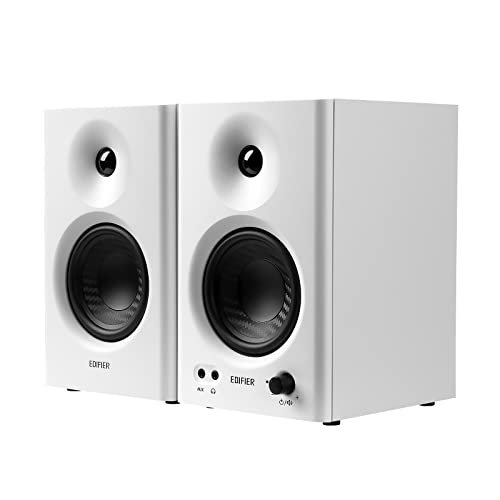
Designed with artists and music creators in mind, the Edifier MR4 Powered Studio Monitor Speakers deliver exceptional sound quality at an affordable price. Featuring 1-inch silk dome tweeters and 4-inch composite woofers, these monitors guarantee clear, smooth sound reproduction. The MDF wooden structure minimizes resonance, enhancing audio fidelity. With versatile connectivity options, including balanced TRS and unbalanced RCA inputs, you can easily connect to mixers, computers, or tablets. The dual mode functionality allows you to switch between monitor mode for precise audio during production and music mode for casual listening. Plus, user-friendly controls let you adjust high and low frequencies effortlessly.
Best For: Artists, music creators, and casual listeners seeking high-quality sound reproduction at an affordable price.
Pros:
- Clear and smooth sound due to 1-inch silk dome tweeters and 4-inch composite woofers.
- Versatile connectivity options including balanced TRS, unbalanced RCA, and AUX inputs.
- User-friendly controls for easy adjustment of high and low frequencies.
Cons:
- Limited low-end response due to the smaller woofer size compared to larger studio monitors.
- Potential for resonance if not placed on a proper surface despite MDF construction.
- No Bluetooth connectivity for wireless audio streaming.
Yamaha HS3 Powered Studio Monitor in Black, Pair (HS3 B)

Yamaha HS3 Powered Studio Monitors stand out as an excellent choice for budding producers and home studio enthusiasts due to their impressive sound accuracy and compact design. These 2-way bass-reflex speakers feature a 3.5-inch woofer and a 0.75-inch tweeter, delivering a frequency response from 70 Hz to 22 kHz. With an output power of 26 W, you’ll enjoy clear and balanced sound. The room control and high trim response controls let you tailor the audio to your environment. Plus, with included accessories like speaker cables and anti-slip pads, setting up is a breeze. Experience professional sound without breaking the bank!
Best For: Budding producers and home studio enthusiasts seeking accurate sound reproduction in a compact design.
Pros:
- Excellent sound accuracy ensures true audio representation for mixing and producing.
- Compact design makes them ideal for smaller spaces or home studios.
- Customizable audio settings with room control and high trim response controls.
Cons:
- Limited bass response due to the small 3.5-inch woofer size.
- Output power of 26 W may not be sufficient for larger studio spaces or louder environments.
- Not suitable for larger studio setups where more powerful monitors are required.
Mackie CR3.5 Powered Studio Monitors

If you’re in the market for budget-friendly studio monitors that deliver impressive sound quality, the Mackie CR3.5 powered studio monitors are an excellent choice. Featuring 3.5″ drivers, they excel in music production, gaming, and HiFi listening. You’ll appreciate the versatile connectivity options with TRS, RCA, and 3.5 mm inputs, along with a handy headphone output. The tone control knob lets you customize sound, allowing you to boost bass and enhance highs. Plus, with a location switch for desktop and bookshelf modes, you can optimize your listening experience wherever you are. For deeper bass, connect them to the CR8SBT subwoofer.
Best For: Those seeking budget-friendly studio monitors that offer excellent sound quality for music production, gaming, and HiFi listening.
Pros:
- Versatile connectivity options with TRS, RCA, and 3.5 mm inputs.
- Customizable sound with a tone control knob for adjusting bass and treble.
- Convenient location switch for optimizing performance in desktop or bookshelf settings.
Cons:
- Limited low-end performance without an additional subwoofer.
- 3.5″ drivers may not provide sufficient volume for larger spaces.
- May lack some advanced features found in higher-end studio monitors.
Edifier MR3 Powered Studio Monitor Speakers

The Edifier MR3 Powered Studio Monitor Speakers are an excellent choice for aspiring audio creators and enthusiasts looking for high-quality sound without breaking the bank. With Hi-Res Audio certification and a flat response from 52Hz to 40kHz, you’ll achieve precise monitoring and music creation. Multiple connectivity options, including Bluetooth V5.4, let you connect various devices simultaneously. Enjoy 18W RMS output with rich sound thanks to the 3.5-inch mid-low drivers and tweeter. Plus, you can customize your listening experience in Music, Monitor, and Custom modes through the EDIFIER ConneX app, making these monitors perfect for any audio project.
Best For: The Edifier MR3 Powered Studio Monitor Speakers are best for aspiring audio creators, musicians, and enthusiasts seeking high-quality sound for various audio projects.
Pros:
- Hi-Res Audio certified for precise sound quality.
- Multiple connectivity options including Bluetooth V5.4 for simultaneous device connections.
- Customizable sound modes through the EDIFIER ConneX app for a tailored listening experience.
Cons:
- May not provide the same output power as higher-end studio monitors.
- MDF cabinet design might not appeal to all aesthetic preferences.
- Limited to specific sound modes, which may not suit every listener’s taste.
Edifier R1280T Powered Bookshelf Speakers
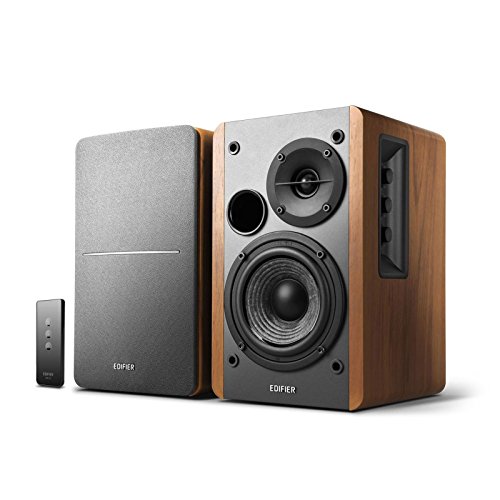
For those seeking an affordable yet high-quality audio solution, the Edifier R1280T Powered Bookshelf Speakers stand out as a top choice in the budget studio monitor category. With 42 watts RMS power, these speakers deliver studio-quality sound through a 13mm silk dome tweeter and a 4-inch full-range unit. You’ll appreciate the dual AUX inputs, allowing you to connect multiple devices simultaneously. Plus, the remote control and side panel options let you easily adjust volume and EQ settings. The classic wood finish adds a touch of elegance, making them a perfect fit for any home decor.
Best For: Those looking for an affordable and stylish audio solution that delivers studio-quality sound for home use.
Pros:
- Studio-quality sound reproduction with a silk dome tweeter and full-range unit.
- Dual AUX inputs allow for simultaneous connection of multiple devices.
- Remote control and side panel adjustments for convenient volume and EQ control.
Cons:
- Limited to wired connections with no Bluetooth or wireless options available.
- Bass response may not satisfy those looking for heavy low-end performance.
- Larger size may not be suitable for very small spaces or minimalistic setups.
YAMAHA Hs5 Powered Studio Monitor, Pair

Looking for studio monitors that deliver exceptional sound quality without breaking the bank? The Yamaha HS5 Powered Studio Monitor pair is an excellent choice. With a 2-way bass reflex design, these monitors feature a 5-inch cone woofer and a 1-inch dome tweeter, ensuring crisp highs and deep lows. You’ll appreciate their frequency response from 54 Hz to 30 kHz and a total power amplification of 70 watts. The HS5 emphasizes sonic purity, providing an accurate representation of your audio without coloration. Plus, with both XLR and TRS inputs, they easily connect to your gear, making them perfect for any studio setup.
Best For: Audio professionals and enthusiasts seeking high-quality, reliable studio monitors for accurate sound reproduction.
Pros:
- Emphasizes sonic purity with no coloration or alteration of sound.
- Wide frequency response from 54 Hz to 30 kHz for a balanced audio experience.
- Versatile input options with both XLR and TRS connections for easy integration into any studio setup.
Cons:
- Limited low-end response compared to larger models, which may not satisfy bass-heavy applications.
- May require additional acoustic treatment in smaller rooms to optimize sound quality.
- Higher price point compared to entry-level studio monitors, which could be a barrier for beginners.
PreSonus Eris E4.5-2-Way 4.5″ Near Field Studio Monitor (Pair)

Ideal for music lovers, content creators, and gamers, the PreSonus Eris E4.5 studio monitors deliver premium sound quality without breaking the bank. With a 4.5-inch woven-composite low-frequency transducer and a 1-inch silk-dome high-frequency transducer, you’ll enjoy balanced and clear audio. The monitors feature high- and low-frequency controls for precise tuning, ensuring the sound fits your space perfectly. Their 50-watt Class AB amplification provides plenty of volume for near-field monitoring, while the rear-firing bass-reflex port enhances bass response. Plus, you get valuable software like Studio One Prime, giving you everything you need for music production right out of the box.
Best For: Music lovers, content creators, and gamers seeking affordable studio-quality sound for home environments.
Pros:
- High-quality sound with a balanced audio profile thanks to the woven-composite low-frequency transducer and silk-dome high-frequency transducer.
- Customizable sound with high- and low-frequency controls for tailored audio response.
- Includes valuable software like Studio One Prime and Studio Magic plug-in suite, enhancing music production capabilities at no extra cost.
Cons:
- Limited low-end response due to the 4.5-inch low-frequency transducer, which may not satisfy bass-heavy preferences.
- Rear-firing bass-reflex port may require careful placement to avoid sound distortion in certain setups.
- 50-watt amplification may not be sufficient for larger rooms or high-volume requirements.
Edifier R1280Ts Powered Bookshelf Speakers
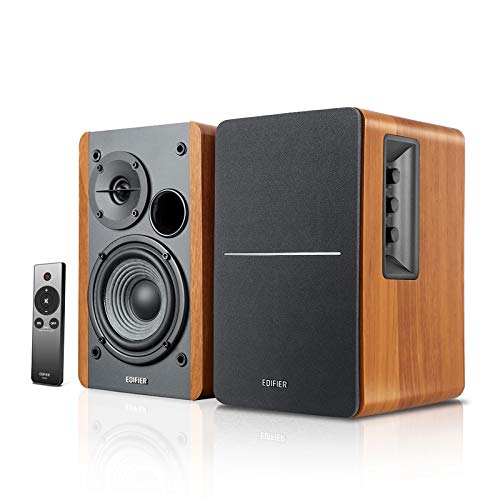
The Edifier R1280Ts Powered Bookshelf Speakers stand out as an excellent choice for anyone seeking budget-friendly studio monitors without sacrificing sound quality. With a power output of 42 Watts RMS, these speakers deliver crisp audio thanks to their 4-inch sub-woofer and 13mm silk dome tweeter. You’ll appreciate the dual RCA inputs, allowing you to connect two devices at once. The updated remote control makes adjusting volume and muting effortless, while side panel knobs let you fine-tune bass and treble to your liking. Enhanced listening is just a button away with the Soundfield Spatializer feature, providing a personalized experience.
Best For: Those seeking affordable studio monitors that combine high-quality sound with versatile connectivity options.
Pros:
- High-quality sound with 42 Watts RMS power and a well-balanced audio profile from the sub-woofer and tweeter.
- Dual RCA inputs allow simultaneous connection of two devices, increasing versatility for users.
- User-friendly controls including a remote for volume adjustments and side panel knobs for personalized EQ settings.
Cons:
- Limited bass performance compared to larger speakers or dedicated subwoofers, which may not satisfy bass enthusiasts.
- Wooden enclosure may not appeal to all aesthetics or fit seamlessly with modern decor.
- Lack of Bluetooth connectivity, limiting wireless use with modern devices.
Factors to Consider When Choosing Budget Studio Monitors
When choosing budget studio monitors, you need to contemplate several key factors. Audio quality, connectivity options, size, and customization features all play a crucial role in your decision. Plus, staying within your budget is important to guarantee you get the best value for your money.
Audio Quality Importance
Choosing budget studio monitors requires careful consideration of audio quality, as it plays a significant role in how accurately you can mix and master your music. Look for monitors with a flat frequency response; this guarantees all audio frequencies are reproduced evenly, allowing you to evaluate sound without coloration. Quality drivers, like silk dome tweeters and composite woofers, enhance clarity in both high and low frequencies, contributing to a balanced sound profile. High power amplification, such as Class AB, provides headroom and volume without distortion, keeping audio clear at various listening levels. Additionally, customization features like tuning controls let you adjust sound output to fit your acoustic environment and personal preference, further improving audio quality.
Connectivity Options Available
Several factors come into play regarding connectivity options for budget studio monitors. First, look for monitors with multiple input types, such as balanced TRS for professional gear, unbalanced RCA for consumer devices, and AUX for versatile compatibility. Having a front-panel headphone output is essential for convenient monitoring without disconnecting other gear. Consider models with Bluetooth technology for easy wireless connectivity with your smartphone or tablet. Dual inputs allow you to connect multiple devices simultaneously, making shifts seamless. Additionally, some monitors feature subwoofer outputs, enhancing low-frequency response when paired with an external subwoofer. By evaluating these connectivity options, you’ll guarantee your monitors meet your audio needs and provide flexibility for your setup.
Size and Placement
Finding the right size and placement for your budget studio monitors is essential for achieving the best sound quality in your workspace. If you have a compact area, consider smaller monitors (around 3 to 5 inches). For larger setups, go for monitors that are 5 inches and above. Position your monitors at ear level and equidistant from your listening spot to enhance stereo imaging and sound accuracy. Near-field monitors, typically placed 3 to 5 feet away, work well in small studios. Keep in mind the enclosure design; front-ported models allow for more flexible placement near walls, while rear-ported ones need extra space for air circulation. Finally, don’t forget to treat your room acoustics to minimize unwanted reflections.
Customization Features Offered
When you’re selecting budget studio monitors, considering the customization features can greatly enhance your listening experience. Look for high- and low-frequency tuning controls that let you adjust the audio output to match your personal preferences or room acoustics. Some monitors even offer dual modes, allowing you to switch between monitor mode for precise audio during production and music mode for casual listening. Check for models that provide separate tone controls for bass and treble, helping you tailor the sound to your needs. Additionally, accessible front-panel headphone outputs and volume controls make it easy to manage sound quickly. Advanced models might even integrate software for personalized EQ control, giving you the ultimate flexibility in fine-tuning your sound profile.
Budget Considerations
Choosing the right budget for studio monitors is essential, especially since it directly impacts your sound quality and overall experience. For entry-level models, aim to allocate between $100 and $300, which typically offers decent audio quality for home studios. If you’re serious about music production, consider spending between $300 and $800 for higher-quality monitors that provide enhanced sound fidelity and better build quality. Don’t forget additional costs like stands, cables, or even a subwoofer, which can inflate your budget. Also, consider the need for soundproofing or acoustic treatment in your workspace, as this affects monitor effectiveness. Finally, assess your intended use—whether for casual listening or professional work—to determine the right type and budget for your monitors.
