Choosing among the best digital mixing consoles for broadcast depends on more than channel count. You need dependable routing, clean preamps, practical monitoring, and controls that make live production easier.
This roundup compares 10 options ranging from compact Bluetooth-equipped mixers to full-featured consoles designed for demanding studio, stage, and broadcast workflows.
Best 10 Digital Mixing Consoles for Broadcast Picks for 2026
Best Hands-On Control

- 16 channels with 10 digital mic preamps
- Touch faders and 7-inch display
- USB, Bluetooth, app control, and scene recall
Best For: Small broadcast, livestream, and mobile production setups
Best All-in-One Voice Production

- Four XLR inputs with APHEX voice processing
- Standalone multitrack recording
- Eight programmable SMART pads
Best For: Podcasts, interviews, streaming, and voice-focused broadcasts
Best High-Channel-Count Routing

- 48 channels and 36 buses
- 96kHz processing with under 0.7ms latency
- 64-channel I/O and 32x32 USB interface
Best For: Large broadcast, live production, and expandable recording systems
Best Budget Effects Variety
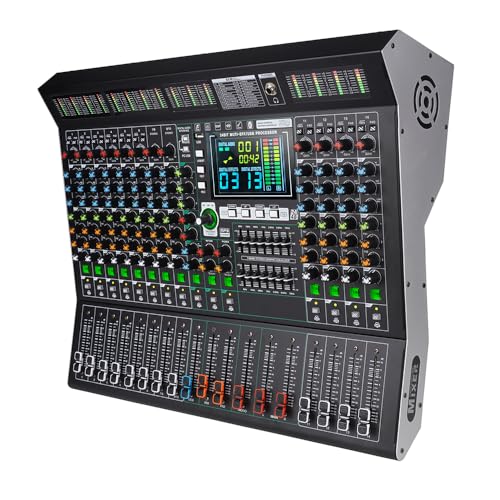
- 14 channels with LED parameter display
- 99 built-in DSP effects
- Bluetooth, USB, 9-band EQ, and 48V power
Best For: Budget-conscious small live, studio, DJ, and broadcast setups
Compact Analog Pick
6-Channel Bluetooth Audio Mixer

- Four XLR inputs with switchable 48V phantom power
- Bluetooth, USB, and U-disk playback support
- 3-band EQ and 16 built-in DSP effects
Best For: Small streaming, karaoke, live, and recording setups
Effects-Focused Choice
12-Channel Bluetooth Studio Mixer

- Twelve inputs for expanded source connectivity
- 99 DSP effects with reverb and delay options
- Bluetooth, USB, U-disk playback, and 48V phantom power
Best For: DJs, live performers, karaoke, and larger beginner setups
Recording-Friendly Option

- USB recording with LCD feedback and built-in MP3 player
- Bluetooth playback and MP3/WAV/WMA file support
- 48V phantom power, balanced inputs, and 3-band EQ
Best For: Podcasting, small events, karaoke, and compatible USB recording setups
Best for Flexible Inputs

- 16 channels with individual EQ, gain, and mute controls
- Bluetooth, USB playback, and 99 built-in DSP effects
- 48V phantom power plus 7-band master EQ
Best For: Larger live, studio, karaoke, and small-venue mixes
Best for Recording Features
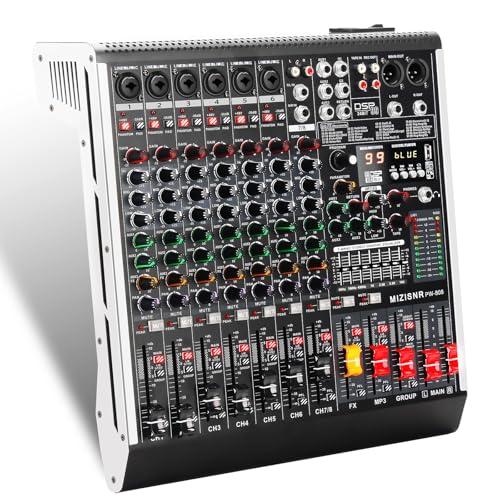
- USB playback and computer recording support
- 99 DSP effects with 7-band main-output EQ
- Independent 48V power, PAD, and channel mute controls
Best For: Smaller recording, podcasting, DJ, and live setups
Best for Slim Setups
FULUODE CT-80S 8-Channel Mixer

- Ultra-thin design for easier placement and storage
- Bluetooth 5.0, MP3/USB input, and USB recording
- Reverb, LED display, and 48V phantom power
Best For: Compact karaoke, conference, studio, and live-music systems
Best Hands-On Control – Alto TMD16
The Alto TMD16 is a practical entry point for digital mixing consoles for broadcast when tactile operation matters. Its 16-channel layout, 100mm touch faders, built-in processing, USB recording, and Bluetooth connectivity suit small productions, livestreams, events, and rehearsal spaces.
Best For: Small broadcast and livestream setups that prefer physical controls over tablet-only mixing.
Pros:
- 16 channels with 10 digital mic preamps and flexible inputs.
- 100mm capacitive faders, dedicated encoders, and a 7-inch display provide hands-on control.
- Built-in EQ, compression, 16-preset effects, USB, Bluetooth, and app control reduce the need for extra gear.
- Scene recall, four aux sends, four subgroups, and XLR main outputs support repeatable setups.
Cons:
- Its 16-channel capacity is less suited to larger broadcast productions.
- The supplied warranty is one year.
The TMD16 balances familiar physical mixing with modern connectivity. It is most compelling for compact, mobile workflows rather than high-channel-count broadcast facilities.
Best All-in-One Voice Production – RØDECaster Pro II
The RØDECaster Pro II is a compact choice among digital mixing consoles for broadcast, especially for podcasts, streaming, and spoken-word production. It combines four XLR mic inputs, APHEX voice processing, multitrack recording, headphone outputs, and programmable sound pads in one standalone desk unit.
Best For: Podcasts, interviews, livestreams, and voice-focused broadcast workflows.
Pros:
- Four studio preamps and APHEX processing can make voices broadcast-ready with preset-based control.
- Records multitrack audio to a computer, microSD card, or USB drive.
- Eight customizable SMART pads trigger music, effects, and mix-minus phone calls live.
- Bluetooth, USB, and Wi-Fi connectivity support flexible production setups.
Cons:
- Four XLR inputs and nine channels limit its fit for larger multi-microphone productions.
- It is optimized for voice production rather than broad live-sound routing.
For broadcast creators who value speed and integrated voice tools, the RØDECaster Pro II offers a focused, computer-optional workflow. Larger productions may need the expanded routing and input capacity of a full live console.
Best High-Channel-Count Routing – Allen & Heath SQ-5
The Allen & Heath SQ-5 is built for demanding digital mixing consoles for broadcast applications where channel count, routing, and low latency are priorities. It provides 48 input channels, 36 buses, 16 onboard preamps, 96kHz FPGA processing, and extensive expansion options for live sound, recording, and broadcast work.
Best For: Larger broadcast, live production, and recording systems requiring extensive routing and expansion.
Pros:
- 48 input channels and 36 buses provide substantial mixing and routing capacity.
- 96kHz XCVI processing delivers stated latency below 0.7ms.
- Includes 12 stereo mixes, LR output, three stereo matrix outputs, and eight stereo FX engines.
- Offers a 64-channel I/O port, 32×32 USB audio interface, and support for remote expanders.
Cons:
- Its 23.1-pound chassis is less convenient for highly mobile setups.
- The greater routing and processing depth may be more than a small broadcast workflow needs.
The SQ-5 is the strongest fit here for channel-heavy, expandable systems. Its connectivity and bus structure make it better suited to complex productions than compact podcast or small-event mixers.
Best Budget Effects Variety – MD-14 Professional Mixer
The MD-14 offers a straightforward option among digital mixing consoles for broadcast when built-in effects and flexible playback are priorities. Its 14 channels, 99 DSP effects, Bluetooth, USB audio playback, 9-band EQ, noise reduction, and 48V phantom power support stage, studio, DJ, and smaller live-production use.
Best For: Budget-conscious live, studio, DJ, and basic broadcast setups needing plentiful onboard effects.
Pros:
- Fourteen independent channels include individual controls and a large LED display.
- Offers 99 DSP effects, including reverbs, delays, choruses, flangers, and pitch-shifting effects.
- Bluetooth playback and USB lossless audio support simplify music playback.
- Includes noise reduction, a 9-band EQ, and 48V phantom power.
Cons:
- Its 14-channel configuration is less capable for larger broadcast systems.
- The 30-day return and exchange policy is shorter than the warranties listed for the other products.
- Supplied notes do not specify multitrack recording or advanced broadcast networking.
The MD-14 prioritizes accessible controls and a broad effects palette over advanced networking. It can suit smaller productions, but buyers needing established expansion or multitrack broadcast workflows should look to a more specialized console.
Compact Analog Pick – 6-Channel Bluetooth Audio Mixer
For shoppers comparing digital mixing consoles for broadcast, this compact 6-channel mixer is a practical option when straightforward analog control, wireless playback, and basic recording connectivity matter. It combines four XLR inputs, 48V phantom power, USB functionality, Bluetooth, 3-band EQ, and built-in DSP effects.
Best For: Small streaming, karaoke, live-performance, and recording setups needing flexible input connections and simple hands-on controls.
Pros:
- Four XLR inputs support microphones and 48V phantom power.
- Bluetooth and USB support provide convenient playback and mixing options.
- Includes 3-band EQ, independent faders, and 16 built-in DSP effects.
Cons:
- It is a traditional analog mixer rather than a fully networked broadcast console.
- The listed warranty is limited to 90 days.
- The six-channel layout may be restrictive for larger productions.
This model makes the most sense for buyers who value accessible physical controls and versatile connectivity over advanced broadcast routing or software integration.
Effects-Focused Choice – 12-Channel Bluetooth Studio Mixer
Among digital mixing consoles for broadcast, this 12-channel mixer stands out for its larger input count and extensive built-in effects. It supports XLR and 1/4-inch connections, 48V phantom power, Bluetooth playback, USB MP3 functionality, individual 3-band EQ, and a 7-band master EQ.
Best For: DJs, live performers, karaoke hosts, and beginners who need more inputs and a broad selection of onboard reverb and delay effects.
Pros:
- Twelve channels accommodate more microphones, instruments, and line-level sources.
- Offers 99 DSP effects plus reverb and delay options.
- Provides Bluetooth, USB, U-disk playback, 48V phantom power, and multiple input types.
Cons:
- The supplied specifications do not identify software-update support.
- Its 6.46 kg weight makes it less portable than smaller mixers.
- The product is described as an analog mixer, so it may not provide advanced digital broadcast workflow features.
Choose this model when channel capacity and built-in processing are higher priorities than compact size or sophisticated network-based control.
Recording-Friendly Option – 8-Channel USB Audio Mixer
For buyers evaluating digital mixing consoles for broadcast, this 8-channel mixer offers a useful blend of physical mixing, wireless playback, and USB recording features. It includes Bluetooth, an MP3/U-disk player and recorder, 3-band EQ, balanced inputs, 48V phantom power, and an LCD for playback and recording feedback.
Best For: Podcasting, karaoke, conferences, small live events, and recording setups using Windows-compatible USB workflows.
Pros:
- Supports Bluetooth playback and MP3, WAV, and WMA files through its built-in player.
- Includes USB recording functionality and high-definition LCD feedback.
- Provides balanced line inputs, gold-plated XLRs, 3-band EQ, and 48V phantom power.
- Backed by a stated two-year warranty.
Cons:
- The supplied notes state that it cannot connect to a MacBook for recording.
- Its eight-channel capacity may not suit complex broadcast productions.
- It is designed for 110V power and includes a standard US plug.
This is a strong fit for users who want integrated playback and recording tools, provided their computer and power setup match the stated compatibility limitations.
Best for Flexible Inputs – 16-Channel Digital Mixer
For buyers comparing digital mixing consoles for broadcast, this 16-channel board offers substantial input capacity plus practical playback and effects features. Bluetooth, USB, 48V phantom power, channel muting, and a 7-band master EQ make it adaptable for studio work, live production, karaoke, and small performance setups.
Best For: Users who need 16 channels and flexible wired or wireless audio sources for live, studio, or small-venue mixing.
Pros:
- Provides 16 channels with independent gain, 3-band EQ, and mute controls.
- Includes Bluetooth streaming, U-disk playback, and a digital display player.
- Offers 99 DSP effects and 48V phantom power for compatible microphones.
- Features a 7-band graphic EQ in the master section.
Cons:
- Its 18.9-inch width and 8.26 kg weight may be more than compact setups require.
- The supplied notes do not confirm software-update support.
This is the most capable option here when channel count and input flexibility matter. It is a practical choice for larger mixes, though buyers prioritizing portability may prefer a smaller console.
Best for Recording Features – 8-Channel USB Mixer
For digital mixing consoles for broadcast and content workflows, this 8-channel model emphasizes connectivity and recording convenience. It combines Bluetooth, USB playback and recording, 99 DSP effects, independent 48V phantom power, and a 7-band main-output EQ in a compact channel format.
Best For: Musicians, podcasters, and creators who want an 8-channel mixer with computer recording, MP3 playback, and broad connection support.
Pros:
- Supports USB computer recording and sound editing, plus MP3, WAV, and WMA playback.
- Provides independent gain, EQ, AUX, PAN, and mute controls on each channel.
- Includes 99 DSP effects and a 7-band EQ for the main output.
- Offers Bluetooth, USB, XLR, TRS, microphone, instrument, and headphone compatibility.
Cons:
- With eight channels, it offers less input capacity than the 16-channel alternative.
- The supplied dimensions are incomplete, so size comparisons are limited.
This model stands out when direct computer connectivity and built-in recording are priorities. Its eight-channel layout suits smaller productions, while the PAD switch and independent phantom-power control add useful input flexibility.
Best for Slim Setups – FULUODE CT-80S 8-Channel Mixer
Among digital mixing consoles for broadcast, the FULUODE CT-80S is a straightforward 8-channel option with an unusually slim 1.57-inch design. It includes Bluetooth 5.0, MP3/USB input, USB recording, reverb, 48V phantom power, and an LED display for home KTV, conferences, campus activities, and live music.
Best For: Buyers seeking a thin, lighter 8-channel mixer for karaoke, basic live music, studio, or conference applications.
Pros:
- Uses an ultra-thin design measuring approximately 1.57 inches thick.
- Includes Bluetooth 5.0, MP3/USB input, USB recording, and song-name display.
- Supports wired, wireless, and condenser microphones plus instruments.
- Provides 48V phantom power and reverb for vocal and live-use applications.
Cons:
- It has eight channels and fewer documented tone-shaping details than the other options.
- The supplied notes identify USB as the output connector, which may limit some system connections.
- The listed 110V American-plug configuration may require consideration for other regions.
The CT-80S is appealing when low-profile storage and basic playback features matter more than extensive control options. Its feature set is well matched to casual performance, karaoke, and compact event systems.
How We Picked the Best Digital Mixing Consoles for Broadcast
We focused on the features that have the greatest effect on real-world broadcast work: input capacity, microphone preamp support, phantom power, signal processing, USB connectivity, monitoring, physical controls, and workflow flexibility. We also considered whether each mixer suits a specific use case, such as podcasting, streaming, live events, recording, or multi-microphone production.
Not every mixer in this category offers the same level of routing or automation. Compact models may provide excellent basic connectivity at a lower cost, while advanced consoles offer deeper bus architecture, more precise control, and better expansion potential.
Quick Comparison
| Best For | What to Prioritize | Most Suitable Type |
|---|---|---|
| Solo podcasting and streaming | USB connectivity, headphone monitoring, easy controls | Compact all-in-one production mixer |
| Small broadcast studio | Several mic inputs, phantom power, EQ, effects | 8- to 12-channel digital mixer |
| Panel discussions and live events | Higher channel count, reliable routing, multiple outputs | 14- to 16-channel console |
| Professional live production | Scene recall, buses, expandability, detailed processing | Advanced digital mixing system |
Key Buying Factors for Digital Mixing Consoles for Broadcast
Inputs, Buses, and Routing
Count the microphones, playback sources, phone feeds, instruments, and backup channels you expect to use simultaneously. Leave room for growth. Bus and aux outputs matter when you need separate mixes for talent headphones, monitors, recording, or a remote feed.
Audio Quality and Processing
Look for clean preamps, useful EQ, compression, gating, and reverb. Built-in DSP can reduce the need for external equipment, but the number of advertised effects matters less than how easily they can be applied and adjusted during a live show.
Computer and Device Connectivity
USB audio is valuable for recording, playback, conferencing, and streaming. Bluetooth can be convenient for music or call audio, but it should supplement—not replace—reliable wired connections. Confirm the mixer’s USB channel behavior and compatibility with your computer or production software.
Control and Reliability
Physical faders are useful when you must make fast adjustments, while app or touchscreen control can simplify complex routing. For broadcast use, prioritize clear metering, dependable monitoring, scene or preset recall, and a layout that operators can learn quickly.
Who Should Buy Which Digital Mixing Consoles for Broadcast?
Choose a compact all-in-one production studio if you mainly create podcasts, streams, interviews, or voice-led shows and want an accessible workflow. An 8- or 12-channel model is a better fit for small studios that need several microphones, basic effects, Bluetooth playback, and USB recording.
Move to a 14- or 16-channel mixer when you regularly handle panels, multiple performers, playback devices, or separate monitor mixes. For larger productions and professional live broadcast environments, prioritize a console with robust buses, deeper processing, scene management, and expansion options over a low purchase price.
Before buying, verify the actual input types, USB routing, output configuration, power requirements, and software support. The best Digital Mixing Consoles for Broadcast are the ones that match your production scale while leaving enough headroom for future channels and more complex shows.
