Indoor air can change quickly with cooking, cleaning, poor ventilation, and occupancy. The best high-accuracy smart air quality monitors make those changes easier to see by tracking key pollutants and environmental conditions in real time.
We compare 10 options ranging from simple Alexa-compatible monitors to detailed multi-parameter displays and Home Assistant-ready systems, so you can choose the right balance of accuracy, visibility, connectivity, and price.
Best 10 High-Accuracy Smart Air Quality Monitors Picks for 2026
Most Comprehensive
16-in-1 Smart Air Quality Monitor

- Measures particles, gases, temperature, and humidity
- Refreshes readings every 1.5 seconds
- Portable with USB-C charging
Best For: Broad, portable indoor air testing
Best for CO2 Tracking
GoveeLife Smart Air Quality Monitor

- CO2 accuracy rated at ±(40 ppm + 5%)
- Includes app, buzzer, and email alerts
- Tracks up to two years of history
Best For: Continuous CO2 monitoring in connected homes
Best Connected Multi-Sensor

- Monitors CO2, particles, VOCs, and formaldehyde
- Includes 90-day history and CSV export
- Supports alerts and six-hour portable use
Best For: Trend analysis and broad connected monitoring
Best Alexa Integration
Amazon Smart Air Quality Monitor

- Measures five key indoor air factors
- Provides Alexa app scores and notifications
- Supports routines for compatible devices
Best For: Simple air monitoring in Alexa-enabled homes
Most Comprehensive Portable Monitor
16-in-1 High-Precision Air Quality Monitor
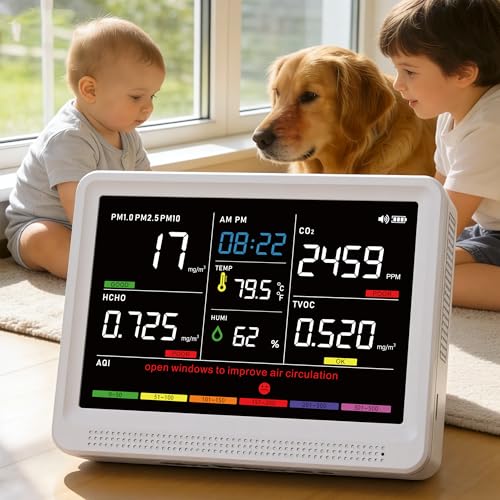
- Measures CO2, particles, HCHO, TVOC, temperature, humidity, and AQI
- 5.5-inch HD display with seven AQI alert functions
- Portable design with USB-C charging and up to 10 hours of runtime
Best For: Portable, all-in-one monitoring across multiple indoor environments
Best Connected PM2.5 Monitor
GoveeLife Smart Air Quality Monitor H5106

- Two-second refreshes for PM2.5, temperature, and humidity
- Wi-Fi/Bluetooth access with graphs and long-term data export
- Automates compatible GoveeHome appliances as air quality changes
Best For: Connected PM2.5 tracking and Govee smart-home automation
Best Open-Source Precision Monitor
AirGradient ONE Indoor Air Quality Monitor
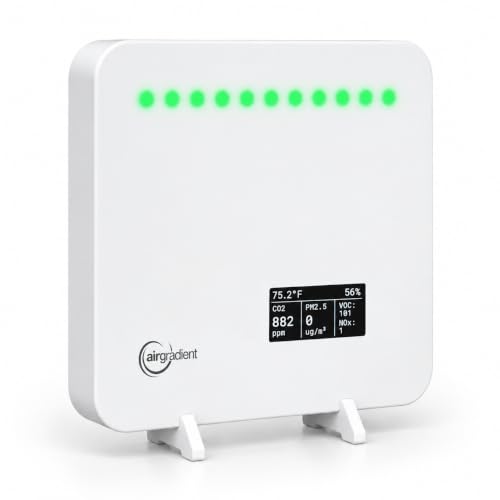
- Measures PM2.5, CO2, TVOCs, NOx, temperature, and humidity
- Calibrated PM2.5 monitoring with a digital test report
- Open-source, subscription-free, and compatible with Home Assistant
Best For: Technical users seeking multi-pollutant monitoring and local integrations
Most Portable
10-in-1 Real-Time Air Quality Monitor

- Tracks 10 air-quality and environmental measurements.
- Processes readings every 1.2 seconds with color-coded levels.
- Runs up to 96 hours on its rechargeable battery.
Best For: Portable, no-app monitoring across rooms, cars, and offices
Best Large Display

- Covers 16 indoor air and environmental measurements.
- Shows data on a large 7-inch full-view display.
- Includes calibration support, adjustable brightness, and alerts.
Best For: Bedrooms and offices needing highly visible readings
Best Connected Controls

- Measures gases, particles, AQI, temperature, and humidity.
- Uses smart calibration and dedicated CO2, HCHO, and TVOC sensors.
- Adds Bluetooth time calibration and three-color visual alerts.
Best For: Portable monitoring with calibration-focused controls
Most Comprehensive – 16-in-1 Smart Air Quality Monitor
For shoppers seeking high-accuracy smart air quality monitors with broad coverage, this 16-in-1 tester tracks particulate matter, gases, temperature, and humidity in one portable unit. Its color screen and frequent 1.5-second sampling make it practical for checking rooms, offices, cars, and other indoor spaces.
Best For: Buyers who want the widest range of readings and a portable monitor for multiple locations.
Pros:
- Tracks PM1.0, PM2.5, PM10, CO2, TVOC, HCHO, temperature, and humidity.
- Updates readings every 1.5 seconds on a clear HD color display.
- Portable design supports use at home, in offices, cars, and bedrooms.
- Includes USB-C charging cable, AC adapter, and 12-month quality support.
Cons:
- Battery life is limited to approximately 4–5 hours per charge.
- The supplied notes do not indicate app connectivity or historical data storage.
This is a strong fit when measurement variety matters more than smart-home integration. It offers broad, at-a-glance monitoring in a compact package, though users wanting long-term app charts may prefer a connected model.
Best for CO2 Tracking – GoveeLife Smart Air Quality Monitor
Among high-accuracy smart air quality monitors, the GoveeLife H5140 stands out for its dedicated CO2 focus and connected alert system. Its SCD4x sensor provides stated accuracy of ±(40 ppm + 5%), while the app adds remote notifications, historical charts, and data export.
Best For: Bedrooms, nurseries, offices, and smart homes where continuous CO2 monitoring and alerts are priorities.
Pros:
- Uses an SCD4x CO2 sensor with a 5-second refresh rate and pressure compensation.
- Displays CO2, temperature, humidity, and a clock.
- Offers buzzer, app, and email alerts with customizable thresholds.
- Stores up to two years of app history and supports CSV export.
Cons:
- Requires standard AC power for continuous monitoring rather than battery operation.
- It focuses on CO2, temperature, and humidity rather than particulate or VOC measurements.
- The clock requires app connection.
The H5140 is a practical choice for users who want dependable, always-on CO2 visibility and smart-home connectivity. It is less suitable for shoppers seeking a full-spectrum particle and chemical pollutant monitor.
Best Connected Multi-Sensor – BREATHE Airmonitor Plus Gen 2
The BREATHE Airmonitor Plus Gen 2 combines high-accuracy smart air quality monitoring with app-based history and export tools. It measures CO2, particle sizes, TVOC, formaldehyde, temperature, and humidity, making it useful for identifying how cooking, cleaning, occupancy, and ventilation affect indoor air.
Best For: Users who want detailed pollutant coverage, remote readings, alerts, and trend analysis.
Pros:
- Provides eight readings, including CO2, PM1, PM2.5, PM10, TVOC, HCHO, temperature, and humidity.
- Combines NDIR CO2 measurement with laser particle sensing and dedicated VOC and formaldehyde detection.
- Offers 2.4 GHz Wi-Fi, remote readings, alerts, 90-day history, and CSV export.
- Provides up to six hours of portable use and can run from USB-C power.
Cons:
- App pairing requires a 2.4 GHz Wi-Fi connection.
- App history is limited to 90 days, less than some dedicated always-on monitors.
- Portable battery operation lasts up to six hours.
This model offers one of the most balanced feature sets in the group, pairing broad sensor coverage with useful digital records. It is especially appealing for buyers who want to investigate patterns rather than simply view a current reading.
Best Alexa Integration – Amazon Smart Air Quality Monitor
For households already using Alexa, this smart air quality monitor offers a straightforward way to track five indoor factors without a complicated display. It measures PM2.5, VOCs, carbon monoxide, humidity, and temperature, then presents an air quality score and notifications through the Alexa app.
Best For: Alexa households seeking simple monitoring and automated responses from compatible smart-home devices.
Pros:
- Tracks PM2.5, VOCs, carbon monoxide, humidity, and temperature.
- Provides a color-coded LED and an easy-to-understand Alexa app score.
- Can send phone notifications or announcements through Echo devices.
- Alexa Routines can control compatible purifiers, dehumidifiers, and fans as air quality changes.
Cons:
- The supplied notes do not specify refresh rate, sensor accuracy, battery life, or display size.
- It relies on the Alexa app for the air quality score and notifications.
- It does not list CO2 measurement.
This is a convenient option for Alexa users who value simple readings and home automation over extensive onboard data. Shoppers needing CO2 readings, detailed history, or a wider sensor set should consider a more specialized monitor.
Most Comprehensive Portable Monitor – 16-in-1 High-Precision Air Quality Monitor
For shoppers comparing high-accuracy smart air quality monitors, this YNAK model emphasizes broad coverage and portability. It monitors CO2, particulate matter, HCHO, TVOC, temperature, humidity, and AQI on a large 5.5-inch HD display, with selectable alerts and up to 10 hours of runtime.
Best For: Households, offices, bedrooms, vehicles, and other indoor spaces where you want many readings on one portable screen.
Pros:
- Tracks nine key air-quality and environmental measurements, including CO2, PM1.0, PM2.5, PM10, HCHO, and TVOC.
- External sensors, enhanced airflow, and a stated 0.001-unit accuracy specification are designed for responsive readings.
- Large HD display, seven AQI alert functions, mute control, USB-C charging, and up to 10 hours of battery life.
Cons:
- Its many readings and alert functions may be more than needed for shoppers focused only on particulate matter.
- Sensor accuracy can be affected by touching the sensors or exposing them to perfumes and strong odors.
- It does not list app connectivity or smart-home integration in the supplied specifications.
This is a strong fit when display size, measurement breadth, and portability matter most. Its 12-month warranty and included adapter add practical value, while buyers seeking remote dashboards or automation should consider a connected alternative.
Best Connected PM2.5 Monitor – GoveeLife Smart Air Quality Monitor H5106
The GoveeLife H5106 is a focused option among high-accuracy smart air quality monitors, measuring PM2.5, temperature, and humidity with a two-second refresh. Its Wi-Fi and Bluetooth connectivity supports remote viewing, historical graphs, data export, and automation with compatible GoveeHome appliances.
Best For: Home users who primarily track PM2.5 and want app-based monitoring or Govee-compatible purifier, humidifier, and fan automation.
Pros:
- Lists PM2.5 accuracy of ±15 µg/m³ from 0 to 100 µg/m³, plus temperature accuracy of ±0.54°F and humidity accuracy of ±3%RH.
- Provides two-second data refreshes and a four-level LED air-quality indicator.
- Supports remote monitoring, 13-day online graphs, two-year data export, and GoveeHome device automation.
Cons:
- Measures only PM2.5, temperature, and humidity; it does not monitor CO2, VOCs, or formaldehyde.
- Requires a power source and has no built-in battery.
- Its Wi-Fi features require a 2.4G network, and it uses Type-C cables only.
This monitor makes the most sense for buyers already using GoveeHome products or those who value historical data and remote access. It is less suitable if you need a broad pollutant panel or a battery-powered device.
Best Open-Source Precision Monitor – AirGradient ONE Indoor Air Quality Monitor
The AirGradient ONE is a premium-minded choice among high-accuracy smart air quality monitors, combining multiple named sensor modules with open-source flexibility. It measures PM2.5, CO2, TVOCs, NOx, temperature, and humidity, while offering a subscription-free dashboard, API access, and Home Assistant support.
Best For: Home-automation users, technical buyers, offices, and classrooms that need multi-pollutant data with local-control and integration options.
Pros:
- Uses a SenseAir NDIR CO2 sensor, Plantower laser particle sensor, Sensirion TVOC/NOx sensor, and Sensirion temperature/humidity sensor.
- Individually calibrated for PM2.5, tested in an AirGradient chamber, and supplied with a digital test report.
- Offers a subscription-free dashboard, free API, open-source hardware and firmware, Home Assistant compatibility, and flexible wall or tabletop installation.
Cons:
- The 1.3-inch OLED display is considerably smaller than the display on some standalone monitors.
- Its advanced integrations and open-source approach may be more involved than necessary for simple at-a-glance monitoring.
- The supplied setup uses USB power rather than a built-in battery.
Choose the AirGradient ONE when sensor quality, transparency, and smart-home flexibility outweigh the need for a large screen or battery operation. Its broad pollutant coverage and tested, calibrated sensor package make it especially compelling for serious indoor-air tracking.
Most Portable – 10-in-1 Real-Time Air Quality Monitor
For shoppers comparing high-accuracy smart air quality monitors, this 10-in-1 model stands out for broad coverage and portable operation. It tracks PM0.3, PM2.5, PM10, CO2, CO, HCHO, TVOC, AQI, temperature, and humidity, with readings processed every 1.2 seconds.
Best For: Homes, offices, kitchens, vehicles, and users who want battery-powered monitoring without Wi-Fi, Bluetooth, or app setup.
Pros:
- Measures particles, gases, AQI, temperature, and humidity in one device.
- Uses a color-coded display and audible alerts for quick status checks.
- 2000mAh rechargeable battery provides up to 96 hours of continuous monitoring.
- USB-C charging and compact portability make it easy to move between rooms.
Cons:
- It does not offer Wi-Fi, Bluetooth, or app connectivity.
- The broad range of readings may be more than casual users need.
This is a practical choice when portability, fast updates, and comprehensive measurements matter more than connected smart-home features. Its CO measurement and PM0.3 tracking also give it unusually broad coverage for a compact monitor.
Best Large Display – 16-in-1 Air Quality Monitor
This 16-in-1 monitor is a strong option for buyers seeking high-accuracy smart air quality monitors with an easy-to-read screen. Its 7-inch full-view display shows CO2, PM1.0, PM2.5, PM10, HCHO, TVOC, temperature, humidity, AQI, and other readings at a glance.
Best For: Bedrooms, home offices, and shared indoor spaces where a large display and visible real-time alerts are priorities.
Pros:
- Monitors a wide range of air-quality and environmental conditions.
- Large 7-inch screen provides a clear overview of readings.
- Adjustable brightness supports daytime and nighttime viewing.
- Built-in calibration support and buzzer alerts help with ongoing monitoring.
Cons:
- Its 7-inch display makes it less compact than portable monitor designs.
- The manufacturer advises avoiding perfumes and strong odors around the sensors.
Choose this model if at-a-glance visibility is more important than a small footprint. Calibration support, adjustable brightness, and muteable alerts make it especially suited to stationary everyday use.
Best Connected Controls – Portable 10-in-1 CO2 Monitor
For shoppers who want high-accuracy smart air quality monitors with Bluetooth-based time setup, this portable 10-in-1 detector combines real-time readings with smart calibration features. It measures CO2, HCHO, TVOC, PM1.0, PM2.5, PM10, AQI, temperature, and humidity, while its color screen highlights changes visually.
Best For: Users monitoring bedrooms, offices, cars, schools, hotels, or other spaces who want portable measurement with Bluetooth time calibration and simple button controls.
Pros:
- Uses dedicated CO2 sensing and electrochemical sensors for HCHO and TVOC.
- Smart calibration is designed to support stable long-term readings.
- Three-color visualization makes changing air-quality conditions easier to spot.
- Compact design supports use in many indoor and vehicle environments.
Cons:
- Bluetooth is used for time calibration rather than described app-based monitoring.
- Several button presses control functions such as calibration and screen sleep.
This model fits buyers who value sensor-focused monitoring and a portable form factor. Its dedicated sensor descriptions and smart calibration are useful for ongoing checks, while the color display provides a quick visual summary.
How We Picked the Best High-Accuracy Smart Air Quality Monitors
We focused on monitors that measure more than temperature and humidity, giving particular weight to CO2, PM2.5, particulate matter, and VOC detection. We also considered sensor technology, display clarity, alarm features, app or smart-home support, portability, power requirements, and how useful the readings are for everyday decisions such as opening windows or running an air purifier.
Because specifications and performance can vary between models, treat stated accuracy as one factor rather than a guarantee. Placement, calibration, airflow, and maintenance can substantially affect readings.
Quick Comparison
- Best for Alexa households: Amazon Smart Air Quality Monitor.
- Best for detailed sensor coverage: A 16-in-1 monitor with a large display and broad pollutant tracking.
- Best for Home Assistant users: AirGradient ONE.
- Best for straightforward CO2 monitoring: GoveeLife H5140 or BREATHE Airmonitor Plus Gen 2.
- Best for portable use: A compact 10-in-1 or 16-in-1 rechargeable-style monitor, provided its power and calibration details meet your needs.
Key Buying Factors for High-Accuracy Smart Air Quality Monitors
Sensor Quality and the Pollutants Measured
CO2 is especially useful for evaluating ventilation, while PM2.5 matters for smoke, dust, and fine particles. TVOC and formaldehyde readings can provide additional warning about chemical pollution, but these measurements may be estimates or affected by household products. Look for NDIR CO2 sensing when dependable CO2 readings are a priority.
Display, Alerts, and Data Access
A large, always-on display is useful in living rooms, classrooms, and offices. App notifications and audible or visual alarms are better when you need warnings from another room. Check whether historical graphs, exports, or integrations are included without a subscription.
Smart-Home Compatibility and Placement
Alexa support is convenient for voice routines, while Home Assistant compatibility offers more flexible automations and local control. Place the monitor away from windows, vents, kitchens, direct sunlight, and humidifiers. A monitor is only as useful as the air it samples.
Who Should Buy Which High-Accuracy Smart Air Quality Monitors?
Choose a simple connected monitor if you mainly want alerts and a quick check of CO2 or overall air quality. Pick a multi-parameter model if you want a broad view of particles, VOCs, humidity, and temperature on one screen. Homeowners building custom automations should prioritize documented integrations and accessible data. For bedrooms, nurseries, or workspaces, favor quiet operation, clear nighttime visibility, and dependable CO2 alerts over an impressive sensor count alone.
