Large rooms can develop uneven air quality, especially when ventilation, occupancy, cooking, or heating changes throughout the day. The right monitor helps you spot elevated CO2, fine particles, humidity, and other conditions before they become a comfort or health concern.
This roundup compares 10 smart air quality monitors for large rooms, from simple Alexa-connected sensors to multi-parameter models with large displays, alarms, and professional-oriented features.
Best 10 Smart Air Quality Monitors for Large Rooms Picks for 2026
Alexa Air Insights
Amazon Smart Air Quality Monitor

- Tracks PM2.5, VOCs, CO, humidity, and temperature
- Shows an air quality score in the Alexa app
- Automates compatible Alexa devices with routines
Best For: Alexa-connected homes needing broad air-quality tracking
Long-Life CO2 Tracking
Aranet4 Indoor Air Quality Monitor
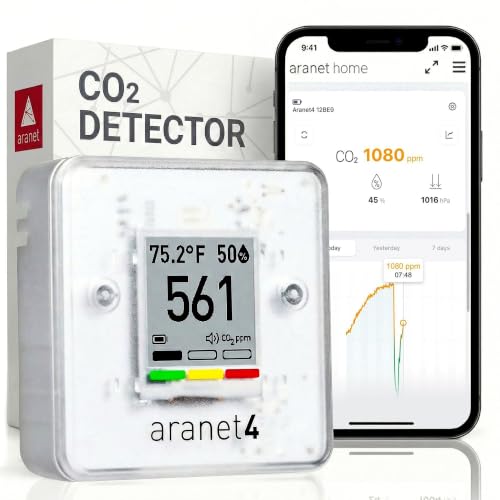
- Measures CO2, temperature, humidity, and pressure
- Offers up to four years of battery life
- Includes an app with 90 days of historical data
Best For: Wireless ventilation monitoring in homes and offices
Connected PM2.5 Monitoring
GoveeLife Smart Air Quality Monitor

- Refreshes PM2.5, temperature, and humidity every two seconds
- Connects to supported GoveeHome appliances
- Stores and exports extended monitoring data
Best For: Govee users wanting fast readings and automation
Whole-Pollutant Coverage
AcuRite Wi-Fi Indoor Air Quality Monitor

- Measures particles, CO2, formaldehyde, and TVOCs
- Uses green, orange, and red IAQ status indicators
- Provides unhealthy-air alerts and remote monitoring
Best For: Broad indoor-pollutant monitoring across varied spaces
Best Smart CO2 Monitor

- Fast-refresh SCD4x NDIR CO2 sensing
- Two-year history with CSV export
- AC-powered with smart alerts
Best For: Bedrooms, offices, and nurseries needing continuous CO2 monitoring
Best Comprehensive Monitor

- Eight-in-one pollutant and comfort tracking
- 90-day history with CSV export
- Up to six hours of portable use
Best For: Large homes, classrooms, and offices needing broad air analysis
Best Portable Value
16-in-1 Indoor Air Quality Monitor

- Tracks particles, gases, temperature, and humidity
- 1.5-second refresh rate with HD color screen
- Portable Type-C design with AC adapter
Best For: Portable testing across rooms, offices, bedrooms, and vehicles
Best Overall
CF-60PP Professional Smart Monitor

- Tracks particles, gases, CO2, pollen, and comfort conditions
- Displays up to 12-hour trends without a phone
- Adds Wi-Fi alerts, cloud history, and USB export
Best For: Detailed home, office, classroom, and facility monitoring
Best Simple Display
AK27 10-in-1 Air Quality Monitor

- Monitors particles, HCHO, TVOC, AQI, and comfort conditions
- Uses a full-color display with clear AQI indicators
- Compact desktop design for everyday indoor use
Best For: Simple, at-a-glance monitoring in bedrooms, offices, and living rooms
Best Large Screen

- Shows a broad range of pollutants and comfort readings
- Uses a 7-inch display with adjustable brightness
- Adds NDIR CO2 sensing, calibration, and audible alerts
Best For: Highly visible monitoring in home offices and shared spaces
Alexa Air Insights – Amazon Smart Air Quality Monitor
For shoppers comparing smart air quality monitors for large rooms, the Amazon Smart Air Quality Monitor is a convenient choice for Alexa-connected homes. It tracks PM2.5, VOCs, carbon monoxide, humidity, and temperature, then presents an air quality score in the Alexa app.
Best For: Alexa users who want broad indoor-air tracking and smart-device automations.
Pros:
- Measures five useful air and comfort factors, including PM2.5, VOCs, carbon monoxide, humidity, and temperature.
- Provides a color-coded LED and an easy-to-understand Alexa app score.
- Can send notifications or Echo announcements when air quality is poor.
- Supports Alexa routines for compatible purifiers, dehumidifiers, and fans.
Cons:
- Its smart-home features are centered on Alexa-enabled devices.
- The notes do not specify a display with detailed on-device readings.
This monitor is especially practical when you want one sensor to inform Alexa routines across a larger living space. It is a strong fit for households already using Echo devices and compatible climate-control products.
Long-Life CO2 Tracking – Aranet4 Indoor Air Quality Monitor
Among smart air quality monitors for large rooms, the Aranet4 stands out for focused CO2 monitoring and wireless operation. Its NDIR sensor measures CO2 in real time while also tracking temperature, relative humidity, and atmospheric pressure.
Best For: Homes and offices where ventilation decisions depend primarily on CO2 levels.
Pros:
- Uses NDIR technology for precise, reliable CO2 measurements.
- Runs wirelessly for up to four years on two included AA batteries.
- Uses color coding, a prominent CO2 reading, and an optional buzzer for high levels.
- App provides up to 90 days of historical graphs and analysis.
Cons:
- It does not measure PM2.5, VOCs, or carbon monoxide according to the supplied specifications.
- Its app history is limited to 90 days.
The Aranet4 is a particularly flexible option for monitoring a large room without placing a cable near the sensor. Choose it when clear CO2 feedback and exceptional battery life matter more than measuring a wider range of pollutants.
Connected PM2.5 Monitoring – GoveeLife Smart Air Quality Monitor
The GoveeLife H5106 is a practical pick among smart air quality monitors for large rooms when you want quick PM2.5 updates and smart-appliance control. Its wired sensor measures PM2.5, temperature, and humidity, with readings refreshed every two seconds.
Best For: GoveeHome users who want visible readings, remote monitoring, and automated air-care devices.
Pros:
- Refreshes PM2.5, temperature, and humidity data every two seconds.
- Offers a digital display, four-level LED air-quality indicator, and night mode.
- Works with supported GoveeLife purifiers, humidifiers, and fans for automatic control.
- Supports remote viewing, 13-day online graphs, and exporting up to two years of data.
Cons:
- Requires continuous power through a Type-C cable and has no built-in battery.
- 2.4 GHz Wi-Fi is required for time display and connected features.
- Measures three indexes rather than CO2 or VOCs.
This monitor makes the most sense for a larger room already equipped with GoveeHome appliances. Its fast refresh rate and data-export options are useful for tracking changes, but placement near an outlet is essential.
Whole-Pollutant Coverage – AcuRite Wi-Fi Indoor Air Quality Monitor
For shoppers seeking smart air quality monitors for large rooms with broad pollutant coverage, the AcuRite 17012M is designed for detailed indoor-air awareness. It monitors particulate matter in three sizes, carbon dioxide, formaldehyde, total VOCs, temperature, and humidity.
Best For: Homes, offices, garages, basements, and studios needing wide-ranging IAQ measurements and alerts.
Pros:
- Measures PM1.0, PM2.5, PM10, CO2, formaldehyde, and TVOCs.
- Provides green, orange, or red overall IAQ status for quick checks.
- Issues a loud audible alert when unhealthy IAQ levels are detected.
- Includes indoor temperature and humidity readings plus remote monitoring through the AcuRite NOW app.
Cons:
- The supplied details do not specify battery operation or battery life.
- The loud alert may need to be disabled in the app if audible notifications are unwanted.
- It is designed for tabletop placement rather than a stated wall-mount setup.
The AcuRite offers the broadest pollutant list in this lineup, making it useful when you want more than basic particulate or CO2 readings. Its quick-glance status indicator and unhealthy-air alert also make monitoring a larger indoor area straightforward.
Best Smart CO2 Monitor – GoveeLife H5140
For shoppers comparing smart air quality monitors for large rooms, the GoveeLife H5140 is a focused option for tracking CO2, temperature, and humidity continuously. Its 5-second refresh rate, app connectivity, and outlet-powered design make it practical for bedrooms, offices, and other spaces where uninterrupted monitoring matters.
Best For: Large bedrooms, offices, nurseries, and smart-home users primarily concerned with CO2 and comfort conditions.
Pros:
- Uses an SCD4x photoacoustic NDIR CO2 sensor with stated accuracy of ±(40 ppm + 5%), plus pressure compensation.
- Displays CO2, temperature, humidity, and a clock, with customizable brightness and day/night scheduling.
- Offers buzzer, app, and email alerts, along with up to two years of historical data and CSV export.
- AC-powered for continuous 24/7 monitoring and compatible with Alexa, Google Assistant, humidifiers, and tower fans.
Cons:
- Measures CO2, temperature, and humidity rather than particulate matter, TVOCs, or formaldehyde.
- Requires app-based outdoor calibration if calibration is needed.
- Cannot link to air purifiers for CO2 control, since air purifiers do not effectively reduce CO2.
The H5140 is a sensible pick when reliable CO2 tracking and smart alerts matter more than broad pollutant coverage. Its continuous power and long data history are especially useful for monitoring ventilation patterns in larger occupied rooms.
Best Comprehensive Monitor – BREATHE Airmonitor Plus Gen 2
Among smart air quality monitors for large rooms, the BREATHE Airmonitor Plus Gen 2 stands out for covering gases, particles, and comfort metrics in one device. It combines NDIR CO2 sensing with particle, TVOC, and formaldehyde detection, while Wi-Fi app access supports remote checks and trend review.
Best For: Homes, classrooms, offices, and other larger spaces where broad pollutant tracking and historical analysis are priorities.
Pros:
- Tracks eight categories, including CO2, PM1, PM2.5, PM10, TVOC, formaldehyde, temperature, and humidity.
- Combines NDIR CO2 measurement with laser particle sensing and dedicated TVOC and HCHO detection.
- Provides configurable CO2 and PM2.5 alerts, 90-day app history, graphs, and data export over 2.4 GHz Wi-Fi.
- Can run from USB-C power or provide up to six hours of portable monitoring.
Cons:
- Portable battery operation lasts up to six hours, so extended mobile use requires recharging.
- App connectivity uses 2.4 GHz Wi-Fi, which may require checking router compatibility during setup.
- Its broader sensor set may be more than needed for shoppers focused only on CO2 and humidity.
The Airmonitor Plus Gen 2 is the strongest all-around choice here for identifying how cooking, cleaning products, furnishings, smoke, dust, and ventilation affect indoor air. Choose it when pollutant breadth and shareable data are more important than a simple CO2 display.
Best Portable Value – 16-in-1 Indoor Air Quality Monitor
This 16-in-1 monitor is a flexible choice for shoppers seeking smart air quality monitors for large rooms as well as vehicles and smaller spaces. Its high-definition color screen refreshes readings every 1.5 seconds and presents multiple pollutant and comfort measurements without requiring a phone app.
Best For: Users who want a portable, easy-to-read tester for rooms, offices, bedrooms, vehicles, and other indoor locations.
Pros:
- Measures PM1.0, PM2.5, PM10, CO2, TVOC, formaldehyde, temperature, and humidity.
- Updates air data every 1.5 seconds on a high-definition color display with color-coded readings.
- Offers one-button operation, adjustable audio prompts, and a quiet sampling mode for nighttime use.
- Includes Type-C charging, an AC adapter, and approximately four to five hours of runtime.
Cons:
- Battery runtime is limited to approximately four to five hours per charge.
- The supplied notes do not indicate app connectivity, remote alerts, or historical data storage.
- Its portable design may require USB-C or wall power for continuous monitoring in a large room.
This model makes the most sense for straightforward, portable spot checks across multiple locations. Its fast refresh rate and broad readings are useful, but shoppers wanting remote access or long-term data analysis should consider a connected alternative.
Best Overall – CF-60PP Professional Smart Monitor
For shoppers comparing smart air quality monitors for large rooms, the CF-60PP stands out for its broad sensor coverage, large color display, and historical trend graphs. It monitors particulate matter, CO2, VOCs, formaldehyde, pollen, temperature, humidity, and AQI, while optional Wi-Fi adds remote alerts and cloud history.
Best For: Homes, offices, classrooms, and facility managers who want detailed local readings plus optional app monitoring and data export.
Pros:
- Displays PM1.0, PM2.5, PM10, CO2, TVOC, HCHO, AQI, temperature, and humidity together.
- Shows 4-minute, 6-minute, 2-hour, and 12-hour color trend graphs without requiring a phone.
- Supports custom thresholds, local alarms, phone push notifications, USB export, and up to one year of stored history.
- Adds a pollen metric and works with both 2.4GHz and 5GHz Wi-Fi.
Cons:
- Its extensive feature set may be more than casual users need.
- Remote alerts and cloud trends require Wi-Fi and app setup.
- At about 1 pound, it is less compact than basic desktop monitors.
The CF-60PP is the strongest fit when you want a detailed, building-oriented view of indoor air rather than a single reading. Its offline display remains useful, while connectivity and export tools support longer-term tracking.
Best Simple Display – AK27 10-in-1 Air Quality Monitor
The AK27 is a straightforward option for shoppers seeking smart air quality monitors for large rooms with easy-to-read information at a glance. Its full-color display shows key pollutant readings, AQI, temperature, humidity, and time in a compact desktop design.
Best For: Bedrooms, living rooms, offices, nurseries, and other spaces where clear real-time readings matter more than app features.
Pros:
- Monitors PM1.0, PM2.5, PM10, HCHO, TVOC, temperature, humidity, and AQI.
- Large color screen is designed for quick viewing from across the room.
- Color-coded AQI indicators make changes easy to interpret.
- Compact 4.17-by-3.54-inch footprint suits desktops and nightstands.
Cons:
- The supplied features do not mention Wi-Fi, app control, or remote notifications.
- It does not list CO2 monitoring among its tracked indicators.
- It provides less historical and export functionality than the CF-60PP.
The AK27 keeps the focus on readable, real-time measurements. It is a sensible choice for everyday indoor awareness, especially if you prefer a simple screen-based monitor over connected features.
Best Large Screen – AK22B 16-in-1 Monitor
The AK22B is built for visibility, making it a practical pick among smart air quality monitors for large rooms. Its 7-inch full-view display puts a wide range of readings in one place, while the NDIR CO2 sensor, calibration support, and audible alerts add useful monitoring controls.
Best For: Users who want a large, readable display and broad pollutant coverage for home offices, bedrooms, or shared indoor spaces.
Pros:
- Tracks CO2, PM1.0, PM2.5, PM10, HCHO, TVOC, temperature, humidity, AQI, and more.
- 7-inch display provides a clear full-view dashboard with adjustable brightness.
- NDIR CO2 sensor and built-in calibration support are designed for stable everyday monitoring.
- Provides real-time buzzer alerts with a mute option and supports Fahrenheit/Celsius settings.
Cons:
- The large display makes the unit less compact than smaller desktop monitors.
- The supplied notes do not mention app connectivity or remote alerts.
- The manufacturer advises avoiding perfumes and strong odors near the sensors.
The AK22B is the best match when screen size is a priority. Its broad measurement list and CO2-focused sensing make it useful for spotting changing conditions, while adjustable brightness helps the display work during both day and night.
How We Picked These Smart Air Quality Monitors for Large Rooms
We focused on monitors that can provide useful readings in spacious homes, offices, classrooms, studios, and other shared areas. Selection criteria included the pollutants and environmental factors measured, sensor type where stated, display readability, alert options, connectivity, portability, and suitability for continuous monitoring.
Because “smart” can mean different things, we separated app and voice-assistant connectivity from standalone monitors with local screens and alarms. A device does not need every feature to be useful, but its strengths should match the room and the decisions you need to make.
Quick Comparison
- Best for Alexa households: Amazon Smart Air Quality Monitor.
- Best for portable CO2 tracking: Aranet4.
- Best for clear local readings: models with large color or 7-inch displays.
- Best for broad pollutant coverage: 16-in-1 and multi-sensor monitors that include PM, HCHO, TVOC, temperature, and humidity.
- Best for business or commercial use: the CF-60PP SMART professional monitor.
Key Buying Factors for Smart Air Quality Monitors for Large Rooms
Measure the Pollutants That Matter
CO2 is a practical indicator of ventilation and rising occupancy. PM2.5 and PM10 readings are more relevant for smoke, dust, cooking, and outdoor pollution. TVOC and formaldehyde measurements may help identify chemical sources, although consumer sensors should be treated as indicators rather than laboratory-grade testing.
Check Sensor Accuracy and Maintenance
Look for clearly specified sensor technology, especially NDIR CO2 sensing when accurate ventilation tracking is a priority. Sensors can drift or become less reliable over time, so check whether calibration, replacement, or periodic fresh-air adjustment is supported.
Prioritize Visibility and Placement
A large room usually benefits from a bright, readable display that can be seen from across the space. Place the monitor at breathing height, away from windows, vents, cooking appliances, direct sunlight, and sudden drafts. In very large or divided areas, one monitor may not represent every zone.
Compare Alerts and Connectivity
App notifications, Wi-Fi dashboards, voice-assistant support, audible alarms, and color indicators serve different needs. Choose app or voice integration if you want remote awareness or automation; choose local alarms and displays if people need immediate feedback without opening a phone.
Consider Power and Portability
Wired monitors are suitable for a fixed desk or wall location, while battery-powered units are easier to move between rooms. For continuous monitoring, confirm expected battery life, USB or adapter requirements, and whether the display remains active when plugged in.
Who Should Buy Which Smart Air Quality Monitors for Large Rooms?
Choose a connected home monitor if you already use Alexa or want simple app-based status checks. Choose a portable CO2-focused model for meeting rooms, bedrooms, classrooms, or anyone who frequently moves the monitor. Choose a large-display multi-parameter unit if readings must be visible at a glance or you want broader coverage beyond CO2 and particles.
Choose a professional-oriented monitor when the device will support workplace oversight or more formal indoor-air-quality checks. Regardless of model, use readings to guide ventilation, filtration, and source control—not as a substitute for certified environmental or medical testing.
