Indoor air can change quickly, from elevated CO2 in a closed bedroom to particulate spikes during cooking or wildfire smoke. Smart air quality monitors make those changes visible so you can respond with ventilation, filtration, or humidity control.
We compared 10 smart air quality monitors across sensor coverage, connectivity, displays, alerts, portability, and ease of use to help you choose the right fit for your rooms and routines.
Best 10 Smart Air Quality Monitors Picks for 2026
Best Alexa-Integrated Pick
Amazon Smart Air Quality Monitor

- Tracks five key indoor-air factors
- Alexa app scores, alerts, and routines
- Color-coded LED for quick status checks
Best For: Alexa users wanting simple monitoring and automation
Best for Detailed Tracking

- Eight-in-one monitoring with CO2 and formaldehyde
- 90-day history, graphs, alerts, and CSV export
- Up to six hours of portable use
Best For: Detailed air-quality analysis and trend tracking
Best for Simple Sidewalk Coverage

- Monitors CO, PM2.5, temperature, and humidity
- Offers actionable indoor-air suggestions
- Uses Amazon Sidewalk without a base station
Best For: Simple connected monitoring across a Sidewalk-enabled home
Best Always-On CO2 Monitor
GoveeLife Smart Air Quality Monitor

- Fast-refresh CO2, temperature, and humidity readings
- Buzzer, app, and email alerts
- Up to two years of history with CSV export
Best For: Continuous CO2 monitoring in bedrooms, nurseries, and offices
Most Comprehensive
16-in-1 Indoor Air Quality Monitor

- Tracks particulate matter, gases, temperature, and humidity
- HD color display refreshes readings every 1.5 seconds
- Portable design with Type-C charging and 4–5-hour runtime
Best For: Broad, portable indoor air testing
Best for Radon Monitoring
Airthings Wave Plus Radon Monitor

- Continuously measures radon for long-term tracking
- Also monitors CO2, VOCs, humidity, temperature, and pressure
- Battery powered with an average 1.5-year battery life
Best For: Radon-focused household monitoring
Best Smart Home Integration
GoveeLife PM2.5 Air Quality Monitor

- Tracks PM2.5, temperature, and humidity with two-second updates
- Works with compatible GoveeLife appliances for automation
- Offers remote viewing and long-term data export
Best For: Connected Govee smart-home setups
Best with Extra Features
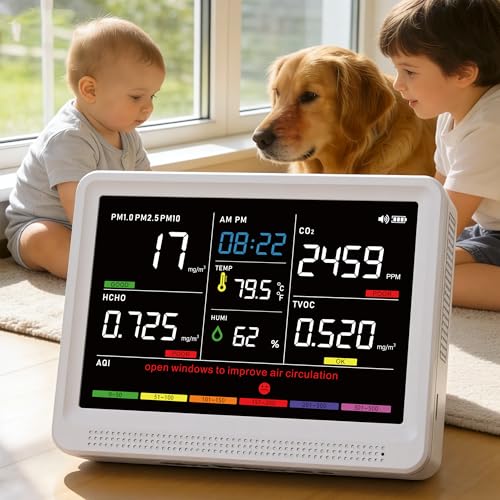
- Tracks CO2, particulate matter, HCHO, TVOC, temperature, humidity, and AQI
- 5.5-inch HD display with adjustable brightness
- Portable design with USB-C charging and up to 10 hours of runtime
Best For: Broad, screen-based monitoring across multiple indoor environments
Best App Guidance
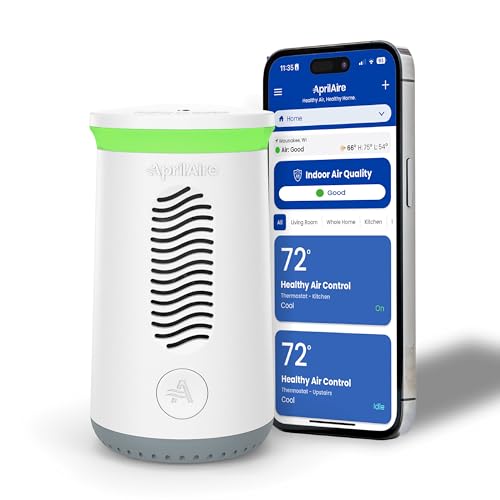
- Measures PM2.5, VOCs, TVOC, CO2, humidity, and temperature
- Healthy Air App offers trends, alerts, explanations, and tips
- Can integrate with select AprilAire systems and thermostats
Best For: Connected home monitoring with guidance and remote notifications
Best Smart-Home Integration

- Matter-compatible with major smart-home platforms
- Shows PM2.5, PM10, temperature, and humidity on a 3.73-inch screen
- Offers alerts plus 12 months of viewable and exportable data
Best For: Connected homes that prioritize automation and historical tracking
Best Alexa-Integrated Pick – Amazon Smart Air Quality Monitor
The Amazon Smart Air Quality Monitor is a straightforward choice among smart air quality monitors for households already using Alexa. It tracks five indoor-air factors and presents the results through a color-coded LED, an Alexa app score, and optional notifications.
Best For: Alexa users who want simple monitoring and smart-home routines.
Pros:
- Tracks PM2.5, VOCs, carbon monoxide, humidity, and temperature.
- Provides an at-a-glance LED indicator and an easy-to-understand Alexa air-quality score.
- Can send alerts and trigger Alexa routines for compatible fans, air purifiers, dehumidifiers, and other devices.
Cons:
- Its smart-home features are centered on Alexa.
- The notes do not indicate historical data, data export, or a portable battery.
This monitor is best when convenience and Alexa automation matter more than advanced reporting. It offers useful coverage of common indoor-air conditions without requiring a complicated setup.
Best for Detailed Tracking – BREATHE Airmonitor Plus Gen 2
The BREATHE Airmonitor Plus Gen 2 stands out among smart air quality monitors for its broad sensor coverage and historical reporting. It measures gases, particles, temperature, and humidity, while its app provides alerts, graphs, up to 90 days of history, and CSV export.
Best For: Users who want detailed indoor-air analysis for a home, office, classroom, or bedroom.
Pros:
- Measures CO2, PM1, PM2.5, PM10, TVOC, formaldehyde, temperature, and humidity.
- Combines NDIR CO2 measurement with laser particle sensing and dedicated TVOC and formaldehyde detection.
- Offers configurable alerts, 90-day app history, data graphs, and CSV export.
- Provides up to six hours of portable use and can run from USB-C power.
Cons:
- App connectivity requires a 2.4 GHz Wi-Fi network.
- Portable monitoring is limited to up to six hours on battery.
Choose this model if you want to connect air-quality changes with activities such as cooking, cleaning, occupancy, or ventilation. Its wider sensor set and exportable data make it the most analysis-focused option in this group.
Best for Simple Sidewalk Coverage – Ring Air Quality Monitor
The Ring Air Quality Monitor is a practical option among smart air quality monitors for tracking basic indoor conditions across a connected home. It monitors temperature, carbon monoxide, humidity, and PM2.5, then provides suggestions such as opening a window or running a purifier.
Best For: Ring or Amazon Sidewalk users seeking simple alerts and actionable guidance.
Pros:
- Tracks temperature, carbon monoxide, humidity, and PM2.5.
- Provides prompts about opening windows, running a purifier, or servicing appliances.
- Connects over Amazon Sidewalk without requiring a base station.
Cons:
- Amazon Sidewalk is required, and coverage may vary.
- It does not measure CO2 or radon.
- It is not a substitute for a certified carbon monoxide alarm and has no microphone or speaker for alarm sounds.
This is a good fit for lightweight monitoring and connected notifications, but it should complement—not replace—proper safety alarms. Buyers specifically seeking CO2 or radon readings should consider another monitor.
Best Always-On CO2 Monitor – GoveeLife Smart Air Quality Monitor
The GoveeLife Smart Air Quality Monitor is one of the more focused smart air quality monitors for continuous CO2 tracking. Its display shows CO2, temperature, humidity, and time, while customizable alerts, app history, and smart-home integrations help turn readings into practical actions.
Best For: Bedrooms, nurseries, and offices that need continuous CO2, temperature, and humidity monitoring.
Pros:
- Uses an SCD4x CO2 sensor with a five-second refresh rate and stated accuracy of ±(40 ppm + 5%).
- Provides buzzer, app, and email alerts for customizable CO2, temperature, and humidity thresholds.
- Tracks up to two years of data and supports CSV export.
- Supports voice queries and links with compatible humidifiers and tower fans.
Cons:
- Requires standard AC power rather than battery operation.
- It focuses on CO2, temperature, and humidity rather than particulate or VOC measurement.
- Air purifiers cannot be linked because they do not effectively reduce CO2.
For users primarily concerned with ventilation and CO2 buildup, this model offers clear readings and strong long-term tracking. Its always-on design is especially useful where uninterrupted bedroom, nursery, or office monitoring is more important than portability.
Most Comprehensive – 16-in-1 Indoor Air Quality Monitor
For shoppers seeking smart air quality monitors with broad sensor coverage, this portable 16-in-1 tester tracks particulate matter, CO2, TVOC, HCHO, temperature, and humidity. Its HD color screen provides frequent updates, while the compact design works in rooms, offices, cars, and other indoor spaces.
Best For: Households that want wide-ranging air measurements and a portable, easy-to-read display.
Pros:
- Measures PM1.0, PM2.5, PM10, CO2, TVOC, HCHO, temperature, and humidity.
- Updates readings every 1.5 seconds on a high-definition color screen.
- Supports handheld or placed use and includes Type-C charging equipment.
- Offers a simple one-button operation with an optional audio prompt.
Cons:
- Continuous battery operation lasts approximately 4–5 hours.
- Its broad feature set may be more than needed for shoppers monitoring only one or two metrics.
This is a versatile choice when you want one device to cover several indoor air indicators. The rechargeable, portable format adds flexibility, though users needing uninterrupted monitoring may prefer to keep it connected to power.
Best for Radon Monitoring – Airthings Wave Plus Radon Monitor
The Airthings Wave Plus stands out among smart air quality monitors by adding continuous radon measurement to its indoor air sensors. It also monitors CO2, VOCs, humidity, temperature, and air pressure, with color-coded readings on the device and more detailed insights through the Airthings app.
Best For: Homeowners who prioritize long-term radon tracking alongside essential indoor air measurements.
Pros:
- Provides continuous radon monitoring designed for long-term measurement.
- Tracks CO2, VOCs, humidity, temperature, and air pressure.
- Offers a color-coded visual indication and Bluetooth app access.
- Battery powered, with an average battery life listed at 1.5 years.
Cons:
- Uses Bluetooth app connectivity rather than a built-in screen for detailed results.
- Does not list particulate-matter monitoring among its sensors.
- Some extended warranty benefits require registration within 30 days.
Choose the Wave Plus if radon is a central concern and you want a low-maintenance monitor for several additional air factors. Its battery-powered design is convenient, while app-based details may suit users comfortable checking readings on a phone.
Best Smart Home Integration – GoveeLife PM2.5 Air Quality Monitor
For shoppers comparing smart air quality monitors that can connect with home appliances, the GoveeLife H5106 focuses on PM2.5, temperature, and humidity. It provides two-second updates, remote viewing through Bluetooth or Wi-Fi, and automation options with compatible GoveeLife purifiers, humidifiers, and fans.
Best For: Govee users who want PM2.5 tracking and appliance automation in a connected home.
Pros:
- Measures PM2.5, temperature, and humidity with stated accuracy specifications.
- Refreshes data every two seconds and displays four ambient air-quality levels.
- Supports remote monitoring, 13-day online graphs, and up to two years of data export.
- Can trigger compatible GoveeLife appliances when air quality changes.
Cons:
- Measures fewer air indicators than broader multi-parameter monitors.
- Requires continuous power and has no built-in battery.
- 2.4GHz Wi-Fi is required for time display and connected features.
This monitor makes the most sense for users already invested in GoveeLife devices or those who value historical data and automation. Its wired-only setup limits portability, but it is well suited to a fixed location near an air purifier or other compatible appliance.
Best with Extra Features – 16-in-1 Air Quality Monitor
For shoppers comparing smart air quality monitors, the YNAK 16-in-1 model emphasizes broad, at-a-glance coverage. It tracks CO2, particulate matter, HCHO, TVOC, temperature, humidity, and AQI on a 5.5-inch HD display, with portable USB-C charging and audible alerts.
Best For: Households wanting a large screen and extensive indoor pollutant monitoring in rooms, offices, vehicles, or campsites.
Pros:
- Monitors CO2, PM1.0, PM2.5, PM10, HCHO, TVOC, temperature, humidity, and AQI.
- Large 5.5-inch HD screen with three brightness levels.
- Offers seven AQI alert functions, a mute button, and up to 10 hours of runtime.
- Includes USB-C charging, an AC adapter, a 12-month warranty, and customer support.
Cons:
- The stated “16-in-1” count combines nine detectable parameters with seven alert types.
- Its sensors should not be touched or exposed to perfumes and strong odors.
- It does not list app or Wi-Fi connectivity in the supplied specifications.
This is a practical choice when display size, portability, and a wide range of measurements matter more than connected-home features. Its broad sensor coverage makes it especially useful for checking several indoor conditions from one device.
Best App Guidance – AprilAire Smart Wi-Fi Monitor
The AprilAire ZAWTHCPV is one of the more connected smart air quality monitors in this roundup. It measures PM2.5, particulate matter, VOCs, TVOC, CO2, humidity, and temperature, then presents trends, explanations, notifications, and improvement tips through the Healthy Air App.
Best For: Homeowners who want remote alerts, understandable air-quality guidance, and potential integration with AprilAire ventilation or filtration equipment.
Pros:
- Wi-Fi monitoring covers PM2.5, VOCs, TVOC, CO2, humidity, and temperature.
- App provides real-time values, trends, explanations, expert tips, and notifications.
- Color-coded status indicators make conditions easy to check at a glance.
- Offers three light settings and a three-year manufacturer warranty.
Cons:
- Requires the AprilAire Healthy Air App to function.
- AprilAire Healthy Air Mode requires a compatible Wi-Fi thermostat sold separately.
- It is corded electric rather than a portable, battery-powered monitor.
The AprilAire stands out for turning measurements into actionable guidance instead of simply displaying numbers. It is best suited to users comfortable with app-based monitoring and the AprilAire ecosystem.
Best Smart-Home Integration – SONOFF Matter Air Monitor
The SONOFF SAWF-07P focuses on connected convenience for shoppers seeking smart air quality monitors that fit into an existing platform. Its 3.73-inch screen shows PM2.5, PM10, temperature, and humidity, while Matter compatibility supports several major smart-home ecosystems.
Best For: Smart-home users who want threshold alerts, platform integration, and long-term air-quality history for bedrooms, offices, or nurseries.
Pros:
- Matter compatibility supports Apple Home, Amazon Alexa, Google Home, SmartThings, and Home Assistant.
- Displays PM2.5, PM10, temperature, and humidity together on a 3.73-inch screen.
- Provides sound, multicolor LED, and app notifications for customizable thresholds.
- Stores up to 12 months of data with graphical viewing and export options.
Cons:
- Its measurement set does not include CO2 or VOC monitoring.
- Continuous power is required for the stated two-second data updates.
- Wi-Fi operation uses the 2.4GHz band.
The SONOFF is a strong fit when smart-home compatibility and data history are higher priorities than measuring a broad range of gases. Its multiple notification methods also make threshold-based monitoring straightforward.
How We Picked the Best Smart Air Quality Monitors
We focused on the measurements most useful in everyday homes: carbon dioxide, particulate matter such as PM2.5, volatile organic compounds, temperature, and humidity. We also considered specialized sensing, including radon, along with app quality, smart-home compatibility, alert options, display readability, power source, and setup requirements.
Because no monitor measures everything equally well, the best choice depends on the pollutants you want to track. A compact monitor with a clear display may be ideal for a bedroom, while a connected model with broader sensing can suit a whole-home monitoring strategy.
Quick Comparison
| Best For | Prioritize | Useful Features |
|---|---|---|
| Everyday home awareness | CO2, PM2.5, temperature, humidity | Readable display and simple alerts |
| Smart-home integration | Reliable Wi-Fi or compatible ecosystem | App notifications and automation support |
| Radon monitoring | Dedicated radon sensor | Long-term trend data and battery operation |
| Portable room checks | Compact design and internal battery | Fast readings and on-device display |
| Detailed diagnostics | Broader sensor coverage | CO2, VOCs, particles, and environmental data |
Key Buying Factors for Smart Air Quality Monitors
Sensor Coverage
CO2 is a useful indicator of ventilation, while PM2.5 helps reveal smoke, cooking particles, and fine dust. VOC sensors can flag changes from cleaning products, paint, furnishings, and other chemicals. If radon is a concern, choose a model designed to measure it rather than assuming a general-purpose monitor can.
Accuracy and Trends
Look for high-quality sensor specifications, frequent updates, and historical graphs. A single reading is less useful than a trend showing when levels rise and whether ventilation or filtration improves them. Place the unit away from windows, vents, direct sunlight, and strong drafts for more representative results.
Connectivity and Alerts
Wi-Fi and app support are helpful when you want remote monitoring or notifications. Check whether the device requires a cloud account, supports your preferred smart-home platform, and continues displaying readings if the internet goes down. On-device alarms and displays are valuable backups.
Power, Placement, and Upkeep
Battery models are easier to move and place temporarily, while wired monitors avoid charging interruptions. Confirm the expected battery life, cable length, display visibility, and calibration or maintenance guidance before buying.
Who Should Buy Which Smart Air Quality Monitors?
Choose a simple display monitor if you mainly want quick, local readings for a bedroom, office, nursery, or living room. Pick a Wi-Fi model with app alerts if you want to check conditions while away or connect air-quality data with a broader smart-home routine.
For homes near wildfire-prone areas, prioritize PM2.5 monitoring and clear alerts. For persistent ventilation concerns, CO2 tracking is especially useful. Buyers specifically investigating radon should choose a dedicated radon-capable model and follow appropriate placement and testing guidance. If you want the broadest snapshot, a multi-parameter monitor can be worthwhile, but compare its sensor list and app experience rather than choosing by parameter count alone.
