When the power goes out, the right backup system can keep essential appliances, communication devices, and medical equipment running without the noise and fuel demands of a conventional generator.
We selected 10 inverter generators and portable power stations across multiple output levels, fuel types, and use cases, from compact battery backups to RV-ready dual-fuel models.
Best 10 Inverter Generators for Power Outages Picks for 2026
High-Capacity Dual-Fuel Pick
WEN DF680iX 6800-Watt Inverter Generator

- Gasoline and propane operation
- Up to 5,100 rated gasoline watts
- 240V, RV, EV, and CO safety features
Best For: Home backup, RVs, and larger outage loads
Fast-Charging Battery Pick
Jackery Explorer 1000 v2 Portable Power Station

- 1,500W output and 1,070Wh capacity
- Lightweight 23.8-pound LFP power station
- App control, quiet mode, and fast charging
Best For: Quiet emergency backup and portable electronics
Portable Dual-Fuel Value Pick
BILT HARD 5500W Dual-Fuel Inverter Generator
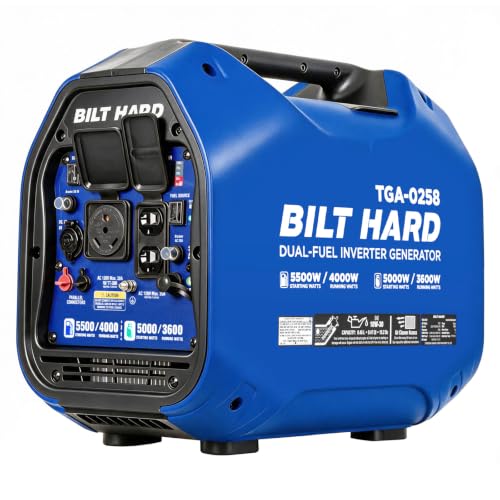
- Up to 4,000 gasoline running watts
- Gasoline or LPG operation
- Eco mode, display, RV outlet, and CO shutoff
Best For: Portable home backup and RV power
Lightweight Essentials Pick
Jackery Explorer 300 Portable Power Station

- 300W output with 292Wh capacity
- About 7.5 pounds with a carry handle
- AC, USB, and car-port charging options
Best For: Small electronics, short outages, and camping
Best Dual-Fuel Pick

- Gasoline and propane operation
- Clean inverter power
- CO Watchdog and RV outlet
Best For: Home backup, RV use, and flexible fueling
Best High-Output Value

- 4,500 peak and 3,500 running watts
- 60.5 dB(A) operation with Eco Mode
- Parallel-ready for expanded capacity
Best For: Longer outages, RVs, and higher-power loads
Best Quiet Compact Option

- 4,000 starting and 3,200 running watts
- Under 59 dBA from 23 feet
- Clean power and parallel readiness
Best For: Quiet camping and residential backup
Best High-Capacity Pick
Oxseryn 4400W Inverter Generator

- 4,400 peak and 3,400 running watts
- Up to 14 hours at 25% load with ECO mode
- RV-ready ports and fuel gauge
Best For: Home backup and RV users needing higher output
Best Quiet Operation
PowerSmart 4000W Inverter Generator

- 4,000 peak and 3,200 rated watts
- 59 dBA at 25% load from 23 feet
- Less than 3% THD and parallel capable
Best For: Quiet camping and electronics-friendly backup power
Best Lightweight Choice
Westinghouse 2550W Inverter Generator

- 43.2-pound portable design
- Up to 11 hours of runtime
- As low as 52 dBA with RV-ready outlet
Best For: Essential-load backup, camping, and easy transport
High-Capacity Dual-Fuel Pick – WEN DF680iX 6800-Watt Inverter Generator
For demanding home backup needs, this WEN model is one of the more capable inverter generators for power outages. It supplies up to 5,100 rated watts on gasoline or 4,500 rated watts on propane, with electric start, RV connectivity, and several built-in safety features.
Best For: Home backup, RV use, and users who want dual-fuel flexibility with substantial output.
Pros:
- Runs on gasoline or propane, with up to 6,800 gasoline surge watts.
- Bonded-neutral 240V configuration supports low-power Level 2 EV and hybrid charging.
- CO Watchdog shutdown, fuel shutoff, wheels, and telescoping handle add practical convenience.
- Includes 120V/240V, RV, USB, and 12V outlets plus a three-year warranty.
Cons:
- At 99.2 pounds, it is substantially heavier than the battery power stations in this roundup.
- Its listed runtime is six hours, so extended outages may require refueling.
- It uses an internal-combustion engine and therefore requires fuel and outdoor operation.
The DF680iX is a strong choice when outage backup involves larger loads or an RV. Its dual-fuel design and 240V capability broaden its usefulness, while the heavier build makes it better suited to planned placement than frequent hand carrying.
Fast-Charging Battery Pick – Jackery Explorer 1000 v2 Portable Power Station
The Jackery Explorer 1000 v2 is a compact battery alternative to fuel-powered inverter generators for power outages. Its 1,070Wh LFP battery and 1,500W AC output can run or charge a range of smaller appliances and electronics without engine noise or gasoline.
Best For: Quiet home backup, emergency electronics, camping, and short-duration appliance use.
Pros:
- Provides 1,500W of AC output with a 3,000W surge peak.
- Lightweight 23.8-pound design includes a foldable handle.
- LFP battery is rated for over 4,000 cycles while retaining more than 70% capacity.
- Offers three AC outlets, USB-C, USB-A, DC car output, LED lights, and app control.
Cons:
- It has limited stored energy compared with fuel-powered generators for long outages.
- One-hour charging requires activating emergency charging in the Jackery App.
- Solar charging is compatible only with Jackery solar panels.
This power station is especially practical when quiet operation, portability, and low maintenance matter more than running high-wattage loads indefinitely. It can be recharged from an outlet or compatible solar panels, but its battery capacity should be matched to the devices you need during an outage.
Portable Dual-Fuel Value Pick – BILT HARD 5500W Dual-Fuel Inverter Generator
The BILT HARD 5500W combines gasoline and LPG operation in a portable package for home backup, RVs, and outdoor use. For shoppers comparing inverter generators for power outages, its digital display, economy mode, parallel-ready design, and CO auto-shutoff provide useful operating and monitoring features.
Best For: Portable backup users who want dual-fuel operation, RV support, and flexible power management.
Pros:
- Delivers up to 4,000 running watts on gasoline or 3,600 running watts on LPG.
- Economy mode can lower engine speed under lighter loads to help reduce fuel use and noise.
- Digital display cycles through volts, frequency, amps, watts, runtime, and fuel level.
- Includes an RV TT-30R outlet, USB-C/USB-A adapter, and parallel connectors.
Cons:
- Recoil start may be less convenient than electric-start models.
- The 1.14-gallon tank is smaller than the WEN model’s listed tank.
- It is limited to 120V output according to the supplied details.
This BILT HARD generator offers a useful balance of output and portability at 61.7 pounds. Its dual-fuel capability supports different fuel preferences, while economy mode and the information-rich display make it easier to manage loads during an outage.
Lightweight Essentials Pick – Jackery Explorer 300 Portable Power Station
For essential electronics rather than whole-home loads, the Jackery Explorer 300 is a lightweight battery option among inverter generators for power outages. Its 292Wh capacity and 300W rated output are suited to devices such as laptops, cameras, drones, and other small electronics.
Best For: Keeping small electronics, communication devices, and select camping gear running during short outages.
Pros:
- Weighs about 7.5 pounds and has an integrated carrying handle.
- Supplies 300W continuously with a 600W peak surge.
- Includes two AC outlets, USB-C PD, two USB-A ports, and a 120W car port.
- LFP battery supports over 4,000 charge cycles, and solar charging is available with Jackery panels.
Cons:
- Its 292Wh capacity and 300W output cannot support large appliances.
- Solar charging requires a compatible Jackery panel, which is optional.
- Battery runtime depends heavily on the connected device and load.
The Explorer 300 is best viewed as a compact emergency power bank rather than a replacement for a high-output generator. Its low weight and multiple charging ports make it convenient for short outages, travel, camping, or keeping essential personal electronics available.
Best Dual-Fuel Pick – WEN DF360iX
For shoppers comparing inverter generators for power outages, the WEN DF360iX stands out for its dual-fuel flexibility, clean inverter power, and built-in carbon-monoxide protection. It provides up to 3,600 surge watts on gasoline and includes RV-ready connectivity in a relatively compact 49-pound package.
Best For: Home backup, RV use, and buyers who want gasoline and propane flexibility.
Pros:
- Runs on gasoline or propane for added fuel flexibility.
- Produces clean power for sensitive electronics such as laptops and smartphones.
- Includes CO Watchdog automatic shutdown and a fuel-shutoff feature.
- Offers two 120V outlets, an RV TT-30R outlet, USB ports, and a three-year warranty.
Cons:
- Gasoline runtime is listed at five hours.
- Its 2,900-watt gasoline running output is lower than some larger home-backup generators.
The DF360iX is a practical choice when fuel flexibility and safety features matter as much as output. Its RV outlet and clean power broaden its usefulness beyond emergency home loads.
Best High-Output Value – ERAYAK 4500P
The ERAYAK 4500P is a strong option for shoppers seeking inverter generators for power outages with higher output and extended runtime. Its 4,500 peak watts, 3,500 running watts, quiet operation, and parallel capability make it suitable for both emergency backup and outdoor use.
Best For: Buyers who need higher output, long runtime, and RV or home backup versatility.
Pros:
- Delivers 4,500 peak watts and 3,500 running watts.
- Runs at a stated 60.5 dB(A) and includes an Eco Mode for efficiency.
- Offers clean inverter power with listed THD between 0.2% and 1.2%.
- Can be connected to a second unit for up to 7,000 rated watts and 9,000 peak watts.
Cons:
- Parallel kit, wheel kit, and telescoping handle are sold separately.
- Requires engine oil before first use.
- It is gasoline-only, without the dual-fuel option offered by some competitors.
With its combination of output, portability, and 16-hour listed runtime, the ERAYAK 4500P is well suited to longer outages. Its parallel-ready design also leaves room to expand capacity later.
Best Quiet Compact Option – PowerSmart 4000W
For compact inverter generators for power outages, the PowerSmart 4000W combines 4,000 starting watts with clean power, a manageable 50.7-pound weight, and noise rated below 59 dBA from 23 feet. Its outlet selection also supports common household, tool, USB, and 12V loads.
Best For: Camping and residential backup users who prioritize quiet operation and easy connectivity.
Pros:
- Provides 4,000 starting watts and 3,200 running watts.
- Produces clean power with THD under 3% for sensitive electronics.
- Includes Eco Mode and operates at less than 59 dBA from 23 feet.
- Supports parallel connection with a second 4000W generator.
Cons:
- Parallel kit is sold separately.
- Gasoline tank capacity is 1.3 gallons.
- Warranty coverage is two years, shorter than some three-year alternatives.
The PowerSmart is a balanced pick for users who want quiet, clean power without moving to a larger generator. Its parallel readiness adds flexibility, while the multiple 120V, twist-lock, DC, and USB outputs simplify everyday use.
Best High-Capacity Pick – Oxseryn 4400W Inverter Generator
For shoppers comparing inverter generators for power outages, the Oxseryn offers substantial capacity in a portable open-frame design. It delivers 4,400 peak watts and 3,400 running watts, with an RV outlet and ECO mode for extended operation.
Best For: Home backup and RV users who need higher output and long runtime.
Pros:
- 4,400 peak watts and 3,400 running watts
- Up to 14 hours of runtime at 25% load with ECO mode
- Includes two 120V AC ports, a 12V DC port, and an RV port
- Fuel gauge and low-oil shutdown add convenience
Cons:
- Open-frame design is less enclosed than some portable inverter models
- Noise is rated under 72 dBA from 23 feet, louder than the quietest options
- Its 56-pound weight may still require two-handed lifting
The Oxseryn is a practical choice when wattage and runtime matter more than ultra-quiet operation. Its 2-gallon tank, RV compatibility, and 1-year manufacturer warranty suit emergency backup and recreational use.
Best Quiet Operation – PowerSmart 4000W Inverter Generator
The PowerSmart is a strong contender among inverter generators for power outages when clean electricity and quiet operation are priorities. Its 4,000 peak watts, less-than-3% THD output, and multiple charging ports cover common household and camping needs.
Best For: Campers and homeowners who want quiet, electronics-friendly backup power.
Pros:
- Produces 4,000 peak watts and 3,200 rated watts
- Runs at 59 dBA from 23 feet at 25% load
- Clean power with less than 3% THD for sensitive electronics
- Parallel capable and backed by a 2-year warranty with lifetime technical support
Cons:
- Runtime is up to 8 hours at 25% load
- Parallel kit is not included
- Its 1.3-gallon tank is smaller than some higher-capacity alternatives
With a twist-lock outlet, household receptacle, USB ports, and digital display, the PowerSmart is versatile without being overly complicated. It is especially appealing for overnight camping or outage use near living areas where reduced noise matters.
Best Lightweight Choice – Westinghouse 2550W Inverter Generator
The Westinghouse iGen2550 is a compact option for shoppers seeking inverter generators for power outages without carrying a heavy unit. At 43.2 pounds, it provides 1,900 rated watts, quiet operation, and an RV-ready TT-30R outlet.
Best For: Individuals who prioritize portability, quiet operation, and essential-load backup.
Pros:
- Lightweight 43.2-pound design
- Up to 11 hours of runtime on a 1.16-gallon tank
- Quiet operation as low as 52 dBA
- Includes an RV-ready TT-30R outlet, USB outlets, and economy mode
Cons:
- 1,900 running watts is lower than the other generators in this roundup
- Best suited to essential loads rather than high-demand appliances
- It has a smaller fuel tank than the Oxseryn
This Westinghouse model makes sense when easy handling and low noise are more important than maximum output. Its clean power, low-oil shutdown, 3-year limited warranty, and RV-ready connection add useful flexibility for home and outdoor use.
How We Picked the Best Inverter Generators for Power Outages
We compared these models by usable output, portability, fuel flexibility, operating noise, runtime features, outlet selection, safety systems, and convenience. We also considered whether each option is better suited to essential electronics, refrigerator backup, RV use, camping, or broader home-emergency needs.
Because portable power stations and fuel-powered inverter generators work differently, they should not be judged by wattage alone. Battery models offer quiet, emissions-free indoor-adjacent operation but require recharging. Gas and dual-fuel generators provide longer runtimes when fuel is available, but must always be operated outdoors and away from doors, windows, and vents.
Quick Comparison
| Type | Best For | Main Advantage | Main Limitation |
|---|---|---|---|
| Portable power station | Electronics and short outages | Silent, no exhaust | Finite battery capacity |
| Compact gas inverter | Camping and essential loads | Lightweight portability | Limited high-wattage capacity |
| Large gas inverter | Refrigerators and home backup | Higher continuous output | Heavier and louder |
| Dual-fuel inverter | Extended emergencies and RVs | Gasoline or propane flexibility | More setup and storage planning |
Key Buying Factors for Inverter Generators for Power Outages
Starting and Running Watts
List the running wattage of the devices you need most, then account for startup surges from refrigerators, pumps, freezers, and motors. Choose a generator with enough continuous capacity plus headroom for simultaneous loads.
Fuel and Runtime
Gasoline is widely available and typically delivers strong output. Propane stores longer and can be useful during extended outages, making dual-fuel models especially practical for emergency preparedness. Check runtime at a stated load rather than relying only on the fuel-tank size.
Safety and Power Quality
Look for carbon-monoxide detection or automatic shutdown, overload protection, low-oil shutdown, and clean inverter power for sensitive electronics. Never run a combustion generator inside a home, garage, basement, or enclosed porch.
Noise, Outlets, and Portability
For neighborhoods, camping, or nighttime use, compare published decibel ratings and consider eco modes. Confirm that the outlets match your needs, including 30-amp RV connections, USB charging, household receptacles, or parallel capability. Wheels, handles, and electric start can matter as much as raw wattage.
Who Should Buy Which Inverter Generators for Power Outages?
Choose a portable power station if quiet operation, indoor convenience, and phone or laptop charging are your priorities. A compact gas inverter is a better fit for camping, tailgating, and a few essential appliances. Larger inverter generators make more sense for refrigerators, freezers, sump pumps, and broader outage coverage.
Choose a dual-fuel model if you want backup flexibility or plan to maintain both gasoline and propane supplies. RV owners should prioritize a compatible 30-amp outlet and adequate continuous wattage. Before an outage, test the unit outdoors, store fuel safely, and use a properly rated transfer solution or extension cords rather than attempting unsafe household backfeeding.
