Keeping microphones protected and organized is easier when each piece of gear has a designated place. The best microphone storage cases for small studios help prevent scratches, cable clutter, impact damage, and hurried setup problems without taking over valuable workspace.
This roundup compares compact carrying bags, padded organizers, and hard-shell cases with different slot capacities, foam layouts, and portability features. Whether you store a few handheld mics or a growing wireless system collection, the right case should match your equipment and your studio routine.
Best 10 Microphone Storage Cases for Small Studios Picks for 2026
Best Compact Hard-Shell Pick

- Hard EVA shell with padded microphone channels
- Stores four wireless or up to eight wired mics
- Mesh lid compartment for cables and accessories
Best For: Small studios carrying several handheld microphones
Best High-Capacity Organizer

- Eight removable dividers organize microphones and cables
- Large compartment with laptop and accessory pockets
- Carries by hand, shoulder, backpack, or luggage strap
Best For: Studios transporting microphones with extensive DJ or recording gear
Best Crush Protection

- Crushproof composite plastic shell
- Pre-cut foam for two mics and a receiver
- Briefcase-style handle and reinforced hinges
Best For: Studios prioritizing rigid protection for a two-mic wireless system
Best Lightweight Option

- Three padded, configurable microphone slots
- Three mesh pockets for cables and adapters
- Compact nylon design with shoulder strap
Best For: Home and small studios carrying up to three handheld microphones
Best Customizable Hard Case
12-Mic Wireless Microphone Case

- Holds up to 12 wireless handheld mics
- Two removable diced-foam trays
- Rugged 16-by-13-by-6-inch design
Best For: Small studios carrying multiple wireless microphones and accessories
Best Soft-Sided Organizer
6-Slot Wireless Microphone Carrying Case

- Stores up to six microphones
- Multiple pockets for accessories
- Three carrying options for travel
Best For: Portable studio, karaoke, and performance setups
Best Single-Mic Protective Case
Custom-Foam Microphone Hard Case

- Pre-cut slot fits mics up to 27 cm
- DIY foam area for cables or small gear
- Hard, dustproof, IPX2 water-resistant shell
Best For: Protecting one microphone during studio-to-stage travel
Best High-Capacity Pick
9-Slot Wireless Microphone Carrying Case

- Holds up to nine microphones
- Removable dividers add storage flexibility
- Multiple pockets and carrying options
Best For: Small studios with several handheld microphones and accessories
Best Compact Organizer
8-Slot Wireless Microphone Storage Bag

- Stores up to eight microphones
- Six removable sponges adjust the fit
- Compact design with a portable handle
Best For: Portable small-studio kits and outdoor microphone transport
Best Hard-Shell Protection
4-Slot Wireless Microphone Case
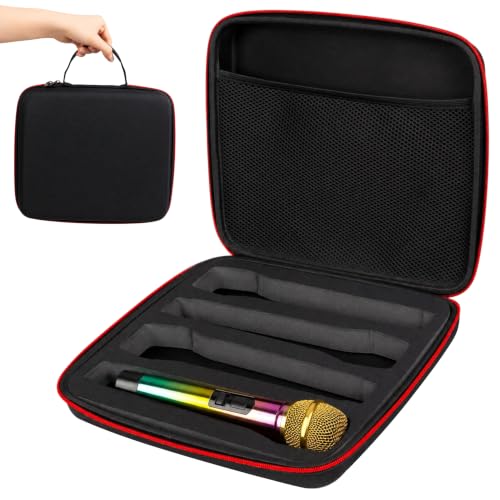
- Designed for four wireless microphones
- High-hardness shell resists pressure and shocks
- Mesh pocket stores receivers and accessories
Best For: Gigging with a four-microphone wireless system
Best Compact Hard-Shell Pick – Four-Mic Travel Case
For small studios seeking microphone storage cases for small studios, this CASEMATIX case offers a compact way to protect and organize up to four handheld microphones. Its hard EVA shell, padded dividers, and lid storage make it practical for studio storage, rehearsals, and transport.
Best For: Small studios with up to four wireless microphones or up to eight wired microphones.
Pros:
- Hard, impact-resistant EVA exterior helps protect against drops and dings.
- Four separate padded channels fit microphones up to 10.75 inches long.
- Mesh lid storage holds cables and small accessories.
- Compact dimensions, dual zippers, and a rubber handle support easy transport.
Cons:
- Designed primarily for handheld microphones rather than larger studio equipment.
- The four microphone channels may be less flexible than fully customizable foam layouts.
This is a focused, portable option for studios that want dedicated microphone protection without carrying a large equipment bag.
Best High-Capacity Organizer – DJ Cable and Mic Gear Bag
Among microphone storage cases for small studios, this padded DJ organizer is the most versatile for teams storing microphones alongside cables, headphones, and other production gear. Its removable dividers let you adapt the main compartment as your setup changes.
Best For: Small studios, mobile recording teams, and musicians who need to carry microphones with extensive accessories.
Pros:
- Six-sided padding helps protect gear and helps the bag maintain its shape.
- Eight removable dividers allow customizable organization and tangle reduction.
- Large 22 x 13 x 12-inch capacity includes microphone pockets and a 17-inch laptop pocket.
- Hand-carry, shoulder, backpack, and luggage-strap options support travel.
Cons:
- Its large size may be excessive for studios storing only microphones.
- Soft-sided construction provides less crush protection than a hard case.
- The supplied listing dimensions contain an inconsistent 1 x 1 x 1-inch detail, so verify sizing before purchase.
This bag makes sense when microphone storage is part of a broader mobile production workflow, especially for studios that regularly transport cables and accessories together.
Best Crush Protection – Two-Mic Hard Case
This TANKENLID case is a strong choice among microphone storage cases for small studios when impact protection is the priority. The crushproof composite shell and formfitting foam are designed for two microphones, a receiver, and related additions.
Best For: Small studios using a two-microphone wireless system with a receiver.
Pros:
- Crushproof composite plastic exterior helps defend against impacts and drops.
- Pre-cut foam cushioning holds two microphones, a receiver, and accessories.
- Briefcase-style handle supports straightforward transport.
- Reinforced hinges are designed for repeated opening and closing.
Cons:
- It is less suitable for studios needing storage for more than two microphones.
- The rigid case is larger and heavier than compact soft microphone bags.
- It includes the case only, not microphones or other equipment.
Choose this model when a dedicated, rigid enclosure matters more than maximum capacity or flexible interior reconfiguration.
Best Lightweight Option – Three-Slot Mic Carrying Case
For compact microphone storage cases for small studios, this three-slot carrying case balances padded protection with a lightweight design. Adjustable dividers create space for three microphones, while mesh pockets keep cables and adapters close at hand.
Best For: Home and small studios storing up to three handheld microphones for recording, singing, or karaoke.
Pros:
- Three configurable padded slots accommodate microphones up to 11 inches.
- Velvet padding and padded dividers help reduce bumps and friction.
- Three extra mesh pockets store cables and adapters.
- Compact dimensions, dual zippers, and a shoulder strap make it easy to carry.
Cons:
- Nylon construction offers less impact protection than a hard-shell case.
- Capacity is limited to three microphones and small accessories.
This is a practical everyday case for studios that need organized microphone storage without the bulk of a larger equipment organizer.
Best Customizable Hard Case – 12-Mic Wireless Microphone Case
For small studios managing several wireless handheld microphones, the CASEMATIX case offers a structured way to protect and organize gear. Its hard shell and removable diced-foam trays let you create spaces for microphones, transmitters, batteries, cables, and other accessories.
Best For: Small studios, performers, and mobile audio setups carrying up to 12 wireless microphones or mixed accessories.
Pros:
- Holds up to 12 standard wireless handheld microphones or a combination of microphones and accessories.
- Two removable diced-foam trays allow a tailored fit for different equipment.
- Rugged, lightweight briefcase-style design includes a built-in carry handle.
- Egg-crate lid foam adds protection during transport.
Cons:
- The foam must be customized before use to fit your particular equipment.
- Its 16-by-13-by-6-inch size may be more case than needed for a single microphone.
At 4 pounds, this is a practical option when organization and capacity matter more than minimal size. The customizable interior makes it particularly useful for studios whose wireless microphone inventory changes over time.
Best Soft-Sided Organizer – 6-Slot Wireless Microphone Carrying Case
This padded carrying bag is a flexible choice for small studios looking for microphone storage cases for small studios that are easy to transport. It stores six microphones in a dedicated compartment while leaving room for cables, chargers, clips, lavaliers, and other accessories.
Best For: Small studios, karaoke setups, and performers who need lightweight storage for six microphones plus accessories.
Pros:
- Dedicated storage for up to six microphones with a removable divider for cords, cables, or a headset.
- Front and inner mesh pockets help organize clips, lavaliers, chargers, and small equipment.
- All-round padding and soft velvet microphone compartments help cushion gear.
- Padded handle, detachable shoulder strap, and luggage belt provide multiple carrying options.
Cons:
- Soft-sided construction does not provide the same rigid protection as a hard case.
- The storage capacity is limited to six microphones.
Weighing 0.81 kg, this nylon bag favors portability and flexible organization. It is a sensible fit when you regularly carry microphones and supporting accessories but do not need a rigid protective shell.
Best Single-Mic Protective Case – Custom-Foam Microphone Hard Case
For a small studio protecting one primary microphone and a few essentials, this hard case combines a pre-cut mic slot with a DIY foam area. The shell, foam liner, dustproof construction, and IPX2 water resistance provide a more protective storage approach for studio-to-stage transport.
Best For: Studio owners and mobile recording setups carrying one microphone plus small audio gear or cables.
Pros:
- Pre-cut slot fits microphones up to 27 cm, with a 19-by-15 cm customizable area.
- Hard shell and foam liner are designed to protect against impacts and bumps.
- Padlock holes, an easy-access switch, and ergonomic handle support transport and security.
- Listed as shockproof, dustproof, and IPX2 water resistant.
Cons:
- The layout is intended primarily for one microphone.
- Its compact interior limits the amount of additional equipment it can hold.
This case is a focused solution rather than a multi-microphone organizer. The combination of a fixed microphone slot and customizable accessory area makes it useful for protecting a main studio microphone with cables or small audio gear.
Best High-Capacity Pick – 9-Slot Wireless Microphone Carrying Case
For small studios managing several handheld microphones, this microphone storage case offers nine dedicated mic spaces in a padded nylon carry bag. Its removable dividers and accessory pockets make it practical for organizing microphones, cables, chargers, and clips.
Best For: Studios, karaoke setups, singers, and stage users transporting up to nine microphones and related accessories.
Pros:
- Individual storage for up to nine microphones.
- Thickened velvet padding helps protect against impacts, bumps, and drops.
- Removable dividers can create more room for cords and cables.
- Includes front and mesh pockets plus hand, shoulder, and trolley carrying options.
Cons:
- The larger 14 x 7.5 x 11.5-inch design may be more capacity than a very compact studio needs.
- It is a soft-sided bag rather than a hard protective case.
This is the most versatile option here for studios that need high capacity and flexible organization. Choose it when accessory storage and multiple carrying methods matter as much as microphone protection.
Best Compact Organizer – 8-Slot Wireless Microphone Storage Bag
This compact microphone storage case is designed for small studios that want organized microphone transport without a bulky bag. It has eight slots, six removable sponges for adjusting the interior, and a lightweight polyester construction with a portable top handle.
Best For: Portable studio kits, outdoor trips, karaoke users, and anyone needing compact storage for up to eight microphones.
Pros:
- Eight microphone slots keep handheld mics arranged in one case.
- Six removable sponges allow the interior to be adjusted for different microphone sizes.
- Thickened material helps resist collisions and scratches.
- Compact 11.8 x 4.3 x 11.8-inch size with a smooth metal zipper and carrying handle.
Cons:
- The supplied details identify a main compartment but do not list dedicated accessory pockets.
- It uses a handle-only carrying design, without a shoulder strap.
Pick this case when compact organization is the priority. Its removable interior padding gives it useful flexibility, while the narrow profile suits portable recording, singing, and event setups.
Best Hard-Shell Protection – 4-Slot Wireless Microphone Case
For small studios that travel with a four-microphone wireless system, this microphone storage case combines individual slots with a high-hardness shell. A padded divider separates the microphones from the mesh lid pocket, which stores receivers, batteries, cables, and other small audio accessories.
Best For: Gigging performers, DJs, event users, and studios carrying four wireless microphones with their essential system accessories.
Pros:
- Four individual microphone slots keep a wireless set organized.
- High-hardness shell and thickened lining help protect against pressure and shocks.
- Top mesh pocket stores receivers, adapters, batteries, and cables separately.
- Compact 12 x 11 x 2.6-inch profile includes dual zippers and a rubber handle.
Cons:
- Capacity is limited to four microphones.
- The compact interior may not accommodate larger accessory collections.
- It is tailored to a four-mic system rather than general high-capacity storage.
This is the strongest fit for users who prioritize a rigid exterior and compact travel storage. It offers focused protection and organization for a four-microphone wireless setup without the footprint of a larger multi-slot bag.
How We Picked These Microphone Storage Cases for Small Studios
We focused on cases that address the everyday needs of small recording rooms, rehearsal spaces, mobile DJs, karaoke setups, and compact live-sound rigs. The selection includes hard-shell protection, padded soft cases, adjustable dividers, pre-cut or diced foam, and multiple microphone capacities. We also considered how clearly each case accommodates handheld microphones, wireless receivers, accessories, and cables.
Capacity was compared against real storage needs rather than treated as the only deciding factor. A four-slot case may be easier to store and carry, while a 12-microphone case can make more sense for a studio building a larger inventory. Protection, organization, portability, and fit all matter.
Quick Comparison
- Best for maximum protection: Hard-shell cases with molded or customizable foam.
- Best for flexible layouts: Diced-foam models or bags with removable dividers.
- Best for small collections: Three- or four-slot carrying cases.
- Best for expanding setups: Six-, eight-, nine-, or 12-slot cases.
- Best for mixed accessories: Multi-pocket organizer bags with room for cables and adapters.
Key Buying Factors
Capacity and Interior Dimensions
Count the microphones you own now, then consider near-term additions. Confirm the maximum microphone length and slot width, especially when storing larger handheld transmitters, receivers, or microphones with unusual shapes. Slot counts can refer only to microphones, so check whether accessory compartments reduce usable space.
Protection Level
A hard shell offers better resistance to crushing and impacts during transport or crowded storage. Thick padding may be sufficient for a case that stays in the studio and needs to remain lightweight. For valuable wireless systems, look for cushioning around both the microphones and receivers, plus a secure closure.
Organization and Customization
Fixed slots provide quick access and prevent equipment from shifting. Removable dividers are useful when microphone sizes vary, while diced or DIY foam lets you create a more precise fit. Separate pockets can keep cables, batteries, clips, and adapters from rubbing against the microphones.
Portability and Storage Footprint
Handles, shoulder straps, backpack-style construction, and manageable dimensions make a difference for mobile recording or gig work. In a small studio, also measure the shelf, cabinet, or rack area where the case will live before ordering.
Who Should Buy Which Microphone Storage Cases for Small Studios?
Choose a compact three- or four-slot case if you mainly record with a small microphone collection or need a grab-and-go solution. A six- to nine-slot case suits singers, podcasters, rehearsal rooms, and small venues that need several handheld microphones ready at once. Consider a 12-slot hard case when your studio owns multiple wireless systems or needs stronger inventory control.
If your microphones vary significantly in size, prioritize customizable foam or adjustable dividers. If cables and accessories are the bigger problem, a multi-pocket organizer bag may be more useful than a microphone-only case. For frequent travel, favor a shock-resistant hard shell; for occasional studio storage, padded construction can offer a lighter and less expensive alternative.
