The best network audio streamers for home theaters make it easier to bring streaming services, local music, and multi-room playback into an existing entertainment system. The right model can also improve connectivity, simplify control, and reduce the need for separate components.
This roundup covers compact wireless receivers, streaming preamps, integrated amplifiers, premium DACs, and multi-zone audio hardware. Use the buying guide below to match features, outputs, room size, and system requirements before you choose.
Best 10 Network Audio Streamers for Home Theaters Picks for 2026
Flexible Hi-Res Hub
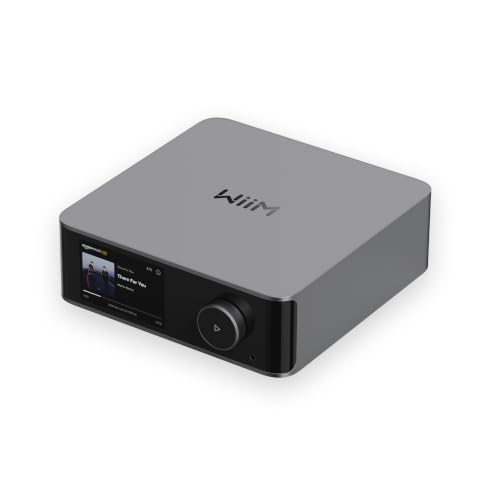
- 24-bit/192 kHz streaming
- HDMI ARC and subwoofer output
- Touchscreen, room correction, and broad connectivity
Best For: Existing stereo or 2.1 home theater systems
MusicCast System Builder

- Adds streaming to existing AV gear
- Wi-Fi, Bluetooth, AirPlay, and Spotify Connect
- Compact preamplifier design
Best For: Existing AV receivers and hi-fi systems
Flagship Room-Tuning Streamer

- ES9039PRO DAC and balanced preamp
- Built-in room correction
- Dual subwoofer outputs with adjustable controls
Best For: High-end stereo or 2.1 systems
All-in-One TV Audio Upgrade

- 60 watts per channel at 8 ohms
- HDMI ARC and powered-subwoofer output
- Streaming amplifier for passive speakers
Best For: Compact stereo TV and music systems
Reference-Grade Control
Gustard X26III Network Streamer

- Dual ES9039SPRO DAC architecture
- Wide range of digital inputs
- PCM768k, DSD512, and MQA support
Best For: Audiophiles building a flexible two-channel home theater system
Easy Multi-Room Upgrade
M5 AudioCast Wireless Streamer

- AirPlay and DLNA Wi-Fi streaming
- Multi-room support for up to eight rooms
- App control for iOS and Android
Best For: Streaming music to existing speakers throughout the home
Complete Listening Hub
Naim Uniti Star Network Streamer

- Integrated streamer, DAC, and amplifier
- 70W-per-channel Class AB amplification
- CD ripping with custom software
Best For: Premium stereo listening with minimal separate components
Best with Extra Features

- HDMI eARC, phono, USB, optical, coaxial, and RCA connectivity
- AirPlay 2, Google Cast, Spotify, Tidal, Qobuz, and Roon support
- Bluetooth 5.4 with LDAC, Auracast, and high-resolution playback
Best For: Mixed home theater and stereo systems needing broad input and streaming support
Touchscreen Theater Streamer

- HDMI ARC and subwoofer output for stereo or 2.1 systems
- ESS DAC, Wi-Fi 6, touchscreen, and up to 24-bit/192kHz playback
- Room correction, EQ, and broad streaming-service support
Best For: TV-based stereo or 2.1 home theaters with a powered subwoofer
Whole-Home Zone Powerhouse
Soundavo WS66i 6-Zone Amplifier

- Six sources and six independently controlled audio zones
- 100 watts per zone for in-ceiling and in-wall speakers
- AirPlay, Spotify Connect, DLNA, USB, and expansion to 18 zones
Best For: Centralized multi-room audio installations with multiple speaker zones
Flexible Hi-Res Hub – WiiM Ultra
The WiiM Ultra is a versatile choice among network audio streamers for home theaters, combining high-resolution streaming with HDMI ARC, subwoofer output, and extensive digital and analog connectivity. Its touchscreen, app control, and room-correction features make it practical for both music and two-channel TV audio.
Best For: Listeners who want a feature-rich streamer for an existing stereo or 2.1 home theater system.
Pros:
- Supports streaming up to 24-bit/192 kHz with services including Spotify, TIDAL, Qobuz, and Amazon Music.
- Offers HDMI ARC, phono, RCA, optical, coaxial, USB, headphone, and subwoofer connections.
- Includes a 3.5-inch touchscreen, Wi-Fi 6, Bluetooth 5.3, EQ, and room correction.
Cons:
- It is incompatible with AirPlay and cannot act as an AirPlay receiver.
- Its stereo/2.1 focus is not intended for discrete multichannel surround sound.
The WiiM Ultra stands out for connectivity and setup flexibility. It is especially compelling when you want one compact component to connect streaming services, a TV, analog sources, and a powered subwoofer.
MusicCast System Builder – Yamaha WXC-50
The Yamaha WXC-50 is a straightforward network audio streamer for home theaters that adds wireless music playback to an existing AV receiver or hi-fi system. It supports Wi-Fi, Bluetooth, AirPlay, Spotify Connect, and voice control through Alexa-compatible devices.
Best For: Owners of an existing Yamaha-compatible or conventional home audio system who want convenient wireless streaming.
Pros:
- Designed to connect an existing home theater AV receiver or hi-fi system.
- Supports Wi-Fi, Bluetooth, AirPlay, and Spotify Connect.
- Provides access to a music library, Pandora, Spotify, Rhapsody, and other services.
Cons:
- Its listed streaming-service support is less extensive than newer competitors.
- It is a preamplifier/streaming component, not a power amplifier for passive speakers.
- Alexa control requires a separately sold Alexa device.
The WXC-50 is best viewed as a compact way to modernize an existing audio system rather than replace an entire home theater stack. Its main appeal is the combination of MusicCast functionality and broad wireless input options.
Flagship Room-Tuning Streamer – EVERSOLO DMP-A10
The EVERSOLO DMP-A10 is a premium network audio streamer for home theaters and serious stereo systems, combining a DAC, preamplifier, streaming platform, and room-correction system. Its ES9039PRO DAC, balanced analog circuitry, dual subwoofer outputs, and large touchscreen are aimed at listeners building a high-end digital front end.
Best For: High-end stereo or 2.1 setups where DAC performance, balanced connections, room correction, and subwoofer control matter.
Pros:
- Combines a streamer, DAC, and preamplifier in one component.
- Supports TIDAL, Qobuz, Amazon Music, TuneIn, Radio Paradise, and additional services.
- Offers room correction, dual subwoofer outputs, and adjustable crossover, gain, and delay settings.
- Uses an ES9039PRO DAC with a fully balanced analog preamplifier circuit.
Cons:
- Its premium feature set may be excessive for basic streaming needs.
- Subwoofer functionality is limited to PCM signals below 192 kHz.
- The supplied notes do not indicate discrete multichannel home theater decoding.
The DMP-A10 is a component for buyers prioritizing refinement and system tuning over simplicity. Its room correction and flexible subwoofer management make it particularly adaptable to demanding stereo-based theater systems.
All-in-One TV Audio Upgrade – WiiM Amp
The WiiM Amp combines streaming and amplification in a compact option for network audio streamers for home theaters. With HDMI ARC, 60 watts per channel at 8 ohms, support for passive speakers, and a powered-subwoofer output, it can turn a pair of bookshelf or floor-standing speakers into a simple TV and music system.
Best For: Living-room systems using passive speakers that need streaming, TV connectivity, and straightforward stereo amplification.
Pros:
- Delivers 60 watts per channel at 8 ohms and 120 watts per channel at 4 ohms.
- HDMI ARC makes it easy to connect a TV, while a subwoofer output supports expanded bass.
- Streams up to 24-bit/192 kHz and supports Spotify Connect, TIDAL Connect, Chromecast Audio, and AirPlay 2 reception.
- Includes app, remote, voice control, EQ, and room-correction features.
Cons:
- It provides stereo or dual-mono output rather than discrete surround sound.
- It cannot transmit AirPlay to other AirPlay-enabled speakers or devices.
- It is intended for passive speakers and does not replace a multichannel AV receiver.
The WiiM Amp is a practical all-in-one solution when the goal is better TV and music sound without a separate amplifier and streamer. Its compact design and HDMI ARC connection keep setup simple while leaving room to add a powered subwoofer.
Reference-Grade Control – Gustard X26III Network Streamer
For listeners building a serious system around network audio streamers for home theaters, the Gustard X26III combines streaming-oriented digital connectivity with a balanced DAC and preamp design. Its dual ESS conversion architecture, extensive inputs, and Class-A analog circuitry make it suited to systems where source flexibility and stereo sound quality matter.
Best For: Audiophiles who need a versatile DAC/preamp for a two-channel home theater or dedicated music system.
Pros:
- Dual ES9039SPRO chips use separate left- and right-channel conversion paths.
- Supports USB, LAN, optical, coaxial, AES, IIS, and clock connections.
- USB supports PCM768k, DSD512, and full MQA decoding through its XMOS XU216 interface.
- Discrete Class-A circuits are designed for low distortion, low noise, and natural reproduction.
Cons:
- Its two-channel design is better suited to stereo systems than multichannel surround processing.
- The extensive connection and clock options may be more than casual listeners need.
The X26III is a feature-rich choice when a home theater system also serves as a high-quality stereo listening setup. It is most compelling for buyers who already have amplification and speakers and want a flexible digital front end.
Easy Multi-Room Upgrade – M5 AudioCast Wireless Streamer
The M5 AudioCast is a compact, app-controlled option for adding wireless playback to an existing speaker or Hi-Fi setup. Among network audio streamers for home theaters, it stands out for simple Wi-Fi streaming, AirPlay and DLNA compatibility, and multi-room control from iOS or Android devices.
Best For: Households that want an affordable way to stream music to existing speakers and coordinate playback across multiple rooms.
Pros:
- Streams from smartphones, tablets, and laptops over Wi-Fi to an existing audio system.
- Supports multi-room playback across up to eight rooms.
- Works with iOS and Android apps and supports services including Spotify, TIDAL, Pandora, and TuneIn.
- Compact design, app control, equalizer features, alarms, and sleep-timer functions add convenience.
Cons:
- It provides stereo output rather than a full multichannel home theater platform.
- Setup guidance advises avoiding the manual’s web-console connection option for some devices.
- The supplied notes do not identify a current software-update date.
This is a practical add-on for modernizing older speakers without replacing the whole system. Choose it for convenient music distribution and app control, not for advanced home theater decoding or high-end standalone DAC features.
Complete Listening Hub – Naim Uniti Star Network Streamer
The Naim Uniti Star is an all-in-one alternative to assembling separate network audio streamers for home theaters, DACs, and amplifiers. It combines network playback, digital conversion, a 70-watt-per-channel Class AB amplifier, and a CD-ripping drive in one substantial tabletop component.
Best For: Buyers who want a premium, space-saving stereo system with streaming, CD ripping, and built-in amplification.
Pros:
- Combines a network streamer, DAC, and 70W-per-channel Class AB amplifier.
- Built-in CD-ROM drive includes custom software for ripping CDs.
- Dual-band 2.4GHz and 5GHz Wi-Fi supports flexible network placement.
- Offers touch and button controls along with smartphone, tablet, and laptop compatibility.
Cons:
- Its stereo output is designed for music listening rather than multichannel surround systems.
- At 30.9 pounds, it is considerably heavier than a compact streaming adapter.
- It is a complete integrated component, so upgrading individual amplification stages may be less straightforward.
The Uniti Star makes sense when simplicity and component consolidation are priorities. Its integrated amplifier and CD-ripping capability can reduce system clutter, while its network connectivity keeps it relevant for modern stereo playback.
Best with Extra Features – Arylic LP100
The Arylic LP100 is a versatile choice for listeners comparing network audio streamers for home theaters. HDMI eARC with CEC connects it to a TV, while its broad input and output selection supports amplifiers, active speakers, subwoofers, turntables, computers, and network music services.
Best For: Home theater users who want streaming, TV audio, vinyl support, and flexible system integration in one preamp.
Pros:
- Supports AirPlay 2, Google Cast, Spotify Connect, Tidal Connect, Qobuz Connect, and Roon Ready playback.
- HDMI eARC with CEC can pass TV audio and allow compatible remote control of power and volume.
- Includes phono, USB-B DAC, optical, coaxial, RCA, subwoofer, and trigger connections.
- Uses an AKM AK4493SEQ DAC and supports high-resolution playback up to 24-bit/192kHz with compatible services.
Cons:
- The Go Control app is required for network setup and several playback controls.
- Some features and maximum resolutions depend on the streaming service or connection method.
- Its one-year manufacturer warranty is shorter than some competing options.
The LP100 stands out when connectivity matters as much as streaming. It is a strong fit for a mixed home theater and two-channel system, especially if you also use a turntable or active subwoofer.
Touchscreen Theater Streamer – WiiM Ultra
The WiiM Ultra is a polished option among network audio streamers for home theaters, combining a touchscreen interface, ESS DAC, HDMI ARC, and subwoofer output. It can serve as the control center for a stereo or 2.1 setup while also supporting high-resolution network playback and room correction.
Best For: Stereo or 2.1 home theater systems that benefit from HDMI ARC, a dedicated subwoofer connection, touchscreen control, and room-tuning tools.
Pros:
- Includes HDMI ARC and subwoofer output for straightforward TV and bass-system integration.
- Features an ESS ES9038 Q2M DAC, Wi-Fi 6, Bluetooth 5.3, and a 3.5-inch touchscreen.
- Supports up to 24-bit/192kHz playback, Spotify Connect, TIDAL Connect, Qobuz Connect, Google Cast, and Roon Ready.
- Offers room correction and independent EQ settings through the WiiM Home App.
Cons:
- It is incompatible with AirPlay and cannot function as an AirPlay receiver.
- Its home theater configuration is stereo/2.1 rather than a multichannel surround processor.
- Some setup and personalization features depend on the WiiM app.
The WiiM Ultra is a particularly practical choice for a two-channel TV system with a powered subwoofer. Its touchscreen and broad digital and analog connectivity make everyday operation easier, while room correction adds useful flexibility.
Whole-Home Zone Powerhouse – Soundavo WS66i 6-Zone Amplifier
The Soundavo WS66i takes a different approach to network audio streamers for home theaters by combining streaming with amplification and whole-house distribution. It can independently serve six zones, power in-wall or in-ceiling speakers, and be controlled through a mobile app.
Best For: Larger homes and custom installations that need centralized amplification, multiple audio sources, and independent music control across several rooms.
Pros:
- Provides six source inputs and six independently controllable zone outputs.
- Delivers up to 100 watts per zone for compatible in-wall or in-ceiling speaker systems.
- Built-in streaming supports AirPlay, Spotify Connect, DLNA, and USB playback.
- Multiple units can be linked to expand the system to as many as 18 zones.
Cons:
- It is a centralized whole-home amplifier rather than a compact standalone streamer.
- The installation requires compatible passive speakers and wiring for each zone.
- Its listed audio format support identifies MP3, so it is less focused on high-resolution music than the other options.
The WS66i is best evaluated as an integrated multi-room installation platform. If your priority is distributing music to many rooms while powering ceiling speakers from one rack-mounted component, its six-zone architecture is more suitable than a conventional single-system streamer.
How We Picked the Best Network Audio Streamers for Home Theaters
We focused on the features that matter when adding network audio to a home theater or listening room: streaming-service support, wireless standards, wired network connectivity, digital and analog outputs, DAC capability, app quality, multi-room support, and system flexibility. We also included products for different installation types, from simple plug-in receivers to full streaming amplifiers and distributed-audio controllers.
Because these products serve different roles, the list includes both source components and models with amplification. Check the product specifications carefully to confirm compatibility with your receiver, active speakers, passive speakers, or whole-home audio wiring.
Quick Comparison
| Best For | Recommended Type | What to Look For |
|---|---|---|
| Adding streaming to an existing system | Wireless receiver or streamer | RCA, optical, coaxial, or USB output; app support |
| Two-channel systems | Streaming preamp or DAC | High-quality analog outputs, volume control, balanced connections |
| Passive speakers | Streaming amplifier | Speaker power, HDMI ARC, subwoofer output, room correction |
| Premium separates | Network DAC/preamp | Balanced circuitry, clock inputs, extensive digital connectivity |
| Whole-home audio | Multi-zone amplifier | Zone count, power per channel, app control, installation wiring |
Key Buying Factors for Network Audio Streamers for Home Theaters
Connectivity and System Matching
Start by identifying the inputs and outputs your system actually needs. HDMI ARC is useful for television audio, while optical and coaxial outputs work well with many AV receivers and DACs. Balanced XLR connections are more relevant to premium two-channel systems. Ethernet can provide a more stable connection than Wi-Fi in congested networks.
Streaming Platforms and Control
Confirm support for the services you use, such as Spotify Connect, Tidal Connect, Qobuz, Amazon Music, AirPlay 2, Google Cast, or DLNA. A responsive app and physical display can make everyday control easier, especially when the streamer is installed away from the listening position.
DAC, Resolution, and Room Correction
Higher-resolution support and a capable DAC can be valuable, but they should not outweigh practical system compatibility. Room correction can be especially helpful in home theaters and difficult rooms, where speaker placement and acoustics often affect sound more than small specification differences.
Amplification and Installation
If you already own an AV receiver or power amplifier, choose a line-level streamer or preamp rather than paying for unused amplification. For passive speakers, an integrated streaming amplifier may save space and simplify setup. Multi-zone models require careful planning for speaker impedance, cable runs, ventilation, and per-zone power.
Who Should Buy Which Network Audio Streamers for Home Theaters?
Choose a compact wireless receiver if you want the least expensive way to add streaming to an existing stereo or powered speaker setup. Select a WiiM or Yamaha-style streamer/preamp when you need flexible outputs, app control, and straightforward integration with separate components. A streaming amplifier is the better choice for a minimalist system built around passive speakers and a television.
Listeners upgrading a revealing two-channel system may prefer a premium network DAC or preamp with balanced outputs and extensive digital inputs. Buyers planning audio throughout the house should consider a multi-zone amplifier instead of separate streamers for every room. Finally, an all-in-one network amplifier is ideal when convenience, fewer boxes, and a cohesive user experience matter more than component-by-component upgrades.
