The best network audio streamers make it easier to enjoy Spotify, Tidal, Qobuz, internet radio, and local music through a traditional stereo or a modern hi-fi system.
Our 2026 roundup includes compact upgrades, feature-rich DACs, preamp-equipped components, and high-end streamer transports for different budgets and listening setups.
Best 10 Network Audio Streamers Picks for 2026
Best All-Rounder
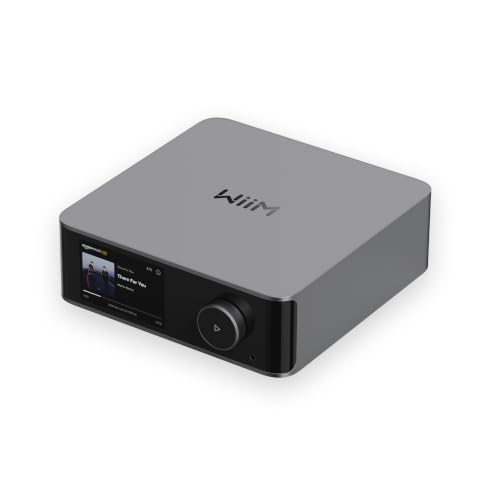
- ESS DAC with high-resolution 24-bit/192 kHz playback
- HDMI ARC, phono, headphone, USB, optical, and coaxial connections
- Touchscreen, Wi-Fi 6, room correction, and multiroom support
Best For: Flexible stereo, TV, headphone, and multiroom systems
Premium Music Center

- Combines streamer, DAC, preamp, and room-correction functions
- High-speed electrical and USB isolation with OCXO clock
- 6.5-inch display plus Ethernet, HDMI, and SFP fiber connectivity
Best For: Advanced systems needing a premium streaming control center
Best for Headphones and TV

- Dual-mono ESS DAC design with balanced XLR outputs
- THX AAA headphone amplifier and full-size headphone connections
- AirPlay 2, HDMI eARC, Bluetooth, and BluOS multiroom support
Best For: Premium stereo, headphone, TV, and whole-home listening
Best Digital Transport

- Dual femtosecond clocks with electrically isolated digital outputs
- IIS, AES/EBU, USB Audio, coaxial, and optical output options
- Wi-Fi 6, high-resolution streaming, touchscreen, remote, and app control
Best For: External-DAC systems requiring a highly configurable digital source
Compact Hi-Fi Upgrade

- 24-bit/192kHz playback with ESS SABRE DAC
- BluOS multi-room and broad streaming support
- RCA, optical, coaxial, USB, Wi-Fi, Ethernet, and Bluetooth
Best For: Existing stereo systems needing BluOS and flexible connectivity
Simple App-Friendly Endpoint

- AirPlay 2, Chromecast, Spotify Connect, Tidal Connect, and Roon
- 24-bit/192kHz playback with PCM5141 DAC
- Analog, optical, coaxial, Wi-Fi, Ethernet, and Bluetooth outputs
Best For: App-focused streaming into an existing audio system
Flexible Whole-Home Streamer

- 24-bit/192kHz playback with gapless support
- AirPlay 2, Google Cast, Spotify, Tidal, Qobuz, and Roon Ready
- Multi-room, voice control, RCA, optical, coaxial, USB-C, Wi-Fi, and Ethernet
Best For: Whole-home streaming and smart-home-integrated stereo upgrades
High-Resolution Bridge

- USB output supports up to PCM 768kHz/32-bit and DSD256 with Roon Ready playback.
- AirPlay, Spotify, Tidal, and Amazon Music support.
- Gigabit Ethernet, dual-band Wi-Fi, LCD, and control knob.
Best For: Component Hi-Fi systems needing high-resolution network playback
Connected Stereo Upgrade

- AirPlay 2, Google Cast, Spotify Connect, TIDAL Connect, and Roon Ready.
- 24-bit/192kHz playback with analog and digital outputs.
- Supports multiroom groups across WiiM, AirPlay, Google, and Alexa devices.
Best For: Flexible whole-home streaming and stereo system upgrades
Compact AirPlay Choice

- Up to 24-bit/192kHz playback through digital and analog outputs.
- AirPlay 2, Spotify Connect, TIDAL Connect, Alexa, and Siri support.
- Compact option for stereo, DAC, amplifier, or powered speaker setups.
Best For: Affordable AirPlay and Wi-Fi streaming for existing stereo systems
Best All-Rounder – WiiM Ultra
The WiiM Ultra is a versatile choice among network audio streamers, combining a touchscreen, high-resolution playback, extensive inputs and outputs, and straightforward app control. It can serve as the hub for a stereo system, home theater setup, or multiroom arrangement.
Best For: Buyers wanting one flexible streamer for music, TV audio, analog sources, headphones, and multiroom listening.
Pros:
- ESS ES9038 Q2M DAC, 24-bit/192 kHz playback, and detailed audio specifications.
- Wide connectivity, including HDMI ARC, phono, RCA, optical, coaxial, USB, and headphone output.
- 3.5-inch touchscreen, Wi-Fi 6, Bluetooth 5.3, room correction, and multiroom support.
Cons:
- It is not compatible with AirPlay or usable as an AirPlay receiver.
- Its many features may be more than needed for a simple streaming-only system.
The WiiM Ultra stands out for practical flexibility. Its combination of source inputs, TV integration, subwoofer support, and broad streaming compatibility makes it a strong fit for systems that may evolve over time.
Premium Music Center – Eversolo DMP-A10
The Eversolo DMP-A10 is a premium network audio streamer designed to act as a central music source, preamp, and DAC. Its high-speed processing, large display, extensive format support, and advanced isolation features suit complex home audio systems.
Best For: Enthusiasts building an advanced system around a streamer, DAC, and balanced preamp.
Pros:
- Combines network playback, DAC functionality, and balanced preamp duties in one chassis.
- Includes high-speed electrical and USB isolation, an OCXO clock system, and digital room correction.
- Offers Ethernet, HDMI, SFP fiber, multi-service streaming, and a 6.5-inch LCD touchscreen.
Cons:
- The supplied details do not specify the full list of streaming services or output connections.
- Its 12.46 kg chassis and advanced feature set may be excessive for simpler setups.
The DMP-A10 is aimed at listeners who want a refined, feature-rich control center rather than a basic network endpoint. Its combination of isolation, room correction, and preamp functionality can simplify a sophisticated system.
Best for Headphones and TV – Bluesound NODE ICON
The Bluesound NODE ICON is a high-end network audio streamer with dual-mono DAC architecture, balanced XLR outputs, a full-color display, and a powerful headphone amplifier. It also brings BluOS multiroom control, AirPlay 2, Bluetooth, and HDMI eARC to a home audio system.
Best For: Listeners who want premium stereo playback, serious headphone listening, and integrated TV or multiroom functionality.
Pros:
- Dual ESS SABRE DACs, QRONO d2a technology, and balanced XLR outputs target detailed playback.
- THX AAA headphone amplification supports dedicated listening through full-size headphone jacks.
- Includes AirPlay 2, aptX Adaptive Bluetooth, HDMI eARC, BluOS multiroom, and a 5-inch display.
Cons:
- Dirac Live requires an upgrade, and a calibration microphone is an additional purchase.
- The advanced feature set may be unnecessary for users seeking only basic network playback.
The NODE ICON is particularly versatile for households that alternate between speakers, headphones, television audio, and whole-home listening. Its broad connectivity and BluOS platform make it an adaptable centerpiece.
Best Digital Transport – Eversolo T8
The Eversolo T8 is a network audio streamer built as a dedicated digital transport. Rather than emphasizing analog outputs, it focuses on isolated IIS, coaxial, AES/EBU, USB Audio, and optical connections for pairing with an external DAC.
Best For: Digital-focused systems using an external DAC and listeners who value clock precision, isolation, and extensive transport outputs.
Pros:
- Dual femtosecond clocks and electrically isolated digital outputs are designed to reduce jitter and ground-loop noise.
- Supports TIDAL Connect, Qobuz Connect, Spotify Connect Lossless, Roon Ready, and high-resolution formats.
- 6-inch touchscreen, remote and app control, Wi-Fi 6, room calibration, and 10-band parametric EQ.
Cons:
- It is a transport, so buyers need a separate DAC for analog playback.
- SFP modules are sold separately and must be compatible with the selected SFP switch.
- IIS compatibility may require choosing among its eight supported pinout configurations.
The T8 makes the most sense when a system already has—or is being built around—a preferred external DAC. Its isolated outputs, clocking architecture, and broad digital connectivity give experienced users considerable setup flexibility.
Compact Hi-Fi Upgrade – Bluesound Node Nano
The Bluesound NODE NANO is a compact choice among network audio streamers for listeners who want to modernize an existing stereo amplifier or powered-speaker setup. It combines high-resolution playback, BluOS multi-room support, and a broad selection of wired and wireless connections in a small enclosure.
Best For: Existing stereo systems that need BluOS multi-room streaming and flexible high-resolution connectivity.
Pros:
- Supports audio up to 24-bit/192kHz through its ESS SABRE ES9039Q2M DAC.
- Offers stereo RCA, optical, coaxial, USB, Ethernet, dual-band Wi-Fi, and aptX Adaptive Bluetooth.
- Works with AirPlay 2, Spotify Connect, Tidal Connect, MQA, and local server mode.
- Can group with other Bluesound players for multi-room playback.
Cons:
- DSD playback is listed as available through a future update.
- Its feature set may be more than needed for a simple single-room setup.
With gapless playback, IR remote learning, programmable presets, and wall-mounting support, the NODE NANO is a well-equipped bridge for upgrading legacy audio gear without replacing the whole system.
Simple App-Friendly Endpoint – NAD CS1 Endpoint
The NAD CS1 Endpoint is one of the more straightforward network audio streamers for adding modern services to an existing audio system. It supports popular app-based platforms without requiring extra software, while its analog and digital outputs make it easy to connect to different equipment.
Best For: Listeners who want broad streaming-app compatibility and a compact endpoint for an amplifier, receiver, external DAC, or powered speakers.
Pros:
- Supports AirPlay 2, Chromecast, Spotify Connect, Tidal Connect, Bluetooth, DLNA apps, and Roon.
- Delivers up to 24-bit/192kHz audio using a Texas Instruments PCM5141 DAC.
- Includes stereo RCA, optical, and coaxial outputs for flexible system integration.
- Offers dual-band Wi-Fi, Ethernet, and Bluetooth connectivity.
Cons:
- The supplied notes provide fewer details about multi-room functionality than some competing models.
- Its compact endpoint design is focused on audio streaming rather than broader system-control features.
The CS1 is a practical plug-and-play option when you value compatibility with familiar music apps and want the choice of analog or digital signal paths in a minimalist enclosure.
Flexible Whole-Home Streamer – WiiM Pro Plus
The WiiM Pro Plus is a versatile pick among network audio streamers for upgrading a conventional stereo with high-resolution playback and broad smart-home integration. It supports direct streaming from several major services, multiple output formats, and synchronized playback across compatible multi-room devices.
Best For: Users who want high-resolution streaming, voice control, and flexible multi-room options across AirPlay 2, Google Cast, Alexa, or WiiM devices.
Pros:
- Streams up to 24-bit/192kHz on digital and analog outputs with gapless playback.
- Supports AirPlay 2, Google Cast, Spotify Connect, Tidal Connect, Qobuz Connect, Roon Ready, NAS, and DLNA features.
- Provides RCA, optical, coaxial, USB-C, Ethernet, Wi-Fi, and Bluetooth connectivity.
- Supports multi-room groups and voice control through Alexa, Google, or Siri-compatible setups.
Cons:
- It receives AirPlay streams but cannot transmit AirPlay to other AirPlay-enabled speakers or devices.
- Not every music service offers 24-bit/192kHz content.
With presets, a remote, and direct app connections that leave your phone available for other tasks, the WiiM Pro Plus offers an unusually broad feature set for modernizing a traditional stereo system.
High-Resolution Bridge – FiiO SR11
The FiiO SR11 is one of the more capable network audio streamers for listeners building a Hi-Fi system around a separate DAC, amplifier, or powered speaker setup. It supports AirPlay, Roon Ready playback, Ethernet, and dual-band Wi-Fi, with particularly high-resolution output available through USB.
Best For: Audiophiles who want a high-resolution streaming bridge with wired Ethernet and broad AirPlay/Roon support.
Pros:
- Supports up to PCM 768kHz/32-bit and DSD256 through USB with Roon Ready playback.
- Works with AirPlay and services including Spotify, Tidal, and Amazon Music.
- Offers stable networking through gigabit Ethernet plus 2.4GHz and 5GHz Wi-Fi.
- Front LCD and control knob make close-up setup and adjustment convenient.
Cons:
- SPDIF output is limited to PCM 192kHz/24-bit and DSD64.
- Its streaming-bridge design assumes you already have suitable decoding or amplification equipment.
The SR11 stands out when maximum USB resolution and network stability matter most. Choose it over a simpler streamer if you are assembling a component-based system and plan to use Roon or a separate DAC.
Connected Stereo Upgrade – WiiM Pro Plus
The WiiM Pro Plus is a flexible choice among network audio streamers for upgrading an existing stereo. It combines AirPlay 2, Google Cast, Spotify Connect, TIDAL Connect, Alexa, and other streaming options with analog and digital outputs, making it easy to integrate into a connected home.
Best For: Stereo owners who want broad streaming compatibility, multiroom playback, and high-resolution output from one compact device.
Pros:
- Supports AirPlay 2, Google Cast, Spotify Connect, TIDAL Connect, Alexa, and Roon Ready features.
- Streams up to 24-bit/192kHz through digital and analog outputs with gapless playback.
- Works with AirPlay, Google Home, Alexa, and WiiM multiroom groups.
- Offers Ethernet, Wi-Fi, Bluetooth, optical, coaxial, RCA, and USB Type-C connectivity.
Cons:
- It is an AirPlay receiver only and cannot transmit AirPlay to other devices.
- High-resolution availability depends on the streaming service and source material.
The Pro Plus is a strong all-around option when compatibility matters more than a single ecosystem. Its range of inputs, outputs, and multiroom platforms makes it especially practical for mixed-device households.
Compact AirPlay Choice – WiiM Mini
The WiiM Mini is a compact, affordable option for adding network audio streaming to a stereo, amplifier, DAC, or compatible smart-home setup. It focuses on Wi-Fi playback, AirPlay 2, Spotify Connect, TIDAL Connect, Alexa, and multiroom use while retaining up to 24-bit/192kHz output.
Best For: Budget-conscious listeners who need a small AirPlay-enabled streamer for an existing stereo or powered system.
Pros:
- Supports unaltered playback up to 24-bit/192kHz through digital and analog outputs.
- Works with AirPlay 2, Spotify Connect, TIDAL Connect, and Alexa Cast.
- Can join multiroom groups with AirPlay 2, Alexa, or other WiiM devices.
- Includes optical and auxiliary outputs and supports voice control through Alexa and Siri.
Cons:
- Does not support Google Cast.
- It can receive AirPlay but cannot transmit AirPlay to other AirPlay devices.
- Qobuz works through the WiiM Home app but does not support Qobuz Connect.
The Mini is a sensible pick when you want the core network audio streamer features without the broader platform support of larger WiiM models. Its limitations are easiest to accept in an Apple-, Alexa-, or WiiM-focused setup.
How We Picked These Network Audio Streamers
We selected models that offer a practical combination of sound-quality potential, streaming compatibility, connection options, software support, and value. The lineup spans simple plug-in upgrades such as the WiiM Mini and WiiM Pro, higher-spec units with integrated DACs and displays, and premium components designed for demanding digital systems.
We also considered support for widely used services and standards, including Spotify Connect, Tidal Connect, Qobuz, AirPlay 2, Chromecast, Bluetooth, and multi-room playback. Because system compatibility matters as much as specifications, each product should be evaluated against your amplifier, speakers, preferred music services, and available inputs.
Quick Comparison
| Best For | Look For | Recommended Type |
|---|---|---|
| Affordable stereo upgrade | Simple setup and broad app support | Compact streamer |
| Built-in digital conversion | Quality DAC and analog outputs | Streamer with integrated DAC |
| System control | Volume control, display, and preamp functions | Streamer-preamp |
| Multi-room listening | Compatible ecosystem and reliable wireless networking | Multi-room streamer |
| High-end digital transport | Advanced clocking and isolated outputs | Dedicated transport |
Key Buying Factors for Network Audio Streamers
Connections and System Matching
Check whether the streamer provides the outputs your system needs. Analog RCA outputs are useful when connecting directly to an older integrated amplifier, while optical, coaxial, USB, or balanced outputs may be preferable with an external DAC or modern preamp. A streamer with a volume-controlled output can simplify a system, but fixed-level output is often better when a separate preamp handles volume.
Streaming Services and Control
Native support for your preferred services is important for reliable playback and convenient browsing. AirPlay 2 and Chromecast add flexibility from phones and computers, while Spotify Connect and Tidal Connect can send playback directly from their respective apps. Check whether the manufacturer’s control app supports playlists, room grouping, firmware updates, and local music libraries.
Resolution, DACs, and File Support
Higher resolution does not automatically guarantee better sound, but compatible DAC hardware and careful implementation can matter. Confirm supported PCM and DSD formats if you maintain a local high-resolution library. If you already own a well-regarded DAC, a transport-focused model may be the better value.
Networking and Everyday Usability
Stable Wi-Fi is convenient, but Ethernet can provide a dependable connection in crowded wireless environments. Consider touchscreen or remote control options, standby behavior, app quality, and whether the unit fits your rack or desktop space.
Who Should Buy Which Network Audio Streamers?
Choose a compact WiiM, FiiO, or NAD-style endpoint if you want to modernize an existing stereo without replacing its amplifier. Step up to a streamer with a stronger DAC when you want direct analog connection and fewer components. A model with preamp features suits listeners building a simplified system around powered speakers or a power amplifier. Premium Eversolo or Bluesound options make more sense when you value a richer interface, advanced connections, multi-room integration, or higher-end system matching. Before buying, prioritize compatibility and control features over headline resolution numbers.
