When it comes to managing multiple speakers in your audio setup, having the right passive speaker selector can make all the difference. These devices not only connect various speaker pairs to a single amplifier but also give you control over volume levels for each zone. With so many options available, it’s essential to find the right fit for your needs. Let’s explore the top contenders that can enhance your listening experience.
Monoprice SSVC-4.1 Single Input 4-Channel Speaker Selector
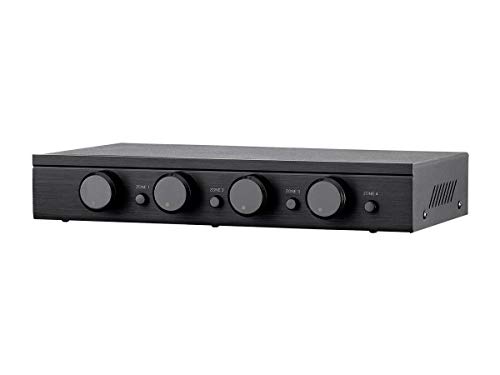
If you’re looking to connect multiple speaker pairs to a single amplifier without compromising sound quality, the Monoprice SSVC-4.1 Single Input 4-Channel Speaker Selector is an excellent choice. This selector allows you to manage up to four speaker pairs with ease, featuring individual on/off buttons and independent volume controls for each zone. With a robust power handling of 100 watts per channel, it supports various speaker impedances, ensuring compatibility with your setup. The heavy-duty screw-type connectors accommodate thicker wires, while the isolated circuit grounds maintain safe connections. Plus, it boasts a solid 4.3-star rating from users, making it a trusted option.
Best For: Audiophiles and home theater enthusiasts looking to manage multiple speaker pairs from a single amplifier without sacrificing sound quality.
Pros:
- Individual zone on/off buttons and independent volume controls for tailored listening experiences.
- Durable screw-type connectors support thicker speaker wire for improved connectivity.
- Impedance protection circuitry ensures safe operation with various speaker configurations.
Cons:
- Limited to four speaker pairs, which may not be sufficient for larger setups.
- Some users may find the weight of 6.94 pounds cumbersome for installation.
- May require additional setup time compared to simpler speaker selectors.
Pyle 4 Channel Stereo Speaker Selector with Volume Control

The Pyle 4 Channel Stereo Speaker Selector with Volume Control is an excellent choice for audiophiles who want to manage multiple speaker pairs without compromising sound quality. This robust unit, weighing 6.39 lbs and measuring 6.29 x 16.92 x 3.03 inches, delivers up to 100 watts per channel, ensuring powerful audio performance. You can easily control the volume for each speaker pair with its user-friendly push-button design. Plus, it supports up to four distinct speaker pairs and boasts a frequency response of 20Hz to 20KHz. Enjoy seamless installation and reliable protection circuitry, making it a solid pick for any setup.
Best For: Audiophiles looking for a versatile speaker management solution that allows for individual volume control of multiple speaker pairs.
Pros:
- Powerful Output: Delivers up to 100 watts per channel for robust sound performance.
- User-Friendly Design: Features individual volume controls for each speaker pair with a convenient push-button interface.
- Easy Installation: Plug and play setup ensures quick and hassle-free connectivity.
Cons:
- Limited Power per Speaker: Maximum output per speaker is 18W RMS, which may not be sufficient for larger setups.
- Weight: At 6.39 lbs, it may be heavier than some users prefer for portable use.
- Gauge Compatibility: Only accepts speaker wires up to 14 gauge, limiting options for some users.
Pyle 6 Channel Stereo Speaker Selector with Volume Control

For home theater enthusiasts seeking versatility and control, the Pyle 6 Channel Stereo Speaker Selector with Volume Control offers an exceptional solution. This robust unit lets you manage up to six speaker pairs, each with individual volume control for a personalized listening experience. It’s compatible with 8-ohm speakers and supports speaker wires up to 14 gauge, ensuring flexibility in your setup. With a maximum output of 100W RMS, you can enjoy high-quality audio across various environments. Plus, its plug-and-play design makes installation a breeze, enhancing your home cinema without hassle. Enjoy tailored sound management effortlessly!
Best For: Home theater enthusiasts looking for a versatile speaker management system with individual volume control for a personalized audio experience.
Pros:
- Individual Volume Control: Each speaker pair can be adjusted independently for customized listening preferences.
- Easy Installation: The plug-and-play design simplifies setup, making it user-friendly for any home cinema enthusiast.
- High Power Capability: Supports up to 100W RMS output, ensuring high-quality audio performance across various listening environments.
Cons:
- Weight: At approximately 9.7 lbs, it may be heavier than some users prefer for easy portability.
- Limited to 8 Ohm Speakers: Compatibility is restricted to 8-ohm speakers, which could limit options for some users.
- No Wireless Functionality: Lacks wireless connectivity options, requiring wired connections for all speakers.
Monoprice SSVC-6.1 Single Input 6-Channel Speaker Selector

Looking to manage multiple speaker pairs from a single amplifier? The Monoprice SSVC-6.1 Single Input 6-Channel Speaker Selector is a fantastic choice. It features individual zone on/off buttons and volume controls for personalized sound management. With a continuous power handling capacity of 100 watts per channel and peak capabilities of 200 watts, it supports various speaker setups. Heavy-duty screw-type connectors accommodate 12-18 AWG wire, ensuring secure connections. Plus, automatic impedance protection circuitry prevents damage, while accurate switching enhances your audio experience. This selector makes it easy to enjoy tailored sound in any room.
Best For: Home audio enthusiasts looking to manage multiple speaker pairs from a single amplifier with customizable sound settings.
Pros:
- Individual zone on/off buttons and volume controls for personalized sound management.
- Heavy-duty screw-type connectors support a wide range of speaker wire gauges (12-18 AWG).
- Automatic impedance protection circuitry prevents damage to the amplifier and speakers.
Cons:
- Limited to a maximum of six channels, which may not be sufficient for larger setups.
- Requires careful speaker pairing to avoid exceeding impedance limits.
- May not be ideal for users who prefer a more complex multi-zone audio system.
Pyle 4 Channel Speaker Selector Switch
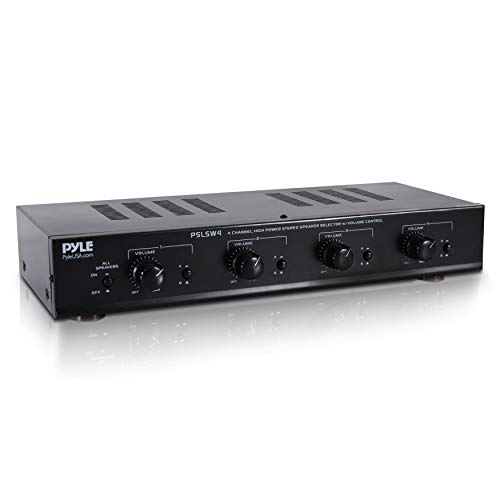
Designed for audio enthusiasts who want to control multiple speaker pairs without hassle, the Pyle 4 Channel Speaker Selector Switch is an excellent choice. This compact tabletop unit lets you manage up to four pairs of speakers with ease. Supporting a power handling of 100 watts per channel, it connects smoothly to your home theater amplifier. Its independent volume controls and push-button activation for each speaker pair enhance your listening experience. With built-in overload protection and a master switch for added control, the Pyle switch guarantees reliability and high-quality audio performance, earning a solid customer rating of 4.3 out of 5 stars.
Best For: Audio enthusiasts looking for a reliable and efficient way to control multiple speaker pairs in their home theater system.
Pros:
- Supports up to 4 pairs of speakers with independent volume controls for a customized listening experience.
- Built-in electronic overload protection ensures long-term reliability and safety during operation.
- Compact tabletop design makes it easy to integrate into any home audio setup without taking up much space.
Cons:
- Maximum power handling is limited to 100 watts per channel, which may not be sufficient for larger setups.
- Requires speaker cables up to 14 AWG, potentially limiting compatibility with thicker cables.
- Manual push-button activation may be less convenient compared to remote-controlled options.
Pyle 6 Zone Channel Speaker Switch Selector Volume Control Box
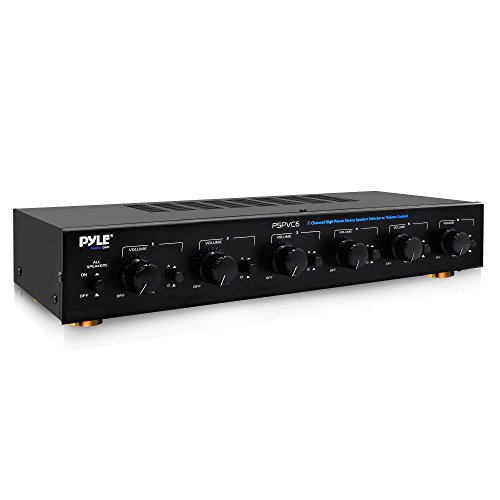
The Pyle 6 Zone Channel Speaker Switch Selector Volume Control Box stands out as an ideal choice for those wanting to manage multiple speaker pairs effortlessly. With the ability to control six pairs of speakers, you can easily switch between zones without hassle. Weighing just 16 ounces and measuring 3.03D x 16.92W x 3.03H, it’s compact and sleek. The 3.5mm jack connector guarantees compatibility with various devices, while the solid build from Pyle assures durability. With an average rating of 4.4 stars from over 300 reviews, it’s clear that users appreciate its functionality and reliability.
Best For: Those looking to efficiently manage and switch between multiple speaker pairs in a home or commercial audio setup.
Pros:
- Durable construction ensures long-lasting use.
- Compact design makes it easy to fit into various spaces without taking up much room.
- High average rating reflects customer satisfaction and reliability.
Cons:
- Limited to 6 pairs of speakers, which may not meet the needs of larger setups.
- Requires speaker wire connections, which may not be ideal for all users.
- No advanced features like remote control or smart connectivity options.
Pyle 6 Channel Speaker Selector Switch

For those seeking versatile audio control in a multi-zone home theater setup, the Pyle 6 Channel Speaker Selector Switch (Model: PSLSW6) stands out with its independent volume controls for each speaker pair. This compact, slim tabletop unit lets you manage up to six speaker pairs simultaneously, allowing for custom listening experiences. With a solid 100 watts per channel and compatibility with 8-ohm speakers, you can connect up to 12 speakers effortlessly. The push-button design and rotary knobs make activation and volume adjustment simple. Plus, with built-in overload protection, you can enjoy reliable performance for years to come.
Best For: Audiophiles and home theater enthusiasts looking for flexible audio control in multi-zone setups.
Pros:
- Supports simultaneous management of up to six speaker pairs with independent volume controls.
- Compact design suitable for various home theater configurations.
- Built-in overload protection ensures long-term reliability and performance.
Cons:
- Requires screw-type connectors, which may be less convenient for some users compared to plug-and-play options.
- Maximum power output of 100 watts per channel may not be sufficient for larger setups.
- Some users may prefer digital controls over manual push-button and rotary knob designs.
PROZOR 2-Zone Speaker Switch Box with A/B Control
Looking for an efficient way to manage multiple speaker setups? The PROZOR 2-Zone Speaker Switch Box with A/B Control lets you connect one amplifier to two speaker pairs or two amplifiers to one pair, all without sound loss. With its 150W RMS per channel capability, it supports 4–16Ω speakers and handles long distances up to 164ft. The independent A/B switches allow easy selection between zones, while the durable metal housing guarantees stability. Plus, with an 18-month warranty and solid customer reviews, it’s a reliable choice for enhancing your audio experience effortlessly. Enjoy seamless sound management with this versatile speaker switch!
Best For: Audio enthusiasts looking to manage multiple speaker setups efficiently without compromising sound quality.
Pros:
- Flexible Setup: Allows connection of one amplifier to two pairs of speakers or two amplifiers to one pair, providing versatility in audio configurations.
- High Power Handling: Supports up to 150W RMS per channel, making it suitable for powerful audio systems.
- Durable Construction: Built with solid metal housing and anti-slip feet for stable and long-lasting use.
Cons:
- Requires Manual Switching: The need for manual operation of independent A/B switches may not be convenient for all users.
- Limited to Passive Speakers: Only compatible with 4–16Ω passive speakers, which may limit options for some setups.
- No Remote Control: Lacks a remote control feature, which could enhance convenience for users managing multiple zones.
Pyle 4 Zone Channel Speaker Switch Selector (PSS4)

Experience seamless audio management with the Pyle 4 Zone Channel Speaker Switch Selector (PSS4), perfect for audiophiles seeking to control multiple speaker pairs effortlessly. This premium switch box supports up to four separate speaker pairs, allowing you to switch between them smoothly. Its compact design measures 7.48 inches wide and handles 100 watts per channel, making it ideal for multi-channel high-powered stereo amplifiers. With 14-gauge speaker wire acceptance and an impedance minimum of 8 ohms, you’ll enjoy reliable performance. Rated 4.2 out of 5 stars by users, it’s a top choice for audio enthusiasts wanting flexibility in sound management.
Best For: Audiophiles and audio enthusiasts looking for an efficient way to manage multiple speaker pairs in a high-powered stereo setup.
Pros:
- Compact design allows for easy integration into any audio system.
- Supports up to 4 separate speaker pairs for versatile sound management.
- Handles 100 watts per channel, ensuring powerful performance.
Cons:
- Limited to a minimum impedance of 8 ohms, which may not suit all speaker setups.
- May require additional equipment for optimal performance in larger setups.
- Some users may find the build quality less durable than expected.
OSD Audio 100W In Wall Volume Control for Home Speakers
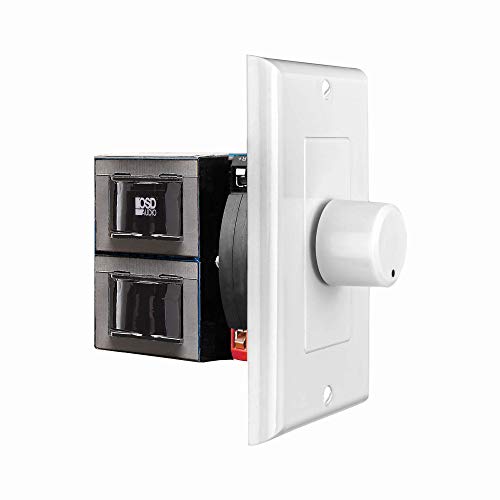
The OSD Audio 100W In Wall Volume Control is perfect for audiophiles who want to manage multiple speaker pairs without sacrificing sound quality. With its 100-watt power rating, you can enjoy independent volume control for up to eight pairs of 8-ohm speakers. The 12-step linear rotary knob allows you to adjust the sound for any listening level, whether loud or soft. Plus, it stabilizes ohm loads, protecting your amplifiers and receivers from overheating. Installation is a breeze with included hardware, and it comes with trim plates in white, ivory, and almond to match your decor seamlessly.
Best For: Audiophiles seeking effective volume control for multiple speaker pairs in a home audio setup.
Pros:
- Supports up to eight pairs of 8-ohm speakers, allowing for extensive audio distribution.
- 12-step linear rotary knob provides precise volume adjustments for various listening preferences.
- Impedance protection prevents overheating, safeguarding your audio equipment.
Cons:
- Limited to 100 watts per channel, which may not be sufficient for very high-powered audio systems.
- Installation requires a standard gang box, which may not be available in all homes.
- The design options are limited to three trim plate colors (white, ivory, almond), potentially not matching all decor styles.
Factors to Consider When Choosing a Passive Speaker Selector With Volume Control
When you’re choosing a passive speaker selector with volume control, there are several key factors to keep in mind. You’ll want to take into account power handling capacity and impedance compatibility to guarantee peak performance. Additionally, think about the volume control features, build quality, and connectivity options that best fit your setup.
Power Handling Capacity
Choosing the right passive speaker selector with volume control means paying close attention to its power handling capacity. You’ll want to find a model rated in watts per channel that meets or exceeds your amplifier’s output for peak performance. Aim for a continuous power handling capacity of at least 100 watts per channel, which is ideal for most home audio setups. Some models can handle peak power specifications of up to 200 watts per channel, providing a buffer against transient audio peaks and preventing distortion. Also, confirm the selector can handle the impedance of your speakers—typically 4, 6, or 8 ohms. Finally, look for protection circuitry to safeguard against overloads and enhance your system’s longevity.
Impedance Compatibility
Understanding impedance compatibility is vital for ensuring your audio system functions smoothly and efficiently. When choosing a passive speaker selector, you need to take into account its ability to handle the combined load of your speakers without risking damage to your amplifier. Many selectors specify a minimum impedance, typically ranging from 4 to 8 ohms. If you connect multiple speakers, keep in mind that the total impedance decreases, which can cause overheating or distortion if not managed properly. Proper impedance matching is essential for maintaining ideal audio performance and avoiding signal loss. Always check the manufacturer’s specifications to confirm that the speaker selector accommodates the impedance ratings of your speakers for reliable operation.
Volume Control Features
Volume control features play an essential role in enhancing your audio experience, especially when managing multiple speakers across different zones. With these features, you can adjust the sound levels for each connected speaker pair, guaranteeing that every area has the perfect audio balance. Many passive speaker selectors come with user-friendly push-button or rotary knob designs, making it easy to control your setup. Look for models that offer independent volume controls for each channel, allowing you to customize settings based on your preferences and room acoustics. Additionally, this control helps prevent distortion and potential damage by letting you lower levels in high-power situations. Built-in impedance protection circuitry further guarantees stability and safety during operation at various volume levels.
Build Quality Materials
When you’re selecting a passive speaker selector with volume control, the build quality materials can make all the difference in performance and longevity. Look for durable materials like aluminum or solid metal housing; these guarantee resistance to wear and tear. Rugged construction features, such as heat sinks and anti-slip elements, promote stability and minimize damage risks during operation. High-quality connectors, including heavy-duty screw-type terminals, accommodate thicker speaker wires (up to 14 AWG) for better signal transmission. Additionally, verify the design allows for easy installation, fitting standard gang boxes or offering a compact tabletop setup. Finally, check for protection circuitry that safeguards against overload and overheating, guaranteeing safe and reliable performance over time.
Connectivity Options
Selecting a passive speaker selector with volume control means considering various connectivity options to guarantee peak audio performance. First, verify it has heavy-duty screw-type connectors that can handle speaker wires from 12 to 18 AWG for ideal sound quality. Look for models that support multiple speaker pairs and offer push-button or rotary volume controls, allowing for independent audio management across different zones. It’s essential to check compatibility with various speaker impedances, like 4-ohm or 8-ohm speakers, as this can impact performance. Additionally, consider units with automatic impedance protection circuitry to safeguard your amplifiers from damage. Finally, opt for plug-and-play models that simplify installation by connecting directly to your amplifier and speakers without complicated wiring.
Installation Ease
Choosing a passive speaker selector with volume control becomes much easier if you prioritize installation ease. Look for a model with a plug-and-play design, allowing you to quickly connect to your amplifier or receiver’s left and right outputs. Verify compatibility with standard speaker wire gauges, up to 14 AWG, to avoid any connection issues. Screw-type connector terminals are a great choice, as they secure multiple speaker pairs reliably. User-friendly control features, like push-button activation or rotary knobs, simplify operation during setup. Finally, consider selectors with a compact and lightweight design, making it easier to fit in tight spaces or mount on shelves. Streamlined installation means you can enjoy your sound system sooner!
