Choosing a stereo preamplifier for power amplifier use is mostly about matching your sources, controlling noise, and getting the right level of gain. The best option should make your system easier to use without coloring the sound.
Below, we focus on practical picks for vinyl, TV, Bluetooth, and desktop audio setups, plus the key features that matter before you buy.
Best 10 Stereo Preamplifier for Power Amplifier Picks for 2026
Mini Control Hub

- 3 RCA inputs for multiple source devices
- Bass/treble control with 3 gain levels
- Motorized pot and remote for easy volume changes
Best For: Compact home audio systems that need simple source switching and tone control
Rack-Ready All-in-One

- Bluetooth, FM radio, USB, and SD playback support
- Dual RCA inputs with preamp out and subwoofer outputs
- Front-panel tone and balance controls for setup flexibility
Best For: Rack systems that need many playback and control options in one preamp
Compact DIY Module
HiLetgo AD828 Preamplifier Board

- Tiny board for custom audio builds
- DC 5V-15V working voltage
- Uses imported non-polar coupling capacitors
Best For: DIY amplifier projects that need a compact preamp module
Phono Level Converter
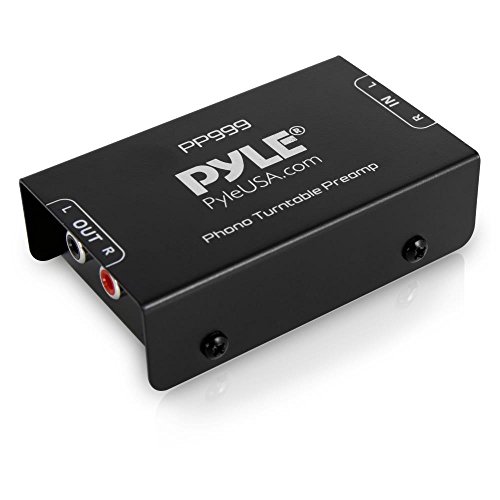
- Converts phono signals to line level
- Low-noise circuitry for turntable playback
- Simple RCA input/output connections
Best For: Turntables that need basic phono-to-line conversion for modern audio gear
Passive RCA Switch Preamp
HiFi RCA Passive Preamp with Volume Control

- Passive design needs no power supply.
- 2-in-1-out RCA source selector.
- A10K volume control for fine adjustment.
Best For: simple analog setups with power amplifiers or active speakers
MM Phono Line Preamp
Fosi Audio BOX X1 Mini Phono Preamp

- Converts MM phono to line level.
- RCA output plus 3.5mm headphone out.
- Includes grounding post and 12V power supply.
Best For: MM turntables feeding a power amp or powered speakers
Feature-Rich Stereo Preamp
Dynasty ProAudio PX1 Stereo Preamplifier

- 4 RCA inputs plus phono and optical.
- Bass/treble EQ with subwoofer crossover.
- Multiple outputs including stereo, sub mono, and headphone.
Best For: home audio setups needing flexible source switching and tone control
Compact Stereo Preamplifier / Headphone Amp
Mini Stereo Audio Preamp, NE5532
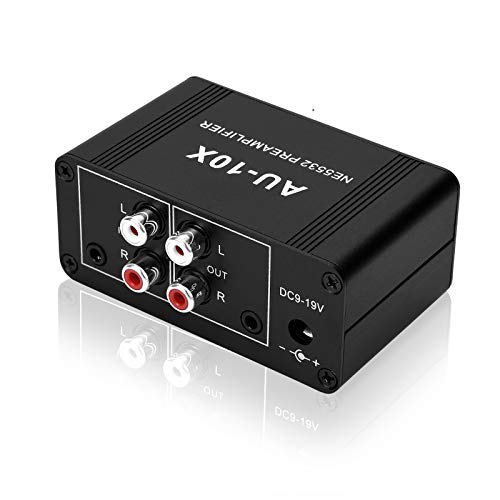
- 20dB gain for weak signals
- RCA and 3.5mm I/O with volume knob
- Drives headphones up to 16 ohms
Best For: Compact line-level boosting and basic headphone listening
Low-Noise Vinyl Preamplifier
Phono Turntable Preamp, RCA/TRS Output

- Converts phono to line level
- Low-noise op-amp design
- Includes 12V adapter and RCA I/O
Best For: Turntables that need clean line-level output
Versatile 12V RCA Preamp
12V RCA Preamp with Headphone Output

- Boosts weak audio to line level
- Dual NE5532 noise-reduction circuit
- RCA/3.5mm inputs and volume control
Best For: Compact setups needing preamp and headphone support
Mini Control Hub – Fosi Audio P4 Mini Preamp
If you need a stereo preamplifier for power amplifier setups with flexible source switching, the Fosi Audio P4 is built for straightforward control. It offers 3 RCA inputs, bass and treble adjustment, three gain settings, and a remote, making it a practical hub for compact home audio systems.
Best For: Listeners who want a compact preamp for switching multiple RCA sources and tuning sound from one desk-friendly unit.
Pros:
- Supports up to 3 RCA inputs for sources like CD players, streamers, DACs, cassette decks, and turntables with built-in phono preamp
- Includes volume control, bass and treble adjustment with bypass, plus 3-level gain at 3/6/9 dB
- Motorized analog potentiometer is designed for smooth volume changes, reduced noise, and low distortion
- Compact build aims to save space while resisting electromagnetic interference
Cons:
- RCA-only design may not suit systems that rely on digital inputs
- Best fit is a simple 2-channel home audio setup rather than a feature-heavy receiver
- Requires an external power supply, which adds one more component to manage
The P4 stands out as a clean, modern control point when you want useful tuning features without a bulky chassis. For users who value compact size, remote control, and low-noise operation, it is a strong match for a stereo preamplifier role in front of a power amplifier.
Rack-Ready All-in-One – Pyle PPRE70BT Pre-Amplifier
The Pyle PPRE70BT is a practical stereo preamplifier for power amplifier setups when you want more than basic line-level control. It combines Bluetooth, FM radio, USB and SD playback, recording mode, and a full front-panel control layout, so it can serve as a versatile central unit in a rack system.
Best For: Users who want a rack-mount preamp with wireless streaming, radio, and multiple playback options in one unit.
Pros:
- Built-in Bluetooth supports wireless music streaming with a range of 25+ feet
- Includes FM radio, recording mode, USB flash input, and SD card reader
- Two sets of RCA inputs plus RCA preamp out and mono RCA subwoofer outputs
- Front-panel controls provide independent source selection, bass, treble, mid, balance, and master volume
Cons:
- Its feature set is broader than a simple purist preamp, so it may be more complex than some users need
- Output power is listed at 15 watts, which suggests it is intended more as a control unit than a power solution
- Rack-style size may be less convenient for very small setups
If you want a do-it-all front end for a home or project audio rack, this model covers a lot of ground. The mix of Bluetooth, physical media support, and tone controls makes it especially useful when flexibility matters more than minimalism.
Compact DIY Module – HiLetgo AD828 Preamplifier Board
HiLetgo 3pcs AD828 Stereo Preamplifier Board Preamp Power Amplifier Board AMP Module DC5V-15V 12V
Check Price On AmazonThe HiLetgo AD828 board is a compact option for a stereo preamplifier for power amplifier projects where space and DIY integration matter. It uses a small-volume design with a DC 5V-15V working range, making it more suitable as a build component than a finished consumer preamp.
Best For: DIY builders who need a tiny preamp module for custom audio projects or amplifier integration.
Pros:
- Very small board design helps it fit into compact custom builds
- Supports DC 5V-15V operation for flexible integration
- Uses a full patch process with imported non-polar brand coupling capacitors
Cons:
- Sold as a bare board module, so it is not a ready-to-use desktop preamp
- No enclosure, controls, or input/source switching features are listed
- Requires DIY knowledge and supporting hardware to be useful in a system
This is the most build-oriented option in the group and makes sense only if you are assembling your own signal chain. For custom projects, it offers a compact starting point, but it is not the easiest choice for everyday plug-and-play listening.
Phono Level Converter – Pyle PP999 Turntable Preamp
The Pyle PP999 is a focused stereo preamplifier for power amplifier setups when the main job is turning phono signal into line level. It is designed for turntables with magnetic pickups and uses low-noise circuitry, making it a simple bridge to receivers, speakers, computers, or laptops that lack a phono input.
Best For: Vinyl listeners who need a basic, low-noise phono preamp for connecting a turntable to standard audio gear.
Pros:
- Converts phono signals to line level for use with modern sound equipment
- Supports turntables with magnetic pickups and 3mV input sensitivity at 50K ohms
- Low-noise operational amplifiers are intended to reduce unwanted noise and interference
- Simple RCA input and output layout makes setup straightforward
Cons:
- Limited to phono-to-line conversion rather than broader source switching
- No tone controls, gain options, or remote features are listed
- Most useful when placed close to the source, so placement matters
For a turntable-only application, the PP999 keeps the job simple and focused. It is a practical add-on if you need clean phono conversion before feeding an amplifier or powered speakers, but it is not a general-purpose control preamp.
Passive RCA Switch Preamp – HiFi RCA Passive Preamp with Volume Control
If you want a stereo preamplifier for power amplifier setups without adding gain or requiring external power, the FV2 is a simple passive option. It works as a 2-in-1-out RCA selector with volume control, making it useful when you need to switch sources and trim level in a compact signal path.
Best For: Users who want a passive RCA preamp/selector for power amplifiers, active speakers, or monitor audio devices.
Pros:
- Passive design with no power supply needed.
- 2 input, 1 output RCA switching for source selection.
- High-precision A10K potentiometer for volume adjustment.
- No gain design is intended to match power amplifiers and similar gear.
Cons:
- No gain stage, so it won’t boost weak signals.
- Limited to basic RCA switching and level control.
- Not designed for phono or digital inputs.
For a clean, straightforward control box in a simple analog system, the FV2 keeps things practical. It is best viewed as a passive stereo interface for selecting sources and managing volume rather than a full-featured preamp.
MM Phono Line Preamp – Fosi Audio BOX X1 Mini Phono Preamp
For vinyl playback, this stereo preamplifier for power amplifier systems is really a phono stage rather than a general-purpose line preamp. The BOX X1 converts MM turntable phono signals to line level, adds RCA output for speakers, and even includes a 3.5mm headphone output for flexible listening.
Best For: MM turntable owners who need a low-noise phono preamp before a power amp, powered speakers, or headphones.
Pros:
- Converts MM phono signals to line-level output.
- Includes RCA line output and 3.5mm headphone output.
- Grounding post helps support turntable hookup.
- Uses a 12V supply and is built for low-noise playback.
Cons:
- Only supports MM turntables, not a general multi-input preamp.
- No tone controls or source switching.
- Designed for phono use, so it’s not ideal for TVs or digital sources.
The BOX X1 is a focused solution for record players and keeps the signal chain simple. If your main goal is clean vinyl playback into a power amplifier or powered audio system, it offers the right connections without unnecessary extras.
Feature-Rich Stereo Preamp – Dynasty ProAudio PX1 Stereo Preamplifier
If you need a stereo preamplifier for power amplifier use with more routing and control, the PX1 is the most versatile of the three. It combines multiple RCA line inputs, a phono RIAA input, optical input for TV or digital gear, and EQ plus subwoofer management in a rack-friendly chassis.
Best For: Home audio systems that need a flexible preamp with phono, optical, EQ, and subwoofer support.
Pros:
- 4 RCA line inputs plus phono RIAA input and ground terminal.
- Optical input adds support for TVs and other digital sources.
- Bass and treble controls with a low-cut crossover for sub use.
- Multiple outputs including full-range stereo, sub mono, and headphone.
Cons:
- Larger rack-style unit than a compact desktop preamp.
- More features may be unnecessary for very simple systems.
- Front-panel mic input is specialized if you only need music playback.
The PX1 is built for users who want control and connectivity, not just basic volume management. For a home stereo or mixed-source setup feeding a power amplifier, it offers one of the broadest feature sets in this group.
Compact Stereo Preamplifier / Headphone Amp – Mini Stereo Audio Preamp, NE5532
If you need a stereo preamplifier for power amplifier setups, this compact unit is built to lift weak audio signals to line level with 20dB of gain. It also adds a simple volume knob and flexible RCA/3.5mm connectivity, making it a practical fit for small home audio systems and source components.
Best For: Users who want a tiny, low-noise preamp for line-level boosting and basic headphone use.
Pros:
- Uses dual NE5532 op amps and a noise-reduction circuit for cleaner playback.
- Provides 20dB gain to strengthen weak signals into line-level output.
- Offers RCA and 3.5mm input/output options plus a volume control knob.
- Can directly drive headphones up to 16 ohms.
Cons:
- Cannot be used as a power amplifier for passive speakers.
- Headphone output cannot be used at the same time as the other output ports.
- Best suited to small, simple setups rather than high-power applications.
This is a straightforward mini preamp for users who want signal boosting, noise-conscious design, and compact size in one affordable-style package. If your goal is to feed a power amplifier with cleaner line-level audio, it covers the essentials without extra complexity.
Low-Noise Vinyl Preamplifier – Phono Turntable Preamp, RCA/TRS Output
For vinyl listeners looking for a stereo preamplifier for power amplifier connections, this phono stage converts turntable output to line level for use with modern audio gear. It focuses on simple plug-and-play setup, low-noise operation, and clean signal handling for magnetic pickup turntables.
Best For: Vinyl setups that need a low-noise phono preamp with easy RCA connections.
Pros:
- Converts phono signals to line level for use with amplifiers and receivers.
- Uses low-noise operational amplifiers for cleaner playback.
- Includes RCA input/output and a 12V DC adapter.
- Simple plug-and-play design for modern sound equipment.
Cons:
- Only appropriate for turntables without a built-in preamp.
- Best performance depends on placing the preamp close to the source.
- Designed for phono use rather than general-purpose signal boosting.
This is a practical choice if your main goal is to get a turntable into a receiver, speaker system, or other line-level input without extra setup. Its low-noise design and included adapter make it a focused vinyl-friendly option.
Versatile 12V RCA Preamp – 12V RCA Preamp with Headphone Output
This stereo preamplifier for power amplifier use is designed to boost weak sources like turntables into line-level audio while keeping the setup compact and simple. With dual NE5532 circuitry, RCA and 3.5mm connectivity, and adjustable volume, it works as a flexible mini preamp for everyday home audio hookups.
Best For: Users who want a compact preamp with headphone output and multiple input options.
Pros:
- Amplifies weak signals into line-level output for clearer audio.
- Dual NE5532 circuit is designed for noise reduction and cleaner sound.
- Supports RCA and 3.5mm inputs with adjustable volume control.
- Can directly drive headphones up to 16 ohms.
Cons:
- Cannot be used as a power amplifier for passive speakers.
- Headphone output is not shared with the other outputs at the same time.
- Best suited to compact, low-power audio setups.
Overall, this model is a good fit if you want a small preamp that can handle both signal boosting and basic headphone listening. It emphasizes convenience, compatibility, and clean amplification rather than speaker-driving power.
How We Picked the Best Stereo Preamplifier for Power Amplifier
For this roundup, we focused on preamps that make sense in real-world stereo systems: clean signal path, useful input/output options, simple volume control, and compatibility with common home audio sources. We also considered power needs, noise performance, and whether the unit is better suited to passive line-level switching or active gain stages.
When shopping for a Stereo Preamplifier for Power Amplifier setups, the goal is not maximum features. It is the right balance of transparency, connectivity, and control for your speakers, amplifier, and source components.
Quick Comparison
Some models are best for turntables and phono playback, while others are better for adding source switching, headphone output, or basic level control between a source and a power amp. If you need vinyl support, look for phono-specific input and RIAA equalization. If you need broader system flexibility, choose a line preamp with multiple RCA inputs or optical/Bluetooth support.
Key Buying Factors for Stereo Preamplifier for Power Amplifier
Input and Output Compatibility
Check that the preamp supports your source gear: RCA for most analog components, phono input for turntables, and optical or wireless inputs if you want to connect modern devices. Output matching matters too, especially if your power amplifier expects a standard line-level signal.
Gain, Noise, and Volume Control
A good preamp should raise weak signals only when needed and stay quiet at normal listening levels. Too much gain can add hiss or distortion. For turntables, low-noise circuitry and proper phono EQ are especially important.
Passive Vs Active Design
A passive preamp can be a simple, transparent volume and input control solution, but it cannot add gain. Active models are more flexible and better when your source output is low or your cable runs are longer.
Form Factor and Features
Rack units suit full-size systems, while compact boxes are better for shelves, desktops, or near-turntable setups. Extra features like headphone outputs, remote control, or subwoofer support can be useful, but only if they fit your actual setup.
Who Should Buy Which Stereo Preamplifier for Power Amplifier?
If you are building a vinyl-focused system, choose a phono preamp with the correct cartridge support and low-noise operation. If you need an all-around Stereo Preamplifier for Power Amplifier use, prioritize multiple inputs and straightforward volume control. If you want the simplest signal path possible, a compact passive unit may be enough. For multi-source living room systems, an active preamp with switching and remote control is usually the most practical choice.
In short, the best preamp is the one that matches your source type, amplifier sensitivity, and listening habits without adding unnecessary complexity.
