Choosing the right studio monitors for your home studio is essential for achieving clear and accurate sound. With so many options available, it can be overwhelming to find the perfect fit for your needs. From compact designs to advanced features, each monitor offers unique advantages. Let’s explore the top picks that can elevate your sound quality and help you make informed decisions for your setup.
PreSonus Eris 3.5 Studio Monitors (Pair)

If you’re looking for an affordable yet high-quality option for your home studio, the PreSonus Eris 3.5 studio monitors are an excellent choice. These powered speakers deliver exceptional sound for near-field music production and hi-fi audio listening. With 50 Watts of Class AB dual amplification and woven-composite woofers, you’ll enjoy tight bass and clear audio. The 1-inch silk-dome tweeters guarantee natural highs and superb stereo imaging. Plus, with versatile connectivity options and customizable tuning controls, you can tailor the sound to fit your space perfectly. Consider adding the Eris Sub 8BT for enhanced low frequencies and Bluetooth capabilities.
Best For: Home studio musicians and audio enthusiasts seeking affordable, high-quality near-field monitors for music production and hi-fi listening.
Pros:
- Exceptional sound quality with tight bass and clear audio due to woven-composite woofers.
- Versatile connectivity options including TRS, RCA, and aux inputs for easy integration with various devices.
- Customizable tuning controls allow for tailored audio output based on personal preference and room acoustics.
Cons:
- Limited low-frequency response without the optional subwoofer for deeper bass.
- Smaller size may not be suitable for larger studio spaces or professional environments.
- Power-saving mode may interrupt use after 40 minutes of inactivity, requiring manual reactivation.
Yamaha HS3 Powered Studio Monitor in Black, Pair (HS3 B)

The Yamaha HS3 Powered Studio Monitor is an excellent choice for home studio enthusiasts who demand accuracy in sound reproduction. With a 3.5-inch woofer and a 0.75-inch tweeter, it delivers a frequency response of 70 Hz to 22 kHz, guaranteeing every detail in your mix shines through. The 26 W output power provides ample volume without distortion. Plus, the room control and high trim response controls allow you to tailor the sound to your environment. Equipped with various inputs—including XLR/TRS and RCA—it’s versatile for different setups. Included accessories like speaker cables and anti-slip pads guarantee a seamless experience.
Best For: The Yamaha HS3 Powered Studio Monitor is best for home studio enthusiasts seeking accurate sound reproduction for mixing and mastering.
Pros:
- Accurate Sound Reproduction: Designed for studio use, ensuring clarity and detail in your mixes.
- Versatile Connectivity: Multiple input options including XLR/TRS and RCA for various setups.
- Customizable Sound: Room control and high trim response controls allow for tailored audio performance.
Cons:
- Limited Bass Response: The 3.5-inch woofer may not provide deep bass for certain genres.
- Small Size: May not be suitable for larger studio spaces or high-volume environments.
- Power Output: At 26 W, it may lack the power needed for larger rooms without distortion.
Ortizan C7 Dual-Mode Studio Monitors (Pair)

For home studio enthusiasts seeking high-quality audio performance, the Ortizan C7 Dual-Mode Studio Monitors are an excellent choice. These active speakers deliver impressive sound through a 3.5-inch carbon fiber speaker and a 0.75-inch silk dome tweeter. With Bluetooth 5.3, RCA, and AUX inputs, you can easily connect multiple devices. The built-in 24-bit DAC minimizes signal loss, enhancing sound fidelity. Extensive laboratory tuning guarantees a flat response curve, providing balanced audio across all frequencies. Whether you’re producing music, gaming, or watching movies, the Ortizan C7 monitors adapt to your needs, making them a versatile addition to your setup.
Best For: Home studio enthusiasts and audio lovers seeking high-quality sound for music production, gaming, and movie watching.
Pros:
- Bluetooth 5.3 technology allows for quick and easy pairing with smartphones and tablets.
- Built-in 24-bit DAC minimizes signal loss, enhancing overall sound fidelity.
- Extensive laboratory tuning ensures a flat response curve for balanced audio reproduction.
Cons:
- May not provide the bass response desired by some audiophiles without additional subwoofers.
- Limited to near-field use, which may not be suitable for larger room setups.
- The compact design might not accommodate larger professional audio equipment easily.
Mackie CR3.5 Powered Studio Monitors

Mackie CR3.5 Powered Studio Monitors are perfect for those seeking studio-quality sound in a compact package. With 3.5″ drivers, they deliver impressive sound across various applications, from music production to gaming. You can easily connect them to audio interfaces or playback devices via TRS and RCA connectors, and the 3.5 mm input makes it simple to hook up your gaming console or PC. The tone control knob lets you customize your sound, while the location switch adjusts for desktop or bookshelf use. For enhanced bass, consider pairing them with the CR8SBT subwoofer. Enjoy clean, immersive audio effortlessly.
Best For: Those seeking studio-quality sound in a compact design for music production, gaming, and casual listening.
Pros:
- Versatile Connectivity: Easily connects to various devices using TRS, RCA, and 3.5 mm inputs.
- Sound Customization: Tone control knob allows users to adjust bass and treble for a tailored listening experience.
- Compact Design: Ideal for small spaces, with placement options for both desktop and bookshelf use.
Cons:
- Limited Low-End: Without a subwoofer, the bass response may not satisfy bass-heavy music enthusiasts.
- Power Output: May not be powerful enough for larger rooms or professional studio settings.
- No Bluetooth Connectivity: Lacks wireless options for modern streaming devices.
JBL 305P MkII 5″ Powered Studio Reference Monitors

Looking to elevate your home studio setup? The JBL 305P MkII 5″ Powered Studio Reference Monitors deliver exceptional audio quality with their patented Image Control Waveguide, providing a wide sweet spot and immersive sound. With dual 41-Watt Class-D amplifiers, you’ll experience dynamic range and deep bass from the 5-inch woofer. Customize your sound using the Boundary EQ and HF Trim to achieve accurate mixes tailored for your space. Designed with a sleek MDF enclosure and equipped with versatile XLR/TRS inputs, these monitors promise durability, having undergone rigorous reliability testing. Transform your productions with the precision of JBL’s expertise!
Best For: The JBL 305P MkII is best for home studio producers and vloggers seeking high-quality sound and accurate mixing capabilities.
Pros:
- Exceptional audio quality with a patented Image Control Waveguide and wide sweet spot for immersive sound.
- Customizable sound features like Boundary EQ and HF Trim to adapt to different room acoustics.
- Durable design backed by rigorous 100-hour reliability testing, ensuring consistent performance.
Cons:
- Size may be limited for larger studio spaces, as they feature only a 5-inch woofer.
- Potential for overemphasis on bass, which might not suit all mixing preferences.
- Requires proper placement and setup to fully utilize the acoustic advantages.
Edifier MR4 Powered Studio Monitor Speakers (White, Pair)
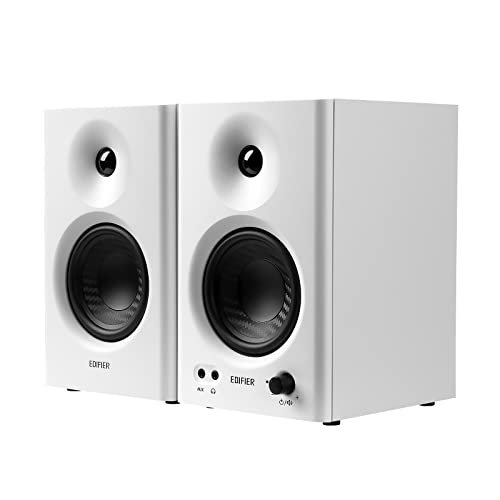
The Edifier MR4 Powered Studio Monitor Speakers are an excellent choice for artists and music creators seeking accurate sound reproduction in their home studio. With 1-inch silk dome tweeters and 4-inch composite woofers, you’ll enjoy clear and smooth audio. Their MDF wooden structure minimizes resonance, enhancing true sound quality. Plus, the MR4 offers versatile connectivity options, including 1/4-inch balanced TRS, RCA, and AUX inputs, alongside a front headphone output. You can easily switch between monitor mode for production and music mode for casual listening. With user-friendly controls for frequency adjustments and volume, these monitors meet all your audio needs.
Best For: Artists and music creators looking for accurate sound reproduction in their home studio.
Pros:
- High-quality sound with 1-inch silk dome tweeters and 4-inch composite woofers for clear audio.
- Versatile connectivity options including TRS, RCA, AUX inputs, and a headphone output.
- Dual mode functionality allows easy switching between monitor mode for production and music mode for casual listening.
Cons:
- May not be suitable for larger studio spaces due to their near-field design.
- Limited low-end response compared to larger studio monitors.
- Some users may find the volume control placement less convenient.
YAMAHA Hs5 Powered Studio Monitor, Pair

For aspiring music producers and audio engineers seeking accuracy in their sound, the Yamaha HS5 Powered Studio Monitor is an excellent choice. This 2-way bass reflex bi-amplified monitor features a 5-inch cone woofer and a 1-inch dome tweeter, delivering a frequency response from 54 Hz to 30 kHz. With a total power amplification of 70 watts, it guarantees dynamic sound reproduction without any coloration. The HS5 accepts balanced XLR and TRS inputs, making it versatile for various setups. Designed for high-performance audio applications, this pair of monitors emphasizes sonic purity, helping you achieve the ultimate sound quality in your home studio.
Best For: The Yamaha HS5 Powered Studio Monitor is best for aspiring music producers and audio engineers seeking accurate sound reproduction in their home studios.
Pros:
- Delivers a wide frequency response of 54 Hz to 30 kHz for detailed audio reproduction.
- Emphasizes sonic purity with no coloration, ensuring original sound integrity.
- Versatile input options with XLR and TRS phone jack inputs for compatibility with various setups.
Cons:
- The 5-inch woofer may not provide sufficient bass for larger studio spaces.
- May require additional acoustic treatment in the room for optimal performance.
- The price point may be higher compared to entry-level studio monitors.
Edifier MR5 Studio Monitor Bookshelf Speakers

Crafted for aspiring musicians and audio enthusiasts, the Edifier MR5 Studio Monitor Bookshelf Speakers deliver exceptional sound quality with their 3-way active crossover system. Featuring a 5″ long-throw woofer, 3.75″ mid driver, and 1″ silk dome tweeter, these speakers provide a frequency response of 46Hz–40kHz, guaranteeing clear and detailed audio. With Bluetooth 6.0 connectivity and multiple inputs, you can easily stream or connect your devices. The Edifier ConneX App allows for advanced room tuning, while the 110W RMS amplifier guarantees powerful sound. Plus, the user-friendly design makes setup and customization a breeze, enhancing your audio experience.
Best For: Aspiring musicians and audio enthusiasts seeking high-quality sound and versatile connectivity options for their audio setup.
Pros:
- Exceptional sound quality with a 3-way active crossover system for clear audio reproduction.
- Advanced room tuning capabilities through physical knobs and the EDIFIER ConneX App.
- Multiple connectivity options including Bluetooth 6.0 and various input types for versatile device compatibility.
Cons:
- The rear knob adjustments may require additional space for easy access.
- Wireless streaming may face occasional latency depending on the device used.
- Some users may prefer a more robust bass response for certain music genres.
PreSonus Eris E5 2-Way 5.25″ Near Field Studio Monitor

If you’re a budding music producer or an aspiring audio engineer looking to attain accurate mix translation in your home studio, the PreSonus Eris E5 2-Way 5.25″ Near Field Studio Monitor is an excellent choice. With a 5.25-inch woven composite woofer, it delivers solid low-end sound with minimal distortion, while the 1-inch silk-dome tweeter guarantees a balanced high-frequency response. Its 80-watt Class AB bi-amplification provides ample volume, and the maximum SPL of 102 dB is perfect for nearfield monitoring. Plus, the versatile connectivity options and acoustic tuning controls let you optimize your sound for any environment.
Best For: Budding music producers and aspiring audio engineers seeking accurate mix translation in home studio environments.
Pros:
- Excellent low-end sound with minimal distortion thanks to the 5.25-inch woven composite woofer.
- Balanced high-frequency response provided by the 1-inch ultra-low-mass silk-dome tweeter.
- Versatile connectivity options including balanced XLR, 1/4-inch inputs, and unbalanced RCA inputs.
Cons:
- May not be suitable for larger studio spaces due to its nearfield design.
- Maximum SPL of 102 dB might not be sufficient for very high-volume applications.
- Lacks built-in DSP features compared to some higher-end models.
KRK RP5G5 ROKIT 5 Generation Five 5″ Powered Studio Monitor Pair

The KRK RP5G5 ROKIT 5 Generation Five studio monitors are perfect for home studio enthusiasts who demand high-quality audio performance without breaking the bank. With custom-designed Class D power amplifiers, they enhance audio integrity while keeping temperatures low. The new 1” silk dome tweeter improves high-mid and high-frequency performance, ensuring clarity. Plus, the low diffraction baffle design minimizes distortion for better stereo imaging. Setup is a breeze thanks to acoustic foam wedge isolation pads that reduce resonance. You’ll appreciate the versatile input options, including XLR and 1/4” TRS combo, that allow compatibility with various audio devices.
Best For: Home studio enthusiasts seeking high-quality audio performance at an affordable price.
Pros:
- Custom-designed Class D amplifiers enhance audio integrity and reduce operating temperatures for reliability.
- Improved high-frequency performance with a new 1” silk dome tweeter ensures clarity in sound reproduction.
- Versatile input options (XLR and 1/4” TRS combo) provide compatibility with a wide range of audio devices.
Cons:
- Limited low-frequency response due to the 5″ woofer size, which may not satisfy bass-heavy applications.
- Price may be higher than some entry-level studio monitors, making it a larger investment for beginners.
- Potential for resonance issues if isolation pads are not properly utilized during setup.
Factors to Consider When Choosing Studio Monitors for Home Studio
When you’re choosing studio monitors for your home studio, several key factors come into play. You’ll want to think about speaker size and type, frequency response range, and power output. Don’t forget to take into account connectivity options and acoustic tuning features to make certain your setup meets your needs.
Speaker Size and Type
Choosing the right speaker size and type is essential for achieving the best sound in your home studio. Monitor sizes usually range from 3 to 8 inches for woofers. If you’re working in a smaller space, opt for monitors with 3-5 inch woofers for better control. Larger models, with 6-8 inch woofers, enhance bass response and volume for bigger rooms. You’ll also need to decide between active and passive monitors; active models have built-in amplification, making setup simpler. Consider the design as well; 2-way monitors offer clarity, while 3-way models provide more detailed sound. Finally, think about placement—near-field monitors work best up close, reducing room acoustics’ impact, while larger monitors suit bigger spaces.
Frequency Response Range
Understanding the frequency response range is essential for achieving accurate sound reproduction in your home studio. This range, measured in Hertz (Hz), indicates the spectrum of sound frequencies your studio monitors can reproduce. Ideally, you want monitors that cover 20 Hz to 20 kHz, as this encompasses the full range of human hearing. A wider frequency response allows your monitors to produce low bass tones and high treble sounds, resulting in a balanced and detailed audio experience. Be cautious, though; monitors with a significant deviation from a flat response can color the sound, complicating your mixing process. Consider your specific needs—bass-heavy genres may require lower ranges, while critical listening benefits from extended highs. Choose wisely!
Power Output Considerations
Power output plays an essential role in how well your studio monitors perform, impacting both volume levels and audio clarity. Monitors typically range from 26 to over 110 watts, and higher power output can enhance sound clarity and headroom, allowing for detailed audio without distortion at high volumes. For near-field monitoring, aim for monitors with at least 50 watts to guarantee you achieve adequate volume levels while maintaining sound quality. Also, consider the type of amplifier, like Class AB or Class D, as it influences efficiency and sound characteristics, regardless of the power rating. Finally, factor in your studio space size; larger rooms may need monitors with higher wattage to fill the area effectively with sound.
Connectivity Options Available
When setting up your home studio, the connectivity options of your studio monitors can greatly influence your workflow. Look for monitors that offer balanced XLR/TRS inputs and unbalanced RCA inputs, as these allow versatile connections with various audio sources. Many models also feature 3.5mm AUX inputs, making it easy to connect consumer electronics like smartphones. If you prefer to monitor sound privately, consider monitors with headphone outputs. Bluetooth connectivity is becoming more common, giving you the flexibility to pair devices wirelessly. Finally, some monitors include multiple input channels, enabling you to connect different devices at once for seamless shifts. Choosing the right connectivity options will enhance your overall studio experience.
Acoustic Tuning Features
Acoustic tuning features play an essential role in optimizing your studio monitors for the unique characteristics of your home studio. Look for monitors with high- and low-frequency controls, allowing you to adjust the sound output according to your preferences and room acoustics. Front-firing acoustic ports can enhance bass reproduction while minimizing distortion, which is vital for accurate mixing. Advanced tuning capabilities guarantee a flat response curve, providing balanced audio across all frequencies. Additionally, room control and high trim response controls help tailor the performance to suit your specific environment. Finally, choose monitors with built-in protection against RF interference and transient spikes to improve reliability and maintain sound quality during long sessions.
Near-field vs. Far-field
Optimizing your studio monitors is only part of the equation; understanding the difference between near-field and far-field monitors is key to making the right choice for your home studio. Near-field monitors are designed to be placed close to you, usually within 3 to 5 feet. This proximity allows for accurate sound reproduction while minimizing room reflections, making them ideal for mixing in smaller spaces. On the other hand, far-field monitors are suited for larger studios, positioned 6 feet or more away. They offer a wider frequency response and can produce greater volume levels, helping you evaluate mixes in bigger rooms. Your choice will depend on your studio size, the type of work you do, and your personal sound preferences.
Room Size and Acoustics
Choosing the right studio monitors involves more than just personal preference; room size and acoustics play an essential role in ensuring ideal sound quality. If you have a larger room, you’ll likely need monitors with bigger woofers to fill the space adequately. Keep in mind that hard surfaces can cause reflections, while soft furnishings help absorb sound, affecting monitor performance. Position your monitors at ear level and away from walls to reduce acoustic interference. The frequency response of your monitors should match your room’s acoustic properties; smaller monitors may struggle with low frequencies in big spaces. Finally, consider using acoustic treatments like bass traps and diffusers to enhance clarity and accuracy, improving your mixing decisions, no matter the monitor size.
Budget and Price Range
When you’re setting up your home studio, establishing a budget is essential since studio monitors can vary greatly in price and quality. Entry-level monitors typically range from $100 to $400 per pair, providing decent sound for beginners. If you’re serious about audio production, consider mid-range monitors priced between $400 and $1,000, which offer enhanced fidelity and features. For professional use, high-end monitors above $1,000 deliver superior accuracy and advanced tuning options. Remember to factor in additional costs like stands, isolation pads, and acoustic treatment, as these items can greatly impact overall sound quality. By aligning your budget with your needs, you can find the right studio monitors that fit your home studio perfectly.
