Great rehearsals depend on hearing yourself clearly, not just loudly. The right in-ear monitor system can tighten timing, reduce stage volume, and make practice sessions more productive.
Below, we focus on practical features that matter most for music practice, so you can choose a setup that fits your band, room, and budget.
Best 10 In-Ear Monitor Systems for Music Practice Picks for 2026
Compact 2.4GHz Monitor Pick

- Less than 5ms latency
- 2.4GHz wireless with 6 channels
- About 5 hours of battery life
Best For: Musicians and small bands needing simple wireless rehearsal monitoring
Flexible Practice Monitor Choice
Wireless IEM for Singers and Drummers

- Stereo and mono monitoring modes
- Up to 30m open-air range
- Portable clip-on design with 5-hour battery
Best For: Singers, drummers, and worship teams practicing on a budget-friendly wireless monitor
Long-Run Practice IEM Pick
JOYO JW-07 Wireless IEM System

- Less than 5ms latency
- Over 8 hours of battery life
- 12 channel banks with anti-interference
Best For: Guitar players and solo practice users who need long battery life
UHF Stage Stability Choice
Phenyx Pro PTM-11 Wireless IEM

- UHF 900MHz with 50 frequencies
- Mono monitoring with pass-through outputs
- Metal base and carry case included
Best For: Bands, churches, and presenters needing stable mono monitoring
Portable Wireless IEM with Charging Case
MELONARE PM-2 portable wireless in-ear monitor system

- Up to 30 hours total runtime with charging case
- OTG input supports phones, tablets, and laptops
- One transmitter can feed multiple receivers
Best For: Portable practice setups and mobile monitoring
Low-Latency 2.4GHz Wireless IEM
INPARTNER A88T low-latency wireless in-ear monitor

- Latency rated under 4ms for real-time feedback
- Frequency hopping helps fight interference
- Charges transmitter and receiver together
Best For: Fast-response rehearsal and studio monitoring
UHF 7-Channel Stage IEM
POGOLAB UHF 7-channel wireless in-ear monitor

- 1ms stated latency for tight real-time monitoring
- 7 UHF channels help reduce interference
- XLR and AUX/LINE inputs add setup flexibility
Best For: Stage rehearsals and band monitoring
Compact Multi-RX Pick
LEKATO MS-1 2.4GHz Stereo IEM System
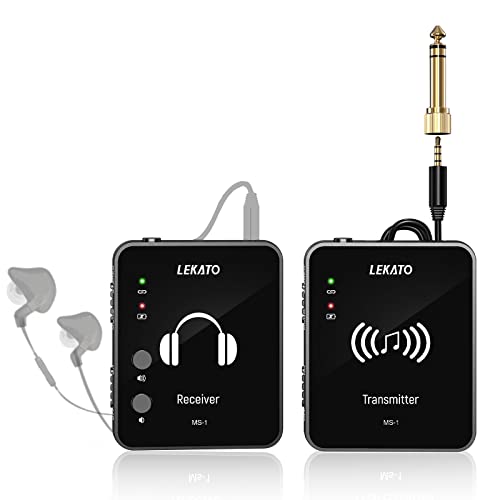
- One transmitter can support up to 6 receivers.
- Auto-pairing keeps setup simple for practice.
- Rated for stereo audio, low latency, and 100 ft range.
Best For: Bands and rehearsal groups that want a simple multi-receiver wireless IEM setup.
Long-Run Practice Choice

- Up to 10 hours of battery life per charge.
- Auto-pairing and mono/stereo switching simplify setup.
- Supports multiple receivers from one transmitter.
Best For: Rehearsals and small performances that need longer battery life.
Low-Latency Upgrade Pick
LEKATO MS-02 2.4G Stereo IEM System

- Mono mode is rated at under 4.5 ms latency.
- Supports up to 4 receiver pairs from one transmitter.
- Includes LED battery indicators and one-key mute.
Best For: Musicians who want lower latency and simple controls for practice.
Compact 2.4GHz Monitor Pick – Xvive U4 Wireless IEM System
If you want a straightforward option in in-ear monitor systems for music practice, the Xvive U4 keeps things simple with a compact 2.4GHz wireless setup, low latency, and a clean uncompressed signal. It is built for personal monitoring in rehearsal, studio, and live settings, and its metal housing and easy pairing make it practical for players who want to get up and running fast.
Best For: Musicians and small bands who want a simple wireless monitor setup for rehearsal or live performance.
Pros:
- Less than 5ms latency for tight real-time monitoring
- 2.4GHz wireless operation with up to 6 channels
- Rechargeable battery with about 5 hours of use
- Built-in limiter helps reduce distortion from hot inputs
Cons:
- Battery life is shorter than some competing systems
- Listed as mono input only, so it may not suit stereo monitoring needs
- No extra frills beyond the basic monitor workflow
Overall, the U4 is a practical choice if you value low-latency monitoring and easy setup over advanced routing features. It fits well as a compact practice and performance solution for musicians who want dependable wireless monitoring.
Flexible Practice Monitor Choice – Wireless IEM for Singers and Drummers
For in-ear monitor systems for music practice, this wireless monitor is aimed at singers, drummers, guitarists, and worship teams who want more freedom of movement during rehearsal or livestreaming. It supports stereo and mono modes, uses 2.4GHz wireless transmission, and offers a portable clip-on design with a rechargeable battery for everyday practice use.
Best For: Singers, drummers, worship teams, and practice setups that need a lightweight wireless monitor.
Pros:
- Supports both stereo and mono monitoring modes
- Up to 30m operating range in open environments
- Clip-on design is lightweight and portable
- Rechargeable battery lasts up to 5 hours
Cons:
- Best performance depends on direct line-of-sight placement
- Battery life is moderate rather than long
- Volume control is handled through the pairing button, which may feel less direct
This is a sensible pick if you need a flexible monitor solution for rehearsal rooms, church stages, or small studio sessions. It focuses on practical wireless monitoring without adding much complexity.
Long-Run Practice IEM Pick – JOYO JW-07 Wireless IEM System
Among in-ear monitor systems for music practice, the JOYO JW-07 is built around low-latency wireless monitoring with clear 48kHz/16bit audio and a simple transmitter-and-receiver layout. It is especially practical for guitar practice and monitoring, with anti-interference frequency hopping, multiple channel banks, and a battery rated for more than 8 hours.
Best For: Guitar players and practice-focused users who want longer battery life and stable wireless monitoring.
Pros:
- Less than 5ms latency for real-time feedback
- Over 8 hours of battery life on a full charge
- 12 channel banks across 4 groups for flexible practice use
- Frequency hopping helps reduce interference
Cons:
- One transmitter does not support multiple receivers
- Open-space range is moderate at 40-60 ft
- Positioned most clearly as a guitar practice device
If longer practice sessions matter more than extra routing features, the JW-07 is a strong fit. It combines stable wireless behavior with extended battery life for focused individual monitoring.
UHF Stage Stability Choice – Phenyx Pro PTM-11 Wireless IEM
If you need in-ear monitor systems for music practice that lean toward stability and stage-friendly routing, the Phenyx Pro PTM-11 uses UHF 900MHz transmission with a mono monitoring design. It is intended for band, studio, and lecture use, and its separate outputs plus PAD switch make it a practical option when you want clean signal handling and simple setup.
Best For: Bands, churches, and presenters who want a stable mono wireless monitor with straightforward routing.
Pros:
- UHF 900MHz operation with no stated latency
- 50 selectable frequencies and support for up to 5 systems together
- Separate left/right inputs and pass-through outputs
- Metal transmitter base and included carry case for portability
Cons:
- Mono-only monitoring may not suit users wanting stereo sound
- Open-range performance depends on avoiding thick walls and obstacles
- One transmitter can support multiple receivers, but the package includes a single receiver
The PTM-11 makes sense when reliability and easy integration matter more than advanced monitoring modes. It is a solid, stage-oriented solution for focused mono monitoring in practice or performance settings.
Portable Wireless IEM with Charging Case – MELONARE PM-2 portable wireless in-ear monitor system
If you want in-ear monitor systems for music practice that are easy to move around with, the MELONARE PM-2 is built for quick setup and long sessions. It uses 2.4GHz wireless audio, supports OTG input for phones, tablets, and laptops, and includes a charging case to help keep practice time going without frequent resets.
Best For: Musicians, hosts, and rehearsing performers who want portable wireless monitoring with strong battery life.
Pros:
- Up to 30 hours of total runtime with the included charging case
- OTG audio input works with devices that do not have a headphone jack
- 24bit/48kHz audio with 20Hz–20kHz response for clear practice playback
- One transmitter can connect to multiple receivers with independent volume control
Cons:
- Uses a 2.4GHz wireless design, so setup environments with many nearby devices may still matter
- Noise control is listed as none
Overall, this is a practical pick if you value convenience, mobile compatibility, and long battery life more than premium stage features. The mono/stereo switching and one-to-many monitoring support make it especially useful for rehearsals and small practice setups.
Low-Latency 2.4GHz Wireless IEM – INPARTNER A88T low-latency wireless in-ear monitor
For in-ear monitor systems for music practice where timing matters, the INPARTNER A88T focuses on low latency and straightforward wireless monitoring. It uses 2.4GHz transmission with frequency hopping for better interference resistance, plus a compact receiver and transmitter setup made for studio or band use.
Best For: Players and small groups who want fast response, stable wireless monitoring, and simple charging.
Pros:
- Low latency under 4ms for real-time monitoring
- Frequency hopping helps reduce interference from other wireless devices
- 48kHz/16bit audio for clear, accurate practice playback
- Includes a 1-to-2 USB-C and USB-A charging cable for charging transmitter and receiver together
Cons:
- Battery life is listed at over 8 hours, which is shorter than some alternatives
- No headphone jack on the unit itself
This model stands out when you want responsive monitoring without a complicated setup. The 100ft range and multipoint pairing support make it a useful fit for rehearsal rooms and small production spaces.
UHF 7-Channel Stage IEM – POGOLAB UHF 7-channel wireless in-ear monitor
If you need in-ear monitor systems for music practice that can also handle live performance, the POGOLAB UHF model is the most stage-oriented of the three. It adds 7 selectable UHF channels, XLR and AUX/LINE input flexibility, and a 1ms stated transmission delay for precise monitoring.
Best For: Bands, worship teams, and performers who want a more professional UHF monitor system.
Pros:
- 1ms ultra-low latency for real-time monitoring
- UHF design with 7 selectable channels to help avoid interference
- XLR input plus AUX/LINE switch adds source flexibility
- 48kHz/24-bit audio with over 106dB dynamic range
Cons:
- Up to 5 hours of battery life is shorter than some wireless practice options
- Designed around belt-pack use, so it is less compact than ultra-portable systems
This is a strong choice if your practice setup needs to translate directly to stage work. The channel options, wired input compatibility, and clear battery indicators make it well suited to rehearsals, soundchecks, and small gigs.
Compact Multi-RX Pick – LEKATO MS-1 2.4GHz Stereo IEM System
If you need in-ear monitor systems for music practice that are simple to set up and flexible for small-group use, the LEKATO MS-1 is built around quick pairing, stereo monitoring, and one transmitter feeding multiple receivers. It’s a practical fit for rehearsals, church bands, and small gigs where you want wireless freedom without a complicated menu system.
Best For: Bands or practice setups that want one transmitter to serve multiple receivers with easy auto-pairing.
Pros:
- Supports up to 6 sets working at the same time with one transmitter to many receivers.
- Auto-pairing makes setup straightforward, with no channel selection required.
- True stereo transmission with a one-key stereo/mono switch.
- 2.4GHz design is rated for low noise, low latency, and up to 100 ft range in open areas.
Cons:
- Battery life is listed at about 5 hours, which may be limiting for longer sessions.
- To get stereo performance, the source must be stereo and a stereo cable is required.
Overall, the MS-1 is a strong pick if you want a straightforward wireless IEM setup for practice sessions and smaller live environments. Its appeal is in the easy pairing and multi-receiver support more than extra bells and whistles.
Long-Run Practice Choice – M6S 2.4G Wireless IEM System
For in-ear monitor systems for music practice where battery life and easy shared use matter, the M6S offers automatic pairing, stereo/mono switching, and support for multiple receivers from one transmitter. It’s designed for stage performance, band practice, and church use with a focus on clear monitoring and simple operation.
Best For: Players who want a longer-running wireless monitor system for rehearsals or small performances.
Pros:
- Built-in rechargeable batteries are rated for up to 10 hours after a full charge.
- Multiple receivers can pair with one transmitter, with up to 6 units working simultaneously.
- Automatic pairing removes the need for manual channel changes.
- Includes mono/stereo input switching and a 24-bit/48KHz audio processor.
Cons:
- The package includes one pair of in-ear headphones, so you may still need extra earbuds for additional users.
- It uses a clip-on transmitter/receiver design that may be less minimal than ultra-compact alternatives.
The M6S stands out as a practical pick when you want more runtime and easy shared monitoring for practice sessions. Its feature set is aimed at keeping setup fast while supporting longer rehearsals.
Low-Latency Upgrade Pick – LEKATO MS-02 2.4G Stereo IEM System
If you’re comparing in-ear monitor systems for music practice and want a lower-latency option, the LEKATO MS-02 focuses on fast response, easy pairing, and compact portability. It’s aimed at singers, bands, church use, and studio monitoring where clear sound and a simple workflow are priorities.
Best For: Practice setups that prioritize lower latency and quick one-touch control.
Pros:
- Mono mode is rated at under 4.5 ms latency for very fast wireless monitoring.
- Supports one transmitter to multiple receivers, up to 4 pairs of devices.
- Offers 6-8 hours of operation and includes LED battery/volume indicators.
- Features one-key mute plus mono/stereo switching for easy control.
Cons:
- Earbuds are not included, so you’ll need to buy them separately.
- It supports up to 4 pairs, which is less than some competing multi-RX systems.
The MS-02 is a smart choice if you want a more responsive monitoring feel during practice or live use. Its lower latency and compact design make it especially appealing for players who value timing and convenience.
How We Picked These In-Ear Monitor Systems for Music Practice
We focused on systems that are practical for rehearsals, home studios, and small live setups. Priority went to low latency, stable wireless performance, easy setup, usable range, and receiver comfort. We also considered whether a system is better suited to solo practice, duo use, or full band monitoring.
Quick Comparison
For simple practice rooms, 2.4GHz systems are usually the easiest to use because pairing is fast and setup is minimal. For busier RF environments or larger bands, UHF options can offer more channel control and flexibility. Mono systems are often perfectly fine for basic monitoring, while stereo systems give a more natural mix and can make instruments easier to place in the sound field.
Key Buying Factors for In-Ear Monitor Systems for Music Practice
Latency
Latency is the delay between playing a note and hearing it in your ears. Lower latency helps you stay locked in rhythm, especially for drummers, bassists, and singers who depend on tight timing.
Connection Type and Stability
2.4GHz systems are popular for convenience, while UHF systems may provide better control in crowded wireless environments. If you rehearse in different locations, look for auto-pairing, interference resistance, and reliable line-of-sight performance.
Mono Vs. Stereo
Mono works well when you mainly need a clear mix and don’t care about placement. Stereo can improve separation and make it easier to hear vocals, click tracks, and instruments distinctly during practice.
Inputs, Range, and Power
Check whether the transmitter accepts XLR, AUX, or line-level sources so it matches your mixer or audio interface. Also confirm the usable range and battery life, especially if you rehearse on larger stages or for long sessions.
Who Should Buy Which In-Ear Monitor Systems for Music Practice?
Solo musicians and small-home users usually benefit from simple, compact systems with quick setup and good battery life. Bands and worship teams may want stronger range, multiple frequency options, or stereo monitoring for more control. If you practice often and travel, a portable system with a charging case can be especially convenient. For higher-traffic rehearsal spaces, a UHF model may be the safer choice when wireless congestion is a concern.
In short, the best choice depends on how many performers need monitoring, how complex your mix is, and whether convenience or flexibility matters more in your workflow.
