Last updated on October 24th, 2026
Great bookshelf speakers can bring detail, convincing vocals, and a wide stereo image to a listening space without demanding floorstanding-speaker room. The right pair depends as much on your amplifier, placement, and listening distance as it does on the speakers themselves.
These 10 picks span passive hi-fi models and powered, input-ready systems. Use the buying guide below to narrow them down by setup, room size, and the features you’ll actually use.
Best 10 Audiophile Bookshelf Speakers Picks for 2026
Best for Dynamic Sound

- 1-inch titanium tweeter with larger Tractrix horn
- 6.5-inch Cerametallic woofer and Tractrix port
- Dual terminals for bi-wiring or bi-amping
Best For: Amplifier-driven systems seeking detailed highs and flexible wiring
Best for Home Theater Flexibility

- Power Port design supports stronger, cleaner bass
- Works with 4- and 8-ohm amplifiers and AV receivers
- Wall-mount hardware adds placement options
Best For: Expandable surround systems that also handle stereo listening
Best Powered Pick
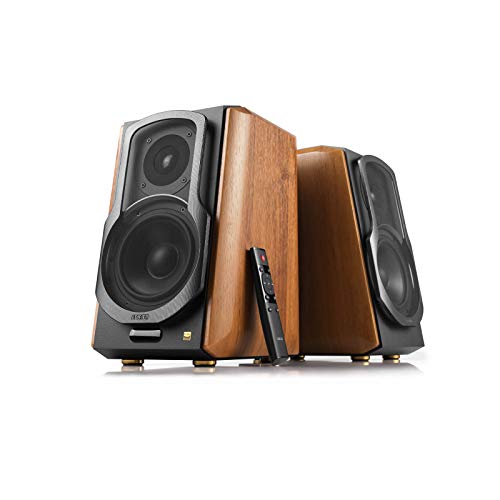
- Built-in Class D amplifier: 60 watts per speaker
- Bluetooth 5.0 with aptX HD decoding
- Optical, coaxial, and auxiliary inputs
Best For: All-in-one stereo setups without a separate amplifier
Best for Cabinet Control

- Internal bracing reduces unwanted vibration
- 6.5-inch woven aramid-fiber woofer
- Aluminum dome tweeter with wide-dispersion design
Best For: Passive stereo systems focused on cabinet and driver design
Dynamic Stereo Pick

- Large Tractrix horn and titanium tweeter
- 5.25-inch Cerametallic woofer
- Walnut finish with magnetic grilles
Best For: Wired stereo or home-theater setups with an amplifier
Compact 3-Way Pick

- Compact 3-way, 3-driver design
- Wide-dispersion super tweeter
- Stated 53–50,000 Hz response
Best For: Small-space wired stereo or home theater
Premium Hi-Fi Pick
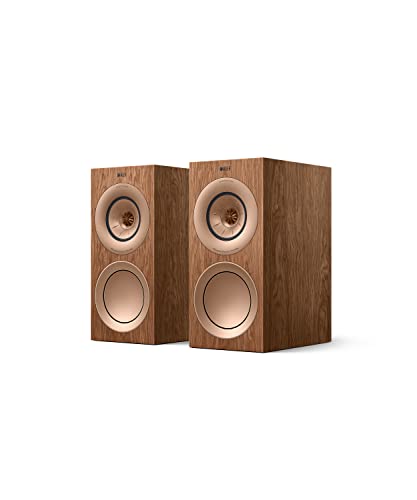
- 12th-generation Uni-Q driver array
- Metamaterial Absorption Technology
- Passive design with 4-ohm impedance
Best For: Premium hi-fi systems with compatible amplification
Best Powered All-Rounder

- Powered three-way pair with 144W RMS
- HDMI eARC, LDAC Bluetooth, and wired inputs
- Subwoofer output and app-based 9-band EQ
Best For: One powered pair for music, computer, and TV
Best Three-Way Hi-Fi Upgrade
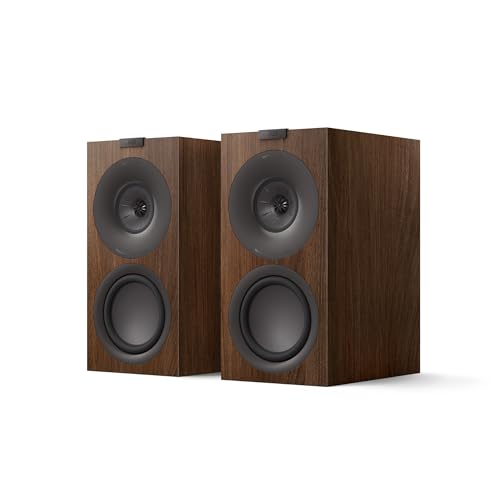
- Passive three-way design with 6.5-inch bass driver
- Uni-Q driver arrangement for even dispersion
- Needs a separate amplifier
Best For: An upgradeable hi-fi system with room for larger cabinets
Best Compact Passive Pick

- 11.9-inch-tall passive cabinet
- 5.25-inch bass/midrange driver with Uni-Q and MAT
- Requires a separate amplifier
Best For: A first stereo system in a smaller room
Best for Dynamic Sound – Klipsch RP-600M II
The Klipsch RP-600M II pair is a strong choice among audiophile bookshelf speakers if you want detailed highs and substantial bass from a passive stereo or home-theater setup. Its 1-inch titanium LTS tweeter sits in a larger Tractrix horn, paired with a 6.5-inch Cerametallic woofer.
Best For: Listeners building an amplifier-driven system who want horn-loaded detail and flexible wiring options.
Pros:
- Vented tweeter housing and larger horn are designed for clear, detailed treble.
- Tractrix port promotes efficient airflow for cleaner bass.
- Dual terminals support bi-wiring or bi-amping; magnetic grilles offer a cleaner look.
Cons:
- Requires an external amplifier or receiver.
- At 15.75 inches tall and 13 inches deep, each cabinet needs meaningful shelf space.
Choose this pair when you can accommodate its cabinet size and want to tailor a passive system around its horn tweeter and dual-input design.
Best for Home Theater Flexibility – Polk Signature Elite ES20
The Polk Signature Elite ES20 pair suits shoppers comparing audiophile bookshelf speakers for both music and surround sound. A 1-inch Terylene tweeter, 6.5-inch woofer, and Power Port bass design make it a versatile passive option for an AV receiver or stereo amplifier.
Best For: Home-theater builders who want bookshelf speakers that can also serve as surround channels.
Pros:
- Power Port technology is designed to reduce port turbulence and deliver stronger bass.
- Compatible with 4- and 8-ohm amplifiers and AV receivers.
- Keyhole slots and screw inserts support wall mounting; the pair can also go on stands.
Cons:
- Needs an amplifier or AV receiver; it is not a powered speaker pair.
- Speaker stands are sold separately.
The ES20 makes particular sense if you plan to expand into Polk’s timbre-matched Signature Elite home-theater lineup.
Best Powered Pick – Edifier S1000MKII
The Edifier S1000MKII offers a simpler route to audiophile bookshelf speakers: its built-in Class D amplification means you do not need a separate receiver. Bluetooth 5.0 with aptX HD, optical, coaxial, and auxiliary inputs accommodate a range of music and TV sources.
Best For: Listeners who want a powered stereo pair for a desk or entertainment setup without adding an external amplifier.
Pros:
- Built-in amplification provides 60 watts per speaker.
- Bluetooth aptX HD and multiple wired inputs support flexible source connections.
- On-speaker volume, bass, and treble controls come with a wireless remote.
Cons:
- Its 5.5-inch bass drivers are smaller than the 6.5-inch drivers in several other picks here.
- Bluetooth aptX HD playback requires a compatible source device.
Pick the S1000MKII if convenient connections and an all-in-one stereo system matter more than assembling separate speakers and amplification.
Best for Cabinet Control – ELAC Debut 3.0 DB63-WN
The ELAC Debut 3.0 DB63-WN pair appeals to buyers seeking audiophile bookshelf speakers with an emphasis on controlled cabinet behavior. Its internally braced, bass-reflex enclosure houses a 6.5-inch woven aramid-fiber woofer and a 1-inch aluminum dome tweeter.
Best For: Listeners putting together a passive stereo system who prioritize cabinet bracing and wide treble dispersion.
Pros:
- Internal bracing helps reduce unwanted cabinet vibration.
- Tweeter waveguide and phase plug are designed for wider dispersion.
- Magnetic grilles and a walnut finish keep the presentation tidy.
Cons:
- Requires an external amplifier or receiver.
- Wired connectivity only; there is no built-in wireless streaming.
With its 6-ohm impedance, this pair is worth considering alongside an amplifier suited to the load, especially if you value its braced cabinet and driver design.
Dynamic Stereo Pick – Klipsch RP-500M II Walnut
The Klipsch RP-500M II is a practical choice among audiophile bookshelf speakers if you want a compact, wired stereo pair with a focus on clear detail and efficient output. Its larger Tractrix horn, 1-inch titanium-diaphragm tweeter, and 5.25-inch Cerametallic woofer give it a distinctive driver design.
Best For: Listeners building a stereo or home-theater system around an amplifier or AV receiver.
Pros:
- Large 90° x 90° Tractrix horn and vented tweeter design emphasize clear, detailed sound.
- Tractrix rear ports are designed for cleaner, more powerful bass.
- Walnut finish and magnetic grilles offer two display options.
Cons:
- Wired speakers require a compatible amplifier or AV receiver.
- At 10.65 inches deep, they need adequate shelf space.
Choose this pair for its horn-based design and furniture-grade look; check placement depth and plan for separate amplification before buying.
Compact 3-Way Pick – Sony SS-CS5M2
For shoppers comparing audiophile bookshelf speakers for a smaller room, the Sony SS-CS5M2 offers a compact, wired 3-way design. Each speaker combines a 5.12-inch woofer, a precision tweeter, and a wide-dispersion super tweeter, with a stated frequency response of 53–50,000 Hz.
Best For: Small-space stereo or home-theater systems, particularly those using a Sony AV receiver.
Pros:
- Three-driver layout includes a super tweeter designed for an expansive soundstage.
- Bass-reflex enclosure and reinforced cellular cone are designed to limit distortion.
- Compact 8.7-inch-deep cabinets suit tighter spaces.
Cons:
- Wired connection requires a receiver or amplifier.
- The stated low-frequency response starts at 53 Hz, so buyers seeking deeper bass may want a subwoofer.
This pair makes sense when shelf space and a broad stated frequency range matter. Match it with suitable electronics and set bass expectations around its published specifications.
Premium Hi-Fi Pick – KEF R3 Meta Walnut
The KEF R3 Meta targets buyers seeking audiophile bookshelf speakers for a customizable passive hi-fi system. Its 12th-generation Uni-Q driver array is designed for even sound dispersion, while Metamaterial Absorption Technology addresses unwanted high-frequency sound from the driver.
Best For: Music or movie listeners pairing premium passive speakers with a compatible integrated amplifier or AV receiver.
Pros:
- Uni-Q array is designed to create a broad listening area.
- MAT is intended to reduce unwanted high-frequency sound.
- 6.5-inch woofer and walnut finish combine substantial driver size with a refined look.
Cons:
- Passive design requires separate amplification.
- Its listed 4-ohm impedance makes amplifier compatibility worth checking.
- Cabinet dimensions warrant careful measurement before shelf placement.
The R3 Meta is the system-building choice here: prioritize it if you value its dispersion-focused design and are prepared to match it with suitable amplification and space.
Best Powered All-Rounder – Edifier R2750DB MKII
For shoppers comparing audiophile bookshelf speakers without wanting to choose a separate amplifier, the Edifier R2750DB MKII is a powered, three-way stereo pair with 144W RMS output. Its range of inputs makes it practical for a desk or TV setup.
Best For: Listeners who want one powered pair for music, a computer, and a TV.
Pros:
- Dedicated 7-inch woofer, 4.5-inch midrange driver, and 1-inch silk-dome tweeter.
- HDMI eARC, optical, coaxial, line-in, and Bluetooth 6.0 with LDAC.
- Subwoofer output, app-based 9-band EQ, presets, and included remote.
Cons:
- At 15.35 inches tall, each cabinet needs more room than a compact desktop speaker.
- Listeners seeking deeper bass may still want to use the subwoofer output.
The R2750DB MKII is the convenient choice here: its built-in amplification and flexible connections simplify a multi-source setup, while the EQ offers room to tailor the sound.
Best Three-Way Hi-Fi Upgrade – KEF Q Concerto Meta
Among passive audiophile bookshelf speakers, the KEF Q Concerto Meta stands out for its three-way design: a 6.5-inch bass driver handles low frequencies while dedicated midrange and tweeter drivers handle the rest. It is intended for a stereo or home-theater system with a separate amplifier.
Best For: Hi-fi buyers who have, or plan to buy, an amplifier and want a larger three-way bookshelf speaker.
Pros:
- Dedicated bass, midrange, and high-frequency drivers.
- 12th-generation Uni-Q design aims for coherent sound and even dispersion.
- Metamaterial Absorption Technology reduces unwanted sound from the rear of the tweeter.
Cons:
- Requires a separate amplifier; it is not a powered or wireless speaker.
- The 16.3-inch-tall cabinet needs a suitably sized shelf or stand.
Choose the Q Concerto Meta if a conventional, upgradeable hi-fi system appeals to you and you have space for its larger cabinets. Its three-way layout is its clearest distinction from smaller two-way options.
Best Compact Passive Pick – KEF Q1 Meta
The KEF Q1 Meta suits shoppers looking for audiophile bookshelf speakers for a smaller room. This passive two-way model has a 5.25-inch bass/midrange driver in a cabinet just 11.9 inches tall, making it easier to place than larger bookshelf designs.
Best For: A first amplifier-based stereo system in a bedroom, study, apartment, or smaller living room.
Pros:
- Compact cabinet is practical where shelf space is limited.
- Uni-Q design is intended to keep vocals clear and sound balanced off-axis.
- Metamaterial Absorption Technology helps reduce unwanted distortion.
Cons:
- Needs a separate stereo amplifier and speaker wire.
- Listeners seeking deeper bass can add a subwoofer later.
The Q1 Meta is a manageable starting point for a component hi-fi setup. Its compact size is the draw; the separate amplifier requirement is the main planning consideration.
How We Picked These Audiophile Bookshelf Speakers
We focused on models that serve distinct needs rather than treating every speaker as interchangeable. The selection covers passive speakers for existing hi-fi systems, powered speakers for simpler setups, compact cabinets, and larger bookshelf designs. We also considered published driver configurations, connectivity, placement demands, and the equipment needed to make each pair work. Specifications can help narrow a shortlist, but they cannot predict how a speaker will sound in your room.
Quick Comparison: Which Type Fits Your System?
Want a ready-to-play setup? The powered Edifier S1000MKII and R2750DB MKII have built-in amplification; check their inputs against your TV, computer, or source before choosing. Already own an amplifier? The Klipsch, Polk, ELAC, Sony, and KEF models here are passive and need a compatible amp or receiver. Short on space? Compare cabinet dimensions first; the Klipsch RP-500M II and KEF Q1 Meta are alternatives to larger models such as the RP-600M II, Polk ES20, and KEF Q Concerto Meta.
Key Buying Factors for Audiophile Bookshelf Speakers
Amplification and Inputs
Decide between powered and passive before comparing sound-related features. Passive speakers leave amplifier and source selection to you, which offers upgrade flexibility but adds cost and complexity. Powered speakers simplify the chain, but their built-in inputs and controls determine what you can connect. For a turntable, confirm whether you also need a phono preamp.
Room Size, Bass, and Placement
Cabinet size and bass specifications are useful starting points, not guarantees of deep bass in your room. Larger speakers may suit listeners seeking more low-frequency output, while a compact pair can be easier to place. Rear-ported speakers may need breathing room behind them; consult the maker’s placement guidance. Put tweeters near seated ear height, leave space between speakers for a stable stereo image, and consider stands or isolation rather than crowding a shelf.
Listening Preferences and Budget
Think about whether you prioritize clear dialogue and vocals, lively dynamics, or relaxed long-session listening. If possible, audition at your usual volume with familiar recordings. Compare total system cost, including an amplifier for passive models and any stands, cables, or subwoofer you may want. A subwoofer can be more useful than moving to a bigger bookshelf speaker when low bass is the main goal.
Who Should Buy Which Audiophile Bookshelf Speakers?
For a simple desktop or living-room system: start with the powered Edifier options and compare their connections and physical size. For an existing stereo receiver: shortlist the Polk ES20, ELAC DB63, Sony SS-CS5M2, and Klipsch models based on available space and your preferred presentation. For a KEF-based passive system: compare the compact Q1 Meta, larger Q Concerto Meta, and premium R3 Meta against your room and amplifier budget. No single pair is best for everyone; the best match is the one you can position properly, power appropriately, and enjoy at your normal listening level.
