Finding the right guitar amp for a home studio means balancing tone, volume, connectivity, and available space. A powerful stage amplifier is not always the best choice when you need controlled levels, headphone practice, or easy recording.
This roundup compares 10 guitar amplifiers for home studios, including compact solid-state combos, portable rechargeable models, bass amplification, and feature-rich digital options. Use the guide below to match the amp to your instruments, workflow, and neighbors.
Best 10 Guitar Amplifiers for Home Studios Picks for 2026
Best All-Around Choice
Marshall MG15GFX Combo Amplifier

- Four channels from clean to overdrive
- Built-in modulation, delay, octave, and reverb
- Headphone output plus 3.5mm line input
Best For: Home guitarists seeking flexible tones and built-in effects
Best Budget Practice Amp
Leo Jaymz 20W Electric Guitar Amplifier

- 20-watt output with clean and crunch channels
- Three-band equalization for tone shaping
- CD line and AUX input for external audio
Best For: Affordable everyday practice in a simple setup
Best for Bass Home Studios

- 25-watt bass combo with an 8-inch speaker
- Switchable overdrive and contour controls
- Aux input and headphone output for practice
Best For: Bassists building a compact home practice or recording setup
Best Portable Option
10W Rechargeable Mini Guitar Amp

- Clean and drive modes with gain and tone controls
- Up to six hours of USB-C rechargeable playtime
- Headphone, AUX, and 5.3 wireless connectivity
Best For: Portable practice and compact, low-clutter setups
Best Budget Recording Amp

- 20 watts with overdrive tone
- Line output for recording equipment
- AUX input and headphone output
Best For: Affordable home practice and basic recording setups
Best Portable Practice Amp

- 5 watts with four built-in effects
- Bluetooth playback for accompaniment
- Rechargeable and highly compact
Best For: Portable practice with backing tracks
Best Modeling Amp for Tone Variety

- 100-plus editable presets
- 24 effects and extensive amp modeling
- 50 watts with a 12-inch speaker
Best For: Home studios needing broad tone experimentation
Compact Home Practice Pick
VELWAVE GA-20 20W Guitar Amplifier
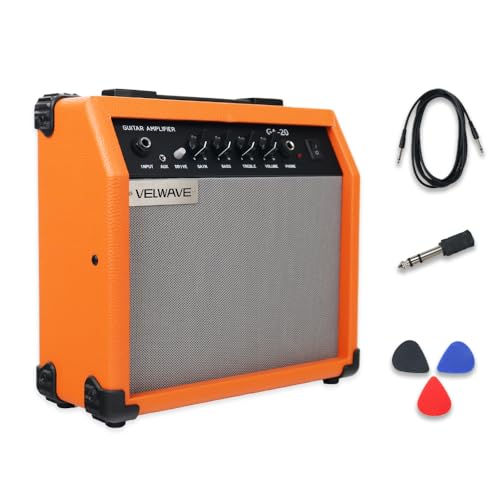
- 20 watts with a 6.5-inch speaker
- Clean and distorted tones with EQ controls
- Includes cable, headphone adapter, and picks
Best For: Home practice and compact guitar setups
Trusted Beginner Choice

- 10-watt solid-state practice amp
- Built-in overdrive and basic EQ controls
- Headphone jack, aux input, and two-year warranty
Best For: Beginners and low-volume home practice
Quiet Practice Option

- 20 watts with a 6.5-inch speaker
- Headphone and AUX inputs for flexible practice
- Lightweight cabinet with included noise-shielded cable
Best For: Portable home practice and headphone use
Best All-Around Choice – Marshall MG15GFX Combo Amplifier
For guitar amplifiers for home studios, the Marshall MG15GFX offers a practical balance of tone shaping, effects, and quiet-practice features. Its 15-watt output and 8-inch speaker suit home playing, while the headphone output and line input support silent practice and play-along sessions.
Best For: Home guitarists who want several amp voices and built-in effects in one compact combo.
Pros:
- Four channels cover clean, crunch, and two overdrive sounds.
- Built-in chorus, phaser, flanger, delay, octave, and two reverb types expand the available tones.
- Headphone output and 3.5mm input support quiet practice and jamming with external audio.
- Three-band EQ provides separate bass, mid, and treble control.
Cons:
- The 8-inch speaker and 15-watt output are intended for home use rather than large venues.
- It is corded and weighs 16.3 pounds, so it is less portable than a battery-powered mini amp.
The MG15GFX is a versatile home-studio option when onboard effects and multiple gain levels matter. It is especially useful for players who want to practice, shape tones, and monitor through headphones without adding separate effects equipment.
Best Budget Practice Amp – Leo Jaymz 20W Electric Guitar Amplifier
Among guitar amplifiers for home studios, the Leo Jaymz 20W model keeps the setup straightforward with clean and crunch channels, tone controls, and an audio input. Its 6.5-inch speaker and carry handle make it a compact choice for practice rooms, recording spaces, or small courtyards.
Best For: Budget-conscious electric guitarists who need basic clean, crunch, and play-along functions.
Pros:
- 20-watt output offers more rated power than many small practice amps.
- Clean and crunch channels provide two core playing sounds.
- Three-band equalization allows practical tone adjustment.
- CD audio line and AUX 6.5mm input support external playback.
Cons:
- The supplied specifications list a single output channel and a 6.5-inch speaker.
- It has a 30-day warranty, which is shorter than the coverage listed for some alternatives.
- The supplied notes do not list a headphone output for silent practice.
The Leo Jaymz is a simple, affordable pick for players who prioritize basic amplification over extensive effects. Its clean/crunch layout and audio input make it well suited to uncomplicated practice and entry-level home recording setups.
Best for Bass Home Studios – Fender Rumble 25 V3 Bass Amp
For bassists comparing guitar amplifiers for home studios, the Fender Rumble 25 V3 is a dedicated bass combo with 25 watts and an 8-inch speaker. Its three-band EQ, switchable contour, overdrive, auxiliary input, and headphone output make it suitable for focused home practice and bass-oriented recording setups.
Best For: Bass players who want a compact Fender combo with overdrive, contour shaping, and headphone monitoring.
Pros:
- Designed specifically for bass guitar with a 25-watt output and 8-inch speaker.
- Switchable overdrive and contour controls add tonal variety.
- Three-band EQ supports bass, mid, and treble adjustment.
- Auxiliary input and headphone output support play-along and quiet practice.
Cons:
- This is a bass amplifier, so it is not the most direct choice for standard electric-guitar tones.
- At 23.9 pounds, it is heavier than the smaller guitar amps in this selection.
- The supplied details list one output channel.
The Rumble 25 V3 makes the most sense when bass is the priority. It combines useful practice connectivity with dedicated bass voicing, while its overdrive and contour controls provide additional ways to shape a home-studio sound.
Best Portable Option – 10W Rechargeable Mini Guitar Amp
For portable guitar amplifiers for home studios, the flatsons FBA-10 combines a compact battery-powered design with clean and drive modes. Its headphone and AUX connections support quiet practice, while 5.3 wireless audio and USB-C charging make it convenient for flexible sessions around the home or on the move.
Best For: Guitarists who value portability, rechargeable operation, wireless audio, and quick practice setups.
Pros:
- USB-C rechargeable battery provides up to six hours of playtime according to the supplied notes.
- Clean and drive modes, plus gain and tone controls, offer basic sound shaping.
- Headphone and AUX jacks support silent practice and external audio.
- Compact 580-gram design includes 5.3 wireless connectivity for phones, tablets, and laptops.
Cons:
- The 1.7-inch speaker is much smaller than the speakers in the larger combo amps.
- Its 10-watt output is aimed at portable practice rather than high-volume room filling.
- Wireless audio is intended for external devices and does not replace a wired guitar connection.
The FBA-10 is a convenient choice when space and portability matter more than a large speaker. It works well for quiet practice, travel, and quick home-studio ideas, with rechargeable power and wireless playback reducing setup clutter.
Best Budget Recording Amp – Monoprice 20-Watt 1×8 Combo
For guitar amplifiers for home studios, the Monoprice 1×8 Combo offers a straightforward setup with 20 watts of output, overdrive, and a line-level output for sending the signal to a recorder or mixing board. Its auxiliary input also supports play-along practice.
Best For: Home players who want an affordable, simple amp with recording and playback connections.
Pros:
- 20-watt output with overdrive tone and 86dB of gain
- Line-level output can connect to a recorder or mixing board
- AUX input supports MP3 play-along practice
- 3.5mm headphone output for quieter sessions
Cons:
- Solid-state design offers fewer built-in sound options than a modeling amp
- Heavier and less portable than a mini practice amplifier at 15.4 pounds
This is a practical choice when basic amplification and direct recording connectivity matter more than extensive effects or preset variety.
Best Portable Practice Amp – LEKATO JA-05G Mini Amp
Among guitar amplifiers for home studios, the LEKATO JA-05G is designed for compact practice rather than high-volume tracking. It combines a 5-watt speaker with four effects, Bluetooth audio playback, and a rechargeable battery for flexible practice at home or on the go.
Best For: Guitarists who prioritize portability, quick practice sessions, and backing tracks from a phone.
Pros:
- Four built-in effects: clean, distortion, overdrive, and reverb
- Bluetooth audio lets you play along with music from compatible devices
- Rechargeable battery provides about six hours of use after a full charge
- Compact design and 5-watt output suit portable practice
Cons:
- 5-watt output and 2-inch speaker are aimed at practice, not large-room volume
- Bluetooth does not support Bluetooth headphones or speakers
- Requires a compatible 5V 2A charger and warns against chargers above 5V
The JA-05G is best viewed as a convenient practice companion. Its small size and wireless music playback are useful, while its limited output makes it less suited to full studio monitoring or loud recording.
Best Modeling Amp for Tone Variety – Marshall CODE50 Digital Combo
The Marshall CODE50 stands out among guitar amplifiers for home studios when sound variety is a priority. Its 50-watt output, 12-inch speaker, 100-plus editable presets, and broad selection of preamp, power amp, speaker, and effect models provide substantial room for experimenting with recorded tones.
Best For: Home studio players who want extensive modeled Marshall-style sounds, effects, and preset editing.
Pros:
- 100-plus editable presets support extensive tone experimentation
- Includes 24 digital effects, including reverb, delay, chorus, flanger, and tremolo
- 14 preamp models and four power amp models cover varied voicings
- Eight speaker emulations, Bluetooth, AUX input, and a headphone jack add flexibility
Cons:
- At 28.6 pounds, it is less convenient to move than a mini amp
- Its 50-watt output and 12-inch speaker may be more than needed for quiet practice
With its deep modeling options and multiple connectivity features, the CODE50 is the strongest fit here for players building varied tones at home, provided its larger size and power suit the room.
Compact Home Practice Pick – VELWAVE GA-20 20W Guitar Amplifier
For guitar amplifiers for home studios, the VELWAVE GA-20 offers a compact 20-watt setup with a 6.5-inch speaker, clean and distorted sounds, and basic tone shaping. Its headphone output and auxiliary input make it practical for quiet practice and play-along sessions.
Best For: Home practice, compact setups, and occasional outdoor use.
Pros:
- 20 watts with clean and distorted sound options
- Gain, bass, treble, and volume controls
- Includes a cable, headphone adapter, and guitar picks
- Compact, sturdy design with a carry handle
Cons:
- Single 6.5-inch speaker may be limited for larger spaces
- Its compact format is oriented toward practice rather than full studio monitoring
The GA-20 is a space-conscious choice when you want useful tone controls, headphone practice, and enough output for home playing without an overly large cabinet.
Trusted Beginner Choice – Fender Frontman 10G
The Fender Frontman 10G is a straightforward option among guitar amplifiers for home studios, pairing a 10-watt solid-state design with a 6-inch speaker. Gain, overdrive, volume, treble, and bass controls provide a useful range for practice tones from clean sounds to distortion.
Best For: Beginners and home players who want a simple Fender practice amp.
Pros:
- Simple 10-watt practice-focused design
- Built-in overdrive and gain controls
- Closed-back cabinet provides heavier bass response
- Includes a headphone jack, auxiliary input, and two-year warranty
Cons:
- Lower power than the two 20-watt alternatives
- Only a 6-inch speaker
The Frontman 10G makes sense for players prioritizing familiar branding, uncomplicated controls, and low-volume practice in a home studio or bedroom setup.
Quiet Practice Option – CXLWZ CX20W1 20W Guitar Amp
The CXLWZ CX20W1 is a practical contender among guitar amplifiers for home studios, with 20 watts of output, a 6.5-inch speaker, and controls for gain, bass, treble, and volume. Its auxiliary input, headphone output, and included noise-shielded cable support quieter, cleaner practice sessions.
Best For: Home players who want portability and headphone-friendly practice.
Pros:
- 20-watt output with clean-to-distorted tone control
- Headphone jack and AUX input for quiet practice and play-alongs
- Includes a professional-quality noise-shielded cable
- Compact 6.2-pound design with reinforced edges and rubber feet
Cons:
- Single 6.5-inch speaker is intended for compact use
- Product details do not specify a warranty duration
With its portable cabinet, noise-reduction design, and convenient connectivity, the CX20W1 is well suited to players moving between rooms or practicing without disturbing others.
How We Picked the Best Guitar Amplifiers for Home Studios
We focused on features that matter in smaller recording and practice spaces: usable low-volume tone, speaker size, channel and gain controls, headphone connectivity, auxiliary inputs, portability, and the ability to produce clean and overdriven sounds. We also considered whether each model is better suited to electric guitar, bass, casual practice, or more flexible home recording.
Because studio needs vary, the list includes both straightforward analog combos and digital or portable amplifiers. Product specifications, intended use, control layouts, and connectivity were weighed more heavily than maximum volume alone.
Quick Comparison
| Best For | Recommended Type | Key Features to Look For |
|---|---|---|
| Quiet practice | Small solid-state or rechargeable amp | Headphone output, compact size, low-volume control |
| Basic recording | 20W-class combo | Clean and distortion channels, aux input, stable speaker response |
| Multiple amp sounds | Digital modeling combo | Presets, effects, USB or recording-friendly connectivity |
| Bass practice | Dedicated bass combo | Appropriate voicing, bass speaker, headphone output |
| Portable playing | Battery-powered mini amp | Rechargeable battery, Bluetooth, built-in effects |
Key Buying Factors for Guitar Amplifiers for Home Studios
Power and Volume Control
More wattage does not automatically mean better studio performance. In a bedroom or compact tracking space, an amp with a responsive volume control is often more useful than a high-powered model. Lower-wattage combos can deliver satisfying tones without overwhelming microphones or nearby rooms.
Headphone and Recording Connections
A headphone output is valuable for late-night playing and monitoring. Auxiliary or MP3 inputs let you play along with backing tracks, while digital models may offer additional effects or recording-oriented features. Check the connector type and whether the output is designed for headphones, an audio interface, or both.
Tone Shaping and Effects
At minimum, look for useful gain, volume, bass, middle, and treble controls. Built-in overdrive, reverb, delay, or modeling can reduce the need for pedals, but a simple amp may be preferable if you already use software plugins or external effects.
Size, Speaker, and Instrument Compatibility
Compact speakers save space and work well for practice, while larger speakers may provide fuller projection. Bass players should use a dedicated bass amplifier, such as the Fender Rumble option in this selection, rather than relying on a guitar combo. Confirm that the amp’s input and tonal range suit your instrument.
Who Should Buy Which Guitar Amplifiers for Home Studios?
Choose a compact practice amp if you need simple controls, low cost, and easy placement. Choose a portable rechargeable model for mobility, casual playing, Bluetooth accompaniment, and quick setup. Choose a digital modeling amp if you want many amp voices and effects without building a large pedalboard.
Choose a conventional 20W combo for straightforward home recording and dependable clean or distorted tones. Choose a dedicated bass combo for bass guitar practice and tracking. Before buying, prioritize the connections and volume behavior you will actually use; those details usually matter more in a home studio than headline wattage.
