The best off-grid portable power stations give you dependable electricity when outlets are unavailable, whether you are camping, working remotely, traveling, or preparing for outages. The right model balances usable capacity, output power, recharge speed, portability, and solar compatibility.
We compare 10 leading options ranging from compact battery backups for phones and small electronics to higher-capacity solar generators designed for appliances and emergency power. Use the guide below to match your needs, budget, and preferred charging setup.
Best 10 Off-Grid Portable Power Stations Picks for 2026
Best Overall
EcoFlow DELTA 3 Classic Solar Generator

- 1,024Wh capacity with 1,800W output
- Includes a 220W bifacial solar panel
- Fast AC charging and 10ms UPS
Best For: Off-grid living, emergencies, camping, and larger appliances
Best Lightweight Pick
Jackery Explorer 300 Portable Power Station

- Compact 292Wh capacity and 300W output
- Weighs about 7.5 pounds
- Supports solar charging with optional panels
Best For: Hiking, camping, travel, and personal electronics
Best Expandable Power

- 2,000W output with 4,500W surge
- Expandable from 1,024Wh to 5,120Wh
- Includes a 100W solar panel and app control
Best For: RV travel, off-grid living, emergencies, and heavy-duty equipment
Best Compact Fast-Charger

- 230Wh capacity with 300W output
- 100W USB-C PD fast recharge
- Seven outlets and built-in three-mode LED light
Best For: Short trips, campsites, personal devices, and emergency lighting
Best for Easy Setup
Jackery Solar Generator 1000 v2

- 1,070Wh capacity and 1,500W output
- Included 200W solar panel
- App control and long-life LiFePO4 battery
Best For: Camping, road trips, and emergency backup
Best Value
1000W 1024Wh LiFePO4 Power Station

- 1,024Wh capacity with 1,000W output
- Five-device charging through AC and USB ports
- Supports up to 300W solar input
Best For: Moderate home backup and camping
Best High-Output Design
BROWEY S1600 Solar Power Station
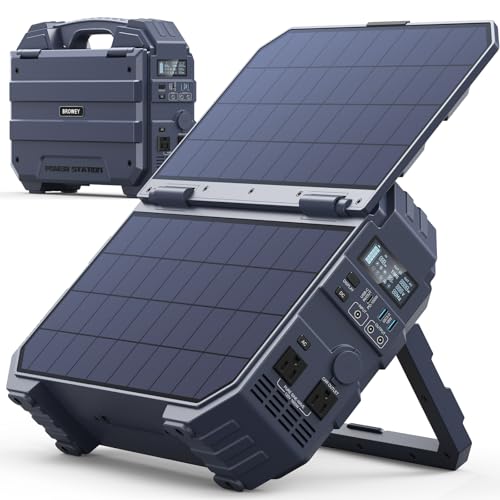
- 1,600W output with 3,200W peak
- Built-in 40W solar panel
- Eight outlets and long-life LiFePO4 battery
Best For: RV trips, tools, CPAP machines, and emergency backup
Best High-Capacity Pick

- 999Wh capacity with 1,000W continuous output
- Solar, AC, and car charging support
- Wide selection of AC, DC, USB, and wireless outputs
Best For: Extended camping, RV use, and home backup
Best Lightweight Essentials Pick

- 5.7-pound design with 192Wh LiFePO4 battery
- 300W pure sine wave output for essential electronics
- AC, car, and optional solar charging support
Best For: Lightweight camping, travel, and small electronics
Best Overall – EcoFlow DELTA 3 Classic Solar Generator
The EcoFlow DELTA 3 Classic is a strong all-around choice for off-grid portable power stations, pairing a 1,024Wh battery with an included 220W bifacial solar panel. Its 1,800W output, fast charging, and UPS functionality make it suitable for both outdoor use and home backup.
Best For: Off-grid living, emergency backup, camping, and powering larger appliances.
Pros:
- 1,800W output with 3,600W surge capacity and X-Boost support.
- Recharges from 0–80% in about 45 minutes through AC power.
- Includes a 220W solar panel with up to 25% energy conversion efficiency.
- LiFePO4 cells, a 10ms UPS, and a five-year manufacturer warranty.
Cons:
- The power station and solar panel arrive separately.
- Its 15.7-pound dimensions and 1,024Wh capacity are less packable than compact units.
Choose this model if you want one system that can handle everyday electronics, selected appliances, and renewable recharging. It offers a particularly balanced mix of output, durability, and solar capability.
Best Lightweight Pick – Jackery Explorer 300 Portable Power Station
The Jackery Explorer 300 is a compact option among off-grid portable power stations, delivering 292Wh of capacity in a lightweight package. With AC, USB, and 12V car outputs, it is designed for portable electronics and smaller camping loads rather than high-wattage appliances.
Best For: Hiking, camping, travel, cameras, laptops, drones, and CPAP use.
Pros:
- Lightweight design at approximately 7.5 pounds with an integrated handle.
- Offers 300W rated output, 600W peak surge, and six-device charging.
- LiFePO4 battery is rated for more than 4,000 cycles before reaching 70% capacity.
- Can reach 80% charge in about 2.8 hours with a 100W Jackery solar panel.
Cons:
- Solar panel is optional rather than included.
- The 292Wh capacity is limited for refrigerators, microwaves, and other demanding appliances.
- Orders require a physical address instead of only a PO Box.
This is a practical choice when portability matters more than maximum capacity. It provides useful connections and durable battery chemistry for personal electronics and light-duty off-grid trips.
Best Expandable Power – OUPES Mega 1 Solar Generator
The OUPES Mega 1 stands out among off-grid portable power stations for its combination of 2,000W output, expandable storage, and included 100W solar panel. It can support heavier appliances and grow from 1,024Wh to as much as 5,120Wh with extra batteries.
Best For: RV travel, off-grid living, emergency preparation, and heavy-duty equipment.
Pros:
- Provides 2,000W pure sine wave output with a 4,500W surge rating.
- Expandable capacity reaches up to 5,120Wh with two additional B2 batteries.
- Supports up to 800W solar input and includes a 100W solar panel.
- Offers app control, 13 ports, and a UPS response time under 20ms.
Cons:
- At 27.8 pounds, it is substantially heavier than compact power stations.
- Maximum solar input requires additional suitable panels.
- The included 100W panel provides less solar input than the station’s 800W maximum.
The Mega 1 is a good fit for buyers who want substantial output now and the option to build a larger backup system later. Its fast charging and expandable architecture are especially useful for extended stays away from the grid.
Best Compact Fast-Charger – VTOMAN FlashSpeed 300
The VTOMAN FlashSpeed 300 is a small, feature-rich option for off-grid portable power stations, combining 230Wh of storage with 300W output and a 100W USB-C PD input. Its compact design, multiple charging methods, and built-in emergency light make it useful for short outdoor trips.
Best For: Campsites, short trips, phones, cameras, drones, lights, and CPAP machines.
Pros:
- Weighs about 7.4 pounds and provides seven outlets.
- 100W USB-C PD input recharges the station to 80% in about two hours.
- LiFePO4 battery is rated for more than 3,000 cycles.
- Supports wall, solar, vehicle, and USB-C recharging, plus three LED light modes.
Cons:
- The 230Wh capacity is modest for extended off-grid use.
- Its 300W output is intended for smaller devices rather than high-demand appliances.
- A solar panel is not listed among the included components.
This model makes sense when you want a lightweight backup for personal devices and campsite essentials. The fast USB-C input and built-in light add convenience, while the modest capacity keeps it best suited to shorter outings.
Best for Easy Setup – Jackery Solar Generator 1000 v2
The Jackery Solar Generator 1000 v2 is a well-rounded choice for off-grid portable power stations, combining a 1,070Wh LiFePO4 battery, 1,500W output, and an included 200W solar panel. Its compact 23.8-pound design suits camping, road trips, and emergency backup.
Best For: Campers and emergency-preparedness buyers who want strong output, fast charging, and a relatively lightweight setup.
Pros:
- 1,500W continuous output with a 3,000W surge peak can handle appliances such as fridges and electric pots.
- LiFePO4 battery is rated for over 4,000 cycles while retaining more than 70% capacity.
- App control offers emergency fast charging, quiet overnight charging, and energy-efficiency modes.
- Includes three pure sine wave AC outlets, USB-C, USB-A, a car port, LED lights, and a 200W solar panel.
Cons:
- The one-hour charging mode must be enabled in the Jackery App; the default charge time is 1.7 hours.
- Solar charging to 80% takes about six hours with the included 200W panel under suitable conditions.
Choose this model when portability and flexible charging matter as much as capacity. The app-dependent fast-charge feature is useful, but buyers should know the station normally uses a slower battery-health-focused setting.
Best Value – 1000W 1024Wh LiFePO4 Power Station
This 1,000W, 1,024Wh unit offers practical off-grid portable power stations performance for camping and home outages. It supports up to five devices at once and accepts up to 300W of solar input, while its 27.7-pound body remains manageable for one person.
Best For: Buyers seeking a straightforward, high-capacity backup for lights, routers, mini fridges, laptops, and travel devices.
Pros:
- 1,024Wh LiFePO4 battery can power listed essentials such as lights, routers, and mini fridges during outages.
- Two 110V AC outlets, a 60W USB-C PD port, and two USB-A ports can charge five devices simultaneously.
- Supports up to 300W solar input and can use an optional 200W panel for a stated six-to-eight-hour full charge.
- Six-layer battery management protection addresses overcharge, overload, short circuit, and high-temperature risks.
Cons:
- The product has a lower 1,000W continuous output than higher-output models in this roundup.
- The solar panel is optional rather than included.
- At 27.7 pounds, it is heavier than the Jackery option.
This model emphasizes useful capacity and essential ports rather than maximum output. It is a sensible fit for moderate household backup and outdoor use, especially if you already own compatible solar panels.
Best High-Output Design – BROWEY S1600 Solar Power Station
The BROWEY S1600 stands out among off-grid portable power stations with 1,600W continuous output, a 3,200W peak, and a built-in 40W solar panel. Its 1,024Wh LiFePO4 battery and eight outlets make it suited to demanding camping, RV, and emergency-power tasks.
Best For: RV users, off-grid campers, and households needing higher output for refrigerators, CPAP machines, tools, and other demanding equipment.
Pros:
- 1,600W pure sine wave output and 3,200W peak capacity support a broad range of devices.
- Built-in 40W solar panel can collect energy while the station powers devices.
- LiFePO4 battery is rated for more than 3,000 cycles to 80% capacity and a 10-plus-year service life.
- Includes eight outlets, USB-C PD up to 100W, car charging, an accessory bag, and DC adapter tips.
Cons:
- The built-in solar panel is only 40W, so solar replenishment may be slower than with larger external panels.
- At 12 kg, it is the heaviest option in this selection.
- Its 1,024Wh capacity is similar to the smaller-output units despite the higher wattage rating.
The S1600 is the strongest choice here for output headroom and integrated solar convenience. Its higher power capability comes with greater weight, while the built-in panel is best viewed as a supplemental charging source.
Best High-Capacity Pick – EBL 1000W Solar Generator
For shoppers comparing off-grid portable power stations, the EBL EB1000 stands out with 999Wh of capacity, 1,000W continuous output, and a broad selection of charging ports. It is suited to camping, RV use, job sites, and home backup when you need more runtime than a compact power bank can provide.
Best For: Longer-duration camping, RV trips, small appliances, electronics, and emergency backup.
Pros:
- 1,000W output and 999Wh capacity can power small appliances, tools, and electronics.
- Supports solar, AC, and car charging, with pass-through charging for added convenience.
- Includes an AC outlet, DC outputs, car outlet, USB-C PD, USB-A ports, and wireless charging.
- Built-in BMS, automatic cooling fan, LCD display, SOS light, and folding handle add practical usability.
Cons:
- At roughly 18 pounds, it is less backpack-friendly than smaller power stations.
- AC charging takes about 7–8 hours, while car charging takes about 9–11 hours.
- Solar input is limited to 12–26V and 8A maximum.
The EB1000 is a strong choice when capacity, output, and port variety matter more than minimum weight. Its solar input and pass-through charging make it especially practical for extended off-grid use.
Best Compact 600W Option – DARAN LiFePO4 Power Station
The DARAN NEOK2 is a compact option among off-grid portable power stations, combining a 288Wh LiFePO4 battery with 600W pure sine wave output and 1,200W surge capacity. Its lightweight design and fast AC charging make it useful for camping, travel, CPAP equipment, and short-term emergency power.
Best For: Lightweight camping, CPAP use, laptops, cameras, power tools, and group charging.
Pros:
- 600W continuous output with 1,200W surge capacity supports compatible medical devices and tools.
- LiFePO4 battery chemistry provides a durable, long-life power source.
- Can charge up to six devices at once through AC, car, USB-C, and USB-A outputs.
- AC charging reaches 80% in about two hours, and the unit weighs under nine pounds.
Cons:
- Its 288Wh capacity provides less runtime than larger 999Wh models.
- The solar panel, solar cable, and car charging cable are not included.
- It is limited to devices drawing no more than 600W.
Choose the NEOK2 if portability and quick recharge are priorities. It offers a useful balance of output and size, though its smaller battery is better suited to essentials and shorter trips than extended backup.
Best Lightweight Essentials Pick – DaranEner 300W Power Station
For basic off-grid portable power stations needs, the DaranEner NEOZ2 keeps weight and size low while providing 192Wh of LiFePO4 battery capacity and 300W pure sine wave output. It is designed for phones, laptops, lights, fans, cameras, and other essentials rather than high-wattage appliances.
Best For: Lightweight camping, road trips, electronics, lighting, and small emergency backups.
Pros:
- At about 5.7 pounds, it is easy to carry and store.
- LiFePO4 cells are rated for more than 3,500 cycles, with BMS protection against common battery risks.
- Offers two AC outlets, 60W USB-C PD, USB-A charging, and a 12V DC output.
- Supports AC, car, and optional solar charging, plus a built-in multi-mode LED light.
Cons:
- 300W output is not suitable for rice cookers, hair dryers, mini-fridges, or other high-power appliances.
- The 192Wh capacity is intended for shorter runtimes and essential devices.
- Solar panels and car charging cables are not included.
The NEOZ2 is a sensible pick when portability matters most and your devices stay comfortably below 300W. Its durable battery and useful port mix make it a practical lightweight backup, but it is not intended for demanding appliances.
How We Picked These Off-Grid Portable Power Stations
We focused on practical specifications that affect real-world use: battery capacity, continuous and peak output, battery chemistry, charging options, included solar panels, portability, and the types of devices each unit can support. Models with LiFePO4 batteries received particular attention because they generally offer strong cycle life and stable performance. We also included a range of capacities, from compact units around 200Wh to larger 1,000Wh-plus systems.
Because advertised runtime varies by device and conversion losses, watt-hours should be treated as a comparison point rather than a guaranteed runtime. Solar charging performance also depends on panel placement, weather, temperature, and whether the panel is included.
Quick Comparison
- Compact everyday backup: Choose a 192Wh to 300Wh unit for phones, tablets, lights, cameras, routers, and other low-power devices.
- Balanced camping and emergency capacity: A 999Wh to 1,070Wh station can handle longer trips and many essential devices while remaining reasonably portable.
- Higher-output versatility: Units rated around 1,000W or more are better suited to demanding electronics and selected small appliances.
- Solar-ready convenience: Bundled panels simplify setup, while panel compatibility matters if you plan to expand later.
Key Buying Factors for Off-Grid Portable Power Stations
Capacity and Usable Runtime
Capacity is measured in watt-hours. A 1,000Wh station does not deliver 1,000Wh to every AC device because inverter and charging losses reduce usable energy. Estimate your load by multiplying watts by hours of use, then choose extra capacity for inefficiency and unexpected demand.
Output, Outlets, and Surge Rating
Continuous wattage determines what a station can run steadily; peak or surge wattage helps it start devices with brief startup demands. Check the requirements of refrigerators, pumps, heating appliances, and power tools before buying. USB-C power delivery is especially useful for modern laptops and mobile devices.
Battery Chemistry and Recharging
LiFePO4 batteries are often preferable for frequent use because of their long cycle life. Compare AC charging speed, car charging, and solar input limits as well as battery capacity. A built-in or bundled solar panel adds convenience, but confirm its wattage and whether additional panels can be connected.
Size, Weight, and Safety Features
Large-capacity models provide more runtime but are harder to transport. Look for clear displays, overload and short-circuit protection, temperature safeguards, regulated outputs, and a warranty appropriate to your intended use.
Who Should Buy Which Off-Grid Portable Power Stations?
Campers and travelers should prioritize a compact unit with USB-C, multiple output types, and enough capacity for phones, lights, cameras, and laptops. Emergency-preparedness buyers will usually benefit from roughly 1,000Wh or more, solar charging, and sufficient inverter headroom for essential appliances. Remote workers should look for quiet operation, reliable AC and USB-C outputs, and enough capacity for a full workday. Frequent off-grid users should favor LiFePO4 construction, fast recharging, expandable solar input, and a durable design. Before purchasing, verify the exact model’s included accessories, outlet layout, charging limits, and weight, since these details can vary by configuration.
