Last updated on September 30th, 2026
A subwoofer isolation platform can help limit vibration transferred into a floor, shelf, or desk. The right choice depends less on marketing claims than on whether it safely supports your subwoofer and fits where you need it.
These 10 selections cover compact stands, larger platforms, and foam risers. Use the buying guide below to narrow them down by footprint, load requirements, and setup.
Best 10 Subwoofer Isolation Platform Picks for 2026
Compact Floor Decoupler

- 15-by-15-inch platform
- Low 1.75-inch profile
- Targets structural vibration
Best For: Compact subwoofer setups with a matching footprint
Modular Isolation Stand
- 75-pound capacity per stand
- 7.8-by-10-inch footprint
- Combine units for larger subs
Best For: Subwoofers suited to a compact, modular support
High-Capacity Foam Riser
- For 8- to 10-inch subs
- 165-pound listed capacity
- Verify conflicting footprint specs
Best For: Smaller subwoofers in studios or apartments
Wide Home Theater Platform

- 22-by-18-inch surface
- Low 1.75-inch profile
- Targets floor-borne resonance
Best For: Home theater subs needing a wider platform
Best for Larger Subs

- 20 x 17 x 3-inch platform
- Designed for 12- to 15-inch subs
- Foam, EVA, and MDF construction
Best For: Larger subwoofers in home studios or apartments
Best Heavy-Duty Support

- Stated 250-pound capacity
- 19 x 19 x 1.75-inch size
- Designed for 10- and 12-inch subs
Best For: Heavier 10- or 12-inch subwoofers that fit a 19-inch square pad
Best Two-Pad Set
3-Layer Isolation Pads for 8- to 10-Inch Speakers

- Two pads included
- Each measures 13 x 15.5 x 1.8 inches
- Rubber sponge and non-slip fibreboard
Best For: Pairs of 8- to 10-inch monitors or smaller subs
Heavy-Duty Pick
Rockville ISO 12-18 Foam Platform

- 30 x 20-inch platform
- 350-pound stated capacity
- High-density vibration-damping foam
Best For: Large, heavy 12- to 18-inch subwoofers
Compact Pick

- 15 x 15-inch footprint
- 90-pound load capacity
- Anti-slip rubber base pad
Best For: Smaller subwoofers and studio speakers
Steel-Top Pick

- 22.3 x 15-inch surface
- Integrated steel top plate
- 100-pound load capacity
Best For: Longer speaker bases weighing up to 100 pounds
Compact Floor Decoupler – Auralex SubDude-II
Auralex Acoustics SubDude-II Subwoofer Acoustic Isolation Platform, 1.75" x 15" x 15"
Check Price On AmazonThe Auralex SubDude-II is a 15-by-15-inch subwoofer isolation platform designed to decouple a sub from the floor. Its low 1.75-inch profile suits setups where you want to reduce structural vibration without raising the cabinet much.
Best For: Subwoofers that fit on a 15-by-15-inch platform in compact home theater setups.
Pros:
- Designed to diminish structural vibrations and muddy resonance.
- Low-profile platform adds relatively little height.
- Inert structural layer and velour construction.
Cons:
- 15-by-15-inch surface may not accommodate larger cabinets.
- Check your subwoofer’s footprint before buying.
Choose this model when its compact footprint fits your sub and floor-borne vibration is the main concern; the platform is intended to clean up bass by reducing resonance, not change your subwoofer’s output.
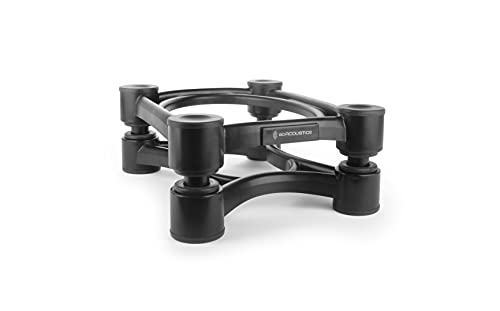
The IsoAcoustics Iso-200Sub takes a stand-based approach to a subwoofer isolation platform. This single 7.8-by-10-inch stand supports up to 75 pounds, and additional units can be combined to support larger subwoofers.
Best For: Buyers who want a compact, modular stand and can match the number of units to their subwoofer.
Pros:
- Patented isolator design aims to reduce vibration transferred into the supporting surface.
- Can be used alone or paired with additional stands for larger subwoofers.
- Rated for a 75-pound load per stand.
Cons:
- Package contains only one stand; larger setups may need additional units.
- Raises the subwoofer 3.5 inches.
Its modular layout is useful when a full-size pad is not the right fit. Confirm the subwoofer’s weight and support points before deciding whether one stand is enough.
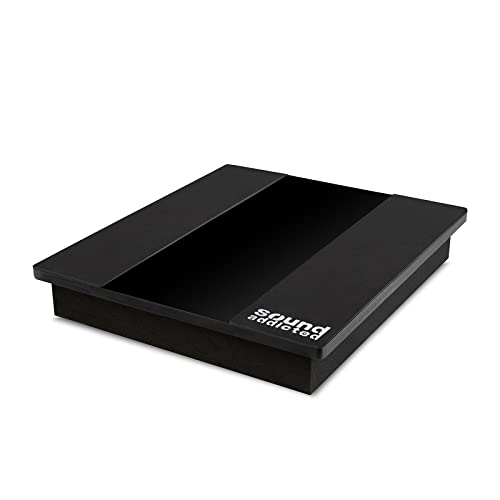
The Sound Addicted VibeBoss P10 is a subwoofer isolation platform aimed at 8- to 10-inch subwoofers. It combines high-density foam, EVA material, and an MDF board in a 2.5-inch-tall riser to help limit vibration transfer.
Best For: Home studios or apartments using an 8- to 10-inch subwoofer that fits the platform.
Pros:
- Foam, EVA, and MDF construction combines damping with a firm top layer.
- Non-slip base helps keep the platform positioned.
- Listed load capacity is 165 pounds.
Cons:
- Marketed for 8- to 10-inch subwoofers, so check larger cabinets carefully.
- Supplied dimensions conflict: the title lists 13.7 by 15.7 inches, while the details list 13.7 by 13.7 inches.
This is a practical choice if you want a foam-based riser with a high stated load rating. Verify the current platform dimensions against your subwoofer’s base before ordering.
The Auralex SubDude HT is a 22-by-18-inch subwoofer isolation platform for home theater setups that need more surface area. At 1.75 inches high, it decouples the sub from the floor while keeping the rise modest.
Best For: Home theater subwoofers whose bases fit within the 22-by-18-inch platform.
Pros:
- Large footprint accommodates more cabinet sizes than a compact pad.
- Designed to diminish structural vibration and muddy resonance.
- Low 1.75-inch profile.
Cons:
- 22-by-18-inch platform takes up substantial floor space.
- Confirm your subwoofer’s base fits before purchase.
If you need a broad, low platform, the SubDude HT is the roomier Auralex option here. Its stated aim is less floor-coupled resonance and sound transmission to neighboring spaces, though results will depend on the room and placement.
Best for Larger Subs – Sound Addicted VibeBoss P12
If your subwoofer has a broad footprint, this subwoofer isolation platform offers a 20 x 17-inch surface designed for 12- to 15-inch models. Its foam, EVA, and MDF construction pairs a dampening layer with a sturdy board.
Best For: Home studios or apartments with a 12- to 15-inch subwoofer that fits its 20 x 17-inch footprint.
Pros:
- Designed for larger 12- to 15-inch subwoofers.
- High-density foam, EVA, and MDF construction.
- Non-slip base helps keep the subwoofer stable.
Cons:
- Its 20 x 17-inch footprint needs more floor space than smaller pads.
- Raises the subwoofer 3 inches.
Check your subwoofer’s base dimensions before ordering; if they fit, the P12 is a practical choice for reducing vibration under a larger cabinet.
Best Heavy-Duty Support – Rockville ISO 10-12
The Rockville ISO 10-12 is a subwoofer isolation platform built around high-density foam with a stated 250-pound load capacity. Its 19 x 19-inch surface is intended for 10- and 12-inch subwoofers, with a relatively low 1.75-inch profile.
Best For: Buyers who want a low-profile pad for a 10- or 12-inch subwoofer and need a stated 250-pound capacity.
Pros:
- Supports up to 250 pounds, according to the supplied specifications.
- 19 x 19-inch surface also suits some studio monitors.
- High-density foam is designed to reduce vibration transfer.
Cons:
- Its square 19-inch footprint may not suit tighter spaces.
- Not specified for larger 15-inch subwoofers.
This is the capacity-focused option of the three; confirm both your equipment’s weight and base dimensions before choosing it.
Best Two-Pad Set – 3-Layer Isolation Pads for 8- to 10-Inch Speakers
This two-pack gives you a compact subwoofer isolation platform for each of two smaller speakers or compatible subs. Each pad measures 13 x 15.5 x 1.8 inches and uses a three-layer design with shock-absorbent rubber sponge and a non-slip fibreboard base.
Best For: A pair of 8- to 10-inch studio monitors or smaller subwoofers that fit the pads.
Pros:
- Includes two isolation pads.
- 13 x 15.5-inch footprint works for smaller equipment and desktops.
- Three-layer construction includes a non-slip base.
Cons:
- Not presented as a fit for subwoofers larger than 10 inches.
- No load-capacity rating is provided in the supplied details.
The pair makes sense for a stereo setup, but check each speaker’s base measurements; the pads’ usable footprint matters more than the speaker’s nominal driver size.
Heavy-Duty Pick – Rockville ISO 12-18 Foam Platform
If you need a subwoofer isolation platform for a large cabinet, the Rockville ISO 12-18 offers a 30 x 20-inch surface and a stated 350-pound capacity. Its high-density foam is designed to reduce vibration transfer into floors and walls.
Best For: Larger 12-, 15-, or 18-inch subwoofers in home theaters, studios, or live-sound setups.
Pros:
- 350-pound stated load capacity accommodates heavy subwoofers.
- 30 x 20-inch footprint provides room for larger cabinets.
- High-density foam helps limit vibration and unwanted resonance.
Cons:
- Large footprint may be awkward in tight spaces.
- Notes do not specify an anti-slip rubber base.
Choose this one when cabinet size and weight capacity matter more than a compact footprint; check your subwoofer’s base dimensions before buying.
Compact Pick – Pyle PSI15 Speaker Riser
The Pyle PSI15 is a compact subwoofer isolation platform for speakers that fit its 15 x 15-inch surface and stay within its 90-pound load limit. High-density foam helps reduce vibration, while a rubber base pad adds grip.
Best For: Smaller subwoofers or studio speakers needing a compact, grippy riser.
Pros:
- 15 x 15-inch footprint suits tighter setups.
- Anti-slip rubber base pad helps keep the riser stable.
- High-density foam is intended to reduce vibration and resonance.
Cons:
- 90-pound capacity rules out heavier subwoofers.
- 15-inch square surface may not fit wide cabinets.
This is the space-conscious option of the three, provided your speaker’s footprint and weight are within its limits.
Steel-Top Pick – Pyle PSI21 Speaker Riser
The Pyle PSI21 is a subwoofer isolation platform with a 22.3 x 15-inch surface, a 3-inch height, and a stated 100-pound load capacity. It pairs high-density foam with an anti-slip rubber base and an integrated steel top plate.
Best For: Speakers or subwoofers that fit a longer platform and benefit from a steel top plate.
Pros:
- Steel top plate provides a sturdy speaker placement surface.
- Rubber base pad helps resist slipping.
- Longer 22.3-inch surface offers more placement space than a square 15-inch riser.
Cons:
- 100-pound limit is lower than the Rockville platform’s stated capacity.
- 15-inch width may be too narrow for some subwoofers.
The PSI21 makes sense if you want its steel-top construction and longer footprint, but measure your cabinet and confirm its weight before ordering.
How We Picked the Best Subwoofer Isolation Platform
We focused on practical differences across the selected products: platform dimensions, the subwoofer sizes they are intended to accommodate, construction style, and placement flexibility. The list includes rigid platforms, an isolation stand, and foam risers because each can suit a different space. A product’s stated subwoofer size is a starting point, not a substitute for checking your cabinet’s actual footprint and weight.
Quick Comparison: Which Style Fits Your Setup?
For a compact subwoofer, start with a smaller platform such as the Auralex SubDude-II or Sound Addicted VibeBoss P10, then verify that all feet sit securely on the usable surface. For a larger cabinet, compare the dimensions of the Auralex SubDude HT, VibeBoss P12, and Rockville ISO 12-18. The Rockville ISO 10-12 targets a different size range. The IsoAcoustics Iso-200Sub is a stand rather than a broad pad, so pay particular attention to its supported footprint and load rating. Foam options, including the monitor-pad two-pack and Pyle risers, may offer flexible placement, but check that their shape and firmness suit your subwoofer. The selected list contains two identical Pyle entries; treat them as the same option when comparing styles.
Key Buying Factors for a Subwoofer Isolation Platform
Footprint and Weight Capacity
Measure the cabinet at its base, including the spacing between its feet. Check the platform’s usable top surface—not just its outside dimensions—and leave enough support under every foot. Confirm the manufacturer’s weight rating where provided, especially for heavy or large subwoofers. A pad that compresses unevenly or lets a foot overhang is a poor fit.
Floor Type, Height, and Stability
Isolation is most relevant when vibration is being transmitted into a surface, such as a wood floor or a shelf. On a thick carpet or a rigid concrete floor, the benefit may be less noticeable. Check added height before buying: a taller platform can affect clearance beneath furniture or the look of a living-room setup. On any surface, the sub should remain level and resist rocking.
Set Realistic Expectations
A platform aims to reduce mechanical vibration transfer; it does not soundproof a room or stop low-frequency sound from passing through walls and floors. Placement, crossover settings, volume, and room acoustics still shape what you hear. If bass is boomy, try adjusting placement or calibration as well as considering isolation.
Who Should Buy Which Subwoofer Isolation Platform?
Choose a compact platform when you have a smaller sub and limited floor space. Look at larger pads or platforms when your cabinet needs a wider, fully supported base. Consider the IsoAcoustics stand if its rated capacity and dimensions match your sub and you prefer that support style. Foam risers are worth considering for a lighter, appropriately sized setup, provided they stay stable under load. Whichever style you choose, measure first and prioritize a secure fit over the subwoofer size printed in a product name.
