Choosing the right bass amp for a small venue is about more than wattage. You need enough clean headroom to sit in the mix, a speaker size that moves air without overwhelming the room, and controls that make quick tone shaping easy on the fly.
Below, we focus on bass amplifiers for small venues that balance portability, usable volume, and practical features for rehearsals, cafés, bars, and intimate live sets.
Best 10 Bass Amplifiers for Small Venues Picks for 2026
Compact Club Ready

- 40-watt combo with 10-inch speaker
- Overdrive and contour controls for easy tone shaping
- Lightweight ported cabinet for portability
Best For: Small gigs, rehearsals, and players who want an easy-to-carry combo
Premium Room-Filling Combo

- 12-inch combo with neodymium speaker
- Flat, scooped, and FSW voicing options
- Bi-band limiter and tweeter for control
Best For: Small venues, bass guitar, and double bass players wanting more control
Vintage Feel, Gig Ready

- 50-watt 1x10 combo for small venues
- Super Grit Technology overdrive included
- XLR direct output for live use
Best For: Small gigs and players who want vintage styling with practical features
Budget Practice Pick
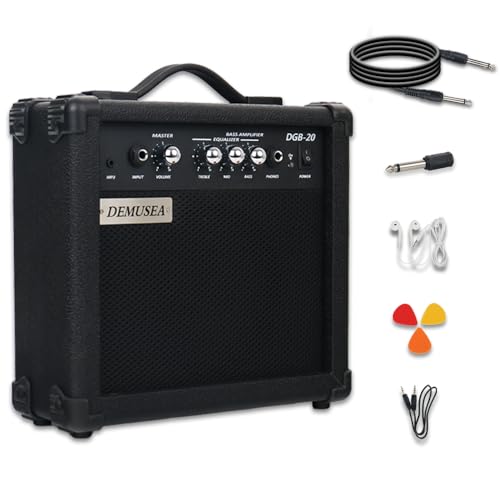
- 20W portable amp for practice and small jams
- 3-band EQ with headphone jack and aux input
- Includes cable, adapter, picks, and earphone
Best For: Beginners and travelers needing a compact practice amp
Orange 100W Combo

- 100 watts of solid-state power
- 15-inch speaker for fuller low end
- Balanced output and effects loop
Best For: Players needing a straightforward combo for small gigs and rehearsals
Portable Practice Mini Amp
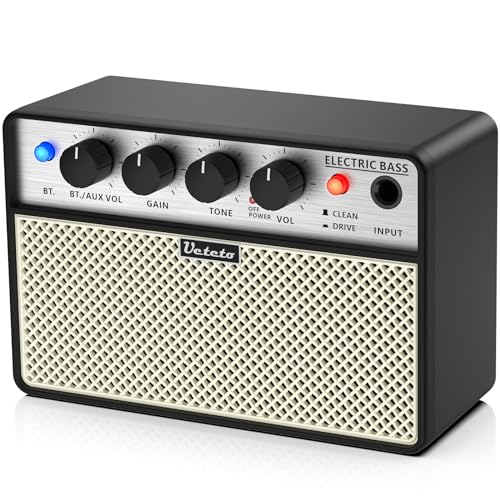
- Rechargeable with up to 4 hours use
- Bluetooth and AUX inputs included
- Clean and drive channels
Best For: Practice, travel, and quiet home sessions
High-Output Mini Head

- 600 watts RMS into 4 ohms
- DDT speaker protection included
- 3-band EQ with Punch and Bright controls
Best For: Players pairing a compact head with a separate cabinet
Portable Bluetooth Practice Rig

- 30W bass-optimized combo with 4" speaker
- Bluetooth 5.1 and OTG recording support
- 3-band EQ with mid frequency control
Best For: players needing a portable amp for practice, streaming, and tiny venues
Ultra-Portable Battery Practice Amp

- 10W combo with normal and drive channels
- Battery or adapter power for up to 3 hours
- Headphone jack and AUX input for quiet practice
Best For: traveling beginners and players who need a tiny practice amp
Budget 20W Combo for Practice

- 20W practice combo for small-room use
- Bass, middle, treble, gain, and volume controls
- Headphone jack plus MP3 aux input
Best For: beginners wanting a simple, affordable practice amp
Compact Club Ready – Fender Rumble 40 V3 Bass Amp
If you want bass amplifiers for small venues that are easy to move but still deliver real stage-ready tone, the Fender Rumble 40 V3 is a practical starting point. Its 40 watts, 10-inch Fender Special Design speaker, and switchable contour plus overdrive controls make it a flexible combo for rehearsals and smaller gigs.
Best For: Bassists who need a lightweight, versatile combo for rehearsal spaces, lessons, and intimate live rooms.
Pros:
- 40-watt output with a 10-inch speaker for straightforward small-venue coverage
- Overdrive circuit and contour switch add quick tone shaping
- Compact, lightweight ported enclosure with removable grille
- XLR connector and Fender build quality with warranty coverage
Cons:
- 40 watts is better suited to smaller spaces than louder stages
- Single-channel design keeps the layout simple, not feature-heavy
The Rumble 40 V3 makes sense if you need a simple bass combo that travels well and still offers useful tone controls. It is geared toward players who value portability and a balanced sound profile over maximum volume.
Premium Room-Filling Combo – Markbass Mini CMD 121P V
For bass amplifiers for small venues where you want more headroom and a refined feel, the Markbass Mini CMD 121P V stands out with a 12-inch solid-state combo design and versatile EQ shaping. Its bi-band limiter, piezo tweeter, and flat/scooped/FSW voicing options make it a strong fit when you need clarity and control on a small stage.
Best For: Players who want a more premium combo for small venues, including bass guitar and double bass use.
Pros:
- 12-inch neodymium speaker for a bigger combo format
- Flat, scooped, and FSW settings support different tonal needs
- Bi-band limiter and piezo tweeter add useful control
- Suitable for both bass guitar and double bass
Cons:
- Heavier than smaller practice combos at 32.5 pounds
- Higher-output design may be more than casual home use requires
This combo is a good match if your small-venue setup benefits from stronger presence and more tonal flexibility. It keeps the feature set focused on stage usefulness rather than extra extras.
Vintage Feel, Gig Ready – Ampeg Rocket Bass RB110
The Ampeg Rocket Bass RB110 is a sensible pick among bass amplifiers for small venues if you want a compact 1×10 combo with familiar styling and modern features. With 50 watts, Super Grit Technology overdrive, and both 0dB and -15dB inputs, it offers a straightforward setup for smaller live spaces.
Best For: Bassists looking for a compact gigging amp with vintage character and practical stage features.
Pros:
- 50-watt 1×10 combo suited to small-room playing
- Super Grit Technology overdrive adds usable grit
- 0dB and -15dB inputs provide input flexibility
- XLR direct output helps with live or direct connection use
Cons:
- Single 10-inch speaker limits low-end size compared with larger combos
- Feature set is focused on essentials rather than deep editing
Overall, the RB110 is built for players who want a compact amp that can handle small gigs without feeling bare-bones. Its mix of output, direct-out capability, and overdrive gives it practical stage value.
Budget Practice Pick – 20W Electric Bass Amplifier
If you are shopping bass amplifiers for small venues on a tight budget, this 20W electric bass amplifier is better viewed as a portable practice solution than a full performance rig. It includes a 3-band EQ, headphone jack, and aux input, which makes it useful for quiet practice, lessons, and small jam sessions.
Best For: Beginners and travelers who want a compact bass amp for practice, lessons, and very small sessions.
Pros:
- 20 watts is enough for bedroom practice and small jam sessions
- 3-band EQ with treble, mid, and bass controls
- Headphone jack and aux input support silent practice
- Includes cable, adapter, picks, aux cable, and earphone
Cons:
- 20W output is not aimed at larger live venues
- Best suited to beginners and practice rather than full-band gigs
This amp makes the most sense if portability and included accessories matter more than stage volume. It is a budget-friendly way to practice bass at home or on the go.
Orange 100W Combo – Orange CRUSH BA100 1×15 Combo
If you need one of the more capable bass amplifiers for small venues, this 100-watt Orange combo gives you enough output to cover rehearsals, practice spaces, and modest live setups. The 1×15-inch speaker, active 3-band EQ, parametric mid control, and footswitchable blend/gain controls make it a flexible option when you want quick tone shaping and a single, self-contained rig.
Best For: Bass players who want a simple 100-watt combo with strong onboard control for small gigs and rehearsal rooms.
Pros:
- 100 watts of solid-state power for small venue use
- 15-inch speaker for a fuller low-end response
- Active 3-band EQ plus parametric mid control for dialing in tone
- Balanced output and buffered effects loop add setup flexibility
Cons:
- At 33.1 pounds, it is not the lightest combo to carry
- Single-channel combo format may be less flexible than separate head-and-cab rigs
This is a practical all-in-one amp for players who want a straightforward stage-ready combo without extra pieces. Its control set and direct output features make it a useful fit when you need reliable bass reinforcement in smaller rooms.
Portable Practice Mini Amp – Ueteto 10W Mini Bass Amp
For players looking for compact bass amplifiers for small venues, this Ueteto unit is really more of a portable practice amp than a room-filling stage amp. Its rechargeable design, dual 5W subwoofers, clean and drive channels, and Bluetooth/AUX inputs make it useful for quiet practice, backing tracks, and on-the-go sessions where portability matters most.
Best For: Bassists who want a small rechargeable amp for practice, travel, and private playing.
Pros:
- Compact and lightweight design for easy carrying
- Rechargeable battery supports up to 4 hours of continuous use
- Clean and drive channels for simple tone switching
- Bluetooth and AUX inputs for playing with backing tracks
Cons:
- 10W output is not suited to true small-venue performance volume
- Built-in headphone output and portable format point more toward personal use than gigging
As a practice-first amp, it makes sense when portability and convenience matter more than stage power. If your needs are limited to home sessions, travel, or quiet rehearsals, it offers useful features in a very small package.
High-Output Mini Head – Peavey MiniMAX 600W Head
Among bass amplifiers for small venues, a compact head like the Peavey MiniMAX makes sense if you already have a cab and want serious power in a small footprint. With 600 watts RMS into 4 ohms, DDT speaker protection, and a useful control set including pre-gain, TransTube gain boost, and a 3-band EQ, it is built for players who need headroom and tone shaping rather than an all-in-one combo.
Best For: Bassists who want a powerful amp head to pair with a cabinet for compact live setups.
Pros:
- 600 watts RMS into 4 ohms for substantial output
- DDT speaker protection helps support safer operation
- Pre-gain with TransTube gain boost adds drive control
- 3-band EQ with Punch, Mid-shift, and Bright controls
Cons:
- Requires a separate cabinet, so it is not a self-contained combo
- Best suited to players who already have a rig or plan to build one
This is the strongest option here for players prioritizing output and rig flexibility. If your small-venue setup uses an external cab, the MiniMAX offers a lot of power and control in a compact head format.
Portable Bluetooth Practice Rig – JOYO Vibe Cube BA-30
If you’re comparing bass amplifiers for small venues, this 30W JOYO combo is a practical grab-and-go option for rehearsals, coffeehouse sets, and compact solo gigs. It keeps the footprint small while still offering bass-optimized output, Bluetooth 5.1 for backing tracks, and OTG direct recording for simple content capture.
Best For: Bassists who want a portable amp for practice, livestreams, and very small gigs with recording support.
Pros:
- 30W output with a 4″ speaker and LF radiator for punchy low-end in a compact cabinet.
- 3-band EQ plus mid frequency control for more precise tone shaping.
- Bluetooth 5.1 and OTG direct recording make it useful for backing tracks and demos.
- Headphone output supports silent practice when volume needs to stay low.
Cons:
- No internal battery, so cordless use requires an external PD power bank and compatible cable.
- Small 4″ speaker limits how much air it can move for louder rooms.
- Best suited to compact spaces rather than full-band stage volume.
This is a flexible choice if portability and connectivity matter more than sheer output. For small venues and home-to-gig transitions, it offers useful features without adding much bulk.
Ultra-Portable Battery Practice Amp – JOYO MA-10B Mini Bass Amp
For players shopping bass amplifiers for small venues, this 10W JOYO mini combo makes the most sense as a lightweight practice and warm-up amp. It is built for easy transport, runs on batteries or an adapter, and includes headphone and AUX input for quiet sessions with backing tracks.
Best For: Beginners and traveling bassists who need a tiny, affordable amp for practice and casual outdoor jamming.
Pros:
- Compact, lightweight design that fits in a backpack and weighs under 3 pounds.
- Battery operation allows up to three hours of outdoor use.
- Headphone output and AUX input are handy for silent practice and jamming along with music.
- Dual channels with a drive mode add some flexibility for different practice sounds.
Cons:
- 10W output is better for home practice than for true venue volume.
- Smaller feature set than larger combo amps.
- Not designed to cover a room the way higher-wattage bass amplifiers can.
As a budget-friendly practice amp, it covers the essentials and travels easily. It is a smart pick when portability matters more than stage-level power.
Budget 20W Combo for Practice – GLARRY 20W Bass Combo Amp
If you want a straightforward option from the bass amplifiers for small venues category, this 20W GLARRY combo keeps things simple and useful. It offers enough power for practice and small-room playing, plus gain, volume, treble, bass, and middle controls to help shape your sound.
Best For: Beginners and budget buyers who want a portable practice amp with basic tone control.
Pros:
- 20W output is a step up from tiny practice amps and works well for small settings.
- Gain, volume, treble, bass, and middle controls offer flexible tone shaping.
- Headphone output supports silent practice, and the aux input works with MP3 players.
- Rubber edging and a lightweight build improve portability and durability.
Cons:
- Corded power only, so it is not as flexible outdoors as battery-powered models.
- Single-channel design keeps the feature set basic.
- Best for practice and very small rooms rather than louder live setups.
This amp is a practical pick if you want usable tone controls without paying for extra features. It is geared more toward home use and small spaces than serious stage reinforcement.
How We Picked These Bass Amplifiers for Small Venues
We prioritized real-world usefulness over spec-sheet hype. The strongest options combine enough output for small stages, reliable low-end response, and a format that is easy to carry, set up, and use in mixed-genre venues. We also considered player-friendly extras such as headphone outs, aux input, Bluetooth, onboard EQ, compressor circuits, and direct recording support where relevant.
Quick Comparison: What Matters Most
For Bass Amplifiers for Small Venues, the best choice depends on how loud the band is, whether you need the amp to carry the room on its own, and how often you rehearse versus perform. A 10W to 40W combo can be ideal for practice, writing, and very quiet rooms, while 50W to 100W combos are better for smaller gigs with a controlled stage volume. Head units and higher-powered combo systems make sense when you need more rig flexibility or plan to add an external cabinet.
Key Buying Factors for Bass Amplifiers for Small Venues
Power and Headroom
Wattage is only part of the story, but it still matters. More clean headroom helps the bass stay defined when the drummer gets louder or the room fills up. For small venues, prioritize enough power to stay clean at gig volume rather than chasing the highest number available.
Speaker Size and Cabinet Design
A 10-inch speaker often offers a strong balance of punch and portability, while a 12-inch or 15-inch design can add more low-end fullness. Smaller practice amps can work well for quieter settings, but they usually need PA support in live rooms.
EQ, Compression, and Tone Shaping
Simple, effective EQ is a major advantage. Bass, mid, and treble controls help you adapt to different rooms quickly, while built-in compression can smooth dynamics and keep notes even across the fretboard.
Connectivity and Convenience
Features like a headphone jack, aux input, Bluetooth, and DI or USB recording can make an amp more versatile. These extras are especially useful if the amp must handle practice, home recording, and small performance duties.
Who Should Buy Which Bass Amplifiers for Small Venues?
If you want an easy all-around choice for rehearsals and small gigs, look for a compact combo with enough clean output and a responsive EQ. If portability matters most, a mini practice amp is better for apartments, travel, and quiet sessions. If you play louder venues or need more stage presence, step up to a 100W-class combo or a higher-powered head paired with the right cabinet. In short, the best Bass Amplifiers for Small Venues are the ones that match your actual room size, volume needs, and setup preferences—not just your ideal specs.
