Small rooms demand more than a mixer that simply fits on a desk. The best digital mixing consoles for small rooms balance useful inputs, quiet preamps, straightforward controls, and connectivity for recording, streaming, rehearsal, or small performances.
This roundup compares 10 compact options, from tablet-controlled systems with advanced routing to affordable mixers with Bluetooth, USB recording, phantom power, and built-in effects. Use the buying guide below to narrow the field based on your space, sources, and workflow.
Best 10 Digital Mixing Consoles for Small Rooms Picks for 2026
Best for Tablet-Controlled Mixing
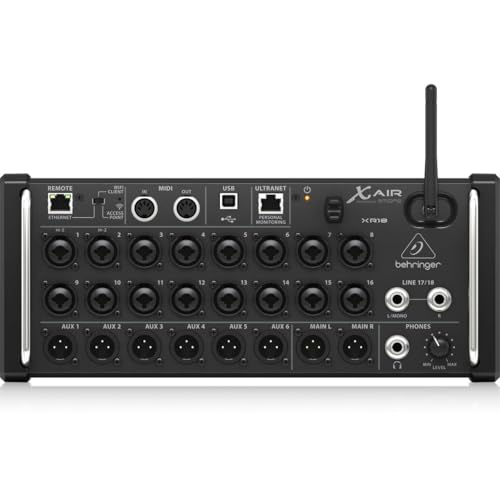
- 18 channels and 12 buses in a compact format
- 16 programmable Midas-designed preamps
- Built-in Wi-Fi and 18 x 18 USB interface
Best For: Small studios and live setups needing remote control
Best Traditional Compact Mixer

- 10 inputs with USB connectivity
- Built-in SPX digital effects
- Three-band EQ, filters, and one-knob compression
Best For: Hands-on home studio and small performance mixing
Best for Built-In Effects
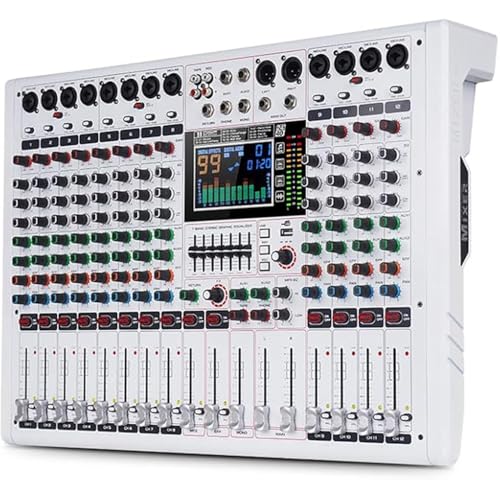
- 12 channels with a color LCD screen
- 99 DSP effects and seven-stage equalizer
- Bluetooth and USB playback connectivity
Best For: Karaoke, small performances, and entertainment setups
Best Small-Footprint Feature Set

- Compact desktop design with eight channels
- Four combo inputs with phantom power and Hi-Z switching
- USB, Bluetooth, MP3 playback, and DSP effects
Best For: Home studios, streaming, podcasting, and karaoke
Feature-Rich 8-Channel Pick

- 8 channels with XLR and balanced line inputs
- Bluetooth, USB recording, and MP3 playback
- 3-band EQ, reverb, and +48V phantom power
Best For: Home studios, karaoke, podcasting, and small events
Compact Value Choice
Pyle 6-Channel Bluetooth Mixer
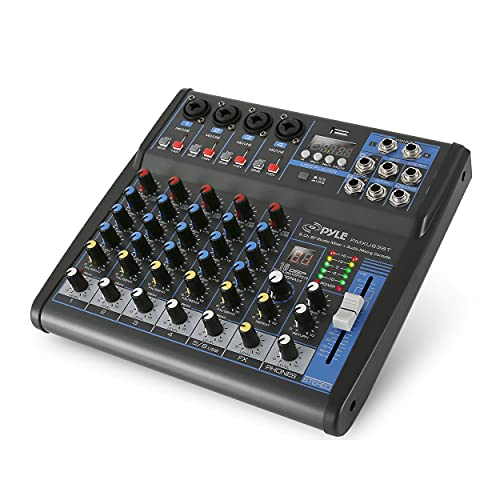
- Compact 9.3-inch-wide steel-chassis design
- Bluetooth, USB, flash-drive, and MP3 support
- 3-band EQ, 16-bit DSP effects, and phantom power
Best For: Desk-based DJ, karaoke, rehearsal, and small live setups
Effects-Focused Option

- 16 built-in DSP effects with reverb and delay
- Four XLR inputs with switchable +48V phantom power
- Bluetooth, USB playback, and 3-band EQ
Best For: Karaoke, streaming, basic recording, and small performances
Feature-Rich Pick
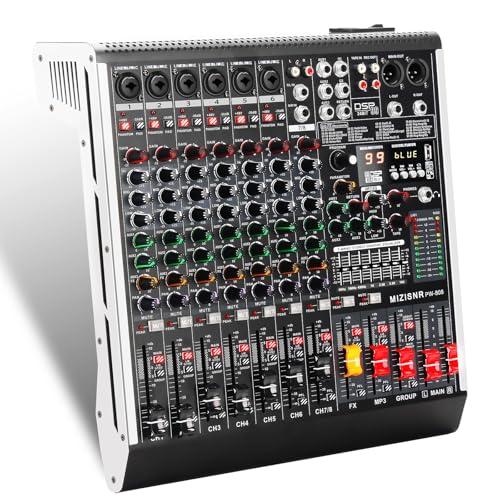
- Eight channels with individual controls and mute buttons
- 99 DSP effects plus 7-band main-output EQ
- Bluetooth, USB recording, MP3 playback, and 48V phantom power
Best For: Creators and performers needing maximum input and feature flexibility in a small room
Compact Analog-Style Choice

- Six channels in a thin, dust-resistant chassis
- Bluetooth, USB, flash-reader, and MP3 connectivity
- 48V phantom power, three-band EQ, and output metering
Best For: Small-room live mixing, karaoke, DJ playback, and basic recording
Small-Footprint Effects Pick

- Compact six-channel design with 99 digital effects
- USB playback and recording for MP3, WAV, and WMA files
- Bluetooth streaming and XLR inputs with 48V phantom power
Best For: Compact podcasting, vocals, and small-room performances with effects
Best for Tablet-Controlled Mixing – Behringer X AIR XR18
For digital mixing consoles for small rooms that need substantial input capacity without a large desk, the Behringer X AIR XR18 offers 18 channels in a compact, tablet-controlled format. Its 16 programmable Midas-designed preamps, built-in Wi-Fi, and USB interface suit both studio and live applications.
Best For: Small studios, rehearsal spaces, and compact live setups needing remote control and many microphone inputs.
Pros:
- 18-channel, 12-bus design provides room for larger small-room setups.
- 16 programmable Midas-designed mic preamps support detailed input control.
- Built-in Wi-Fi enables direct iPad or Android tablet operation without an external router.
- 18 x 18 bidirectional USB interface supports direct recording.
Cons:
- Operation depends on a tablet-based control workflow rather than traditional onboard controls.
- The supplied notes do not specify a current software-update status.
The XR18 is the most capable choice here for channel count and flexible remote mixing. It is particularly compelling when a small room needs recording connectivity and multiple microphone inputs in a compact unit.
Best Traditional Compact Mixer – Yamaha MG10XU
The Yamaha MG10XU is a practical option among digital mixing consoles for small rooms when straightforward physical controls, USB connectivity, and built-in effects matter. Its 10 inputs, SPX effects, three-band EQ, high-pass filters, and one-knob compressors cover common recording and performance needs.
Best For: Home studios, small rehearsals, and compact performances where hands-on mixing is preferred.
Pros:
- 10-input layout fits modest studio and live applications.
- USB connectivity supports computer-based audio use.
- SPX digital effects add onboard processing without external equipment.
- Three-band EQ, high-pass filters, and one-knob compressors simplify tone shaping.
Cons:
- Its 10-input capacity is lower than the XR18’s 18 channels.
- It uses a corded power connection and weighs 7.7 pounds.
Choose the MG10XU if you want a compact, rugged mixer with familiar controls and useful built-in processing. It offers a less network-dependent workflow than a tablet-controlled design while retaining USB audio connectivity.
Best for Built-In Effects – GF12 PRO 12-Channel Mixer
For buyers comparing digital mixing consoles for small rooms with playback and effects in mind, the GF12 PRO combines 12 channels with a color LCD screen, Bluetooth, USB, and 99 DSP effects. Its individual channel controls and seven-stage equalizer provide flexible adjustment for compact performances and entertainment spaces.
Best For: Karaoke rooms, small performances, studios, and other setups that benefit from wireless playback and many onboard effects.
Pros:
- 12-channel design offers more input capacity than a basic compact mixer.
- 99 DSP effects accommodate varied performance and entertainment applications.
- Bluetooth and USB support convenient wireless streaming and stored-media playback.
- Individual channel gain, balance, EQ, effects-send, and volume controls support detailed mixing.
Cons:
- The supplied warranty information lists only a 30-day return and exchange policy.
- Its listed dimensions are relatively large at 23.8 inches deep by 18.3 inches wide.
- The notes do not specify a computer audio interface function for the USB connection.
The GF12 PRO stands out for users who value onboard effects, Bluetooth playback, and a visual display. Confirm that its footprint and USB functionality match your room and recording plans before choosing it.
Best Small-Footprint Feature Set – Pyle PMX408ST
The Pyle PMX408ST is a compact choice among digital mixing consoles for small rooms, combining eight channels with Bluetooth, USB recording and playback, an MP3 player, DSP effects, and +48V phantom power. Its four XLR combo inputs and desktop-sized chassis suit home studios, podcasts, karaoke, and small live systems.
Best For: Home recording, streaming, podcasting, karaoke, and small setups needing flexible connectivity in limited space.
Pros:
- Small 9-by-10.2-by-2.4-inch footprint suits desktop use.
- Four XLR/mic/line combo inputs include individual +48V phantom power and Hi-Z switching.
- USB, Bluetooth, and built-in MP3 playback support several audio sources.
- Per-channel faders, three-band EQ, control-room output, and headphone control add practical flexibility.
Cons:
- Eight channels provide less capacity than the 10-, 12-, and 18-channel alternatives.
- The supplied notes do not identify the exact number of DSP effect presets.
The PMX408ST is a strong fit when space and connectivity are higher priorities than maximum channel count. Its combo inputs, phantom power, faders, and control-room output give a small-room setup useful recording and monitoring flexibility.
Feature-Rich 8-Channel Pick – Bluetooth USB Mixing Console
For shoppers comparing digital mixing consoles for small rooms, this 8-channel model offers a flexible setup with Bluetooth playback, USB recording, and multiple microphone and instrument connections. Its 3-band EQ, reverb, and +48V phantom power make it suitable for varied home audio and event applications.
Best For: Home studios, karaoke setups, podcasting, and small events that need several input options.
Pros:
- Eight channels with XLR and balanced line connectivity.
- Bluetooth playback supports wireless streaming from compatible mobile devices within up to 33 feet.
- Includes USB recording, MP3/WAV/WMA playback, a built-in MP3 player and recorder, and LCD feedback.
- Provides 3-band EQ, reverb, and +48V phantom power for condenser microphones.
Cons:
- The supplied notes specify that it cannot connect to a MacBook for recording.
- Its 15.75-inch width and 4.51 kg weight may require a dedicated small-room setup space.
This is the most capable option here for buyers who want extra channels and integrated playback and recording features. Verify computer compatibility before purchasing if MacBook recording is important.
Compact Value Choice – Pyle 6-Channel Bluetooth Mixer
This Pyle model is a practical contender among digital mixing consoles for small rooms, combining six channels with Bluetooth, USB/computer input, and a built-in MP3 player. Its compact 9.3-inch width and steel chassis suit desk-based audio, karaoke, and small performance setups.
Best For: Compact DJ, karaoke, rehearsal, and small live-use setups needing straightforward connectivity.
Pros:
- Compact design with a rugged steel chassis and sealed rotary controls.
- Supports Bluetooth streaming from iOS and Android devices.
- Offers USB, flash-drive, computer, and MP3 compatibility for mixing and recording.
- Includes 3-band EQ, +48V phantom power, LED peak indicators, and 16-bit DSP effects.
Cons:
- It has six channels, fewer than the 8-channel alternative in this roundup.
- The supplied warranty description is one year.
With its small footprint and broad playback options, the PMXU63BT is well suited to rooms where space matters. Its multi-voltage power supply also adds flexibility for compatible worldwide setups.
Effects-Focused Option – 6-Channel DSP Audio Mixer
For buyers seeking digital mixing consoles for small rooms, this 6-channel mixer emphasizes hands-on control through 3-band EQ, independent faders, Bluetooth, USB playback, and 16 built-in DSP effects. Four XLR inputs with phantom power support a range of microphones and instruments.
Best For: Karaoke, streaming, basic recording, and small performance rigs that benefit from onboard reverb and delay effects.
Pros:
- Four XLR inputs support condenser and dynamic microphones with switchable +48V phantom power.
- Includes Bluetooth streaming and USB-stick or MP3 playback.
- Provides 3-band EQ and 16 DSP effects, including delay and reverb.
- Supports XLR and 1/4-inch connections for microphones, guitars, DI boxes, and other instruments.
Cons:
- The listed warranty is 90 days from the purchase date.
- The supplied dimensions indicate a relatively deep, large footprint for a six-channel mixer.
This model stands out for users who want built-in effects without adding separate processors. Its short warranty and listed footprint are important considerations for a permanent small-room installation.
Feature-Rich Pick – 8-Channel DSP Mixer
For shoppers comparing digital mixing consoles for small rooms, this 8-channel board offers substantial flexibility in a manageable format. It combines channel-level controls, 99 DSP effects, Bluetooth, USB playback and recording, plus separate main-output EQ adjustment.
Best For: Small-room musicians, podcasters, DJs, and creators who need multiple inputs, onboard effects, and computer or mobile connectivity.
Pros:
- Eight channels with independent gain, EQ, AUX, PAN, and mute controls.
- Includes 99 DSP effects and a 7-band EQ for the main output.
- Supports 48V phantom power, Bluetooth streaming, USB recording, and MP3 playback.
Cons:
- Its broad feature set may be more than a very basic small-room setup requires.
- The supplied details do not specify the complete dimensions.
This is the most expandable option of the three, particularly if you expect to connect several microphones or instruments and want extensive sound-shaping tools. The mute buttons, PAD switch, and USB functions are practical additions for flexible home or compact-room use.
Compact Analog-Style Choice – Depusheng DX6 Mixer
The Depusheng DX6 is a practical choice among digital mixing consoles for small rooms, with six channels, a thin chassis, and straightforward controls. It supports USB, flash-drive, MP3, and Bluetooth sources while retaining microphone and stereo line inputs for live or studio-style setups.
Best For: Users who want a compact mixer for vocals, instruments, karaoke, DJ playback, or basic recording and streaming.
Pros:
- Thin, rugged chassis with sealed rotary controls designed to resist dust.
- Offers Bluetooth streaming, USB/flash playback, and MP3 connectivity.
- Includes 48V phantom power, three-band channel EQ, and 10-segment stereo output metering.
Cons:
- Six channels provide less expansion room than the eight-channel alternative.
- The supplied notes do not list onboard DSP effects.
With a 13.46-by-13.39-inch footprint and 6.3-pound weight, the DX6 is still substantial but remains a straightforward desk-based option. Its familiar controls and broad source compatibility suit small setups that prioritize hands-on operation over advanced digital processing.
Small-Footprint Effects Pick – Jiayete JM6 6-Channel Mixer
The Jiayete JM6 keeps the footprint focused while providing useful features for digital mixing consoles for small rooms. This six-channel mixer combines 99 preset effects, Bluetooth streaming, USB playback and recording, and XLR inputs with 48V phantom power.
Best For: Podcasters, vocalists, and small-room performers who want onboard effects, wireless playback, and a compact control surface.
Pros:
- Provides 99 built-in digital effects, including reverb and delay.
- Supports USB storage, MP3/WAV/WMA playback, and recording.
- Accepts XLR microphones with 48V phantom power and supports Bluetooth streaming from mobile devices.
Cons:
- Six channels offer less input capacity than the featured eight-channel model.
- The supplied details do not describe channel EQ controls or the full monitoring workflow.
At approximately 10.24 by 10.04 by 1.97 inches, the JM6 is well suited to tighter workspaces. Its combination of effects and playback features makes it appealing when you want more than basic mixing without moving to a larger console.
How We Picked the Best Digital Mixing Consoles for Small Rooms
We focused on mixers that suit limited desk, studio, rehearsal, and small-stage spaces without sacrificing essential control. The selection considers channel count, microphone preamp availability, phantom power, monitoring options, USB or computer connectivity, built-in effects, wireless features, physical footprint, and ease of setup. We also included a range of designs, from compact analog-style mixers with digital features to fully app-controlled digital systems.
Because product specifications and control layouts vary widely, buyers should confirm the exact input configuration and software compatibility before ordering. A higher channel count does not always mean a better fit if the mixer is difficult to operate or offers more routing than your room requires.
Quick Comparison
- Most flexible for multichannel work: Behringer X AIR XR18, with tablet control, multiple inputs, and extensive routing.
- Best for familiar hands-on operation: Yamaha MG10XU, with a conventional layout and integrated effects.
- Best for basic home recording: Compact Pyle, Depusheng, and similar USB mixers with Bluetooth, MP3 playback, and phantom power.
- Best for effects-focused setups: Models advertising multiple DSP presets, provided the controls and documentation meet your needs.
Key Buying Factors for Digital Mixing Consoles for Small Rooms
Inputs and Real Channel Capacity
Count the microphones, instruments, playback devices, and stereo sources you will use at the same time. Check whether advertised channels are mono mic inputs, stereo line channels, or shared inputs. For future expansion, leave at least one or two channels free.
Room-Friendly Connectivity
USB is useful for computer recording, playback, and sometimes streaming, but implementation differs between models. Bluetooth and built-in MP3 players are convenient for background music or rehearsal tracks, while tablet control can reduce cable clutter and let you mix from the room. Confirm whether wireless control depends on a separate network or the mixer’s integrated Wi-Fi.
Monitoring, Effects, and Gain Control
Look for headphone monitoring, main and auxiliary outputs, mute controls, and a clear method for setting gain. Phantom power matters if you use condenser microphones or active direct boxes. Built-in reverb and other DSP effects can simplify a compact setup, but a long effects list is less important than usable editing and reliable routing.
Size, Noise, and Workflow
Measure your available surface and consider where cables will enter the mixer. A small room benefits from a quiet power supply, accessible controls, and a layout that can be operated without blocking other equipment. App-controlled mixers save space but require a phone or tablet and may involve a steeper learning curve.
Who Should Buy Which Digital Mixing Consoles for Small Rooms?
Choose the XR18 if you need extensive routing, several microphones, remote mixing, or a setup that can grow. Choose the Yamaha if you prefer immediate physical controls and a familiar live-sound workflow. The compact Pyle, Depusheng, and comparable six- to eight-channel models are better suited to simple podcasts, karaoke, casual streaming, practice sessions, and small recording projects where affordability and built-in playback matter most. Buyers who prioritize built-in effects should compare actual effect controls, not just the advertised preset count.
