The best digital mixing consoles give you powerful routing, recallable settings, built-in processing, and streamlined control for live shows, rehearsals, houses of worship, and recording.
Our 2026 roundup compares 10 standout options, from compact mixers with Bluetooth and USB connectivity to full-featured consoles with advanced networking and extensive channel capacity.
Best 10 Digital Mixing Consoles Picks for 2026
Large-Format Workhorse

- 40 inputs and 25 buses
- 32 programmable MIDAS preamps
- 25 motorized 100 mm faders
Best For: Large live sound rigs, venues, and studios
Compact Touch-Control Mixer

- 16 channels with 10 digital mic preamps
- 100 mm touch faders and 7-inch display
- USB, Bluetooth, and app connectivity
Best For: Small venues, rehearsals, and mobile setups
Modern Production Hub
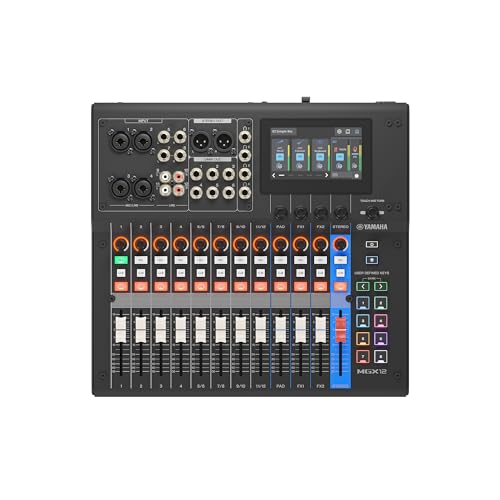
- 18-channel digital mixing console
- Dual USB-C, Bluetooth, and microSD
- DSP, touchscreen, and software bundle
Best For: Compact live production and content workflows
Networked Recording Console

- 40 channels and 26 mix buses
- 64x64 USB recording interface
- Milan-certified AVB networking
Best For: Professional live production and networked recording
High-Capacity Workhorse

- 48 input mixing channels with 33 motorized faders
- 20 Aux buses, Stereo/Sub buses, and 8 DCA groups
- 32 XLR/TRS combo inputs plus RCA stereo inputs
Best For: Larger live sound systems needing extensive hands-on control
Connected Recording Hub

- 40 channels, 26 mix buses, and 25 motorized faders
- 64x64 USB interface with Capture and Virtual Soundcheck
- Milan-certified AVB networking and remote control support
Best For: Live production and recording setups needing networking
Compact Dante Specialist

- 22 channels with 96 kHz operation
- 16x16 Dante interface and nine-inch touchscreen
- 16 Yamaha preamps and eight XLR outputs
Best For: Compact Dante-enabled live and installed audio systems
Best Professional Workflow
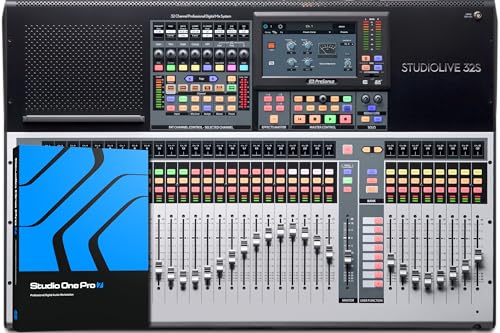
- 40-input, 32-channel digital console
- 128-channel USB interface and SD recording
- AVB networking with extensive DSP
Best For: Professional live sound, mobile production, and recording
Best Modern Hybrid Setup

- Tactile faders with 4.3-inch touchscreen
- Bluetooth, USB-C, and microSD connectivity
- Auto Gain, Clip Safe, and Scene Recall
Best For: Hands-on digital mixing with recording and workflow assistance
Best Budget Feature Set

- 99 built-in DSP effects
- Bluetooth and U-disk playback
- 48V phantom power and per-channel EQ
Best For: Small venues, karaoke, rehearsals, and home studios
Large-Format Workhorse – Behringer X32
The Behringer X32 is a substantial choice among digital mixing consoles for studios and live applications. Its 40-input, 25-bus design, 32 programmable MIDAS preamps, and motorized faders provide extensive routing and hands-on control for complex setups.
Best For: Live sound engineers, larger bands, venues, and studios needing many inputs and flexible bus management.
Pros:
- 40 inputs and 25 buses support complex mixes.
- 32 MIDAS-designed programmable mic preamps.
- 25 automated 100 mm motorized faders support quick scene recall and mix changes.
- Includes 16 XLR outputs plus additional line inputs and outputs.
Cons:
- At 45.4 pounds, it is less convenient for frequent transport.
- Its large control surface may be more mixer than smaller setups require.
The X32 prioritizes channel count, physical control, and routing flexibility. Choose it when your system needs a full-size console rather than a compact mobile mixer.
Compact Touch-Control Mixer – Alto TMD16
The Alto TMD16 combines digital mixing consoles features with a compact, road-ready design. It offers 16 channels, 100 mm touch faders, a 7-inch display, onboard processing, USB, Bluetooth, and app control for small live sound systems and practice spaces.
Best For: Small venues, rehearsal spaces, houses of worship, event centers, and mobile musicians who want hands-on control without a tablet.
Pros:
- Ten digital mic preamps and 16-channel capacity suit smaller productions.
- 100 mm capacitive touch faders and dedicated encoders provide tactile control.
- Built-in EQ, compression, and 16-preset FX engine reduce the need for external gear.
- USB recording, Bluetooth, app control, four aux sends, and four subgroups add flexibility.
Cons:
- Its 16-channel format offers less capacity than larger consoles.
- It is corded electric rather than battery powered.
The TMD16 is a practical balance of portable size and physical control. It is especially appealing when quick setup, onboard effects, and wireless connectivity matter more than very high channel counts.
Modern Production Hub – Yamaha MGX12
The Yamaha MGX12 is a production-focused option among digital mixing consoles, combining 18 channels with a 4.3-inch touchscreen, tactile faders, Bluetooth, microSD recording, and dual USB-C audio connectivity. Its DSP and assistive features are designed to simplify setup and monitoring.
Best For: Creators, small production teams, and live operators who need integrated recording, wireless audio, and streamlined control.
Pros:
- 18-channel layout includes versatile auxiliary, Bluetooth, and USB connectivity.
- 4.3-inch touchscreen and five control knobs complement tactile faders.
- Built-in DSP supports professional sound and latency-free monitoring.
- Includes a software bundle with Cubase AI, WaveLab Cast LE, and Basic FX Suite.
Cons:
- The 18-channel format may not suit large, input-heavy productions.
- Its HDMI video capture and pass-through features may be unnecessary for audio-only users.
The MGX12 stands out for combining mixing, recording, and video-oriented connectivity in one unit. It is a strong fit for users building a compact audio and content-production workflow.
Networked Recording Console – StudioLive Series III SE 16
The StudioLive Series III SE 16 is a flexible choice among digital mixing consoles for advanced live sound and recording workflows. It provides 40 channels, 26 mix buses, integrated recording, AVB networking, a 64×64 USB interface, and rack-mountable portability.
Best For: Professional live production, networked stage systems, multitrack recording, and setups using PreSonus monitoring or stagebox equipment.
Pros:
- 40 channels and 26 mix buses support sophisticated productions.
- State-Space modeled EQ and vintage-inspired compressor options are available on every input and bus.
- Milan-certified AVB networking connects compatible PreSonus systems and selected Dante infrastructure.
- Bidirectional 64×64 USB 2.0 interface supports integrated multitrack workflows.
Cons:
- The advanced feature set may exceed the needs of simple mixing setups.
- Its networking and software ecosystem can require compatible equipment for full benefit.
The StudioLive Series III SE 16 is built for users who need more than basic fader control. Its combination of processing, networking, remote operation, and recording makes it particularly capable in integrated production environments.
High-Capacity Workhorse – Yamaha TF5
For larger productions that need substantial input capacity, the Yamaha TF5 is one of the more expansive digital mixing consoles in this roundup. It combines 33 motorized faders with 48 input mixing channels, flexible bus routing, and 32 analog XLR/TRS combo inputs.
Best For: Larger live sound setups, venues, and applications requiring many simultaneous inputs and physical faders.
Pros:
- 48 input mixing channels and 33 motorized faders provide plenty of control.
- Includes 20 Aux buses, Stereo and Sub buses, plus eight DCA groups with Roll-out.
- Offers 32 XLR/TRS combo mic/line inputs and two RCA stereo line inputs.
Cons:
- Its 34.1-inch width and 20 kg weight make it less portable than compact consoles.
- Higher input capacity may be more than smaller setups require.
The TF5 is a practical choice when expansion room and hands-on control matter more than minimizing footprint. Its broad channel count and bus configuration suit demanding applications, while USB and Wi-Fi connectivity add flexibility.
Connected Recording Hub – StudioLive Series III SE 24
The StudioLive Series III SE 24 is a flexible option among digital mixing consoles for users who want live mixing, recording, and network expansion in one unit. It provides 40 channels, 26 mix buses, 25 motorized faders, and an integrated 64×64 USB audio interface.
Best For: Professional live sound, recording workflows, and systems that benefit from AVB networking and remote control.
Pros:
- Offers 40 channels, 26 mix buses, 16 FlexMixes, and 24 DCAs.
- Includes 32 XMAX mic preamps and modeled EQ and compressor options on every input and bus.
- 64×64 USB 2.0 connectivity and included Capture software support multitrack recording and Virtual Soundcheck.
- Milan-certified AVB networking connects compatible stage boxes and personal monitor mixers.
Cons:
- At 41.7 pounds, it is less convenient to transport than ultracompact alternatives.
- Its advanced networking and recording features may be unnecessary for basic mixing tasks.
This console stands out for combining substantial mixing capability with recording and networking tools. It is especially compelling for users building an integrated PreSonus ecosystem or needing remote operation through Universal Control.
Compact Dante Specialist – Yamaha DM3-D
The Yamaha DM3-D is designed for buyers who want professional digital mixing console features in a compact format. Its 22 channels, 96 kHz operation, nine-inch touchscreen, and 16×16 Dante interface make it a focused choice for space-conscious systems.
Best For: Compact live sound, installed audio, and Dante-based systems that need high-resolution processing and straightforward control.
Pros:
- 96 kHz operation supports Yamaha’s stated sound-quality focus.
- Includes a 16×16 Dante interface for networked audio workflows.
- Nine-inch touchscreen provides a clear control interface in a small console.
- Provides 16 mono channels, stereo and effects returns, six mono or three stereo mixes, two matrices, and a stereo bus.
Cons:
- Its 22-channel capacity is more limited than the larger consoles in this roundup.
- It has wired connectivity rather than the broader connectivity mix listed for some competing models.
The DM3-D prioritizes portability and Dante integration over maximum channel count. With 16 Yamaha preamps, eight XLR outputs, and a compact design, it fits buyers who need capable networked mixing without a larger console footprint.
Best Professional Workflow – StudioLive 32S
PreSonus StudioLive Series III 32S Digital Console Mixer with Studio One Pro Software
Check Price On AmazonThe PreSonus StudioLive Series III 32S is a strong choice among digital mixing consoles for installed sound, mobile applications, and recording. Its 40-input, 32-channel design combines extensive processing, recallable settings, AVB networking, multitrack SD recording, and a 128-channel USB interface.
Best For: Professional live sound, mobile production, installed systems, and multitrack recording.
Pros:
- Dual-core FLEX DSP Engine supports 286 simultaneous processors.
- Built-in 128-channel USB interface and multitrack SD recorder with Virtual Soundcheck.
- AVB networking supports PreSonus stage boxes, personal monitor mixers, and switches.
- Includes Studio One Artist DAW and Capture software.
Cons:
- At 37 pounds, it is less convenient to transport than smaller mixers.
- Its broad feature set may be more than needed for simple setups.
The 32S stands out when routing flexibility, recording capability, and system integration matter more than minimizing size or weight. Its 16 FlexMixes and four-slot FLEX FX processor also give advanced users considerable control over complex productions.
Best Modern Hybrid Setup – Yamaha MGX12
The Yamaha MGX12 is a versatile option among digital mixing consoles, pairing tactile faders with a 4.3-inch touchscreen and five control knobs. It adds dual USB-C audio connectivity, Bluetooth, microSD recording support, onboard DSP, and assistive features designed to simplify setup and operation.
Best For: Users who want hands-on control with modern digital features, recording tools, and straightforward workflow assistance.
Pros:
- Tactile faders and touchscreen provide direct control and visual feedback.
- Includes Bluetooth audio, USB-C connectivity, and a microSD card slot.
- Auto Gain, Clip Safe, Scene Recall, and Simple/Standard modes support easier operation.
- USB-HDMI interface supports 4K video capture and pass-through.
Cons:
- The 18-channel configuration offers less capacity than larger professional consoles.
- Its one-year manufacturer warranty is shorter than some competing options.
The MGX12 is a practical fit for creators and operators who prefer physical faders but still need digital convenience. Its DSP supports latency-free monitoring, while the software bundle adds Cubase AI, WaveLab Cast LE, Basic FX Suite, and Steinberg Plus access.
Best Budget Feature Set – 16-Channel DSP Mixer
This 16-channel mixer offers an accessible entry point into digital mixing consoles for live performances, karaoke, rehearsals, home studios, and small venues. It combines Bluetooth and USB playback with 99 DSP effects, 48V phantom power, per-channel EQ and mute controls, and broad microphone and instrument compatibility.
Best For: Small live events, karaoke, rehearsals, home studios, and users seeking built-in playback and effects.
Pros:
- Provides 99 built-in DSP effects, including reverb, delay, and ambience.
- Bluetooth and U-disk playback support flexible music input.
- 48V phantom power supports condenser microphones.
- Individual channel EQ, mute, and fader controls simplify live adjustments.
Cons:
- The 360-day warranty is shorter than the coverage listed for the PreSonus console.
- It lacks the advanced networking and multichannel USB recording features described for the larger consoles.
- Its 8.26 kg weight may still require a dedicated carrying setup.
For buyers prioritizing a broad effects library and convenient wireless playback over high-end routing, this mixer delivers a feature-rich small-system package. Its 16 channels and 7-band master graphic EQ provide useful control for modest productions.
How We Picked the Best Digital Mixing Consoles
We focused on the features that most affect day-to-day usability: input and bus capacity, onboard processing, recording connectivity, control options, networking, software support, and overall flexibility. The selection spans compact 16-channel designs, larger 32-channel consoles, Dante-enabled systems, and affordable mixers suited to home studios or small venues.
We also considered whether each console fits a clear use case. A mixer designed for mobile performers has different priorities from one intended for a permanent installation, theater, worship space, or professional recording workflow.
Quick Comparison
- Best for broad live-sound flexibility: Behringer X32 and PreSonus StudioLive 32S.
- Best for compact professional setups: Yamaha DM3-D and Yamaha TF5.
- Best for integrated recording: Yamaha MGX12 models and PreSonus StudioLive consoles.
- Best for smaller budgets and simple setups: ALTO TMD16 and the 16-channel Bluetooth mixer.
- Best for ecosystem-focused users: StudioLive Series III and Yamaha models with bundled software.
Key Buying Factors for Digital Mixing Consoles
Channel Count and Bus Capacity
Count more than the physical input sockets. Check the number of microphone preamps, stereo channels, aux sends, matrix outputs, and groups. A compact console may be ideal for a solo act, while a band, venue, or production team may need substantially more headroom.
Processing and Scene Recall
Look for useful EQ, compression, gates, effects, feedback management, and recallable scenes. Scene storage is especially valuable when a console serves multiple bands, presenters, or services. Confirm that saved settings can be edited quickly from the hardware or a remote-control app.
Connectivity and Networking
USB recording is convenient for multitrack capture, playback, and virtual soundcheck. Bluetooth is useful for background music and casual playback but should not be the main reason to choose a professional console. If your system uses networked audio, verify compatibility with Dante or the relevant protocol, along with required expansion hardware.
Control, Size, and Reliability
Physical faders can make live operation intuitive, while tablet control may provide greater flexibility around the room. Consider screen visibility, motorized faders, remote apps, rack or desk mounting, ventilation, and the availability of firmware updates and replacement accessories.
Who Should Buy Which Digital Mixing Consoles?
Choose a compact Yamaha or ALTO model if you need straightforward control for small gigs, rehearsals, streaming, or a project studio. Choose a StudioLive console if integrated software, recording, and a broader live-production workflow matter. Choose the Yamaha DM3-D if a small footprint and Dante networking are priorities. Choose the Yamaha TF5 or Behringer X32 for larger channel counts, more complex shows, and room to expand. The budget 16-channel Bluetooth option is best for basic applications where advanced networking and sophisticated scene management are not essential.
