Large file transfers can expose the limits of ordinary gigabit networking, especially when multiple workstations access a NAS, media server, or shared backup system at once. Multi-gigabit switches provide the capacity needed for faster transfers without forcing every device onto a 10GbE connection.
This roundup compares ten managed and unmanaged options, including compact desktop models, rack-mount switches, 2.5GbE upgrades, and higher-port-count solutions for growing storage networks.
Best 10 Multi-Gigabit Network Switches for Large File Storage Picks for 2026
Best Managed Value
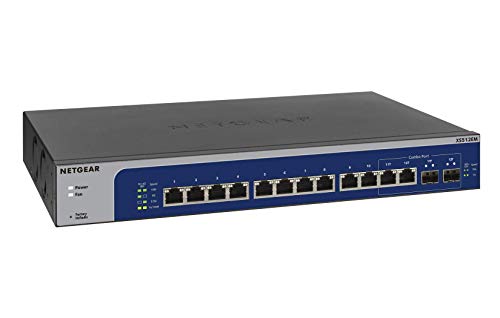
- 12 multi-gigabit ports from 1G to 10G
- Two shared 1G/10G SFP+ ports
- Easy Smart Managed controls
Best For: Small offices and home labs needing manageable 10G connectivity
Best Plug-and-Play Expansion

- 16× 2.5G ports plus 2× 10G RJ45
- 120Gbps switching capacity
- Fanless, unmanaged plug-and-play design
Best For: Large copper networks with multiple 2.5G devices and two 10G endpoints
Best for Growing Racks

- 22 multi-speed 10GBase-T ports
- Two combo 10G SFP+ ports
- VLAN, QoS, and link aggregation
Best For: Larger rack deployments with mixed-speed storage and workstation devices
Best Compact Lite-Managed Pick

- Six 10GbE RJ45 and two combo ports
- 160Gbps switching capacity with 12K jumbo frames
- VLAN, QoS, LACP, and loop detection
Best For: Compact NAS and media networks needing 10GbE with essential management
High-Capacity 10G Hub

- 24 10-Gigabit Ethernet ports
- Desktop or rackmount design
- Limited lifetime protection
Best For: Large storage networks needing many 10GbE connections
Simple 10G Storage Upgrade

- Eight 10G ports with 160 Gbps capacity
- Auto-negotiates five link speeds
- Plug-and-play desktop/rackmount design
Best For: Small NAS and workstation clusters
Managed Mixed-Speed Backbone
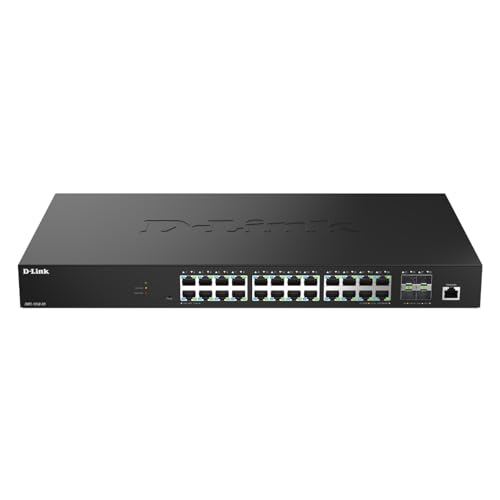
- 24 2.5GbE ports and four 10G SFP+ uplinks
- Web, CLI, SNMP, and centralized management
- Includes enterprise-oriented security features
Best For: Managed networks linking 2.5GbE clients to 10G storage
Best All-Port 10G Expansion

- Eight 10Gbps RJ45 ports
- Auto-negotiates across compatible speeds
- Desktop or wall mounting
Best For: Expanding a copper-based 10G storage network
Best Quiet 5-Port Value

- Five auto-negotiating 10G ports
- Fanless and quiet operation
- Plug-and-play metal design
Best For: Compact, quiet NAS and workstation networks
Best Rack-Ready Uplink Flexibility

- Four 10G Ethernet ports
- 1G/10G SFP+ uplink
- Desktop and rackmount support
Best For: Mixed copper-and-SFP+ storage networks
Best Managed Value – NETGEAR XS512EM
The NETGEAR XS512EM is a practical choice for multi-gigabit network switches for large file storage when you need flexible copper connectivity plus basic network management. Its twelve ports support speeds from 1G through 10G, while the shared SFP+ ports add fiber or 10G uplink flexibility.
Best For: Small offices, studios, and home labs that need manageable 10G connections without a larger 24-port chassis.
Pros:
- Twelve 1G/2.5G/5G/10G multi-gigabit Ethernet ports.
- Two shared 1G/10G SFP+ ports provide additional uplink options.
- Easy Smart Managed software supports configuration, security, and monitoring.
- Supports desktop or rackmount placement and includes mounting hardware.
Cons:
- The two SFP+ ports are shared, limiting simultaneous port use.
- Its twelve-port layout may be restrictive for larger deployments.
- Listed for use in the U.S. and Canada only.
With quiet operation, IEEE 802.3az energy efficiency, and a limited lifetime hardware warranty, the XS512EM is a balanced managed option for growing storage networks.
Best Plug-and-Play Expansion – NICGIGA 18-Port 10G Switch
For multi-gigabit network switches for large file storage, this unmanaged NICGIGA model offers broad copper-port capacity with a simple plug-and-play setup. Sixteen 2.5G ports handle everyday multi-gig devices, while two RJ45 ports support speeds up to 10G for a NAS, server, or high-performance workstation.
Best For: Users who want to connect many 2.5G devices and a couple of 10G endpoints without configuring managed network features.
Pros:
- Provides sixteen 2.5G/1G/100Mbps ports and two 10G/5G/2.5G/1G/100Mbps ports.
- 120Gbps switching capacity supports substantial data traffic.
- Unmanaged plug-and-play operation requires no software configuration.
- Fanless design, metal housing, and desktop or wall-mount support.
Cons:
- Unmanaged operation does not provide VLAN, QoS, or monitoring controls.
- All high-speed connections use RJ45 rather than SFP+.
- The warranty is one year, shorter than some competing options.
This switch is a straightforward way to expand a copper-based storage network, particularly when silent operation and a high count of 2.5G ports matter more than advanced management.
Best for Growing Racks – NETGEAR XS724EM
The NETGEAR XS724EM is built for larger installations needing multi-gigabit network switches for large file storage. It combines twenty-two 100Mbps-to-10GBase-T ports with two combo 10G SFP+ ports, giving a rack-mounted network room more room for NAS devices, workstations, and uplinks.
Best For: Businesses, production environments, and server racks with many mixed-speed devices and a need for VLAN, QoS, and link aggregation.
Pros:
- Twenty-two copper ports support 100Mbps, 1G, 2.5G, 5G, and 10G speeds.
- Two combo 10G SFP+ ports support flexible uplink integration.
- Advanced management includes VLAN, QoS, and link aggregation.
- Rack-mountable design suits existing server-rack installations.
Cons:
- Its 24-port rack format is more equipment than smaller networks may need.
- The supplied data rate is listed as 10Gbps rather than a higher aggregate figure.
- Cloud Care warranty support is tied to the listed seller offering.
With extensive port capacity and management features, the XS724EM is the strongest fit here for a structured rack deployment where storage traffic and network segmentation will grow over time.
Best Compact Lite-Managed Pick – QNAP QSW-L3208-2C6T
The QNAP QSW-L3208-2C6T is a compact option among multi-gigabit network switches for large file storage, combining six multi-speed 10GbE RJ45 ports with two combo SFP+/RJ45 ports. Its 12K jumbo-frame support and 160Gbps switching capacity are suited to large transfers and media-heavy workloads.
Best For: Small teams, content creators, and NAS users who need 10GbE performance with essential controls in a compact enclosure.
Pros:
- Six RJ45 ports support 10G, 5G, 2.5G, 1G, and 100Mbps connections.
- Two combo 10GbE SFP+/RJ45 ports support copper or fiber links.
- Lite-managed features include VLAN, QoS, LACP, IGMP snooping, and loop detection.
- Offers 160Gbps switching capacity, 80Gbps non-blocking throughput, and 12K jumbo frames.
Cons:
- Eight total ports provide less expansion than larger rack switches.
- Its essential lite-managed feature set may not replace a full enterprise switch.
- The listed power consumption is 36W, which may exceed smaller unmanaged alternatives.
This QNAP balances high-speed storage transfers with useful network controls and a relatively compact design, making it a strong fit when a full-size rack switch would be excessive.
High-Capacity 10G Hub – 28-Port 10G Smart Switch
For multi-gigabit network switches for large file storage, the NETGEAR XS728T emphasizes port density and 10GbE connectivity. It provides 24 10-Gigabit Ethernet ports in a desktop- or rackmount-friendly design, making it suitable for connecting storage, servers, and high-speed workstations.
Best For: Large file-storage networks that need many 10GbE wired connections.
Pros:
- Offers 24 10-Gigabit Ethernet ports within a 28-port switch.
- Supports desktop or rackmount installation.
- Includes limited lifetime protection from NETGEAR.
Cons:
- The supplied notes do not list multi-speed auto-negotiation or management features.
- Its 6.49 kg weight may make placement less convenient than smaller desktop switches.
The XS728T is the capacity-focused option here. Choose it when the priority is a large number of dedicated 10GbE connections rather than a compact, plug-and-play switch.
Simple 10G Storage Upgrade – 8-Port 10G/Multi-Gig Switch
The TP-Link TL-SX1008 is a straightforward choice among multi-gigabit network switches for large file storage. Its eight 10G/multi-gig ports automatically negotiate between 100Mb, 1G, 2.5G, 5G, and 10G, helping connect a 10G NAS, server, workstation, or Wi-Fi access point without manual configuration.
Best For: Small storage setups that want flexible 10GbE performance with plug-and-play installation.
Pros:
- Provides eight 10-Gigabit ports and up to 160 Gbps of switching capacity.
- Auto-negotiates among five link speeds for broader device compatibility.
- Includes flow control, a speed-adjusting smart fan, and a durable metal casing.
- Supports desktop or rackmount placement with no software installation required.
Cons:
- Only eight ports are available, limiting expansion for larger deployments.
- It is unmanaged, so advanced network configuration and monitoring are not provided.
For a smaller NAS or workstation cluster, the TL-SX1008 balances high throughput and simple setup. Its multi-speed ports also make it easier to mix 10G hardware with compatible slower devices.
Managed Mixed-Speed Backbone – 28-Port Multi-Gig Switch
D-Link 28-Port Multi-Gigabit Smart Managed Switch with 4 10G SFP+ & 24 2.5G Ports (DMS-1250-28)
Check Price On AmazonThe D-Link DMS-1250-28 combines 24 2.5GbE ports with four 10G SFP+ uplinks, giving multi-gigabit network switches for large file storage a practical mix of local access and high-speed backbone connectivity. Its management tools and security features also suit networks that need more control than an unmanaged switch provides.
Best For: Managed storage networks connecting 2.5GbE clients or access points to 10G storage, servers, or a core switch.
Pros:
- Provides 24 2.5GbE ports for NAS devices, PCs, access points, and other endpoints.
- Includes four 10G SFP+ uplinks for storage, servers, or core-switch connections.
- Supports Web UI, CLI, SNMP, Nuclias Connect, and D-View 8 management.
- Offers features such as 802.1X, ACLs, DHCP snooping, and IP-MAC binding.
Cons:
- The 24 access ports top out at 2.5GbE rather than 10GbE.
- The four 10G uplinks use SFP+, so compatible transceivers or cabling may be needed.
- Its 17.3-inch rack-oriented chassis is less compact than an eight-port desktop switch.
The DMS-1250-28 is a strong fit for a mixed-speed environment: use its 2.5GbE ports for everyday clients and its 10G SFP+ uplinks for demanding storage or server traffic. It is the most management-oriented option in this group.
Best All-Port 10G Expansion – NETGEAR XS308Mv2
For multi-gigabit network switches for large file storage, the NETGEAR XS308Mv2 offers eight RJ45 ports that all support 10Gbps. Auto-negotiation helps it work with compatible devices and existing Cat5e or Cat6 cabling, making it a straightforward way to connect storage, workstations, and other high-speed equipment.
Best For: Users who need eight 10G-capable copper ports and a simple unmanaged setup.
Pros:
- Eight 10Gbps multi-gigabit Ethernet ports
- Auto-negotiates connection speeds and supports Cat5e or Cat6 cables
- Compact metal design supports desktop or wall mounting
- Energy Efficient Ethernet helps reduce power consumption
Cons:
- Unmanaged design provides no configuration features
- Specified for use in the U.S. and Canada only
The XS308Mv2 is a strong fit when port count matters more than advanced network controls. Its all-RJ45 layout avoids the need for SFP+ equipment, while the included mounting hardware adds installation flexibility.
Best Quiet 5-Port Value – TP-Link TL-SX105
The TP-Link TL-SX105 is a practical choice among multi-gigabit network switches for large file storage when five ports are sufficient. Its ports auto-negotiate at 100Mbps, 1G, 2.5G, 5G, or 10G, while the fanless design keeps operation quiet around a workstation or home office.
Best For: Small storage setups needing flexible 10G connectivity without fan noise or configuration work.
Pros:
- Five 10G/multi-gigabit ports with five-speed auto-negotiation
- Fanless design supports quiet operation
- Plug-and-play setup requires no software or configuration
- Metal casing supports desktop or wall mounting
Cons:
- Five ports provide less expansion room than eight-port models
- Unmanaged operation does not offer advanced network controls
With up to 100 Gbps of stated switching capacity and support for 10G NAS devices, servers, and network adapters, the TL-SX105 covers a focused high-speed setup. It is especially appealing where quiet operation and simple installation are priorities.
Best Rack-Ready Uplink Flexibility – NETGEAR XS505M
The NETGEAR XS505M combines four 10G Ethernet ports with a 1G/10G SFP+ uplink, giving storage networks a useful connection option for compatible fiber or direct-attach equipment. Its unmanaged plug-and-play design keeps deployment simple, while desktop and rackmount support suits home offices and business installations.
Best For: Users who need four 10G copper connections plus an SFP+ uplink for rack or mixed-media networking.
Pros:
- Four 10G Ethernet ports
- Includes a flexible 1G/10G SFP+ port
- Supports desktop or rackmount placement with hardware included
- Whisper-quiet design and energy-efficient operation
Cons:
- Only four copper 10G ports are available
- Unmanaged design lacks configurable network features
The XS505M stands out when an SFP+ uplink is as important as copper connectivity. Its mounting flexibility and lifetime limited hardware warranty make it a practical option for a more permanent storage or office network installation.
How We Picked the Best Multi-Gigabit Network Switches for Large File Storage
We focused on switches that can improve real-world storage performance, not just advertise high aggregate bandwidth. The selection includes 2.5GbE, 5GbE, and 10GbE copper ports, along with SFP+ uplinks for fiber or direct-attach connections. We also considered port count, management features, installation flexibility, and whether each model suits a home lab, studio, office, or rack-mounted infrastructure.
Managed models are useful when you need VLANs, traffic monitoring, link aggregation, or more control over a busy storage network. Unmanaged switches are simpler and often cost less, making them practical for straightforward NAS-to-workstation upgrades.
Quick Comparison
- Best for compact managed networks: NETGEAR XS512EM and QNAP QSW-L3208-2C6T-US.
- Best for many 10GbE devices: NETGEAR XS724EM, XS728T, and D-Link DMS-1250-28.
- Best for simple plug-and-play expansion: TP-Link TL-SX1008, TL-SX105, and NETGEAR XS308Mv2.
- Best for mixed 10GbE and 2.5GbE systems: NICGIGA 18-port switch and the NETGEAR XS505M.
Key Buying Factors for Multi-Gigabit Network Switches for Large File Storage
Port Speeds and Layout
Match the switch to your fastest devices. A 10GbE NAS and editing workstation benefit from dedicated 10GbE ports, while 2.5GbE ports are a cost-effective fit for newer desktops, Wi-Fi 6E or Wi-Fi 7 access points, and secondary systems. Check whether ports are copper RJ45, SFP+, or combo ports before buying cables and transceivers.
Managed Versus Unmanaged Operation
Unmanaged switches require almost no configuration and work well for a single flat network. Managed models are preferable for offices, studios, and labs where VLANs, link aggregation, quality-of-service rules, diagnostics, or centralized monitoring matter.
Capacity, Cooling, and Mounting
Leave room for future devices rather than filling every port immediately. Higher-capacity switches may use active cooling, so check noise levels if the unit will sit near a desk. Rack-mount brackets are useful for structured installations, while desktop designs suit smaller storage setups.
Real-World Throughput
Switch speed is only one part of performance. The NAS drives, RAID or SSD configuration, workstation network adapters, cabling, and file protocol can all become bottlenecks. For 10GbE, use suitable Cat6a or better copper cabling for longer runs, and confirm that every connected device supports the desired speed.
Who Should Buy Which Multi-Gigabit Network Switches for Large File Storage?
Choose an unmanaged 5- or 8-port model if you need a quick upgrade for one NAS and a few high-speed computers. Choose a managed 8- or 12-port switch if you need segmentation, monitoring, or room to expand. Larger offices, production studios, and server rooms should consider 24- or 28-port managed models, particularly when several 10GbE systems and 2.5GbE clients share storage.
For mixed-speed networks, prioritize multi-gigabit auto-negotiation and a practical combination of RJ45 and SFP+ ports. The best choice is the one that matches your current adapters and storage hardware while leaving enough capacity for the next stage of your network.
