The best music synthesizers for music production can shape everything from basses and leads to evolving pads, rhythmic sequences, and complete song ideas. The right choice depends on your preferred synthesis style, workflow, connectivity, and available space.
We’ve selected 10 options spanning compact portable instruments, hands-on desktop synths, polyphonic analog designs, FM workstations, and MIDI controllers. Use the guide below to narrow the field by sound, features, and production needs.
Best 10 Music Synthesizers for Music Production Picks for 2026
Experimental Hybrid Pick
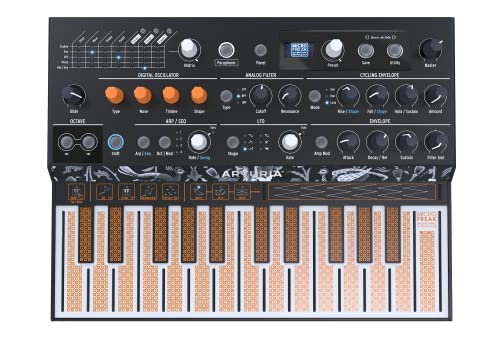
- Hybrid digital oscillator and analog filter
- Poly-aftertouch 25-key touch surface
- CV, USB, and MIDI connectivity
Best For: Advanced producers exploring unconventional sounds
Compact Groovebox Pick

- SH-101-inspired bass and lead sounds
- Wave manipulation and onboard sequencing
- Compact design for portable creation
Best For: Portable jamming and accessible electronic sound design
Deep FM Design Pick

- Six-operator FM with 64 voices
- 37 velocity-sensitive keys with aftertouch
- Sequencing, effects, and deep modulation
Best For: Detailed digital sound design and expressive keyboard production
Chord-Driven Portable Pick

- JUNO-60-inspired four-voice engine
- 100 chord sets and programmable sequencing
- USB-C audio and MIDI interface
Best For: Portable chord progressions and rapid song sketching
Analog Patch Lab

- Dual 3340 analog oscillators
- Semi-modular design with default routings
- Five-shape waveform blending
Best For: Analog sound design and semi-modular experimentation
Mobile Idea Station

- Built-in drums, synths, sampling, and sequencing
- Rechargeable battery, speaker, and microphone
- Compact 16-ounce portable design
Best For: Mobile composition and quick idea capture
Desktop Production Powerhouse
Roland SH-4D Desktop Synthesizer

- 11 oscillator models and up to 60 voices
- Four synth parts plus a rhythm part
- Multitimbral sequencer and USB-C audio/MIDI
Best For: Deep desktop sound design and multitimbral production
Best Analog Polyphony

- Eight-voice analog polyphony
- Two VCOs per voice and unison mode
- Arpeggiator, sequencer, and 400 memories
Best For: Vintage-style chords, pads, leads, and basses
Best Controller for DAW Production

- 37-key, three-octave controller
- CV/Gate, MIDI, and USB connectivity
- Pads, knobs, and built-in 64-step sequencer
Best For: DAW composition, beat making, and hardware control
Best Portable Hybrid Synth

- Vector-morphing hybrid synthesis
- Analog low-pass filter and 16-step sequencer
- Battery or USB-C powered compact design
Best For: Portable sound design and quick sequencing
Experimental Hybrid Pick – Arturia MicroFreak
The Arturia MicroFreak is a strong choice for music synthesizers for music production when you want compact hardware with unusual sound-design options. Its hybrid digital oscillator and analog-filter architecture, pressure-sensitive 25-key touch surface, modulation matrix, and onboard sequencing make it especially useful for exploring original tones and patterns.
Best For: Advanced producers seeking experimental sounds, expressive sequencing, and CV-connected studio hardware.
Pros:
- Offers multiple oscillator modes spanning physical modeling, wavetable, vocoder, noise, and other timbres.
- Poly-aftertouch touch-plate keyboard responds to pressure on individual notes.
- Includes modulation-matrix routing, automation recording, Spice and Dice functions, and randomization.
- Supports USB, MIDI, CV pitch, gate, and pressure connections.
Cons:
- The 25-key printed-circuit-board keyboard may feel unconventional compared with traditional keys.
- Its advanced synthesis and routing features may require a learning curve.
- It is designed for adult and advanced users rather than a straightforward beginner workflow.
Choose the MicroFreak if sound experimentation and hands-on modulation matter more than a conventional keyboard experience. Its compact format and broad connectivity also make it a flexible addition to a DAW or modular setup.
Compact Groovebox Pick – Roland AIRA Compact S-1
The Roland AIRA Compact S-1 Tweak Synth is a practical option among music synthesizers for music production when portability and immediate experimentation are priorities. Inspired by the SH-101, it combines hands-on controls with basses, leads, wave manipulation, onboard sequencing, and performance-oriented features in a compact unit.
Best For: Beginners and experienced creators who want a small, approachable synth for portable jamming and electronic sound design.
Pros:
- Compact design is suited to portable music creation.
- SH-101-inspired workflow supports snappy basses and expressive leads.
- Includes futuristic wave manipulation, sequencing, and performance features.
- Hands-on controls provide an intuitive way to shape sounds.
Cons:
- The supplied notes do not specify a keyboard, so players wanting traditional keys may need another controller.
- Its compact design may provide fewer physical controls than a larger studio synthesizer.
- The feature set is focused on a micro polysynth workflow rather than broad workstation functionality.
The S-1 makes sense when you want a fun, direct instrument for sketching ideas without committing to a larger setup. Its approachable controls suit newcomers, while wave manipulation and sequencing give more experienced users room to explore.
Deep FM Design Pick – Korg opsix MKII
The Korg opsix MKII is built for producers who want deep digital synthesis in a keyboard format. Among music synthesizers for music production, it stands out with six-operator FM synthesis, 64 voices, six synthesis styles, extensive modulation, onboard effects, and sequencing tools for detailed and evolving sounds.
Best For: Sound designers and keyboard players who want extensive FM control, polyphony, and expressive performance features.
Pros:
- Six-operator FM engine supports rich and detailed tone creation.
- Provides 64 voices, 37 velocity-sensitive keys, and assignable aftertouch.
- Includes six synthesis styles, a modulation matrix, motion sequencing, and step sequencing.
- Offers 30 onboard effects plus 250 presets and 250 user programs.
Cons:
- Its extensive synthesis and modulation options may be more than beginners need.
- The supplied notes list USB Type B and MIDI connectivity but do not specify audio outputs.
- FM programming and the broad feature set can require substantial sound-design time.
The opsix MKII is a compelling fit when you want one instrument for complex digital timbres, evolving sequences, and expressive keyboard performance. Its preset library helps you start quickly, while the synthesis styles and modulation tools support deeper production work.
Chord-Driven Portable Pick – Roland AIRA Compact J-6
The Roland AIRA Compact J-6 is a focused choice among music synthesizers for music production when chord progressions and portable song creation are central to your workflow. Its JUNO-60-based four-voice engine, chord library, arpeggio and phrase styles, programmable sequencer, and USB-C audio/MIDI interface make it well suited to quickly building musical ideas.
Best For: Producers who want portable chord sequencing, classic JUNO-inspired sounds, and quick song sketches.
Pros:
- Includes 100 chord sets and 64 user patterns with up to 64 steps each.
- Authentic JUNO-60-inspired four-voice synth engine and 64 ready-to-play presets.
- Provides nine arpeggio and phrase styles with 12 variations each.
- Offers filter and envelope controls, delay, reverb, audio/MIDI, sync, and USB-C connectivity.
Cons:
- Four-voice polyphony may be limiting for dense arrangements.
- Its chord-focused design is less suited to users seeking a broad, fully programmable synthesizer.
- The compact plastic construction may not feel as substantial as larger keyboard instruments.
The J-6 is a useful sketching companion for turning chord ideas into structured patterns quickly. It is particularly attractive for creators who value classic Roland-inspired tones and portable sequencing over a full-size keyboard interface.
Analog Patch Lab – Behringer Neutron
The Behringer Neutron is a strong option among music synthesizers for music production if you want hands-on analog tone and room to explore semi-modular patching. Its dual 3340 oscillators, paraphonic design, and default routings make it approachable for immediate performance while still offering substantial sound-shaping depth.
Best For: Analog sound design, semi-modular experimentation, and producers who want flexible oscillator shaping.
Pros:
- Dual 3340 analog oscillators deliver a full, classic analog character.
- Semi-modular architecture includes default routings for immediate use without patching.
- Waveform blending and individual pulse-width and tone-modulation controls support detailed tone shaping.
Cons:
- Its semi-modular workflow may require a learning curve for beginners.
- The listed design is focused on analog synthesis rather than an all-in-one sequencing setup.
The Neutron makes the most sense when oscillator control and patch-based experimentation matter more than integrated production features. It is a focused analog instrument for building distinctive sounds.
Mobile Idea Station – Yamaha SEQTRAK
The Yamaha SEQTRAK is a compact choice among music synthesizers for music production when portability and fast idea capture are priorities. It combines drums, synths, sound design, sequencing, sampling, a microphone, speakers, and a rechargeable battery in one lightweight unit.
Best For: Mobile composition, quick arrangement, sampling, and creating away from a traditional studio.
Pros:
- All-in-one design includes drums, synths, sound design, and sequencing.
- Built-in speaker, microphone, rechargeable battery, and compact 16-ounce body support portable use.
- Onboard sampling and an advanced sequencer help turn ideas into arranged tracks.
Cons:
- The plastic construction may feel less substantial than a metal-bodied studio instrument.
- Its compact format may provide less hands-on space than larger synthesizers.
SEQTRAK is particularly practical for producers who value immediacy and mobility. It is designed to capture and develop ideas without requiring a full studio setup.
Desktop Production Powerhouse – Roland SH-4D Desktop Synthesizer
The Roland SH-4D is a versatile option among music synthesizers for music production, combining extensive sound design controls with multitimbral sequencing and onboard effects. Its four synth parts, dedicated rhythm part, hands-on panel, and USB-C audio/MIDI interface suit both studio production and live performance.
Best For: Producers who want deep desktop sound design, multitimbral sequencing, and direct DAW connectivity.
Pros:
- Eleven oscillator models, up to 60 voices of polyphony, and four independent synth parts provide broad sound-design range.
- Multitimbral sequencer offers 128 patterns, real-time recording, step entry, and motion recording.
- Direct-access controls, extensive effects, and USB-C audio/MIDI connectivity support hands-on production.
Cons:
- The many controls and synthesis options may take time to master.
- Its 5.6-pound desktop format is less minimal than an ultra-portable groovebox.
The SH-4D is a strong fit when one desktop instrument needs to cover sound design, sequencing, effects, and multitimbral performance. Its feature set favors producers who want an expansive, hands-on workflow.
Best Analog Polyphony – PRO-800
The Behringer PRO-800 is a strong choice for producers seeking music synthesizers for music production with classic analog character. Its eight voices, two VCOs per voice, unison mode, and broad oscillator choices support rich chords, detuned textures, basses, and leads.
Best For: Producers who want vintage-style analog polyphony, wide pads, and fat mono-style sounds in a Eurorack-format instrument.
Pros:
- Eight-voice polyphonic design supports chords and layered parts.
- Pure analog signal path with two VCOs per voice for full, detuned sounds.
- Includes an arpeggiator, sequencer, and 400 program memories.
- Unison mode can combine up to 16 oscillators for leads and basses.
Cons:
- Its Eurorack format may require a compatible setup or additional integration planning.
- The supplied details do not specify an included keyboard.
Choose the PRO-800 if hands-on analog-style polyphony is more important than portability. It offers substantial sound-shaping potential for chords, basses, leads, and evolving sequences.
Best Controller for DAW Production – MPK Mini Plus
The Akai Professional MPK Mini Plus is a versatile controller for music synthesizers for music production, especially when your sounds live inside a DAW or external hardware. Its 37-key layout, pads, knobs, sequencing features, and MIDI/CV connectivity make it useful across composing, beat making, and performance.
Best For: Home producers who want one compact controller for melodies, chords, drums, DAW control, and selected hardware instruments.
Pros:
- 37 keys provide three full octaves for melodic and harmonic performance.
- CV/Gate and MIDI I/O expand compatibility with modular gear, sound modules, and synthesizers.
- Built-in 64-step sequencer includes separate drum and melody or chord tracks.
- Eight RGB MPC pads, eight assignable knobs, and Chords and Scales modes support hands-on creation.
Cons:
- It is a MIDI keyboard controller rather than a self-contained sound-generating synthesizer.
- Its USB connection and included software are oriented toward computer-based production.
The MPK Mini Plus is a practical centerpiece for a compact production setup. Choose it when tactile control and flexible connectivity matter more than having built-in synthesis hardware.
Best Portable Hybrid Synth – Pro VS Mini
The Behringer Pro VS Mini is a compact option for producers comparing music synthesizers for music production in a portable format. Its hybrid design combines four vector-morphing oscillators per voice with an analog low-pass filter, plus a sequencer and arpeggiator for creating and developing ideas.
Best For: Producers who want a small, battery- or USB-powered synthesizer for portable sound design, sequencing, and hybrid tones.
Pros:
- Four vector-morphing oscillators per voice enable wavetable-based hybrid sound creation.
- Analog low-pass filter adds an analog processing stage to the digital oscillator architecture.
- Built-in 16-step sequencer and arpeggiator support standalone idea generation.
- Compact 8.45-by-5.45-by-2.35-inch design works with battery or USB power.
Cons:
- The five-voice designation in the product title and four-voice description in the supplied notes are inconsistent.
- Its small format may offer less physical control space than a larger synthesizer.
- The supplied notes list a 2.5mm jack but do not fully specify the audio connection details.
The Pro VS Mini stands out for travel-friendly hybrid synthesis and quick sequencing. It is a good fit when portability and vector-style motion are priorities, provided its compact controls suit your workflow.
How We Picked the Best Music Synthesizers for Music Production
We focused on instruments that offer meaningful sound-design or sequencing capabilities rather than simply adding another keyboard to a studio. The selection covers analog, digital, FM, hybrid, and MIDI-based workflows, with attention to oscillator architecture, filters, modulation, polyphony, onboard sequencing, portability, and DAW integration.
We also considered how quickly each instrument supports real songwriting. Hands-on controls, preset access, pattern tools, sampling, built-in effects, and practical connectivity can matter as much as raw specifications when developing ideas.
Quick Comparison
| Best For | Look For |
|---|---|
| Portable production | Battery power, compact controls, and built-in sequencing |
| Classic analog sound | Analog oscillators, filters, and hands-on modulation |
| Complex digital tones | FM, wavetable, vector, or multiple synthesis engines |
| Chord and arrangement ideas | Polyphony, chord modes, arpeggiators, and pattern memory |
| DAW-based studios | USB MIDI, dependable key response, and controller integration |
Key Buying Factors for Music Synthesizers for Music Production
Synthesis Engine and Sound Range
Choose analog for immediate basses, leads, and warm modulation; FM or other digital engines for precise keys, metallic textures, and complex harmonics; and hybrid instruments when you want broader sound-design options. Check whether the instrument supports layering, external processing, or user sound creation.
Polyphony and Playability
Monophonic and paraphonic synths are excellent for bass and lead lines, while polyphony is important for pads, chords, and multitrack arrangements. Consider the number of keys, velocity response, octave range, and whether an external MIDI keyboard will be part of your setup.
Sequencing, Sampling, and Effects
An onboard sequencer can turn a compact synth into a self-contained sketchpad. Look for step recording, motion sequencing, pattern chaining, automation, and pattern storage. Sampling and built-in effects are especially useful when producing away from a computer.
Connections and Workflow
Confirm the available USB, MIDI, audio, sync, and CV connections before buying. A synth that fits your existing setup will be used more often. Also assess the interface: dedicated knobs encourage experimentation, while menu-heavy designs may offer more depth but require a slower workflow.
Who Should Buy Which Music Synthesizers for Music Production?
Choose a compact portable synth or groovebox if you make music while traveling, need fast idea capture, or want a self-contained writing tool. Pick an analog or hybrid desktop model if tactile sound shaping, bass, leads, and rhythmic sequences are your priority.
Producers who want detailed digital sound design should consider FM, vector, or multi-engine instruments with deeper modulation and effects. If your main goal is controlling software instruments, a capable USB MIDI keyboard may be more practical than another sound module.
Finally, prioritize polyphony and chord tools for ambient, pop, cinematic, and electronic arrangements. For live performance, favor clear controls, reliable pattern recall, useful connectivity, and a layout you can operate without constantly looking at a screen.
