Choosing among professional music synthesizers means balancing sound design depth, keyboard feel, sequencing, connectivity, and workflow. The right model should support your music today while leaving room to grow.
This roundup compares ten compelling options, from full-size performance instruments and analog synthesizers to standalone production keyboards and compact portable devices.
Best 10 Professional Music Synthesizers Picks for 2026
Versatile Workstation

- Three engines cover analog-style, FM, and instrument sounds
- 61 semi-weighted keys with expressive performance controls
- DAW integration through the Expanded Softsynth Plugin
Best For: Professional performers and studio musicians needing broad sounds and flexible control
Analog Sound Designer

- Knob-rich panel for detailed analog sound design
- Two-note paraphonic 37-key keybed with velocity and aftertouch
- MIDI, USB, audio, CV, and gate connectivity
Best For: Synthesists wanting tactile analog control and flexible studio integration
Standalone Production Hub

- MPC3 enables complete standalone track production
- 37 keys, 16 pads, touchscreen, sampling, and sequencing
- USB-C handles multichannel audio and expanded MIDI
Best For: Producers seeking an all-in-one keyboard and MPC production workflow
Portable Moog Monosynth

- Two wavefolding VCOs and a compensated ladder filter
- 32 full-size semi-weighted keys with velocity and aftertouch
- 64-step sequencer, arpeggiator, CV, MIDI, and USB-C
Best For: Players seeking expressive Moog basses, leads, and sequenced analog sounds
Portable Idea Station

- All-in-one drums, synths, sampling, and sequencing
- Built-in speaker, microphone, and rechargeable battery
- Compact design with hands-on controls
Best For: Mobile producers developing musical ideas anywhere
Experimental Hybrid Pick
Arturia MicroFreak Synthesizer
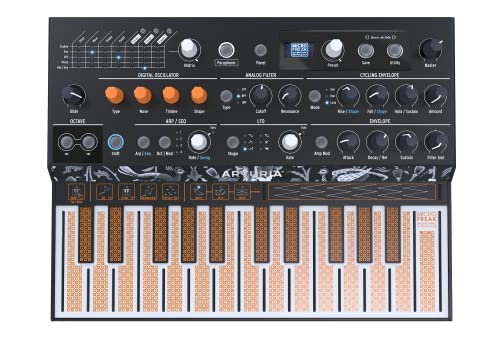
- Hybrid engine with numerous digital oscillator modes
- 25-key keyboard with poly-aftertouch
- CV, USB, and MIDI connectivity
Best For: Advanced experimental sound designers and modular users
Full-Size Production Keyboard
Yamaha MX61 61-Key Synthesizer

- 61-key layout for broader playing range
- 128-note polyphony for live and sequenced work
- USB audio/MIDI with plug-and-play connectivity
Best For: Keyboardists needing a versatile studio or live instrument
Portable Hybrid Pick

- Four vector-morphing oscillators per voice
- Analog filter, sequencer, and arpeggiator
- Battery- or USB-powered compact format
Best For: Portable sound design and pattern creation
Controller Studio Pick
Akai Professional MPK Mini Plus

- 37-key controller with three octaves
- CV/Gate, MIDI I/O, pads, and assignable knobs
- Built-in 64-step drum and melody sequencer
Best For: Compact studio and hardware-control workflows
Portable FM Pick
M-VAVE Wireless FM Synthesizer

- Six operators and 32 FM algorithms
- 128 presets with SYSEX sound-bank support
- Speaker, battery, effects, and multiple MIDI options
Best For: Mobile FM sound design and compact MIDI rigs
Versatile Workstation – Yamaha MODX M6
The Yamaha MODX M6 is a strong choice among professional music synthesizers for players who need broad sound options, hands-on control, and a practical stage-to-studio workflow. Its lightweight 61-key design combines multiple synthesis engines, upgraded navigation, and DAW integration.
Best For: Professional performers and studio musicians who want varied sounds, expressive controls, and a full-size keyboard in a relatively lightweight instrument.
Pros:
- Three sound engines cover analog-style, FM, and realistic instrument sounds.
- Eight physical faders, a Super Knob, color touchscreen, and dedicated display knobs support hands-on editing.
- 61 semi-weighted keys offer improved playability over the MODX+ action.
- Expanded Softsynth Plugin supports sound work inside a DAW.
Cons:
- Its extensive synthesis and workflow features may take time to learn.
- The 61-key format is less compact than shorter performance keyboards.
The MODX M6 is the most broadly equipped option here for musicians who move between live performance, sound design, and computer-based production. Choose it when flexibility and keyboard range matter more than a purely analog signal path.
Analog Sound Designer – Moog Subsequent 37
The Moog Subsequent 37 is a hands-on analog option for professional music synthesizers buyers who prioritize deep sound shaping. With a knob-rich panel, two-note paraphony, and extensive modulation, it is built for detailed programming and expressive performance.
Best For: Synthesists and producers seeking rich analog tones, extensive physical controls, and flexible studio connectivity.
Pros:
- Forty knobs and 74 switches provide direct access to sound-design and sequencing controls.
- Two variable waveshape oscillators, a sub oscillator, noise generator, and filter feedback input offer substantial tonal range.
- 37 semi-weighted keys include velocity and aftertouch, with two-note paraphonic operation.
- MIDI, USB, audio, CV, and gate connections support varied studio setups.
Cons:
- The 37-key layout is less suitable for players who need a wider keyboard range.
- Its extensive analog controls may feel demanding for beginners.
The Subsequent 37 stands out when tactile analog programming is the priority. Its paraphonic keybed adds performance flexibility, while CV and MIDI connections make it a capable centerpiece for a hybrid setup.
Standalone Production Hub – Akai MPC Key 37 G2
The Akai MPC Key 37 G2 expands the professional music synthesizers category into standalone production. It combines a 37-key synth-action keyboard with MPC pads, a touchscreen, sampling, sequencing, and the MPC3 operating system for building complete tracks without a computer.
Best For: Producers who want keys, pads, sampling, sequencing, and computer connectivity in one performance-focused workstation.
Pros:
- Standalone MPC3 workflow supports arranging and finishing tracks without a computer.
- Combines 37 full-size synth-action keys, pitch and mod wheels, and 16 velocity-sensitive MPC pads.
- Eight-core processing supports up to 16 stereo audio tracks and 32 plugin instruments per project.
- USB-C provides multichannel audio, expanded MIDI, sampling, and host/device support.
Cons:
- The 37-key layout may not suit players who require a larger keyboard.
- Its many production functions can create a steeper learning curve than a dedicated synthesizer.
The MPC Key 37 G2 is the best fit for hands-on track creation rather than traditional synthesizer-only use. Choose it if sampling, pads, sequencing, and standalone arrangement are as important as playing keyboard parts.
Portable Moog Monosynth – Moog Messenger
The Moog Messenger is a focused choice among professional music synthesizers for musicians who want classic monophonic analog sound with modern performance features. Its two wavefolding oscillators, ladder filter, full-size keys, and onboard sequencing support both studio programming and live playing.
Best For: Bassists, lead players, and producers who want a portable Moog monosynth with expressive keys, sequencing, and modular-friendly connections.
Pros:
- Two continuously variable-shape VCOs, sync, FM, and a sub-oscillator provide substantial analog tone-shaping options.
- The ladder filter offers low-pass, band-pass, and high-pass responses with resonance bass compensation.
- 32 semi-weighted full-size keys include velocity and aftertouch.
- Integrated 64-step sequencer, arpeggiator, six CV patch points, and MIDI connectivity support performance and integration.
Cons:
- Its monophonic design is intended for one-note lines rather than polyphonic chords.
- The 32-key range is more limited than a 61-key workstation.
The Messenger is a compelling choice for expressive basses, leads, and experimental sequences. Its knob-per-function design keeps the instrument approachable while the CV, MIDI, and USB-C connections make it adaptable to modern studio systems.
Portable Idea Station – Yamaha SEQTRAK
For producers seeking professional music synthesizers in a portable format, the Yamaha SEQTRAK combines drums, synths, sampling, sound design, and sequencing in one compact unit. Its built-in speaker, microphone, and rechargeable battery make it practical for developing ideas away from a studio.
Best For: Mobile producers and creators who want an all-in-one sketching and sequencing device.
Pros:
- Combines drums, synths, sound design, sampling, and sequencing.
- Hands-on controls and a three-part interface support real-time idea capture.
- Compact, lightweight design includes a speaker, microphone, and rechargeable battery.
Cons:
- Its compact design may be less suitable for players wanting a traditional keyboard.
- The plastic body may not feel as substantial as a larger studio instrument.
The SEQTRAK is a strong choice when portability and fast idea development matter more than a conventional synthesizer layout. Its integrated features reduce the need to carry additional gear.
Experimental Hybrid Pick – Arturia MicroFreak Synthesizer
The Arturia MicroFreak is an especially flexible option among professional music synthesizers, pairing digital oscillator engines with a resonant analog filter. Its touch-sensitive 25-key surface, modulation matrix, and CV connectivity suit experimental sound design and compact setups.
Best For: Advanced users who want unusual sounds, expressive control, and modular-friendly connectivity.
Pros:
- Offers multiple oscillator modes spanning physical modeling, wavetable, vocoder, and other timbres.
- 25-key PCB keyboard provides individual pressure or poly-aftertouch control.
- Includes CV, USB, and MIDI connectivity for studio, DAW, and modular integration.
- Spice and Dice sequencing, automation recording, and a 5×7 modulation matrix encourage experimentation.
Cons:
- The touch-plate keyboard differs from a conventional moving-key keyboard.
- Its advanced feature set may require a learning period for newcomers.
MicroFreak stands out for sound exploration rather than traditional workstation workflow. It is a compact, lightweight instrument with unusually broad synthesis and routing possibilities.
Full-Size Production Keyboard – Yamaha MX61 61-Key Synthesizer
The Yamaha MX61 is a 61-key music production synthesizer designed for players who need a broader keyboard alongside extensive sounds and computer connectivity. Its Motif sound engine, 128-note polyphony, and USB audio/MIDI interface support live playing and sequenced production.
Best For: Keyboardists building a studio or live setup around a full-size 61-key instrument.
Pros:
- 61-key layout offers more playing range than compact synthesizers.
- 128-note polyphony helps support live performance and full 16-track sequences.
- Class-compliant USB provides plug-and-play audio and MIDI connectivity.
- Can record or play back stereo audio and 16 channels of MIDI through one USB cable.
Cons:
- At 44.7 inches wide and 14.9 pounds, it is less portable than compact alternatives.
- Some remote-control functions depend on compatible DAW software.
The MX61 is the most traditional performance-oriented choice in this group. It makes sense for musicians who value a longer keyboard, broad polyphony, and direct computer integration over maximum portability.
Portable Hybrid Pick – Behringer Pro VS Mini
The Behringer Pro VS Mini is a compact option for anyone exploring professional music synthesizers in a portable format. Its hybrid design combines four vector-morphing oscillators per voice with an analog low-pass filter, while the built-in sequencer and arpeggiator support hands-on pattern creation.
Best For: Portable sound design, sequencing, and players who want a small battery- or USB-powered synthesizer.
Pros:
- Hybrid synthesis with four vector-morphing oscillators per voice
- Analog low-pass filter plus oscillator, amplifier, and envelope controls
- Built-in 16-step sequencer and arpeggiator
- Compact battery- or USB-powered design with USB-C connectivity
Cons:
- Small 27-key format may not suit extended keyboard performances
- Headphone connector type is not specified in the supplied details
The Pro VS Mini focuses on portability without omitting core synthesis and sequencing tools. It is a practical choice for compact setups, travel, and sketching ideas away from a full studio.
Controller Studio Pick – Akai Professional MPK Mini Plus
The Akai Professional MPK Mini Plus is a versatile controller for professional music synthesizers and computer-based production. Its 37-key layout provides three octaves, while CV/Gate and MIDI connections let it control modular gear, sound modules, synthesizers, and compatible DAW setups.
Best For: Producers who need a compact keyboard controller with pads, sequencing, DAW controls, and hardware connectivity.
Pros:
- 37 velocity-sensitive keys across three full octaves
- CV/Gate and MIDI I/O for connecting external instruments and modular equipment
- Built-in 64-step sequencer with separate drum and melodic or chord tracks
- Eight RGB MPC pads, eight assignable knobs, arpeggiator, and chord and scale modes
Cons:
- It is a MIDI controller rather than a standalone synthesizer
- Requires a computer or external sound source for sound generation
The MPK Mini Plus offers a broad control surface in a compact package. Its combination of keys, pads, sequencing, CV/Gate, and DAW controls makes it especially useful as the central input device in a small production setup.
Portable FM Pick – M-VAVE Wireless FM Synthesizer
The M-VAVE Wireless FM Synthesizer brings classic FM-style sound creation to a highly portable instrument. With six operators, 32 algorithms, 128 presets, built-in effects, and a speaker, it gives shoppers seeking professional music synthesizers a compact way to create and perform without a larger setup.
Best For: Mobile FM synthesis, quick sound exploration, and wireless or compact MIDI setups.
Pros:
- Six-operator FM engine with 32 selectable algorithms
- 128 factory presets and support for standard FM SYSEX sound decoding
- Six built-in effects, arpeggiator, and 16-step sequencer
- Built-in speaker, battery operation, 27 keys, and USB, Bluetooth, and 3.5mm MIDI options
Cons:
- Compact 27-key silicone keyboard may not replace a full-size keyboard
- Plastic and silicone construction may feel less substantial than larger studio instruments
This model is designed around immediate, portable FM experimentation. Its preset library, effects, sequencing, speaker, and multiple MIDI options make it flexible for travel, practice, and integrating a small sound module into a broader rig.
How We Picked the Best Professional Music Synthesizers
We evaluated these instruments by looking at synthesis architecture, hands-on control, playability, sequencing and sampling features, connectivity, portability, and suitability for studio or stage use. We also considered how clearly each synthesizer serves a particular type of musician, rather than treating every model as a direct substitute.
The selection includes analog, digital, hybrid, FM, and workstation-style instruments. Some are complete production centers, while others focus on expressive sound design, MIDI control, or portable idea development.
Quick Comparison
| Best For | Look For | Most Suitable Type |
|---|---|---|
| Live performance | Reliable controls, strong presets, playable keys | Performance synthesizer |
| Analog sound design | Oscillator flexibility, filter character, modulation | Analog synthesizer |
| Beatmaking and production | Sequencing, sampling, pads, standalone operation | Production keyboard |
| Portable composition | Battery power, built-in speakers, compact design | Mobile synthesizer |
| Computer-based setups | USB MIDI, playable key range, controller features | MIDI keyboard or hybrid synth |
Key Buying Factors for Professional Music Synthesizers
Synthesis Engine
Analog instruments are valued for immediate hands-on control and distinctive filter response. Digital and hybrid designs can provide broader timbral variety, complex modulation, sampling, or multiple synthesis methods. FM models are especially useful for precise, bright, metallic, and percussive sounds.
Keyboard and Performance Controls
Consider key count, action, velocity sensitivity, aftertouch, pitch and modulation controls, and the instrument’s overall playing comfort. A 61-key synthesizer is often better for two-handed performance, while compact 25- or 37-key models are easier to place in crowded studios and mobile rigs.
Sequencing, Sampling, and Workflow
If you want to create complete ideas without a computer, prioritize onboard sequencing, sampling, pattern storage, and useful monitoring features. A controller-focused keyboard may be a better value if your main sounds and production tools already live in a DAW.
Connectivity and Expansion
Check USB MIDI, traditional MIDI ports, audio inputs and outputs, sustain-pedal support, headphone connectivity, and compatibility with your existing equipment. Standalone instruments should also be judged by storage, firmware support, and how easily projects can move between devices.
Who Should Buy Which Professional Music Synthesizers?
Choose a full-size Yamaha-style performance synthesizer if expressive playing, dependable live operation, and broad sound coverage matter most. These instruments suit keyboardists who need one central stage or studio keyboard.
Choose an analog Moog if tactile controls, filter character, basses, leads, and experimental monophonic or paraphonic playing are your priorities.
Choose the Akai MPC Key 37 if you want a standalone production keyboard that combines playable keys with sequencing, sampling, and beatmaking tools.
Choose a compact Arturia, Behringer, or M-VAVE model if sound exploration, portability, or a lower-cost entry point is more important than a full-size keyboard and comprehensive workstation workflow.
Before buying, decide whether the synthesizer will be your main instrument, a specialized sound-design tool, or a portable sketchpad. Matching that role to the hardware will usually matter more than choosing the model with the longest feature list.
