Touring musicians need more than impressive sounds: a practical keyboard setup must travel securely, perform reliably, and fit the demands of rehearsals, stages, and quick changeovers.
This roundup covers 10 touring-focused options, from professional synthesizers and arranger keyboards to controllers, flight-ready protection, and portable stands. Use the guide below to match your budget and workflow with the right combination of gear.
Best 10 Keyboard Workstations for Touring Musicians Picks for 2026
Stage-Ready Flagship

- 61-key aftertouch keyboard with metal construction
- ZEN-Core covers classic and modern Roland sounds
- Five-part layering and I-Arpeggio for live arrangements
Best For: Touring players needing deep sound variety and rugged construction
Expressive Polyphonic Synth

- 61-note Polytouch polyphonic aftertouch
- 16 voices with eight oscillators per voice
- Touchscreen interface and varied synthesis modes
Best For: Synth-focused performers seeking expressive sound design
Portable Creation Keyboard

- 61-note touch-sensitive keyboard
- Over 1,000 sounds and 200+ accompaniment styles
- Built-in speakers plus Bluetooth and USB MIDI/audio
Best For: Mobile players wanting easy creation and convenient connectivity
Computer-Based Control Center

- 61-key semi-weighted controller keyboard
- OLED display and eight touch-sensitive knobs
- USB-powered control for virtual instruments and DAWs
Best For: Laptop-based touring rigs using virtual instruments
All-in-One Practice Rig

- 61 touch-responsive keys with 600 tones and 195 rhythms
- Includes stand, bench, headphones, pedal, and power supply
- Supports built-in-speaker or headphone practice
Best For: Players wanting a complete 61-key setup with accessories included
Touring Protection Pick

- 1/4-inch laminated plywood construction
- ATA flight-ready design with interior foam
- Measure the keyboard against the usable dimensions first
Best For: Korg Pa600 owners transporting their workstation on the road
Beginner-Friendly Travel Setup
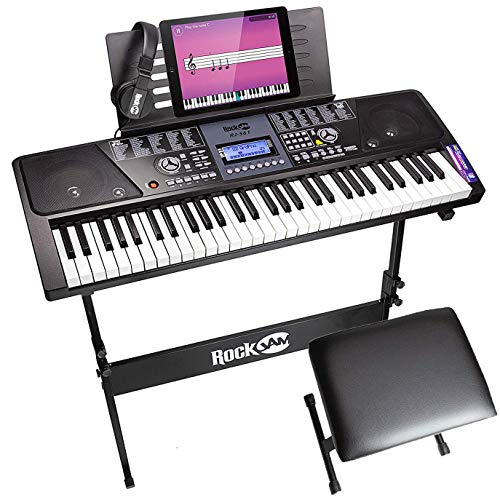
- Complete kit with stand, stool, headphones, and stickers
- 100 rhythms, 50 tones, lessons, and demo songs
- Recording, USB, speakers, and headphone output included
Best For: Beginners seeking a ready-to-use 61-key practice package
Portable Learning Keyboard
Yamaha PSR-E283 61-Key Keyboard

- 61 full-sized keys with beginner-friendly learning tools
- Built-in songs, Quiz Mode, and Smart Chord
- 8.8-pound design with AC or battery power
Best For: Beginners and mobile practice setups
Touring Stand
Kadence NK13WH White Double-X Keyboard Stand

- Dual-braced steel frame supports up to 25 kg
- Five height positions for seated or standing play
- Folds for transport and requires no assembly
Best For: Touring and stage performers needing sturdy support
Colorful Touring Stand
Kadence NK13RD Red Double-X Keyboard Stand

- 25 kg capacity for 61-, 76-, and 88-key keyboards
- Five height positions with locking clutch
- Foldable dual-braced frame with locking straps
Best For: Gigging players wanting sturdy support with a bold finish
Stage-Ready Flagship – Roland JUPITER-X
For touring musicians who need keyboard workstations for touring musicians that can cover vintage synths, digital instruments, drums, and modern sound design, the Roland JUPITER-X is a powerful, performance-focused option. Its 61-key aftertouch-enabled keyboard, layered architecture, and metal construction are suited to demanding stage setups.
Best For: Touring performers who want broad Roland sounds, hands-on control, and a durable workstation-style instrument.
Pros:
- ZEN-Core engine recreates classic Roland synths, digital instruments, pianos, and drum machines.
- Five-part layering, substantial polyphony, and hands-on controls support complex live arrangements.
- Aftertouch-enabled 61-key keyboard and all-metal construction are designed for expressive performance and durability.
- I-Arpeggio can generate complementary drum parts, basslines, chords, and arpeggios.
Cons:
- At 47 pounds, it is comparatively heavy for frequent load-ins.
- Its extensive synthesis and sound options may be more than players seeking a simple keyboard.
The JUPITER-X is the strongest choice here for players who prioritize premium construction and deep sound flexibility over portability. It can serve as a central stage instrument when a tour requires many sounds from one keyboard.
Expressive Polyphonic Synth – ASM Leviasynth
The ASM Leviasynth is a compelling pick for keyboard workstations for touring musicians who build performances around detailed synthesis and expressive control. Its 61-note Polytouch keybed, 16-voice architecture, and color touchscreen provide a modern interface for shaping sounds onstage.
Best For: Synth-focused touring artists who want polyphonic aftertouch and extensive oscillator-based sound design.
Pros:
- 61-note Polytouch polyphonic aftertouch keybed supports expressive playing.
- Sixteen voices with eight oscillators per voice provide substantial synthesis potential.
- Supports phase modulation, frequency modulation, pulse-width modulation, HTE sync, and phase distortion.
- Color touchscreen and ASM Patch Manager simplify navigation, patch management, and firmware updates.
Cons:
- At 38.6 pounds, it may be demanding to transport regularly.
- Its synthesis-focused design may not suit players seeking broad accompaniment features or built-in speakers.
With its Polytouch keybed and flexible oscillator configurations, the Leviasynth stands out for performers who treat the keyboard as an expressive synthesizer. It is best considered when advanced sound creation matters more than an all-purpose accompaniment workflow.
Portable Creation Keyboard – Roland GO:KEYS 3
For musicians seeking approachable keyboard workstations for touring musicians, the Roland GO:KEYS 3 combines a 61-note touch-sensitive keyboard with built-in speakers, Bluetooth, and a broad collection of sounds and accompaniment styles. Its 15.5-pound weight also makes it easier to move between rehearsals and smaller performances.
Best For: Mobile performers, creators, and all-skill players who want quick song building and flexible connectivity.
Pros:
- Over 1,000 ZEN-Core sounds provide wide tonal variety.
- More than 200 accompaniment styles and over 300 chord-sequencer presets support fast arrangement building.
- Built-in stereo speakers allow convenient playing without external amplification.
- Bluetooth audio/MIDI and USB audio/MIDI support streaming and computer or mobile production.
Cons:
- The touch-sensitive keyboard does not list aftertouch or semi-weighted action.
- Its creation-focused feature set may be less suitable for players who need deep flagship-level synthesis control.
The GO:KEYS 3 is a practical, lightweight option when portability and immediate song creation are priorities. Built-in speakers and wireless connectivity make it especially convenient for rehearsal, casual performance, and compact touring rigs.
Computer-Based Control Center – Komplete Kontrol A61
The Native Instruments Komplete Kontrol A61 suits keyboard workstations for touring musicians whose live sounds are hosted in a laptop. This 61-key MIDI controller offers a semi-weighted keybed, OLED navigation, touch-sensitive knobs, and USB bus power for a streamlined computer-based setup.
Best For: Touring performers using virtual instruments and compatible DAWs such as Logic Pro X, Ableton Live, Cubase, or GarageBand.
Pros:
- Semi-weighted 61-key keybed provides a more substantial playing feel than a basic controller.
- OLED display supports at-a-glance navigation.
- Eight touch-sensitive control knobs provide hands-on parameter adjustment.
- USB 2.0 bus power simplifies connections to compatible computers.
Cons:
- It is a MIDI controller, so it requires a compatible computer and software for sound generation.
- USB connectivity is less self-contained than a keyboard with onboard sounds and speakers.
- The plastic construction may be less rugged than metal-bodied stage keyboards.
The A61 is a sensible choice for tours built around virtual instruments rather than onboard synthesis. Its light 10-pound design and focused controls can help reduce hardware weight, provided the computer-based rig is reliable.
All-in-One Practice Rig – Casio CT-X700 Bundle
For musicians seeking keyboard workstations for touring musicians, the Casio CT-X700 bundle is a convenient all-in-one setup for rehearsals, practice, and smaller performances. Its 61 touch-responsive keys, broad sound library, and included stand, bench, pedal, and headphones reduce the need to source accessories separately.
Best For: Players who want a portable 61-key keyboard package with essential accessories included.
Pros:
- 61 full-size touch-responsive keys support expressive playing.
- Includes 600 tones and 195 rhythms for varied styles.
- Bundle includes an adjustable stand, bench, headphones, sustain pedal, and power supply.
- Built-in speakers and a 1/4-inch headphone output support playing and quiet practice.
Cons:
- The bundle’s included stand and bench add to the gear required for transport.
- Its listed 4.3 kg keyboard weight does not represent the full bundle weight.
The CT-X700 is especially practical when convenience matters more than building a customized touring rig. The included accessories make it easy to get started, while USB connectivity and battery or AC power support flexible use.
Touring Protection Pick – Economy Case for Korg Pa600
Among keyboard workstations for touring musicians, this economy case is designed to protect a Korg Pa600 61-key arranger workstation during travel. Its 1/4-inch laminated plywood construction, foam interior, and ATA flight-ready design focus on transport protection rather than playing features.
Best For: Korg Pa600 owners who need a dedicated case for rehearsals, road travel, and touring.
Pros:
- Made from 1/4-inch laminated plywood for a more protective travel enclosure.
- ATA flight-ready design is suited to touring transport.
- Machine split-riveted bindings and channels support the case construction.
- Interior foam and hardware are shown as part of the supplied case design.
Cons:
- It is not water resistant.
- Compatibility depends on matching the keyboard to the listed usable interior dimensions.
- The case has one compartment and is intended for a specific 61-key arranger.
Measure your keyboard before purchasing: the listed usable foam-to-foam space is 41 1/8 by 15 1/2 by 5 1/4 inches. For the correct Korg Pa600 fit, this case offers a practical protection upgrade for touring without claiming universal keyboard compatibility.
Beginner-Friendly Travel Setup – RockJam RJ561 61-Key Kit
For shoppers comparing keyboard workstations for touring musicians, the RockJam RJ561 is a straightforward 61-key kit for practice, learning, and basic portable setups. It combines the keyboard with a stand, stool, headphones, stickers, and lesson access, making it useful when minimizing extra purchases is a priority.
Best For: Beginners and casual players who want an affordable-feeling starter package with private-practice accessories.
Pros:
- Includes a 61-key keyboard, stand, stool, headphones, and keynote stickers.
- Offers 100 rhythms, 50 tones, teaching functions, and demo songs.
- Headphone support enables quieter practice in shared spaces.
- USB connectivity, recording, built-in speakers, and a digital display add useful practice features.
Cons:
- The included 3.5mm headphone jack may require an adapter for headphones with a different plug.
- Its 100 rhythms and 50 tones provide fewer options than the Casio CT-X700 bundle.
- The stand and stool increase the amount of equipment to pack for travel.
The RJ561 is better suited to learning and everyday practice than demanding touring work. Its included lessons, stickers, stool, stand, and headphones create a convenient starting point for players who value a complete kit over advanced workstation depth.
Portable Learning Keyboard – Yamaha PSR-E283 61-Key Keyboard
For musicians building a touring setup on a budget, the Yamaha PSR-E283 is a lightweight 61-key keyboard with practical learning features and flexible power options. Its 8.8-pound design, music rest, headphone jack, and included adapter make it easy to use for rehearsals, practice, or smaller performance setups.
Best For: Beginners and developing players who need a portable keyboard with built-in lessons, songs, and versatile sounds.
Pros:
- 61 full-sized keys support developing playing technique.
- Built-in songs, Quiz Mode, and Smart Chord support learning.
- Portable Grand Piano button provides quick access to a rich piano sound.
- Runs from an AC adapter or batteries and includes a headphone jack.
Cons:
- Its beginner-focused feature set may be limited for advanced touring performers.
- It has 61 keys rather than the 76- or 88-key range some players require.
The PSR-E283 is best viewed as a compact, learning-oriented keyboard rather than a full professional workstation. Its low weight and battery capability are useful for mobile practice and simple gigging, while the included learning tools make it especially approachable for newer players.
Touring Stand – Kadence NK13WH White Double-X Keyboard Stand
For keyboard workstations for touring musicians, the Kadence NK13WH provides a foldable, stage-oriented support option with a dual-braced X frame. It supports 61-, 76-, and 88-key keyboards, offers five height positions, and folds compactly for transport between performances, rehearsals, and studios.
Best For: Gigging keyboardists who need a portable, heavy-duty stand for seated or standing performances.
Pros:
- Dual-braced steel frame is designed for stability in stage environments.
- 25 kg load capacity supports heavier digital pianos and workstations.
- Five height levels and a reinforced locking clutch accommodate different playing positions.
- Folding, tool-free design is convenient for frequent transport and setup.
Cons:
- The double-X design may offer less flexible legroom than some table-style stands.
- Its white matte finish may show stage and transport wear more visibly.
The NK13WH focuses on dependable support and fast setup rather than elaborate workstation expansion. Locking straps, a reinforced frame, and a 25 kg capacity make it a practical choice for touring players carrying a range of keyboard sizes.
Colorful Touring Stand – Kadence NK13RD Red Double-X Keyboard Stand
The Kadence NK13RD is a practical option for keyboard workstations for touring musicians who want a sturdy, transportable stand with a distinctive matte red finish. Its dual-braced X frame supports keyboards from 61 to 88 keys, while the locking clutch, straps, and five height levels help keep a live setup secure.
Best For: Touring and stage players who want a stable, foldable stand with a visible red finish.
Pros:
- Heavy-duty double-X construction supports up to 25 kg.
- Five height settings allow seated or standing performance positions.
- Locking straps help prevent keyboard movement during energetic performances.
- Folds compactly and sets up without tools or assembly.
Cons:
- The X-frame format may provide less open space beneath the keyboard than other stand styles.
- The red matte finish is a style choice that may not suit every stage setup.
With its reinforced steel frame and travel-friendly folding design, the NK13RD is built around straightforward gigging practicality. Choose it when secure support, quick setup, and a bold appearance matter more than modular workstation accessories.
How We Picked the Best Keyboard Workstations for Touring Musicians
We evaluated these options by focusing on the concerns that matter most on the road: portability, sound and control capabilities, setup speed, physical protection, stability, and overall usefulness for live performance. The selection includes complete keyboards as well as supporting equipment because a touring rig is only as dependable as its weakest component.
Professional players may prioritize synthesis depth and stage-ready construction, while newer musicians may benefit more from built-in learning features, bundled accessories, or a simple controller-based workflow. Product descriptions, intended use, included accessories, and touring-oriented design features were considered when organizing the lineup.
Quick Comparison
| Need | Best-fit options | Why they stand out |
|---|---|---|
| Advanced live synthesis | Roland JUPITER-X, ASM Leviasynth | Designed for expressive sound creation and performance control |
| Compact music creation | Roland GO:KEYS 3, Native Instruments Komplete Kontrol A61 | Useful for modern production, arranging, and software-based setups |
| Beginner-friendly full kits | Casio CT-X700 bundle, RockJam RJ561, Yamaha PSR-E283 | Include learning tools or accessories that simplify getting started |
| Touring protection | Roadcases.com Korg Pa600 case | Provides flight-ready protection for compatible arranger workstations |
| Support equipment | Kadence NK13WH, Kadence NK13RD stands | Portable double-X designs for stable keyboard placement |
Key Buying Factors for Keyboard Workstations for Touring Musicians
Portability and Protection
Check the keyboard’s weight, dimensions, power requirements, and carrying options before buying. A protective case is especially important for air travel, vans, and frequent load-ins. Confirm exact model compatibility rather than assuming a generic case will fit.
Sound Engine and Workflow
Consider whether you need onboard synthesis, arranger functions, performance presets, or a MIDI controller for computer-based instruments. A workstation with deep internal sounds can reduce dependence on a laptop, while a controller may offer greater flexibility in a studio-centered rig.
Stage Stability and Setup Speed
A stand should lock securely, support the instrument’s weight, and adjust to a comfortable playing height. Double-X stands are convenient for quick setup, but verify their weight rating and footprint for your keyboard. Also look for accessible controls, clear displays, and dependable power options.
Included Accessories and Total Cost
Bundles can add practical value with a bench, headphones, sustain pedal, stand, or instructional material. Compare what is actually included and account for a case, spare cables, power backup, and transport costs before setting your budget.
Who Should Buy Which Keyboard Workstations for Touring Musicians?
Choose the Roland JUPITER-X or ASM Leviasynth if expressive synthesis and a more advanced performance instrument are your priorities. The Roland GO:KEYS 3 is a sensible choice for convenient, self-contained music creation, while the Komplete Kontrol A61 suits musicians who primarily use software instruments and want hands-on control.
Beginners and budget-conscious players should compare the Casio, RockJam, and Yamaha options based on included accessories and learning features. If you already own a compatible Korg Pa600, the dedicated flight-ready case is the practical touring upgrade. Finally, add one of the Kadence stands when quick setup, portability, and basic stage support matter more than a heavy-duty road-rack solution.
