Large-room sound systems need more than powerful amplifiers and loudspeakers. The right speaker management processor helps balance coverage, protect drivers, route sources, and keep complex PA systems consistent from front to back.
This roundup compares 10 options across live sound, installed audio, commercial zones, conference systems, and line-array applications. Use the buying guide below to narrow your choice by I/O, control method, networking, DSP capability, and installation needs.
Best 10 Speaker Management Processors for Large Rooms Picks for 2026
Best All-in-One PA Tuning Pick

- Improved Auto EQ for quick system tuning
- Enhanced feedback elimination algorithm
- Guided setup with Android and iOS control
Best For: DJs and PA users seeking guided speaker optimization
Best Matrix DSP for Detailed Tuning
AudioControl DM-810 DSP Matrix
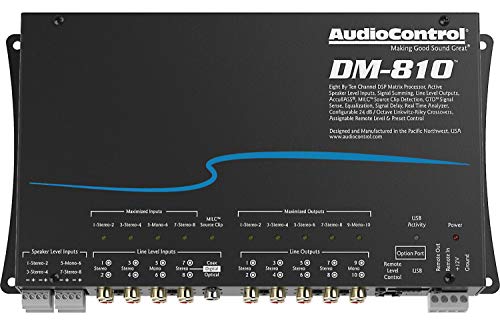
- Eight inputs and ten outputs
- Input and output RTA for tuning
- Includes software and ACR-3 remote
Best For: Installers needing flexible DSP routing and analysis
Best for Speaker Protection
Behringer UltraDrive Pro DCX2496
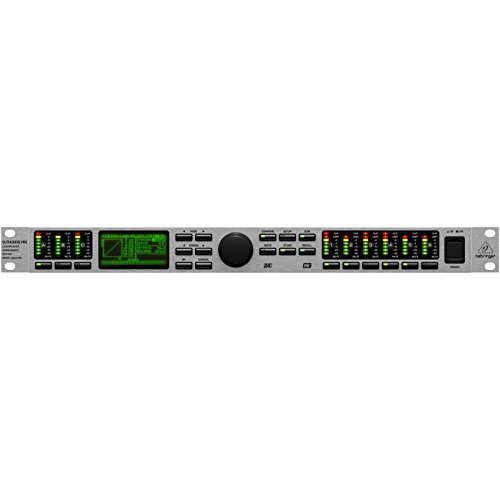
- Limiters on every output channel
- Adjustable input and output delays
- Supports phase and arrival-time correction
Best For: PA systems requiring protection and timing alignment
Best High-Count Matrix Platform

- 16 inputs and 16 outputs
- Built for substantial signal routing
- Suitable for larger distributed audio systems
Best For: Installations prioritizing high channel capacity
Flexible Digital Crossover
Behringer ULTRADRIVE DCX2496LE

- 2 analog inputs and 6 analog outputs
- 24-bit/96 kHz conversion with 113 dB dynamic range
- Dynamic and parametric EQ options
Best For: Multi-speaker systems needing six output channels
Commercial Zone Control
dbx ZonePRO 1260 Digital Zone Processor

- 12 inputs and 6 balanced outputs
- Ethernet, wall-panel, and RS-232 control
- Advanced feedback suppression and dynamics processing
Best For: Commercial installations with multiple audio zones
Advanced Crossover Tuning
Peavey VSX 26e DSP Loudspeaker Management System

- Multiple EQ and all-pass filter types
- Butterworth, Bessel, and Linkwitz-Riley alignments
- Built-in signal generator and stereo channel linking
Best For: Live sound systems requiring detailed crossover tuning
Best FIR DSP for Flexible PA Control
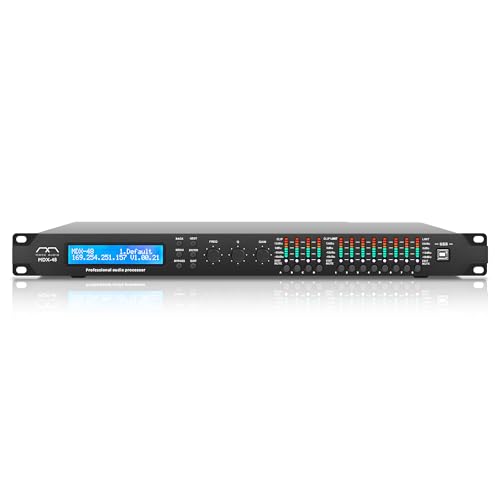
- 4-in/8-out DSP with 96kHz/24-bit processing
- FIR filtering for linear-phase speaker tuning
- Dante, AES, analog, and matrix-routing support
Best For: Large PA and line-array systems needing advanced connectivity and tuning
Best Full-Featured Matrix Processor

- 4-in/8-out DSP with full matrix mixing
- Detailed EQ, crossover, delay, and dynamics controls
- Ethernet, USB, RS485, and control for up to 32 units
Best For: Installed and multi-zone systems requiring extensive remote management
Best Compact 2-in/4-out Processor

- 2-in/4-out design with S/PDIF input
- EQ, crossover, delay, compression, and limiting
- USB and Ethernet remote control for up to 32 units
Best For: Smaller PA zones and installations needing four managed outputs
Best All-in-One PA Tuning Pick – dbx DriveRack PA2
The dbx DriveRack PA2 is a practical choice among speaker management processors for large rooms when you want guided setup, automatic equalization, and feedback control in a rack-mountable format. Its 2×6 configuration is designed for PA and DJ applications, with app control through Android and iOS devices.
Best For: DJs and PA users who want streamlined speaker-system setup with app-based control.
Pros:
- Improved Auto EQ is designed for fast, accurate, and non-intrusive tuning.
- Enhanced AFS algorithm helps eliminate feedback while preserving system tone.
- Wizard functions provide step-by-step guidance.
- Rack-mountable design with Android and iOS control.
Cons:
- Its two-channel audio configuration may be limiting for more complex systems.
- It is not waterproof.
The PA2 stands out for accessible, guided operation rather than extensive matrix routing. It is a strong fit when reliable PA optimization and quick setup matter most.
Best Matrix DSP for Detailed Tuning – AudioControl DM-810 DSP Matrix
AudioControl DM-810 Premium 8 Input 10 Output DSP Matrix Processor, ACR-3 Dash Remote
Check Price On AmazonThe AudioControl DM-810 is a flexible option among speaker management processors for large rooms, offering eight inputs and ten outputs for more involved signal-routing needs. Its included software, input and output RTA, and clip detection features support informed system tuning.
Best For: Installers and audio users who need an 8-input, 10-output DSP matrix with measurement-focused tools.
Pros:
- Provides eight inputs and ten outputs for flexible signal management.
- Includes Smart User Interface software.
- Input and output RTA supports precise tuning.
- Includes ACR-3 Dash Remote and MILC clip detection.
Cons:
- The supplied notes do not specify automatic EQ or feedback-management functions.
- Its feature set may require more setup knowledge than a guided PA processor.
With its higher input and output count, the DM-810 is aimed at systems where routing flexibility and detailed analysis are more important than simplified, wizard-based operation.
Best for Speaker Protection – Behringer UltraDrive Pro DCX2496
The Behringer UltraDrive Pro DCX2496 is a strong consideration among speaker management processors for large rooms when output protection and timing correction are priorities. It combines output-channel limiters with adjustable delays for managing speaker protection, phase, arrival-time, and room-temperature corrections.
Best For: PA operators who need output limiting and adjustable delay controls across inputs and outputs.
Pros:
- Provides limiters on all output channels for speaker protection.
- Zero-attack limiters are designed for rapid response.
- Adjustable input and output delays support timing correction.
- Supports manual or automatic correction for temperature, phase, and arrival-time differences.
Cons:
- The supplied notes do not mention app-based control or guided setup.
- Its listed dimensions indicate a comparatively substantial unit.
The DCX2496 is particularly useful when protection and alignment need to be handled directly at the processor. Its delay and limiter tools make it suitable for more hands-on system configuration.
Best High-Count Matrix Platform – Allen & Heath AHM-16 Matrix
The Allen & Heath AHM-16 is a straightforward option among speaker management processors for large rooms, with a 16-in/16-out audio matrix designed for systems that require substantial routing capacity. Its high channel count makes it relevant for larger or more distributed audio setups.
Best For: Large installations that need equal numbers of inputs and outputs in one audio matrix processor.
Pros:
- Offers 16 inputs and 16 outputs.
- Provides a substantial channel count for larger audio systems.
- Dedicated audio matrix format supports complex signal routing.
Cons:
- The supplied notes do not list EQ, feedback suppression, limiting, or delay features.
- Its listed weight and dimensions may require dedicated rack or installation space.
The AHM-16 is best evaluated as a high-capacity routing platform. Choose it when channel count is the primary requirement, while confirming that any specialized tuning tools you need are available in the intended system.
Flexible Digital Crossover – Behringer ULTRADRIVE DCX2496LE
For anyone comparing speaker management processors for large rooms, the Behringer ULTRADRIVE DCX2496LE offers a flexible 2-input, 6-output platform for routing and tuning a multi-speaker system. Its 24-bit/96 kHz converters and 113 dB dynamic range support detailed signal handling.
Best For: Large-room systems that need multiple outputs, crossover control, and detailed EQ adjustment.
Pros:
- Provides 2 analog inputs and 6 analog outputs.
- Uses 24-bit/96 kHz A/D and D/A converters.
- Includes dynamic EQs and selectable parametric EQs on inputs and outputs.
Cons:
- Offers only two analog inputs.
- The supplied notes do not specify Ethernet or remote-control functionality.
The DCX2496LE is a practical choice when output flexibility and precision processing matter more than extensive input expansion or network control.
Commercial Zone Control – dbx ZonePRO 1260 Digital Zone Processor
The dbx ZonePRO 1260 is built for commercial installations where speaker management processors for large rooms must handle multiple sources and zones. It combines 12 inputs, 6 balanced outputs, Ethernet control, and processing features such as feedback suppression and automatic gain control.
Best For: Commercial audio systems requiring many inputs, multiple outputs, and controllable zone processing.
Pros:
- Offers 12 total inputs, including balanced mic/line, RCA, and S/PDIF connections.
- Provides six electronically balanced, RF-filtered outputs.
- Includes AFS, compression, limiting, noise gating, EQ, and crossover filters.
- Supports Ethernet, wall-panel, and RS-232 control.
Cons:
- Its feature set is oriented toward commercial installations rather than simple setups.
- At 6.82 pounds, it is heavier than some compact processors.
With its extensive I/O and control options, the ZonePRO 1260 is the strongest fit here for complex distributed audio and commercial zone applications.
Advanced Crossover Tuning – Peavey VSX 26e DSP Loudspeaker Management System
The Peavey VSX 26e is a DSP-based option for speaker management processors for large rooms, particularly live sound and reinforcement systems. It supports multiple EQ types, detailed crossover alignments, signal generation, and channel linking for stereo operation.
Best For: Live events, concerts, and sound-reinforcement systems needing detailed crossover configuration.
Pros:
- Supports PEQ, shelving, pass, and all-pass EQ filter types.
- Offers Butterworth, Bessel, and Linkwitz-Riley crossover alignments.
- Provides crossover slopes from 6 dB/octave to 48 dB/octave.
- Includes sine, white-noise, and pink-noise signal generation plus channel linking.
Cons:
- The supplied notes do not specify the number of analog inputs or outputs.
- Its tabletop mounting type may require additional installation planning.
The VSX 26e stands out for hands-on crossover and filter flexibility, making it suitable when system alignment is a priority and exact I/O details can be confirmed before purchase.
Best FIR DSP for Flexible PA Control – Sound Town MODE Audio MDX-48
For large rooms that need detailed system tuning, the Sound Town MODE Audio MDX-48 is a versatile choice among speaker management processors for large rooms. Its 4-in/8-out architecture, FIR filtering, Dante support, and broad routing tools suit demanding PA and line-array applications.
Best For: Installations and live sound systems needing FIR processing, Dante or AES connectivity, and extensive speaker-management control.
Pros:
- 96kHz/24-bit processing with 4 inputs and 8 outputs
- FIR filtering supports linear-phase tuning and noise reduction
- Includes Dante, AES, analog XLR, Ethernet, USB, and RS-232 connectivity
- Offers matrix routing, delay, dynamic EQ, compression, limiting, and up to 30 presets
Cons:
- Its wide feature set may require more setup time than a basic processor
- Windows Mconsole software is required for full PC-based control
The MDX-48 stands out when connectivity and detailed processing matter more than simplicity. Its front-panel controls and software access provide practical flexibility for larger, more complex sound systems.
Best Full-Featured Matrix Processor – MARANI DPA480
The MARANI DPA480 combines 4 inputs, 8 outputs, full matrix mixing, and extensive dynamics control in a 1RU chassis. It is a strong option among speaker management processors for large rooms when remote control, precise crossover design, and system protection are priorities.
Best For: Conference venues, installed sound systems, and multi-zone PA setups requiring robust routing, delay, EQ, crossover, and limiter controls.
Pros:
- 4-in/8-out design with full matrix mixing and 96kHz operation
- 30-band input EQ and 7-band output EQ
- Supports crossover slopes from 6 to 48dB/octave and multiple filter topologies
- Provides peak limiting, RMS compression, up to 480ms input delay, and control of up to 32 units
Cons:
- Its advanced configuration may be excessive for small or simple systems
- Remote setup and monitoring depend on the included PC software and network connections
With flexible crossover choices, extensive delay, and detailed dynamics processing, the DPA480 is well suited to carefully tuned permanent or touring systems. The 1RU format also makes it practical for rack-based installations.
Best Compact 2-in/4-out Processor – MARANI DPA2448QRT
The MARANI DPA2448QRT provides core crossover, EQ, delay, compression, limiting, and matrix-mixing functions in a 2-in/4-out design. For smaller venues or focused speaker zones, it offers a practical entry among speaker management processors for large rooms where four outputs are sufficient.
Best For: Compact PA systems, fixed installations, and speaker zones needing remote USB or Ethernet configuration with four output paths.
Pros:
- 2 analog inputs, 4 analog outputs, and an S/PDIF stereo input
- Offers output crossovers with slopes from 6 to 48dB/octave
- Includes input/output EQ, configurable delay, RMS compression, and peak limiting
- Remote software can control up to 32 units and display real-time levels
Cons:
- Its 2-in/4-out layout provides less expansion than 4-in/8-out models
- Processing is specified at 48kHz rather than 96kHz
- The listed dimensions are larger than a typical compact 1RU processor
The DPA2448QRT is a sensible fit when a system does not need eight outputs but still benefits from professional routing and protection tools. USB, TCP/IP, and S/PDIF support add useful installation flexibility.
How We Picked These Speaker Management Processors for Large Rooms
We focused on processors that can manage multi-way loudspeaker systems, multiple zones, or distributed audio installations rather than basic equalizers or standalone crossovers. The selection includes compact 2-in/6-out units, larger matrix processors, commercial zone platforms, and DSP systems with networking or advanced routing.
Key considerations included input and output count, crossover and limiter functionality, routing flexibility, remote-control options, connectivity, setup workflow, and suitability for touring, fixed installation, conference, and line-array applications. A high channel count alone does not guarantee a better fit; the processor should match the system’s topology and the operator’s workflow.
Quick Comparison
| Best For | Look For |
|---|---|
| Small to medium PA systems | Simple setup, speaker presets, mobile or front-panel control |
| Large multi-way systems | More outputs, flexible matrix routing, precise DSP, robust limiters |
| Installed commercial audio | Zone control, scheduling, Ethernet management, expandability |
| Line arrays and advanced tuning | FIR processing, delay control, system presets, networked audio |
| Conference and distributed rooms | Automatic or flexible matrix mixing, remote access, reliable signal management |
Key Buying Factors for Large Rooms
Input and Output Capacity
Count every source, loudspeaker band, subwoofer feed, fill speaker, delay line, and monitor or zone output you may need. Leave spare capacity if the venue could expand. A processor with insufficient outputs can force compromises in crossover design and coverage.
Routing, Matrix Mixing, and DSP
Look for independent EQ, crossover filters, delay, polarity, gain, and limiting on the outputs you will actually use. Matrix mixing is especially valuable when different rooms, speaker zones, or delay positions require separate source combinations.
Control and Connectivity
Front-panel controls are useful for local setup, while Ethernet, USB, mobile apps, or dedicated remotes make tuning easier from the audience area or control room. For integrated installations, confirm compatibility with the venue’s network and control system.
Protection and System Tuning
Large systems need dependable limiters, delay alignment, phase and polarity controls, and repeatable presets. FIR filters, when available, can support more advanced tuning, but they also require suitable measurement tools and operator expertise.
Who Should Buy Which Speaker Management Processors for Large Rooms?
Choose a straightforward PA-focused processor if you need fast setup for a conventional mains-and-subwoofer system. Select a higher-I/O matrix DSP when the venue uses multiple speaker bands, fills, monitors, or independent zones. Commercial installers should prioritize network control, reliable presets, and zone routing over live-performance features.
For line arrays or demanding system-alignment work, prioritize advanced filtering, delay, phase control, and measurement-friendly workflows. Conference and distributed-audio users should favor flexible matrix mixing and dependable remote management. Before buying, map the complete signal path, verify connector and networking requirements, and reserve at least a few channels for future expansion.
