Choosing the right speaker management processor can make a party sound louder, clearer, and more controlled without forcing you to constantly adjust the system. The best models combine crossover control, equalization, limiting, routing, and feedback management in one setup.
This roundup compares 10 options for DJs, mobile entertainers, karaoke hosts, bands, and event organizers, with attention to connectivity, output flexibility, ease of use, and speaker protection.
Best 10 Speaker Management Processors for Parties Picks for 2026
Best All-in-One Choice

- Fast Auto EQ and guided setup
- Enhanced feedback suppression
- Android and iOS control
Best For: DJs and party hosts seeking easy PA tuning
Best Flexible Matrix Processor

- 2-in/4-out balanced XLR design
- Flexible matrix mixing
- USB and Ethernet computer control
Best For: Complex party and live-sound routing
Best Basic Tuning Option
Graphic Equalizer Driver Rack PA2

- Graphic LCD display
- Stereo output limiter and delay
- Built-in pink-noise generator
Best For: Straightforward stereo PA tuning
Best for Speaker Protection
Behringer Ultradrive Pro DCX2496
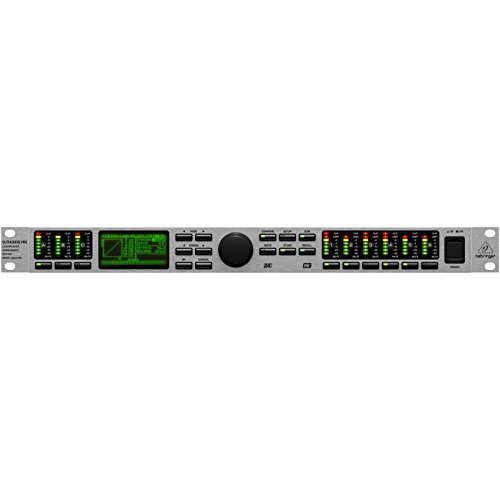
- Limiters on every output channel
- Zero-attack limiter design
- Adjustable input and output delays
Best For: Party systems prioritizing speaker protection
Professional FIR Control
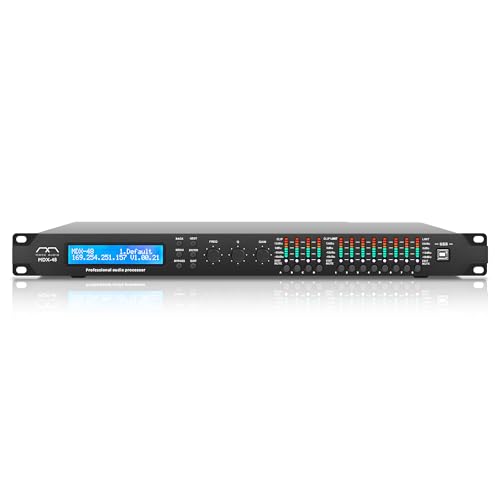
- 4-in/8-out DSP architecture
- FIR filtering with Dante and AES support
- Extensive EQ, routing, and preset tools
Best For: Advanced PA systems and event production
Proven Crossover Flexibility

- 2 analog inputs and 6 outputs
- 24-bit/96 kHz digital processing
- Dynamic and parametric EQ controls
Best For: Flexible analog PA speaker setups
Karaoke Party Audio Control
DSP-11 Karaoke Mixer Processor

- Bluetooth, USB, optical, coaxial, and AUX inputs
- Vocal effects with feedback suppression
- Four XLR outputs plus subwoofer outputs
Best For: Karaoke parties and microphone-led events
Best All-Around Control
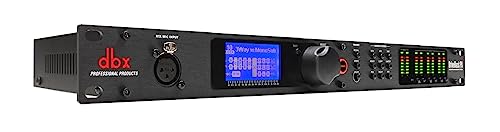
- AutoEQ and Setup Wizard streamline configuration
- Feedback suppression and mobile control included
- Supports full-range, 2-way, and 3-way systems
Best For: DJs and mobile entertainers managing varied PA setups
Best for Flexible Crossover Design

- Offers multiple EQ and filter types
- Provides three major crossover alignments
- Channels can link for stereo operation
Best For: Live-event rigs needing detailed crossover control
Best for Rack Integration

- Combines EQ, crossover, limiter, delay, and filtering
- Offers 2 inputs and 6 outputs
- Includes USB, RS485, and RS232 control options
Best For: Line-array and expandable rack-based party systems
Best All-in-One Choice – dbx DriveRack PA2
The dbx DriveRack PA2 is a practical choice for anyone comparing speaker management processors for parties. Its guided setup, improved Auto EQ, and enhanced feedback suppression help streamline PA tuning for DJs and small-to-medium event systems.
Best For: DJs and party hosts who want app-based setup and automated speaker-system tuning.
Pros:
- Auto EQ is designed for fast, accurate, and non-intrusive system tuning.
- Enhanced AFS helps eliminate feedback while minimizing unwanted tonal changes.
- Wizard functions provide step-by-step setup assistance.
- Supports Android and iOS control, with rack or tabletop mounting.
Cons:
- It is not waterproof, so it needs protection at outdoor parties.
- Its two-channel configuration may be limiting for larger, more complex systems.
For straightforward party PA management, the PA2 stands out for combining automated EQ, feedback control, and guided operation in a rack-friendly unit.
Best Flexible Matrix Processor – MARANI DPA2448QRT
The MARANI DPA2448QRT is a versatile option among speaker management processors for parties, especially when a setup needs flexible routing. It combines two analog inputs, four analog outputs, matrix mixing, and computer control through USB or Ethernet.
Best For: Advanced party, live-sound, and fixed-installation systems requiring detailed routing and processing.
Pros:
- Provides 2 analog inputs and 4 analog outputs with balanced XLR connections.
- Offers matrix mixing so inputs can be routed to outputs in adjustable ratios.
- Includes output EQ, crossover filters, RMS compression, peak limiting, and delay.
- USB and Ethernet control software can manage up to 32 units simultaneously.
Cons:
- The extensive processing options may be more involved than casual party users need.
- It has no wireless communication technology.
- The unit is relatively large and heavy at 9 pounds.
Choose the DPA2448QRT when routing flexibility and detailed signal management matter more than simple plug-and-play operation.
Best Basic Tuning Option – Graphic Equalizer Driver Rack PA2
This Graphic Equalizer Driver Rack PA2 offers core tools for party PA adjustment without an overly detailed feature list. Its graphic LCD, stereo output limiter, delay controls, and pink-noise generator support practical system fine-tuning.
Best For: Users who need basic speaker adjustment and protection features for a stereo party sound system.
Pros:
- Graphic LCD display supports front-panel monitoring and operation.
- Stereo output limiter helps manage output levels.
- Includes speaker fine-tuning delay and a pink-noise generator.
- Uses a 24-bit A/D converter with dynamic range greater than 110 dB.
Cons:
- The supplied notes provide limited information about connectivity and control options.
- Its feature documentation does not indicate the same guided automation described for the dbx PA2.
This model is worth considering when display-based adjustment, delay, limiting, and test-signal tools cover the needs of a straightforward party rig.
Best for Speaker Protection – Behringer Ultradrive Pro DCX2496
The Behringer Ultradrive Pro DCX2496 is a solid candidate among speaker management processors for parties when protecting output channels is a priority. It combines output limiters with adjustable input and output delays for speaker, phase, and arrival-time management.
Best For: Party sound systems that need output limiting and adjustable timing correction.
Pros:
- Provides limiters on all output channels for speaker protection.
- Zero-attack limiters are designed for fast response.
- Adjustable delays are available for both inputs and outputs.
- Delays can support room-temperature, phase, and arrival-time correction.
Cons:
- The supplied notes do not specify app, USB, or network control.
- Its listed dimensions and 4.25-inch size suggest a larger rack format than some compact processors.
If your party setup needs dependable output protection and timing adjustments, the DCX2496 focuses on those essential management functions.
Professional FIR Control – MODE Audio MDX-48
For demanding speaker management processors for parties, the Sound Town MODE Audio MDX-48 offers extensive routing, tuning, and control for a full PA system. Its 4-in/8-out design, FIR filtering, Dante support, and PC software make it suited to more complex setups where precise system configuration matters.
Best For: DJs, event production, and larger PA systems needing detailed DSP control and flexible connectivity.
Pros:
- 4 inputs and 8 outputs support comprehensive speaker and system routing.
- FIR filtering provides linear-phase processing and noise reduction.
- Includes analog, AES, Dante, Ethernet, RS-232, and USB connectivity.
- Offers EQ, crossover, delay, compression, limiting, matrix routing, and up to 30 presets.
Cons:
- Its broad feature set may be more involved than casual party users need.
- Windows PC control software is required for the full remote configuration experience.
The MDX-48 is the most capable option here for advanced party sound systems, particularly when multiple speakers, zones, or digital network connections are part of the plan.
Proven Crossover Flexibility – Behringer DCX2496LE
The Behringer ULTRADRIVE DCX2496LE is a straightforward choice among speaker management processors for parties when you need digital processing with flexible analog routing. Its 2-in/6-out configuration, 24-bit/96 kHz conversion, dynamic EQ, and selectable parametric EQs support practical PA tuning.
Best For: Party DJs and small-to-midsize PA setups using several powered speakers or amplifier channels.
Pros:
- Two analog inputs and six analog outputs provide useful system flexibility.
- 24-bit/96 kHz converters support high-resolution signal processing.
- Dynamic EQ enables level-dependent tonal adjustment.
- Parametric EQs are selectable across inputs and outputs.
Cons:
- It has fewer inputs and outputs than the Sound Town processor.
- The supplied notes specify analog connectivity rather than Dante or AES networking.
With its focused I/O layout and core EQ tools, the DCX2496LE is a practical fit for party rigs that need speaker processing without the larger networked feature set of a more advanced processor.
Karaoke Party Audio Control – DSP-11 Karaoke Mixer Processor
This digital karaoke mixer is a party-focused alternative among speaker management processors for parties, combining DSP tuning with vocal effects, microphone control, and multiple consumer-friendly inputs. Bluetooth, USB, optical, coaxial, and AUX connections make it convenient for mixed music and karaoke sources.
Best For: Home karaoke, hosted events, and party systems centered on microphones, vocal effects, and easy source switching.
Pros:
- Supports Bluetooth, USB, optical, coaxial, and dual AUX inputs.
- Includes two microphone inputs, RCA stereo output, sub output, and four XLR outputs.
- Provides vocal enhancement, mic priority, echo/reverb, key shifting, and 13-band EQ.
- One-touch feedback suppression, LCD control, and an infrared remote simplify operation.
Cons:
- Its feature set emphasizes karaoke and vocal processing rather than advanced multiway speaker management.
- The supplied notes do not specify the number of DSP presets or detailed crossover functions.
The DSP-11 is best when party audio revolves around singers and hosted entertainment. It offers easier everyday control and broader consumer-source compatibility than a dedicated rack speaker-management processor.
Best All-Around Control – dbx DriveRack PA2
The dbx DriveRack PA2 is a versatile choice among speaker management processors for parties, especially when you want guided setup and remote control. Its AutoEQ, feedback suppression, crossover, EQ, limiting, and delay tools cover the core needs of a compact PA system.
Best For: DJs, mobile entertainers, and party hosts running full-range, 2-way, or 3-way speaker systems.
Pros:
- Setup Wizard and streamlined AutoEQ simplify system configuration.
- Advanced Feedback Suppression helps manage microphone feedback.
- Mobile control is supported on Android, iOS, Mac, and Windows.
- Includes crossover, graphic and parametric EQ, limiting, and driver alignment delays.
Cons:
- Its feature set may require time to learn for first-time users.
- Maximum sample rate is 48 kHz.
The PA2 balances practical automation with detailed speaker-management controls, making it a strong fit when party setups vary from event to event.
Best for Flexible Crossover Design – Peavey VSX 26e
The Peavey VSX 26e is a DSP-based option for party sound systems that need detailed filter and crossover adjustment. It offers multiple EQ filter types, several crossover alignments, linked channels for stereo operation, and remote control connectivity.
Best For: Live-event and sound-reinforcement setups where precise crossover and filter choices matter.
Pros:
- Supports PEQ, shelving, pass, and all-pass filter types.
- Crossover alignments include Butterworth, Bessel, and Linkwitz-Riley.
- Filter slopes range from 1st to 8th order, or 6 to 48 dB per octave.
- Channels can be linked for simplified stereo operation.
Cons:
- The supplied specifications identify two audio channels.
- It is designed for professional audio applications rather than waterproof outdoor use.
- Configuration may be more involved than a processor with an automated setup wizard.
Choose the VSX 26e when your party rig benefits from hands-on crossover design and signal-shaping flexibility more than automatic setup assistance.
Best for Rack Integration – DP-26 Digital Audio Processor
The DP-26 combines several signal-processing functions in one rack-mountable unit, making it a practical candidate among speaker management processors for parties with more complex routing needs. It includes EQ, crossover, mixer, limiter, delay, and filter functions, with front-panel or computer-based control.
Best For: Line-array systems and larger party rigs requiring extensive routing, delay, and remote-control options.
Pros:
- Combines crossover, equalizer, limiter, delayer, and filter functions.
- Provides two inputs and six outputs for flexible system configuration.
- Offers 96 kHz sampling, 32-bit DSP processing, and 24-bit conversion.
- Supports USB, RS485, and RS232 control connections, with storage for 12 user programs.
Cons:
- At 10.08 pounds, it is heavier than a compact processor.
- The extensive controls and adjustable delay functions may be more than a basic party setup requires.
- Computer control requires dedicated PC software.
The DP-26 is best suited to users who want an all-in-one rack processor with six outputs, detailed delay control, and broad connection options for expandable systems.
How We Picked These Speaker Management Processors for Parties
We focused on processors that can handle the practical demands of party sound: multiple speaker zones, subwoofer integration, loud-volume protection, fast adjustments, and reliable signal routing. We considered the number of inputs and outputs, DSP functions, control methods, display quality, installation format, and suitability for both portable and permanent systems.
Models with app control or computer-based configuration can be useful when the processor is mounted in a rack or positioned away from the mixing position. Systems with front-panel controls may be preferable when you need quick adjustments during an event. We also included products aimed at different budgets and system sizes, from straightforward two-in/six-out processors to higher-capacity units with matrix mixing, FIR processing, Dante, or AES support.
Quick Comparison
| What to Compare | Why It Matters |
|---|---|
| Inputs and outputs | Determines how many speakers, subwoofers, monitors, and zones you can manage. |
| Crossover and routing | Controls frequency distribution between full-range speakers, tops, and subs. |
| Limiters and protection | Helps reduce clipping and protects drivers during long, loud events. |
| Control options | Front-panel, USB, Ethernet, app, and computer control affect setup speed. |
| Advanced DSP | FIR filters, matrix mixing, feedback suppression, and delay support suit more complex rigs. |
Key Buying Factors for Speaker Management Processors for Parties
Match the I/O to Your System
Count every source and speaker path before buying. A two-input, six-output design works well for common stereo systems with separate subwoofer outputs, while larger systems may need four or more inputs, additional outputs, or matrix routing for multiple rooms and monitor feeds.
Prioritize Protection and Crossover Control
Look for adjustable high-pass and low-pass filters, independent output equalization, limiters, polarity controls, and delay. These tools help blend speakers and subwoofers, prevent excessive low-frequency energy, and reduce the risk of damage when guests expect high volume.
Consider Setup and Live-Event Usability
A clear screen and accessible controls are valuable when you need to troubleshoot quickly. Computer or mobile control is convenient for detailed programming, but confirm that the software, operating system, network connection, or app is compatible with your setup.
Check Connectivity and Expansion
Standard XLR connections suit most analog PA systems. Dante, AES, USB, or Ethernet features can be worthwhile for digital installations and larger production rigs, but they may add complexity that is unnecessary for a simple mobile party system.
Who Should Buy Which Speaker Management Processors for Parties?
Mobile DJs and party hosts: Choose a dependable two-in/six-out processor with straightforward presets, limiters, and simple control. This offers useful speaker protection without making setup burdensome.
Karaoke and vocal-focused setups: A processor with anti-feedback or vocal-oriented effects may be helpful, particularly when microphones are used near the speakers. Still, proper speaker placement and gain structure remain essential.
Bands and larger PA systems: Favor more outputs, independent routing, delay, and flexible crossover settings so mains, subs, monitors, and fill speakers can be tuned separately.
Installed venues and advanced users: Consider models with matrix mixing, network control, FIR processing, Dante, or AES if those features match the rest of your signal chain. Avoid paying for advanced connectivity unless you will actually use it.
