A well-sealed studio door can make a noticeable difference in isolation, room comfort, and recording consistency. Even small gaps around the frame or beneath the door can let in noise, drafts, dust, and unwanted light.
These 10 studio door seals include acoustic kits, kerf-fit weatherstripping, adhesive foam, silicone, and rubber options for different gap sizes, door types, and installation preferences.
Best 10 Studio Door Seals Picks for 2026
Best for Multi-Door Coverage
Audimute Large Soundproofing Door Seal Kit

- Treats up to four standard-size doors
- Includes two seals and one door sweep
- Easy to install for studios or apartments
Best For: Multi-door sound-gap treatment
Best for Kerf-Fit Installation
Ravinte Q-Shaped Foam Door Seal

- Fits 0.35- to 0.59-inch slots
- Installs without adhesive
- Helps block light, drafts, dust, water, and noise
Best For: Doors with compatible kerf grooves
Best for Single-Door Projects
Audimute Standard Soundproofing Door Seal Kit

- Designed for one standard-size door
- Includes a 25-foot seal and door sweep
- Easy to install in studios or apartments
Best For: Single-door sound-gap treatment
Best for Large Gaps
Extra Wide Kerf Door Weatherstripping

- Covers approximately 0.3- to 0.8-inch gaps
- Includes 26 feet of extra-wide strip
- Helps block noise, light, drafts, dust, and water
Best For: Large compatible door-frame grooves
Best Sound-Reducing Pick
VITAM AMO 18-Foot Large-Gap Seal

- Covers 5/16- to 15/32-inch gaps
- EPDM construction for indoor or outdoor use
- Multi-hole profile helps reduce sound transfer
Best For: Studio doors with large gaps and draft or noise concerns
Best Reinforced Adhesion
Large-Gap 20-Foot D-Shaped Seal
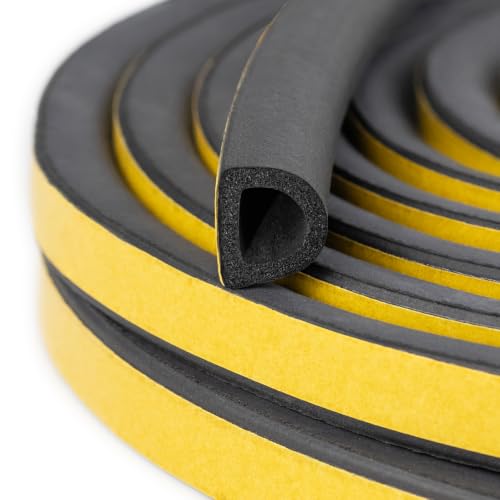
- Fits 5/16- to 15/32-inch gaps
- Mesh-reinforced self-adhesive backing
- Hollow EPDM profile compresses and rebounds
Best For: Uneven studio door gaps needing a durable adhesive seal
Best Thin Foam Tape

- Includes two rolls totaling 33 feet
- 1/2-inch-wide by 1/4-inch-thick profile
- Grid adhesive supports sealing and sound absorption
Best For: Narrow, uniform studio door or window seams
Best for Large Grooves

- Fits grooved frames with larger gaps
- Helps block wind, dust, water, light, and noise
- Includes four foam gaskets
Best For: Studio doors with 1/8-inch grooves and gaps up to about 7/8 inch
Best for Small Gaps

- Fits gaps from about 1/8 to 1/4 inch
- Flexible silicone helps reduce drafts and noise
- Peel-and-stick installation with adhesive promoter
Best For: Smooth studio door frames with small, even gaps
Best for Multi-Door Coverage – Audimute Large Soundproofing Door Seal Kit
Audimute Soundproofing Acoustic Door Seal Kit - Door Sweep and Seal - (Large Size)
Check Price On AmazonFor treating several entry points, this large Audimute kit is a practical choice among studio door seals. It includes two door seals and one sweep, with enough material to treat up to four standard-size doors and help reduce sound traveling through gaps.
Best For: Apartments, studios, and spaces needing coverage for multiple standard doors.
Pros:
- Designed to treat up to four standard-size doors.
- Includes two 50-foot door seals and a 25-foot door sweep.
- Easy to install and made from polyurethane.
Cons:
- The large kit may provide more material than needed for a single door.
- Its effectiveness depends on properly addressing gaps around the door.
This kit stands out when you need studio door seals for multiple doors rather than a single doorway. Its bundled sweep and seals simplify purchasing for a broader sound-control project.
Best for Kerf-Fit Installation – Ravinte Q-Shaped Foam Door Seal
This Ravinte Q-shaped strip is a convenient option for studio door seals when the door frame has a compatible kerf slot. The high-density foam helps block light, air leakage, dust, water, and noise without adhesive.
Best For: Doors with grooves or recesses measuring approximately 0.35 to 0.59 inches.
Pros:
- Fits slots from 0.35 to 0.59 inches.
- Installs by inserting into the groove, with no adhesive required.
- Helps reduce light penetration, drafts, dust, water, and noise.
Cons:
- Requires a compatible slot or recess for installation.
- You need to check the door slot dimensions before ordering.
Choose this strip when you want a clean, no-adhesive installation and your door frame matches its sizing range. It also adds general weather-sealing benefits beyond studio noise control.
Best for Single-Door Projects – Audimute Standard Soundproofing Door Seal Kit
Audimute Soundproofing Acoustic Door Seal Kit - Door Sweep and Seal - (Standard Size)
Check Price On AmazonFor one doorway, this standard Audimute kit offers a focused approach to studio door seals. It combines a door seal and sweep to help block sound moving through gaps around a standard-size door.
Best For: A single standard door in an apartment, studio, or other room where sound enters or exits through the doorway.
Pros:
- Designed to treat one standard-size door.
- Includes a 25-foot door seal and a door sweep.
- Easy to install and made from polyurethane.
Cons:
- Provides less coverage than the large multi-door kit.
- It is intended for standard-size doors, so unusual door dimensions may require additional material.
This is the more targeted Audimute option for a single-door project. Its smaller package can help avoid buying a multi-door kit when only one standard doorway needs sealing.
Best for Large Gaps – Extra Wide Kerf Door Weatherstripping
When standard studio door seals may not cover a broad opening, this extra-wide kerf weatherstrip is designed for larger door gaps. Its 26-foot strip fits grooves around door frames and is intended for gaps of approximately 0.3 to 0.8 inches.
Best For: Exterior, entry, French, sliding, security, or other doors with large compatible frame grooves.
Pros:
- Designed for door gaps from approximately 0.3 to 0.8 inches.
- Offers 26 feet of extra-wide, extra-thick weatherstripping.
- Helps block dust, water, noise, light, and drafts.
Cons:
- Requires a suitable groove around the door frame.
- Its wider profile may be excessive for smaller gaps.
- It is supplied as weatherstripping rather than a complete sweep-and-seal kit.
This option makes the most sense when gap size is the primary concern. Confirm the frame groove and opening dimensions first, especially if you are replacing thinner existing weatherstripping.
Best Sound-Reducing Pick – VITAM AMO 18-Foot Large-Gap Seal
For studio door seals that address drafts, light, water, and some sound transfer, the VITAM AMO strip is designed for larger gaps from 5/16 to 15/32 inch. Its flexible EPDM construction and peel-and-stick backing make it a practical option for residential or commercial door frames.
Best For: Large door or window gaps where reducing drafts and some outside noise is a priority.
Pros:
- 18-foot roll can be cut to the required length.
- Flexible EPDM rubber is intended for interior or exterior use and remains durable in low temperatures.
- Multi-hole design helps reduce sound propagation and closing pressure.
- Self-adhesive installation requires no tools or specialized experience.
Cons:
- The adhesive requires a clean, suitable surface for reliable installation.
- Its fit is limited to gaps within the stated 5/16- to 15/32-inch range.
This is a strong choice when a studio door needs broad weather sealing plus some sound-dampening assistance. Measure the closed gap first, then cut and apply the strip to fit.
Best Reinforced Adhesion – Large-Gap 20-Foot D-Shaped Seal
This D-shaped weather strip is a useful studio door seals option for uneven gaps measuring 5/16 to 15/32 inch. The hollow EPDM profile compresses as the door closes, while its mesh-reinforced adhesive backing is designed for a secure, straightforward installation.
Best For: Entry or studio doors with uneven large gaps that need a compressible, self-adhesive seal.
Pros:
- 20-foot length provides material for longer frames or multiple projects.
- Hollow D-shaped profile compresses and rebounds through repeated door use.
- Mesh-reinforced backing is designed to improve adhesive hold.
- Helps reduce drafts, dust, light leaks, energy loss, and some outside noise.
Cons:
- Fit depends on accurately measuring the closed gap before installation.
- Adhesive may need warming in cold weather and up to 24 hours to bond.
Choose this seal when gap size and adhesive durability are the main concerns. Clean and dry the surface, test the fit, and allow the recommended bonding time before judging the installation.
Best Thin Foam Tape – 33-Foot Neoprene Door Seal
For studio door seals where a slim strip is appropriate, this two-roll foam tape measures 1/2 inch wide by 1/4 inch thick. The CR foam and neoprene construction is intended to help with air leakage, sound absorption, impact protection, and general weather sealing around doors or windows.
Best For: Narrow door or window seams where a thin, cut-to-length foam seal is suitable.
Pros:
- Supplies two 16.5-foot rolls for a combined 33 feet.
- Strong grid adhesive backing is designed to resist peeling and glue residue.
- Foam and neoprene provide sealing, warp resistance, shock absorption, and sound absorption.
- Can be cut to the needed length with a blade.
Cons:
- At 1/4 inch thick, it is intended for narrower seams rather than the larger gaps covered by D-shaped seals.
- The product notes do not specify a broad gap range, so measure carefully before applying.
This tape is a practical pick for smaller, more uniform seams and for projects where extra roll length is useful. Its thin profile may also suit areas where a bulkier weather strip would interfere with door closure.
Best for Large Grooves – Kerf 40FT Door Frame Seal
For studio door seals that need to handle oversized gaps, this 40-foot kerf-style weather stripping is designed for door frames with installation grooves. Its layered PVC and PU foam construction targets drafts, dust, water, light, and everyday noise.
Best For: Door frames with 1/8-inch grooves and larger gaps measuring approximately 3/10 to 7/8 inch.
Pros:
- 40 feet of material covers doors of different sizes.
- Designed to seal against wind, dust, water, light, and noise.
- Includes four foam gaskets for cushioning or situations where the door needs additional adjustment.
- V-shaped, water-droplet-end design provides an extended sealing area.
Cons:
- Requires a compatible grooved door frame; measure the groove before purchasing.
- The notched installation style is less suitable for smooth frames without a slot.
This is the most specialized option of the three, but its broad gap range and long roll make it a practical choice when a studio door has a built-in kerf groove and noticeable leakage around the frame.
Best for Small Gaps – 20FT Silicone D-Shaped Seal
If you need studio door seals for modest frame gaps, this self-adhesive silicone D-shaped strip offers a straightforward cut-to-fit solution. The flexible material is intended to compress into gaps while helping reduce drafts, dust, moisture, light, and outside noise.
Best For: Smooth door, window, cabinet, or frame surfaces with gaps from approximately 1/8 to 1/4 inch.
Pros:
- Soft silicone compresses smoothly around small gaps.
- 20-foot roll can be cut to fit multiple sealing projects.
- Peel-and-stick installation requires no specialized tools.
- Adhesive promoter is included for stronger bonding on smooth surfaces.
Cons:
- Its recommended gap range is narrower than the larger-gap options.
- Surface preparation is important for the adhesive to bond properly.
This silicone strip is a convenient pick for a studio door with a relatively even frame and a small, measurable gap. Check the opening first, since it is not intended as a large-gap seal.
Best Long Roll Value – Fingwerk 50FT Rubber Seal
For studio door seals where you want extra material and adhesive installation, this 50-foot D-shaped rubber strip is easy to cut to length. Its self-adhesive backing is designed for door and window frames and can also be used on other compatible surfaces.
Best For: Door frames with gaps from approximately 1/10 to 11/50 inch, especially when a long roll and included cutting scissors are useful.
Pros:
- 50 feet provides generous coverage for one or several projects.
- Includes tailor scissors for cutting the strip to size.
- Flexible rubber is designed to resist freezing and cracking in changing temperatures.
- Self-adhesive backing is simple to install after cleaning the surface.
Cons:
- Its listed gap range is limited to approximately 1/10 to 11/50 inch.
- The adhesive should be allowed to set for 24 hours before relying on the bond.
This option stands out when coverage matters. The long roll and included scissors make it practical for sealing multiple frame sections, provided your studio door gap falls within its specified range.
How We Picked These Studio Door Seals
We selected products based on the features that matter most for studio doors: gap coverage, seal material, installation method, durability, door-bottom performance, and suitability for sound-control projects. The lineup includes complete acoustic kits as well as individual frame and bottom seals, since the best solution often combines more than one sealing method.
We also considered practical details such as available length, profile shape, adhesive or kerf installation, flexibility, and whether a product is better suited to small interior gaps or larger exterior-style gaps. No door seal can make a room completely soundproof, but reducing air leakage is an important part of improving isolation.
Quick Comparison
| Seal Type | Best For | Installation | Key Advantage |
|---|---|---|---|
| Acoustic door kit | Studio doors needing a complete solution | Mechanical or adhesive installation, depending on kit | Combines frame sealing with a door sweep |
| Kerf foam seal | Doors with compatible kerf channels | Press-fit | Clean installation without exposed adhesive |
| D-shaped rubber or silicone | Medium and large frame gaps | Self-adhesive | Flexible compression and easy trimming |
| Foam tape or bottom strip | Small gaps beneath or around doors | Self-adhesive | Fast, inexpensive gap reduction |
Key Buying Factors for Studio Door Seals
Measure the Gap First
Measure the widest gap between the closed door and frame, then check the clearance beneath the door. A seal that is too thin may not close the leak, while one that is too thick can prevent the door from latching or create excessive pressure on the hinges.
Choose the Right Installation Style
Kerf seals are a strong choice when the door frame already has a compatible groove. Adhesive-backed products are easier for retrofits, but the surface must be clean, dry, and smooth. Acoustic kits are useful when you want coordinated frame and bottom sealing rather than piecing together separate products.
Match the Material to the Use
Foam is easy to compress and works well for many interior gaps. Rubber and silicone generally offer better flexibility and resistance to wear, temperature changes, and moisture. For the bottom of a studio door, select a sweep or threshold seal that does not drag heavily across the floor.
Prioritize a Continuous Seal
Sound and air travel through the smallest open sections. Install the seal continuously around the frame, paying special attention to corners, the latch side, and the door bottom. Avoid stretching adhesive weatherstripping during installation because it may shrink and leave gaps later.
Who Should Buy Which Studio Door Seals?
Choose a complete Audimute acoustic kit if you want an all-in-one approach for a recording, rehearsal, or vocal room. Select a kerf-style product if your frame is already designed for press-fit weatherstripping and you prefer a cleaner, replaceable installation.
Self-adhesive D-shaped rubber or silicone seals are practical for renters, quick upgrades, and doors with larger irregular gaps. Foam tape is best for smaller leaks and simple repairs, while a dedicated bottom seal or sweep is the right choice when most of the noise or draft enters beneath the door.
For the best results, combine a properly sized frame seal with a door-bottom seal, then verify that the door still closes and latches normally.
