If your TV, streamer, or console doesn’t send audio where you need it, an HDMI audio extractor can bridge the gap without replacing your whole setup.
This roundup focuses on the best options for surround sound, from basic optical output to eARC-capable models for modern home theaters.
Best 10 Hdmi Audio Extractor for Surround Sound Picks for 2026
eARC Upgrade Pick
HDMI eARC Audio Extractor for Soundbars

- Supports Dolby Atmos, DTS-X, and 7.1 audio
- Works with TV ARC/eARC and CEC control
- Audio-only HDMI output for surround systems
Best For: Older soundbars and amplifiers that need ARC/eARC support
Flexible 4K Splitter-Style Choice
HDMI to HDMI Plus Audio Extractor
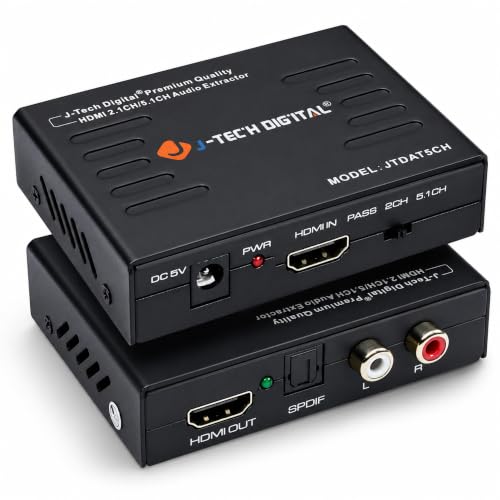
- Stereo RCA and 5.1 SPDIF audio outputs
- Supports 4K@30Hz with EDID pass-through
- ARC is not supported
Best For: Simple HDMI setups that need either stereo or 5.1 audio output
Compact ARC Stereo Option
eARC Audio Extractor to 3.5mm and L/R

- Converts TV ARC/eARC to 3.5mm or L/R audio
- Supports 24bit/192KHz PCM playback
- USB powered with plug-and-play setup
Best For: TV audio routed to simple stereo speakers
4K60 ARC Versatile Pick
HDMI Audio Extractor with RCA and Optical
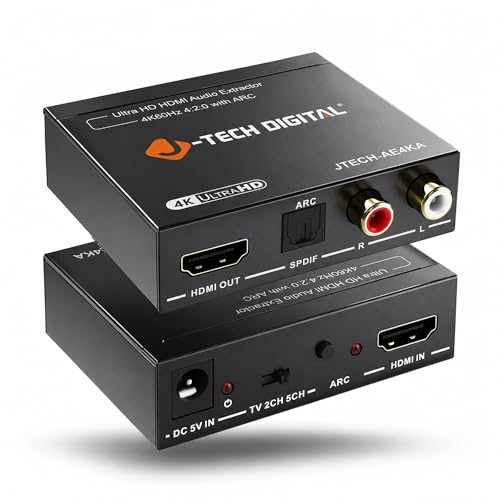
- 4K@60Hz pass-through with ARC support
- RCA stereo plus optical 5.1 outputs
- Does not support eARC
Best For: HDMI sources and smart displays that need RCA or optical audio
8K Pass-Through Extractor

- Passes video up to 8K/60 and 4K/120
- Extracts audio to optical or 3.5 mm
- Supports Dolby, DTS, and Atmos formats
Best For: 8K/4K120 setups that need audio extraction without eARC
Multi-Output TV Adapter
CAMWAY 192KHz eARC/ARC Audio Extractor

- Outputs optical, RCA, and 3.5 mm together
- Supports Dolby Digital 5.1 and DTS 5.1 over optical
- Includes cables for quick plug-and-play setup
Best For: Mixed home theater setups needing surround and stereo outputs
Premium 4K Surround-Sound Pick
OREI 4K@60Hz HDMI Audio Converter Extractor

- 4K @ 50/60Hz pass-through with HDR10/Dolby Vision
- Supports Dolby Digital, DTS, Atmos, and DTS:X passthrough
- Optical and 3.5mm outputs in a metal housing
Best For: Users needing high-resolution video plus broad surround-format compatibility
Budget 4K Audio Splitter

- Optical and 3.5mm outputs with 2.0CH, 5.1CH, and PASS modes
- Supports DTS 5.1 on optical and PCM 2.0 on 3.5mm
- USB-powered, plug-and-play design
Best For: Budget shoppers needing basic optical surround output
Flexible Port Layout Pick
avedio links HDMI Audio Extractor 4K

- Optical SPDIF, RCA L/R, and 3.5mm output options
- PASS, 2CH, and 5.1CH modes for different audio systems
- Wider port spacing helps with easier cable management
Best For: Users needing multiple output choices for older or mixed audio gear
EARC Upgrade Pick – HDMI eARC Audio Extractor for Soundbars
If you need an HDMI audio extractor for surround sound that works with a TV’s eARC or ARC port, this model is built for that job. It sends audio-only over HDMI to compatible soundbars or amplifiers, while supporting formats like Dolby Atmos, DTS-X, Dolby TrueHD, and up to 7.1 channels.
Best For: Upgrading older soundbars and amplifiers to work with modern TV eARC/ARC outputs.
Pros:
- Supports PCM 2.0/5.1/7.1, Dolby Atmos, DTS-X, DTS-HD Master Audio, and Dolby TrueHD.
- Uses HDMI CEC so TV remote volume and power control can work with compatible audio gear.
- Compact, low-power design with Type-C 5V input.
- Audio-only output is aimed at clean integration with home theater setups.
Cons:
- Requires a TV with ARC/eARC; it will not extract audio from a non-ARC TV to an ARC/eARC soundbar.
- Outputs audio only, so it is not meant for video routing.
This is a strong fit if your main goal is preserving full-format surround sound while adding easier TV remote control. It is especially practical for home theater or gaming setups where eARC compatibility matters.
Flexible 4K Splitter-Style Choice – HDMI to HDMI Plus Audio Extractor
This HDMI audio extractor for surround sound is designed for setups that need both video pass-through and separate audio output. It accepts HDMI input, supports up to 4K at 30Hz, and can send audio out through SPDIF or RCA stereo depending on how you want to connect your system.
Best For: Users who want a simple HDMI extractor with both stereo and 5.1 audio output options.
Pros:
- Extracts HDMI audio to either 2-channel analog stereo or 5.1-channel digital output.
- Supports 4K@30Hz video and includes HDCP and EDID pass-through.
- Offers audio EDID modes for Pass, 2CH, and 5.1CH.
- Compatible with compressed audio like DTS Digital and Dolby Digital.
Cons:
- ARC functionality is not supported.
- Maximum video support is 4K@30Hz, not 4K@60Hz.
This is a practical pick if you need a straightforward converter for mixed legacy and digital audio gear. It favors flexibility over premium format support, making it a solid utility option for many HDMI sources.
Compact ARC Stereo Option – eARC Audio Extractor to 3.5mm and L/R
If you are looking for an HDMI audio extractor for surround sound use cases that end in stereo gear, this ARC/eARC adapter is built to pull audio from a TV’s HDMI ARC or eARC port. It converts the TV’s output to 3.5mm or L/R analog audio and is aimed at simple speaker connections with clean PCM playback.
Best For: TV owners who want to feed ARC/eARC audio into 3.5mm or analog stereo speakers.
Pros:
- Works with HDTV ARC/eARC ports and outputs to 3.5mm or L/R stereo audio.
- Supports up to 24bit/192KHz sampling.
- Plug-and-play operation with USB power and no drivers required.
- Includes audio signal indicators for easier status checking.
Cons:
- Only works with HDTV ARC/eARC interfaces, not other HDMI devices.
- Supports PCM and PCM 2.0 only; no Dolby output.
- Not suitable if you need surround-channel digital audio extraction.
Choose this if your priority is getting TV ARC/eARC audio into basic analog speakers rather than a full surround receiver. It is a straightforward solution for PCM-based playback and compact audio setups.
4K60 ARC Versatile Pick – HDMI Audio Extractor with RCA and Optical
This HDMI audio extractor for surround sound is a good fit when you want 4K video pass-through plus flexible audio outputs. It can extract sound from HDMI and send it to RCA or optical, and it also includes an ARC function for taking audio from a smart display to an external sound system.
Best For: Connecting HDMI sources or smart displays to RCA or optical audio systems.
Pros:
- Supports 4K@60Hz (4:2:0) and 4K@30Hz (4:4:4).
- Offers RCA stereo output and optical 5.1-channel output.
- Includes ARC support for compatible smart display setups.
- Uses EDID modes for TV, 2CH, and 5CH to help with compatibility.
Cons:
- Does not support eARC.
- RCA output does not downmix 5.1 audio.
- Requires the source to match the selected audio format for the output being used.
This is a versatile option if your system mixes modern HDMI sources with older stereo or optical gear. It offers useful flexibility, but the audio format needs to be matched carefully to the selected output.
ARC/eARC TV Audio Upgrade – VPFET HDMI eARC Audio Extractor
If you want an HDMI audio extractor for surround sound specifically for a TV’s built-in streaming apps, this VPFET model is built around ARC/eARC extraction rather than general HDMI source splitting. It converts audio from a TV’s HDMI eARC/ARC port to Toslink and coaxial outputs, with support for up to 192 kHz and simultaneous dual digital output for use with soundbars, amplifiers, DACs, or headphone amps.
Best For: TV owners who need to pull surround audio from an ARC/eARC port to optical or coaxial gear.
Pros:
- Extracts audio from TV HDMI ARC/eARC to optical and coaxial outputs.
- Supports up to 24-bit/192 kHz for higher-resolution audio conversion.
- Can send audio to speakers, amplifiers, DACs, or headphone amplifiers.
- Includes a dedicated ARC/eARC status indicator and plug-and-play power.
Cons:
- Only works with the TV’s HDMI ARC/eARC port, not standard HDMI inputs.
- Some TVs may require manual eARC settings changes and TV-speaker disablement.
- Volume control may not work on all TVs.
This is a practical choice if your priority is getting cinema-style audio out of a modern TV without replacing your existing digital audio equipment. Just make sure your television truly supports HDMI eARC or ARC before buying.
8K Pass-Through Extractor – OREI 8K HDMI Audio Extractor
For a more traditional HDMI audio extractor for surround sound, the OREI unit is designed to pull audio from an HDMI source while passing video through up to 8K/60Hz or 4K/120Hz. It supports optical S/PDIF and 3.5 mm output, along with HDMI ARC support and broad compatibility for Dolby, DTS, and other high-bandwidth formats listed by the brand.
Best For: Gamers and home theater users who need 8K video pass-through plus HDMI audio extraction.
Pros:
- Passes video up to 8K@60Hz and 4K@120Hz over HDMI 2.1.
- Extracts audio to optical S/PDIF or 3.5 mm stereo outputs.
- Supports a wide list of audio formats, including Dolby Digital, DTS, Dolby Atmos, and DTS:X.
- Compatible with consoles, PCs, Blu-ray players, TVs, monitors, and projectors.
Cons:
- Does not support eARC.
- TV remote volume control is not supported.
- Requires an HDMI 2.1 cable for the input side.
This is the strongest fit if you need to keep high-resolution video intact while routing audio to a separate system. It is especially useful when your setup needs modern HDMI 2.1 bandwidth but not eARC.
Multi-Output TV Adapter – CAMWAY 192KHz eARC/ARC Audio Extractor
If you need an HDMI audio extractor for surround sound that can feed both modern and legacy gear, the CAMWAY model is built around TV ARC/eARC output with optical, RCA, and 3.5 mm connections. It can send optical audio in Dolby Digital 5.1 or DTS 5.1 while also providing stereo outputs for powered speakers or headphones, making it a flexible match for mixed home audio setups.
Best For: TV owners who want one extractor for surround sound plus stereo headphone or speaker output.
Pros:
- Works with TVs that support eARC or ARC.
- Provides optical, RCA, and 3.5 mm outputs at the same time.
- Optical output supports Dolby Digital 5.1 and DTS 5.1.
- RCA and 3.5 mm outputs can support TV remote volume control when CEC and PCM/LPCM are enabled.
Cons:
- Optical output volume is not controlled by the TV remote.
- Requires CEC setup and correct TV audio settings for full functionality.
- Optical is the surround-friendly path, while RCA and 3.5 mm are stereo only.
This is a practical all-in-one option if you want surround sound for a main system but also need easy stereo output for other listeners. The included cables and simple hookup make it straightforward for a new TV-to-audio-system bridge.
Premium 4K Surround-Sound Pick – OREI 4K@60Hz HDMI Audio Converter Extractor
If you want an hdmi audio extractor for surround sound that can keep up with a modern 4K setup, this OREI model is built for high-bandwidth pass-through and flexible audio outputs. It supports HDMI 2.0b, HDCP 2.2, HDR10, Dolby Vision, and a wide range of surround formats, making it a strong fit when you need both picture quality and multi-channel audio handling.
Best For: Home theater users who need 4K/60Hz video pass-through and broad surround format support from Blu-ray players, consoles, or streaming devices.
Pros:
- Supports video pass-through up to 4K @ 50/60Hz with HDR10 and Dolby Vision.
- Audio support includes LPCM 2/5.1/7.1, Dolby Digital, DTS, Dolby Atmos, and DTS:X passthrough.
- Offers optical and 3.5mm output options in a durable metal housing.
- Wide device compatibility with Blu-ray players, PS5, Xbox, Apple TV, Fire TV Stick, and Roku.
Cons:
- Does not support ARC.
- Not compatible with 1440p/120Hz, 4K/30Hz, or 1080p/120Hz output claims in its notes.
- The 3.5mm output is stereo, so it is not a surround output.
Overall, this is the most capable option here if you care about preserving high-end video while splitting audio for a surround-capable system. Its format support and 4K/60Hz passthrough make it especially appealing for newer gear.
Budget 4K Audio Splitter – VPFET HDMI Audio Extractor
This VPFET model is a simple hdmi audio extractor for surround sound when you mainly need to break audio out of an HDMI source without adding much complexity. It supports optical and 3.5mm output, has three audio modes, and is designed for plug-and-play use with low power draw from a USB connection.
Best For: Buyers who want an affordable audio extractor for basic HDMI setups and optical DTS 5.1 output.
Pros:
- Provides optical and 3.5mm audio output options.
- Includes 2.0CH, 5.1CH, and PASS modes for easier setup.
- Supports DTS 5.1 on optical output and PCM 2.0 on 3.5mm.
- Low power design runs from a USB 5V connection.
Cons:
- Does not support ARC or eARC.
- Limited to HDMI 1.4 / 4K@30Hz and HDCP 1.4.
- Notes state it does not support 7.1 channels.
For straightforward TV, console, or streaming-device audio extraction, this is a practical low-cost choice. It is best treated as a basic surround-sound splitter rather than a feature-rich 4K passthrough unit.
Flexible Port Layout Pick – avedio links HDMI Audio Extractor 4K
If you need an hdmi audio extractor for surround sound with multiple analog and digital outputs, this avedio links unit is built around flexibility. It can send audio to optical SPDIF, RCA L/R, or 3.5mm via the included adapter cable, while also passing HDMI video to a display for a simple home theater or gaming setup.
Best For: Users who want several audio connection options for speakers, amplifiers, soundbars, or home theater systems.
Pros:
- Offers optical SPDIF, RCA L/R, and 3.5mm connection options.
- Includes PASS, 2CH, and 5.1CH audio modes for different systems.
- Supports up to 4K@30Hz, 1080p@60Hz, and 3D over HDMI 1.4b.
- Wider port spacing can make cable handling easier on crowded setups.
Cons:
- Limited to 4K@30Hz rather than 4K/60Hz.
- ARC is not supported.
- Warranty noted as one month.
This is a strong pick if connection variety matters more than the highest video refresh rates. It gives you several ways to feed audio into older or mixed-format sound systems without much hassle.
How We Picked the Best Hdmi Audio Extractor for Surround Sound
We focused on Hdmi Audio Extractor for Surround Sound models that balance audio format support, TV compatibility, and practical outputs. The strongest picks support common home-theater needs such as Dolby Digital, DTS, and, on higher-end units, Dolby Atmos or eARC pass-through. We also favored units with clear output options like optical, coaxial, RCA, and 3.5mm, since the right connection matters as much as the codec list.
Quick Comparison
At a high level, the lineup breaks into three groups: basic 4K extractors for older receivers and speakers, ARC/eARC models for newer TVs and soundbars, and premium 8K/HDCP 2.3 units for future-proof setups. If you want the simplest path to surround sound from a TV, ARC/eARC support is usually the easiest fit. If you’re connecting a Blu-ray player, laptop, or game console to an older audio system, a standard HDMI-to-audio converter may be enough.
Key Buying Factors for Hdmi Audio Extractor for Surround Sound
Audio Format Support
Check whether the extractor supports the audio format your receiver or soundbar can actually decode. For true surround sound, look for Dolby Digital and DTS at minimum. If you use a modern TV and compatible sound system, eARC models that support Dolby Atmos and multichannel audio are the better long-term choice.
Input, Output, and ARC/eARC Compatibility
Make sure the device matches your source and display chain. Some units are designed for HDMI source devices, while others are built specifically for TV ARC or eARC audio return. If your goal is to pull audio from a television into speakers or a receiver, the TV’s ARC/eARC port must be supported.
Video Pass-Through and HDMI Version
For 4K systems, confirm support for the refresh rate and HDR features you need. Gamers and home-theater users should pay close attention to whether the unit supports 4K/60Hz or 4K/120Hz, plus HDCP compatibility. This helps avoid blank screens, handshake issues, or downscaled video.
Output Options
Optical is ideal for many receivers and soundbars, coaxial can be useful for specific AV gear, and RCA or 3.5mm outputs work well for stereo speakers and headphone setups. The best choice depends on whether you want full surround, downmixed stereo, or flexible legacy compatibility.
Who Should Buy Which Hdmi Audio Extractor for Surround Sound?
If you have a newer TV and soundbar, choose an ARC/eARC extractor for the cleanest setup and best chance of preserving advanced audio. If you are using an older receiver or external speakers, a standard Hdmi Audio Extractor for Surround Sound with optical or coaxial output is often the most practical option. For mixed-use setups with laptops, Blu-ray players, or consoles, pick a unit with the video passthrough standard that matches your display chain.
In short, the best model is the one that fits your TV’s audio output, your speaker system’s inputs, and the video resolution you want to keep intact.
