If your TV’s HDMI eARC or ARC output doesn’t play nicely with your soundbar, the right adapter can simplify the setup fast. An earc audio extractor for soundbar helps route TV audio into older or less compatible audio gear without giving up the connection you need.
Below, we focus on models that can handle common TV-to-soundbar needs, from optical and coaxial outputs to more flexible analog options. The goal is to help you match the extractor to your TV, soundbar, and audio format requirements with less trial and error.
Best 10 Earc Audio Extractor for Soundbar Picks for 2026
TV-to-Optical Upgrade
CAMWAY eARC/ARC to Optical Converter

- Bridges ARC/eARC TVs to optical sound systems
- Supports Dolby Digital, DTS 5.1, and PCM 2.0
- Includes HDMI, optical, and USB power cables
Best For: Users upgrading an older soundbar or receiver that only accepts optical
4K eARC Pass-Through
OREI 4K HDMI eARC Audio Extractor

- Passes through 4K/60 HDR video while extracting audio
- Supports Dolby Atmos, DTS pass-through, and CEC
- Selectable 2 CH, 5.1 CH, or 7.1 CH output
Best For: Users with eARC soundbars who want 4K HDR pass-through and multi-channel audio
PCM Stereo Simple Setup
eSynic ARC/eARC to 3.5mm Audio Extractor

- Converts HDTV ARC/eARC to 3.5mm or L/R stereo
- Supports PCM and PCM 2.0 only
- USB powered with plug-and-play setup
Best For: TV owners who only need simple PCM stereo output to speakers or headphones
8K Gaming Audio Bridge
OREI 8K HDMI eARC Audio Extractor

- Passes 4K@120Hz and 8K@60Hz video
- Supports Dolby Atmos, DTS: X, and LPCM 7.1
- Works with PS5, Xbox, Apple TV, and monitors
Best For: Gamers and monitor users who need high-refresh video with eARC soundbar audio
Simple TV-to-Soundbar Upgrade
HDMI eARC/ARC to Optical Converter with 3 Outputs
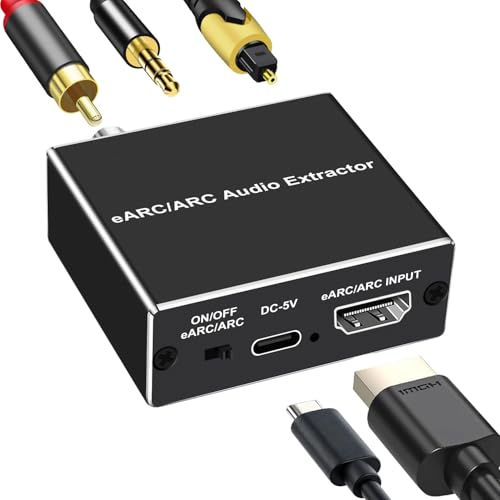
- Outputs to optical, coaxial, and 3.5mm
- Supports PCM 2.0, Dolby 5.1, DTS 5.1
- Plug-and-play, no drivers needed
Best For: TVs with ARC/eARC that need a simple audio extractor for soundbars
Home Theater HDMI 2.1 Hub
8K HDMI eARC Audio Extractor with 48Gbps Passthrough

- Supports 8K@60Hz and 4K@120Hz passthrough
- Handles Dolby Atmos, DTS:X, and TrueHD
- Includes VRR, ALLM, and other HDMI 2.1 features
Best For: High-end HDMI 2.1 home theater systems using an AV receiver
Compact cable-style pick
192KHz HDMI eARC/ARC to Optical Audio Converter

- Built-in 41-inch optical cable
- 24-bit/192kHz audio support
- Plug-and-play with USB power
Best For: Close-range TV-to-soundbar optical setups
TV-to-Optical Upgrade – CAMWAY eARC/ARC to Optical Converter
If you need an eARC audio extractor for soundbar setups that only accept optical input, this CAMWAY unit is built to bridge new TVs and older audio gear. It takes audio from ARC/eARC TVs and sends it to receivers, amplifiers, soundbars, and home theater systems through optical output, with support for Dolby Digital, DTS 5.1, and PCM 2.0.
Best For: Upgrading an existing soundbar or home theater system without replacing the audio equipment.
Pros:
- Works with ARC/eARC TVs and optical-only audio systems
- Supports Dolby Digital, DTS 5.1, and PCM 2.0 output
- Includes HDMI, optical, and USB power cables for easy setup
- Supports up to 24bit/192KHz audio transmission
Cons:
- Optical output does not support TV remote volume control
- USB power is required
- You must set the TV to the correct audio format for 5.1 or stereo
This is a practical choice if your TV has ARC/eARC but your soundbar or receiver still relies on optical. It focuses on simple compatibility and clean pass-through rather than extra features, which makes it a straightforward upgrade path.
4K eARC Pass-Through – OREI 4K HDMI eARC Audio Extractor
This OREI HDMI eARC audio extractor is a strong fit if you want to route audio to an eARC-compatible soundbar while keeping 4K HDR video in the chain. It supports HDMI audio extraction, 4K up to 50/60Hz, HDR, Dolby Atmos, DTS pass-through, and selectable 2-channel, 5.1-channel, or 7.1-channel output modes.
Best For: Home theaters and living rooms using an eARC soundbar with 4K HDR video sources.
Pros:
- Supports 4K @ 50/60Hz with HDR and HDCP 2.2
- Compatible with Dolby Atmos, Dolby Digital, DTS, and CEC
- Selectable 2 CH / 5.1 CH / 7.1 CH audio modes
- Works with soundbars, AV receivers, Sonos, and Bose
Cons:
- Requires proper TV and soundbar setup for best results
- Uses a US plug, though an international adapter is included
- Needs surge protection for safer long-term use
For buyers who want a more capable eARC audio extractor for soundbar systems and multi-channel audio, this model offers broad format support and 4K pass-through. It is especially appealing when you need both modern video compatibility and advanced audio routing.
PCM Stereo Simple Setup – eSynic ARC/eARC to 3.5mm Audio Extractor
If your goal is to move audio from an HDTV ARC/eARC port to a simple stereo speaker or headphone-style setup, this eSynic extractor keeps things focused. It converts ARC/eARC output to 3.5mm AUX or L/R stereo and supports up to 24bit/192KHz with PCM and PCM 2.0 audio formats only.
Best For: TVs connected to 3.5mm or L/R stereo speakers that only need PCM audio.
Pros:
- Converts HDTV ARC/eARC audio to 3.5mm AUX or L/R stereo
- Supports up to 24bit/192KHz sampling rate
- Plug-and-play with USB power and no drivers required
- Includes audio signal indicators for status checks
Cons:
- Does not support optical output
- Does not support Dolby formats
- Works only with HDTV ARC/eARC ports, not other HDMI devices
This is a practical budget-style option when you do not need surround formats and only want clean PCM stereo extraction. It is best treated as a straightforward TV-to-stereo adapter rather than a full-featured home theater converter.
8K Gaming Audio Bridge – OREI 8K HDMI eARC Audio Extractor
This OREI eARC audio extractor is aimed at users who want to send HDMI audio to a soundbar while keeping high-end video passthrough for gaming and modern displays. It supports 4K@120Hz and 8K@60Hz passthrough, along with Dolby Atmos, DTS: X, Dolby TrueHD, DTS-HD Master, and LPCM 7.1 channel audio.
Best For: Gamers and monitor setups that need HDMI 2.1-style video support plus eARC soundbar audio.
Pros:
- Supports 4K@120Hz and 8K@60Hz passthrough
- Works with Apple TV, PS5, Xbox, 4K/8K monitors, and soundbars
- Supports Dolby Atmos, DTS: X, and LPCM 7.1 CH
- CEC support lets you use the TV remote for soundbar volume
Cons:
- CEC-related issues may require support assistance
- Designed for devices with HDMI and eARC-compatible audio systems
- Uses a tabletop design rather than an in-line cable form factor
For buyers building a gaming or monitor-based setup, this model stands out because it combines high refresh video passthrough with advanced audio extraction. It is a better fit when you need modern HDMI performance and soundbar integration in one box.
Simple TV-to-Soundbar Upgrade – HDMI eARC/ARC to Optical Converter with 3 Outputs
If you need an earc audio extractor for soundbar use without replacing your whole setup, this model focuses on the basics: it pulls audio from a TV’s HDMI ARC/eARC port and sends it out through optical, coaxial, or 3.5mm connections. It is a practical pick for straightforward TV audio upgrades, especially when you want plug-and-play operation and support for common surround formats.
Best For: TVs with ARC/eARC that need a simple, multi-output audio conversion for soundbars or home theater gear.
Pros:
- Converts HDMI ARC/eARC audio to optical, coaxial, and 3.5mm outputs
- Supports up to 24-bit/192KHz sampling
- Handles PCM 2.0, Dolby 5.1, and DTS 5.1
- Plug-and-play setup with no drivers required
Cons:
- Does not support CEC remote volume control
- Requires a TV with HDMI ARC/eARC support
- Must be powered on to work properly
Overall, this is a sensible choice if your goal is clean TV audio extraction into a soundbar or similar system without extra setup complexity. Its value is in broad compatibility and simple output options rather than advanced control features.
Home Theater HDMI 2.1 Hub – 8K HDMI eARC Audio Extractor with 48Gbps Passthrough
This earc audio extractor for soundbar setups is really aimed at more advanced HDMI 2.1 systems, but it stands out most when you need full-bandwidth video passthrough and HDMI audio handling for a home theater receiver. It supports 8K/4K high-refresh video, plus modern features like VRR and ALLM, while also offering eARC mode support for ARC/eARC TV audio extraction to a non-ARC AV receiver.
Best For: HDMI 2.1 home theater systems that need high-end video passthrough and audio extraction to an AV receiver.
Pros:
- Supports HDMI 2.1 bandwidth up to 48Gbps
- Passes 8K@60Hz and 4K@120Hz video
- Supports Dolby Atmos, Dolby TrueHD, DTS:X, and multichannel PCM
- Includes VRR, ALLM, QMS, QFT, and SBTM support
Cons:
- Not compatible with eARC soundbars
- Requires an AV receiver with HDMI input for full audio output use
- More complex than a basic TV-to-soundbar converter
For buyers building around a receiver instead of a soundbar, this is the most feature-rich option in the group. It is less of a simple adapter and more of a high-spec HDMI audio management tool.
Compact ARC/eARC Audio Adapter – Dual-Output HDMI eARC Audio Extractor for TV Audio
If you want an earc audio extractor for soundbar connection that stays focused on TV audio only, this adapter is built for ARC/eARC ports and converts that signal into optical and coaxial outputs. It is a useful fit for TVs that rely on HDMI eARC for audio return and for users who want a compact, straightforward bridge to speakers, amplifiers, or headphones.
Best For: TV owners who need a simple ARC/eARC-to-digital-audio adapter with dual outputs.
Pros:
- Supports only TV ARC/eARC audio, keeping the use case focused
- Provides simultaneous Toslink and coaxial output
- Supports up to 24-bit/192kHz sampling
- Compact, plug-and-play design with included cables
Cons:
- Does not support other HDMI devices as inputs
- No CEC volume control support
- TV settings may need manual eARC setup and speaker changes
This model makes sense if your TV has ARC/eARC and you just need reliable audio extraction without extra video features. Its strengths are simplicity, dual digital outputs, and compatibility with older audio gear.
Gaming-friendly HDMI 2.1 pick – 4K@120Hz HDMI 2.1 eARC Audio Extractor
This earc audio extractor for soundbar is built for modern gaming and home theater setups that need both high-bandwidth video and flexible audio routing. It supports HDMI 2.1 features like 4K@120Hz, VRR, ALLM, HDR, and HDCP 2.3, while also offering optical audio out and eARC output for compatible soundbars.
Best For: PS5, Xbox, and HDMI 2.1 setups that need audio extraction for a soundbar or optical system.
Pros:
- Supports 4K@120Hz, 8K@60Hz, VRR, ALLM, HDR, and HDCP 2.3.
- Offers both optical digital audio out and eARC output.
- Compatible with devices like PS5, Xbox Series X, Nvidia Shield, Apple TV, and Fire TV.
- Plug-and-play design with no driver needed.
Cons:
- Requires a 5V/2A power supply.
- Recommends a qualified HDMI 2.1 cable under 10 ft / 3 m.
- Soundbar support depends on using the correct ARC/eARC or optical setup.
If you need a compact extractor that preserves advanced HDMI 2.1 video features while feeding sound to a soundbar, this model is a strong fit. It is especially useful when you want to keep a high-end display path intact and still separate audio cleanly.
Easy optical conversion pick – eSynic 192Khz eARC & ARC to Optical Extractor
This earc audio extractor for soundbar is focused on one job: taking audio from a TV’s eARC or ARC port and sending it to an optical-only soundbar or headphone base. It keeps the setup simple with plug-and-play operation, USB power, and a single optical output.
Best For: TVs with eARC/ARC ports feeding older soundbars, headphone bases, or compact optical audio systems.
Pros:
- Converts eARC/ARC audio to optical Toslink output.
- Supports PCM 2.0, Dolby 5.1, and DTS 5.1.
- USB powered with no drivers or software required.
- Includes optical cable, HDMI cable, and USB power cable.
Cons:
- No CEC volume control through optical.
- Requires a TV with a labeled eARC or ARC port.
- ARC setups need HDMI-CEC enabled according to the notes.
For buyers who want a straightforward bridge from modern TV audio to legacy optical gear, this extractor is easy to understand and easy to wire. Its design is practical rather than feature-heavy, which is often exactly what a soundbar upgrade needs.
Compact cable-style pick – 192KHz HDMI eARC/ARC to Optical Audio Converter
This earc audio extractor for soundbar is a compact cable-style solution for sending TV audio to an optical sound system. It is designed for TVs with eARC or ARC ports and uses a built-in optical SPDIF cable, so you do not need a separate converter box and cable bundle.
Best For: Buyers who want the simplest possible TV-to-soundbar optical connection in a short cable format.
Pros:
- Built-in 41-inch optical cable keeps the setup compact.
- Supports 24-bit/192kHz audio sampling rate.
- Compatible with PCM, Dolby 5.1, and DTS 5.1 settings.
- Plug-and-play with USB power and LED indicator.
Cons:
- Only works with TVs that have eARC or ARC.
- Optical connections do not support CEC volume control.
- Length may be short if your TV and audio gear are far apart.
If you want a no-fuss extractor that minimizes extra parts, this model makes a lot of sense. The short integrated cable is convenient for close-by TV and soundbar placements, but the measured length is worth checking before you buy.
How We Picked the Best Earc Audio Extractor for Soundbar
We focused on practical compatibility first: HDMI eARC/ARC support, output options such as optical, coaxial, and analog, and whether the device fits common soundbar setups. We also considered resolution passthrough, HDR support, CEC behavior, and whether the extractor is useful for modern consoles and 4K/8K TVs.
For an Earc Audio Extractor for Soundbar, the best choice is not always the one with the most features. It’s the one that preserves the audio format you need while staying stable with your TV and soundbar combination.
Quick Comparison
Think of these products in three broad groups: simple TV-to-soundbar adapters for optical output, multi-output models for older receivers and analog gear, and premium HDMI 2.1-style extractors for systems that must preserve high-bandwidth video features. If your setup is basic, a plug-and-play optical unit is usually enough. If you need Dolby Atmos pass-through or gaming features like VRR and ALLM, look higher up the spec ladder.
Key Buying Factors for Earc Audio Extractor for Soundbar
Input and TV Compatibility
Check whether your TV uses HDMI ARC or eARC, and confirm the extractor explicitly supports that mode. Some units are ARC-focused, while others are designed for eARC and can better handle newer TVs.
Output Type
Match the output to your soundbar. Optical is the most common, but it may limit advanced formats. Coaxial and analog outputs can help with older audio systems, while HDMI-based solutions are better if you want to preserve more of the original signal chain.
Audio Format Support
If you care about Dolby Atmos or DTS:X, verify that the extractor and your soundbar both support the formats you want to keep. Many budget units are fine for stereo or basic multichannel audio but will down-convert advanced formats.
Video Passthrough and Gaming Features
If the extractor sits in a chain with a console or high-end streaming device, look for support for 4K 120Hz, 8K, HDR10, HDCP 2.3, VRR, ALLM, and CEC as needed. These features matter most when the extractor must stay invisible to the video side of the system.
Power and Ease of Use
USB-powered units are common and convenient, but cable length and layout still matter. A compact, well-labeled adapter can save time during setup and reduce handshake issues.
Who Should Buy Which Earc Audio Extractor for Soundbar?
If you just want TV audio into a soundbar through optical, choose a simple ARC/eARC-to-optical model. If you have older amps or want more output flexibility, look for a multi-output extractor with coaxial and analog options. If you’re building a premium home theater or gaming setup, prioritize an HDMI 2.1-capable Earc Audio Extractor for Soundbar that supports modern video passthrough alongside the audio formats you need.
In short, buy for compatibility first, then for features. The best extractor is the one that fits your exact TV, soundbar, and content sources without forcing compromises.
