Choosing the right HDMI eARC splitter for home theater can make or break your surround setup, especially when you want clean audio routing without giving up picture quality.
Below, we focus on practical options for soundbars, AV receivers, and mixed TV sources, with an emphasis on compatibility, bandwidth, and real-world ease of use.
Best 10 Hdmi Earc Splitter for Home Theater Picks for 2026
Dual-TV Audio Sharing Pick
OREI eARC Audio Splitter 1 in 2 Out

- Splits one TV ARC/eARC output to two audio systems
- Supports Dolby Atmos, DTS:X, TrueHD, and CEC control
- Audio-only design with simple plug-and-play setup
Best For: Sharing one TV’s sound with two soundbars or receivers
Most Flexible eARC Hub
4K@60Hz HDMI eARC Splitter Switcher 4x2
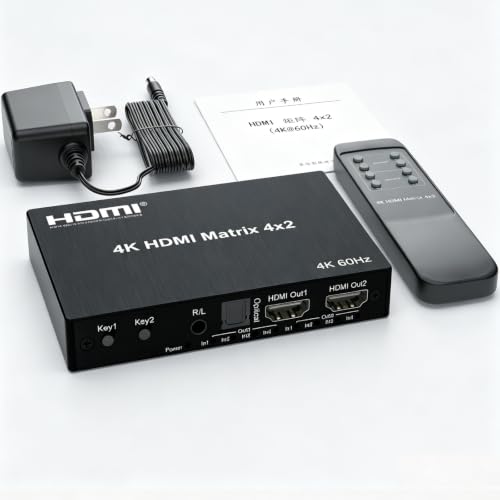
- Works as a splitter, switcher, and HDMI source selector
- Supports 4K@60Hz HDR10 and lossless audio formats
- Includes eARC/ARC plus optical, coaxial, and 3.5mm outputs
Best For: Users who need one device for switching and audio distribution
High-Resolution Video Split Pick
OREI 8K HDMI Splitter 1x2 with Audio Extractor

- Duplicates one HDMI input to two outputs
- Supports up to 8K and 4K/120Hz video
- Uses optical or analog outputs for audio extraction
Best For: High-resolution video systems needing 1x2 splitting and separate audio out
Simple TV-to-Soundbar Link
192KHz HDMI eARC/ARC to Optical Audio Converter

- Converts TV ARC/eARC audio to optical SPDIF
- Supports up to 24-bit/192kHz audio
- Built-in cable and plug-and-play setup
Best For: Simple TV-to-soundbar connections using optical audio
Video + Audio Splitter
8K 1 In 2 Out Splitter with Down Scaler

- 8K@60Hz and 4K@120Hz support
- Mirrors one source to two outputs
- Includes downscaling for mixed displays
Best For: Users who need one HDMI source sent to a TV/projector and an HDMI-input sound device
Premium HDMI eARC Extractor
4K 120Hz Audio Extractor with Optical and Analog

- 8K@60Hz and 4K@120Hz passthrough
- Audio outputs include HDMI, eARC, optical, and analog
- Supports Dolby Atmos and DTS:X
Best For: High-end home theater systems needing flexible audio extraction and next-gen video support
Dual-Mode eARC Switcher
avedio links HDMI eARC Splitter 1 in 2 Out

- Works as a bi-directional HDMI switch and eARC splitter.
- Supports 4K@60Hz with HDCP 2.2.
- Outputs audio via eARC/ARC, optical, coaxial, and 3.5mm.
Best For: Home theater users who want flexible HDMI switching plus dual eARC/ARC audio routing.
Multi-Source HDMI Switch
5 in 1 Out 4K@60Hz HDMI Switch Audio Extractor

- Switches up to 5 HDMI sources to one display.
- Supports 4K@60Hz, HDR10, Dolby Vision, and 18Gbps.
- Extracts audio to optical and 3.5mm; no eARC support.
Best For: People who want a 5-input HDMI switch with audio extraction and no need for eARC.
Dual-TV Audio Sharing Pick – OREI eARC Audio Splitter 1 in 2 Out
If you need an HDMI eARC splitter for home theater that can share one TV’s ARC/eARC audio with two separate sound systems, this OREI unit is built for that job. It focuses on audio only, supports modern surround formats like Dolby Atmos and DTS:X, and keeps setup simple with plug-and-play operation and CEC volume control through the TV remote.
Best For: Homes that want to send one TV’s ARC/eARC audio to two soundbars or AV systems at the same time.
Pros:
- Splits audio from one HDMI ARC/eARC port to two outputs simultaneously.
- Supports Dolby Atmos, DTS:X, TrueHD, and other multi-channel audio formats.
- Includes HDMI-CEC volume control with the TV remote.
- Compact, driver-free design for straightforward installation.
Cons:
- Audio only; it does not pass video signals.
- Designed around ARC/eARC audio setups, so it is not a general HDMI video splitter.
For buyers building a shared audio setup, this is a practical way to route TV sound to two systems without adding much complexity. The main appeal is clean compatibility with ARC/eARC and a broad list of surround formats.
Most Flexible eARC Hub – 4K@60Hz HDMI eARC Splitter Switcher 4×2
This HDMI eARC splitter for home theater is aimed at people who want more than a basic splitter. It can work as a 1×4 eARC audio splitter, a 4×1 switcher, or a 4-source HDMI switch for a display, while also handling 4K@60Hz video and extracting lossless audio to multiple outputs.
Best For: Flexible home theater or multi-room setups that need both audio routing and HDMI source switching.
Pros:
- Three modes in one device: splitter, switcher, and HDMI source selector.
- Supports 4K@60Hz, HDR10, and HDCP 2.2 for modern video setups.
- Handles Dolby TrueHD, DTS-HD, and DSD with 7.1-channel passthrough.
- Offers eARC/ARC output plus 3.5mm, coaxial, and fiber options.
Cons:
- More complex than a simple audio extractor, so setup may take more attention.
- Best suited to users who actually need switching and multi-output flexibility.
If you want one box that can do several jobs in an AV rack, this model stands out for versatility. Its biggest strength is that it combines HDMI switching and eARC audio handling without forcing you into a single-use design.
High-Resolution Video Split Pick – OREI 8K HDMI Splitter 1×2 with Audio Extractor
For shoppers who need an HDMI splitter first and an audio extractor second, this OREI model is a strong fit. It duplicates one HDMI input to two outputs, supports up to 8K and 4K/120Hz video, and extracts audio through optical or analog connections rather than HDMI eARC.
Best For: High-resolution video setups that need 1×2 HDMI splitting with separate optical or analog audio output.
Pros:
- Splits one HDMI input to two outputs with smart EDID management.
- Supports up to 8K and 4K/120Hz video pass-through.
- Extracts audio through optical or analog outputs.
- Compatible with many devices, including PS5, Xbox, Roku, and Blu-ray players.
Cons:
- Does not support Sonos ARC/eARC.
- Audio is not extracted through HDMI.
- Both outputs must support the displayed resolution; it does not downscale.
This is a better match for high-bandwidth video systems than for ARC-based soundbar setups. If you want clean 1×2 duplication with separate audio extraction and very high resolution support, it covers that lane well.
Simple TV-to-Soundbar Link – 192KHz HDMI eARC/ARC to Optical Audio Converter
If your goal is a straightforward HDMI eARC splitter for home theater-style TV audio routing, this unit is more of a direct ARC/eARC-to-optical bridge than a multi-device hub. It uses a built-in optical cable to send TV audio to a sound system, supports plug-and-play setup, and is designed for TVs with ARC or eARC ports.
Best For: TVs with ARC/eARC ports that need a simple optical connection to a soundbar or audio system.
Pros:
- Built-in 41-inch optical cable reduces extra cable clutter.
- Supports up to 24-bit/192kHz audio sampling.
- Plug-and-play design keeps installation simple.
- Works with PCM, Dolby 5.1, and DTS 5.1 audio formats when supported.
Cons:
- Only works with TVs that have ARC or eARC.
- Does not support CEC volume control over optical.
- Volume must be adjusted directly on the soundbar.
For a basic TV-to-sound-system connection, this is the least complicated option in the group. It is best viewed as a clean optical converter rather than a feature-heavy splitter.
Video + Audio Splitter – 8K 1 In 2 Out Splitter with Down Scaler
If you’re shopping for an hdmi earc splitter for home theater, this model is really a video-and-audio splitter rather than a true ARC/eARC pass-through device. It mirrors one HDMI source to two outputs, making it useful when you want to feed a TV or projector plus a soundbar or AV receiver through an HDMI IN port. With 8K@60Hz support, VRR, ALLM, HDR10+, and Dolby Vision/Atmos compatibility, it’s aimed at modern gaming and theater setups.
Best For: Home theater users who need to duplicate one HDMI source to a display and an HDMI-input soundbar or receiver.
Pros:
- Supports up to 8K@60Hz, 4K@120Hz, and 1080P@240Hz for high-end video sources.
- Can send HDMI video and audio to two destinations at once, including a TV/projector and an HDMI-input audio device.
- Includes smart downscaling so mixed 8K and 4K displays can both show stable output.
- Comes with a 4ft 8K HDMI cable and Type-C power adapter for easier setup.
Cons:
- Does not support extended display mode.
- Not compatible with ARC/eARC use cases.
- Soundbar or receiver must use HDMI IN, not ARC/eARC.
For buyers who mainly want signal duplication and modern gaming/video format support, this is a capable splitter. If your goal is specifically to extract or return audio over eARC, you’ll want a dedicated audio extractor instead.
TV ARC/eARC Audio Extractor – Dual Optical/Coax eARC Audio Adapter
This hdmi earc splitter for home theater is really an ARC/eARC audio extractor designed for TVs, not a general HDMI splitter. It takes audio from an HDTV’s HDMI ARC/eARC port and sends it out through Toslink and coaxial outputs, which is handy when your TV lacks other audio ports. With support for up to 24-bit/192 kHz audio, it’s built for clean TV-to-soundbar or TV-to-AV-system connections.
Best For: TVs with HDMI eARC that need optical or coax output for a soundbar, amplifier, or DAC.
Pros:
- Converts TV HDMI ARC/eARC audio to dual optical and coaxial outputs.
- Supports up to 192 kHz sampling for high-resolution audio handling.
- Compact, plug-and-play design with included power cable and audio leads.
- Useful for TVs that only have HDMI eARC and no optical or coax port.
Cons:
- Only works with a TV’s HDMI ARC/eARC port, not other HDMI devices.
- No CEC support.
- Some TVs may require settings changes to enable eARC.
If your setup is centered around streaming apps on the TV and you need a straightforward audio breakout, this is the more relevant style of device. It’s a focused fix for routing TV audio into legacy or digital audio gear.
Premium HDMI eARC Extractor – 4K 120Hz Audio Extractor with Optical and Analog
For shoppers comparing an hdmi earc splitter for home theater, this OREI unit is the most full-featured audio extractor in the group. It supports HDMI 2.1 video passthrough up to 8K@60Hz and 4K@120Hz while extracting audio from TV eARC or HDMI sources to soundbars, receivers, optical gear, or analog devices. It’s a strong fit if you want advanced audio format support with flexible outputs.
Best For: Home theater setups that need high-end video passthrough plus flexible audio extraction from TV or HDMI sources.
Pros:
- Supports 8K@60Hz and 4K@120Hz with HDMI 2.1 bandwidth up to 48Gbps.
- Extracts audio through HDMI, eARC, optical, and analog outputs.
- Handles advanced formats like Dolby Atmos, Dolby TrueHD, DTS-HD Master Audio, and DTS:X.
- Auto eARC detection helps switch between TV apps and external sources.
Cons:
- Optical output is limited to 5.1 channels.
- No built-in volume adjustment.
- Older HDMI sources may have audio compatibility issues.
This is the most versatile option if you need modern HDMI video support and multiple audio output paths in one box. Just be sure your TV and audio gear match the connection requirements before buying.
Dual-Mode eARC Switcher – avedio links HDMI eARC Splitter 1 in 2 Out
If you need an HDMI eARC splitter for home theater that can also handle source switching, this avedio links unit is built for both jobs. It works as a bi-directional 4K@60Hz HDMI switch and as an eARC/ARC audio splitter, so you can route HDMI video or send TV audio to one or two eARC devices.
Best For: Home theater setups that need flexible switching between HDMI sources and dual eARC/ARC audio outputs.
Pros:
- Supports 4K@60Hz video with HDCP 2.2 compatibility.
- Can act as a 2-in-1-out HDMI switch or a 1-in-2-out eARC splitter.
- Includes optical Toslink and coaxial outputs for broader audio compatibility.
- EDID modes let you choose between switching one output or sending audio to two devices at once.
Cons:
- Setup depends on correct EDID dial settings.
- Best features are centered on eARC/ARC and audio routing, not advanced video extras.
This is a practical pick if your priority is clean HDMI eARC routing with the option to share TV audio across two sound devices. It’s especially useful when you want a single box to manage both HDMI source selection and home theater audio distribution.
Multi-Source HDMI Switch – 5 in 1 Out 4K@60Hz HDMI Switch Audio Extractor
This HDMI eARC splitter for home theater is really a 5-source HDMI switch with audio extraction, so it fits better if you need to consolidate several devices into one display. It supports 4K@60Hz video and can send extracted audio to optical or 3.5mm outputs, but it does not support eARC.
Best For: Users who need to switch multiple HDMI sources and extract audio without requiring eARC.
Pros:
- Handles up to 5 HDMI sources into one output.
- Supports 4K@60Hz, HDR10, Dolby Vision, and 18Gbps bandwidth.
- Audio can be extracted to optical or 3.5mm outputs.
- Includes auto and manual switching, plus an IR remote.
Cons:
- Does not support eARC.
- ARC audio is limited to the optical and HDMI ports, not the 3.5mm output.
For systems where source switching matters more than advanced return-audio features, this is a capable all-in-one box. It’s a strong fit for mixed-device setups, but buyers specifically looking for eARC should look elsewhere.
Straightforward Audio Extractor – avedio links 4K@60Hz HDMI to Optical & 3.5mm
For a straightforward HDMI eARC splitter for home theater tasks, this avedio links model focuses on extracting audio from one HDMI source while passing video through to a display. It supports 4K@60Hz, optical Toslink SPDIF, and 3.5mm stereo output, with ARC support only for HDTV input and only on ARC/eARC interfaces.
Best For: Simple HDMI audio extraction setups that need optical and analog outputs alongside 4K video passthrough.
Pros:
- Supports 4K@60Hz video with HDCP 2.2.
- Provides optical Toslink and 3.5mm stereo audio outputs.
- Includes three audio modes: Pass, 2CH, and 5.1CH.
- Compatible with a wide range of HDMI sources, including consoles, streaming devices, and players.
Cons:
- ARC only works with HDTV input and ARC/eARC interfaces.
- Does not support Dolby Digital Plus or CEC.
- 3.5mm output is limited to 2CH PCM/LPCM stereo.
This is a practical choice when you mainly need dependable audio breakout from HDMI without extra switching complexity. It covers the basics well for TVs, soundbars, receivers, and headphones, as long as your format needs stay within its stated limits.
How We Picked the Best Hdmi Earc Splitter for Home Theater
For this roundup, we prioritized models that support modern home theater needs first: HDMI 2.0 or HDMI 2.1 bandwidth where needed, eARC/ARC compatibility, Dolby Atmos and DTS support when available, and reliable passthrough for 4K and 8K sources. We also looked for useful extras such as CEC control, EDID management, and multiple audio outputs for more flexible installs.
Quick Comparison
The best Hdmi Earc Splitter for Home Theater depends on your source chain. If you need the simplest TV-to-soundbar route, an eARC audio extractor or optical converter may be enough. If you are splitting game consoles or Blu-ray players to multiple displays or audio destinations, a true splitter-switcher with higher bandwidth and strong format support is the better fit. HDMI 2.1 models are best for 4K/120Hz and VRR setups, while HDMI 2.0 units are usually sufficient for most 4K/60Hz systems.
Key Buying Factors for Hdmi Earc Splitter for Home Theater
Audio Format Support
Check for Dolby Atmos, DTS:X, TrueHD, or LPCM support if you want lossless or immersive audio. If your system only uses basic stereo or compressed surround, a simpler converter may be fine.
Video Bandwidth and Pass-Through
Match the splitter to your display chain. For current consoles and high-end TVs, look for 4K/120Hz support, HDR10+, VRR, ALLM, and HDCP 2.3. For standard streaming and disc playback, 4K/60Hz is often enough.
Inputs and Outputs
Think about whether you need 1-in-2-out duplication, bidirectional switching, or audio extraction to optical and 3.5mm. The right layout depends on whether you are sharing one source with two displays or routing several sources into one theater display.
Control and Compatibility
Features like CEC volume control, EDID switching, and plug-and-play operation can reduce setup issues. These matter most in mixed-brand systems where handshake problems are common.
Who Should Buy Which Hdmi Earc Splitter for Home Theater?
If you want the most straightforward upgrade for a soundbar-based setup, choose a compact eARC/ARC audio extractor with optical or HDMI output. If you are building a gaming-focused theater, prioritize HDMI 2.1 and 4K/120Hz support. If your system has multiple sources or displays, a splitter-switcher with robust HDCP support will give you the most flexibility. For older receivers or secondary zones, a budget-friendly converter with Toslink and analog out can still deliver a clean result without overbuying.
In short, the best Hdmi Earc Splitter for Home Theater is the one that matches your highest-bandwidth device and your simplest real-world use case. Buy for the formats you actually use, not just the biggest spec number on the box.
