Quiet practice works best when you can hear every detail without turning up the room. The right in-ear monitor system keeps your mix private, reduces noise, and makes late-night or shared-space sessions much easier.
Below, we’ve rounded up 10 of the best options for players who want simple setup, dependable wireless performance, and practical features for rehearsals, home studios, and live use.
Best 10 In-Ear Monitor Systems for Quiet Practice Picks for 2026
Wireless Stage Starter

- Less than 5ms latency
- 24-bit/48kHz audio and 107 dB SNR
- About 5 hours of battery life
Best For: Small bands and solo performers who want a simple mono wireless monitor for rehearsal
Four-Mix Rack Pick
Phenyx Pro PTM-33-4B UHF Monitor

- Four channels with four receiver sets
- Up to 140-164 ft line-of-sight range
- Rackmount-friendly with loop outputs
Best For: Four-person bands and worship teams needing multiple mono mixes
Easy Stereo Practice Unit
- True stereo transmission support
- Auto-pairing with one transmitter to many receivers
- About 5 hours of battery life
Best For: Small bands and church rehearsals that want quick, stereo wireless monitoring
Compact Digital Option
- Mono or stereo monitoring support
- 24-bit/48kHz digital signal path
- Up to 160-200 ft range claim
Best For: Players who want a compact wireless IEM for rehearsal and small-stage use
Quiet Practice Pick
LEKATO MS-02 2.4G Low-Latency IEM

- Under 4.5ms mono latency for responsive monitoring
- Supports one transmitter to up to 4 receivers
- 6-8 hour battery life with LED status indicators
Best For: Small bands and singers practicing quietly with wireless monitoring
Interference-Resistant Choice
UHF Metal IEM System with Pro Earphone

- UHF connection is designed to resist wireless interference
- Included earphones provide up to 33dB passive noise cancellation
- 16 adjustable channels help avoid frequency conflicts
Best For: Singers and bands needing simple, isolated monitoring in busy wireless environments
Long-Run Practice Option

- 2.4GHz design with low noise and low delay
- Up to 10 hours of battery life per charge
- Automatic pairing and support for up to 6 units
Best For: Long practice sessions and simple multi-user rehearsal setups
Studio-Ready 2.4GHz IEM
MX3 Wireless Stereo Monitor System

- 2.4GHz wireless with up to 100 ft range
- Up to 6 channels and channel scan mode
- 10–12 hour rechargeable battery
Best For: Bands and solo players needing portable rehearsal monitoring
Practice-Focused 2.4G IEM
JOYO JW-07 Wireless Monitor System

- Low latency under 5 ms for practice monitoring
- 12 channel banks across 4 groups
- Over 8 hours of battery life
Best For: Beginner guitar players and small practice setups
Ultra-Low Latency UHF IEM
POGOLAB 7-Channel Wireless System

- 1 ms latency with 48kHz/24-bit audio
- UHF system with 7 selectable channels
- XLR and AUX/LINE input flexibility
Best For: Performers who need stable monitoring for rehearsal and stage use
Wireless Stage Starter – Xvive U4 2.4GHz IEM System
If you want in-ear monitor systems for quiet practice without a lot of setup, the Xvive U4 keeps things simple. It uses a 2.4GHz wireless link, supports mono input from compatible mixer outputs, and is built for fast plug-in use with a beltpack receiver and transmitter.
Best For: Singers, small bands, and rehearsal spaces that want a compact wireless monitor with low latency and easy setup.
Pros:
- Less than 5ms latency for responsive monitoring
- 24-bit/48kHz audio with up to 107 dB signal-to-noise ratio
- Built-in limiter helps reduce distortion under hot input levels
- Rechargeable battery offers about 5 hours of use
Cons:
- Mono monitoring only
- Battery life may be short for long sessions
- Requires compatible balanced XLR or unbalanced 1/4-inch output
For quiet practice and straightforward rehearsal monitoring, the U4 is appealing because it trims the system down to the essentials. It is best suited to users who value simple operation, low latency, and a compact metal build over advanced routing features.
Four-Mix Rack Pick – Phenyx Pro PTM-33-4B UHF Monitor
For in-ear monitor systems for quiet practice with multiple players, the Phenyx Pro PTM-33-4B is designed around shared monitoring. It offers four groups of left/right inputs and loop outputs, so a four-person band can build separate mixes from one transmitter setup.
Best For: Four-member bands, church teams, and rehearsal rooms that need multiple bodypacks and flexible mono monitoring.
Pros:
- Four-channel system supports up to four independent mixes
- UHF operation with 4×25 frequencies to help avoid interference
- Interference-free line-of-sight range up to 140-164 ft
- Rackmount kit and loop outputs make setup more practical
Cons:
- Mono monitoring only
- Uses AA batteries for the receivers
- Performance can be affected by thick walls, glass, or metal blocks
This is a strong pick when a practice space needs more than one performer to hear a tailored mix at the same time. The rack-friendly design and four included receivers make it especially useful for organized rehearsal setups and recurring live workflow.
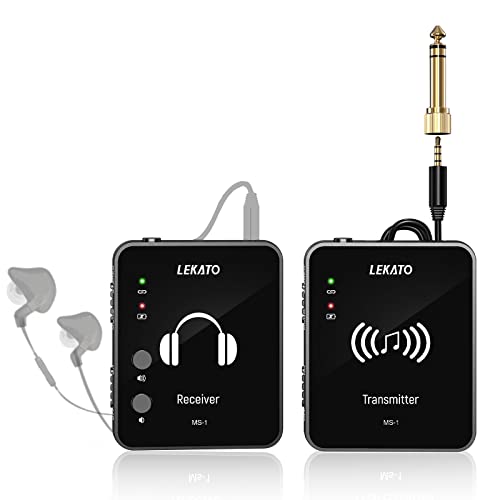
Easy Stereo Practice Unit – LEKATO MS-1 Wireless IEM
The LEKATO MS-1 is aimed at players who want in-ear monitor systems for quiet practice with minimal fuss. It supports stereo transmission, pairs automatically, and can link multiple receivers to one transmitter for small bands or shared rehearsal use.
Best For: Small to medium bands, church groups, and home rehearsal setups that want easy stereo wireless monitoring.
Pros:
- Supports true stereo transmission when fed a stereo source
- Auto-pairing makes setup fast and simple
- Up to 6 sets can work simultaneously with one transmitter
- 2.4GHz design offers low-noise, low-latency monitoring
Cons:
- Listed wireless range is 100 ft in open areas
- Battery life is about 5 hours
- Requires a stereo source and stereo cable for stereo mode
As a practice-focused IEM option, the MS-1 stands out for convenience and stereo flexibility. It is a good fit when you want quick pairing, multiple receivers, and a compact system that works well for everyday rehearsal sessions.
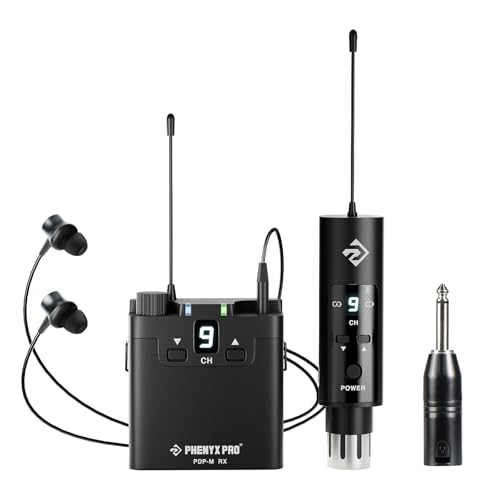
Compact Digital Option – Phenyx Pro PDP-M Stereo IEM
If you are comparing in-ear monitor systems for quiet practice and want something portable, the Phenyx Pro PDP-M keeps the footprint small while adding stereo-capable monitoring. It can run mono from a standard audio source or stereo with the included adapter path, and it uses a 24-bit/48kHz digital signal path for a cleaner monitor feed.
Best For: Musicians and performers who want a compact, portable wireless monitor for rehearsal, worship sets, or small stages.
Pros:
- Supports both mono and stereo monitoring
- 24-bit/48kHz digital signal path for consistent audio
- UHF 900MHz frequency-hopping helps improve stability
- One transmitter can send to multiple receivers
Cons:
- Battery life is up to 4 hours
- Uses a smaller portable form factor rather than a rack system
- Best range and stability still depend on stage conditions
The PDP-M is a practical choice when portability matters as much as monitor quality. It is especially useful for players who want a compact setup that can travel easily between rehearsal spaces and smaller performance venues.
Quiet Practice Pick – LEKATO MS-02 2.4G Low-Latency IEM
If you want in-ear monitor systems for quiet practice, the LEKATO MS-02 is built around low-latency 2.4GHz monitoring, so you can rehearse without dragging a cable across the room. It supports one transmitter to multiple receivers, includes mono/stereo switching, and keeps setup simple with auto-pairing and LED status feedback.
Best For: Small bands, singers, and rehearsal setups that want wireless monitoring for practice or studio use.
Pros:
- Upgraded low latency under 4.5ms in mono mode for tighter monitoring.
- One transmitter can send to up to 4 receivers for group practice.
- 6-8 hour battery life with battery level and volume LEDs.
- 100-foot open-area range helps you move freely while rehearsing.
Cons:
- Earbuds are not included, so you must buy monitoring earbuds separately.
- Mono/stereo switching may take a moment to configure for new users.
This is a practical pick if your main goal is quiet practice with dependable wireless monitoring and easy multi-user pairing. The feature set is aimed more at rehearsal convenience than premium studio extras, which makes it a strong value-focused choice.
Interference-Resistant Choice – UHF Metal IEM System with Pro Earphone
For in-ear monitor systems for quiet practice, this UHF model focuses on stable signal performance and noise isolation rather than flashy extras. The included pro earphones use passive noise cancellation, while the 16 adjustable channels make it easier to avoid interference in shared rehearsal spaces.
Best For: Singers, studio users, and bands that want a simple wireless monitoring setup with strong noise isolation.
Pros:
- UHF design is intended to resist interference from other wireless devices.
- Included earphones offer up to 33dB passive noise cancellation.
- 16 adjustable channels help reduce conflicts at busy venues or practice spaces.
- Rechargeable transmitter and bodypack are lightweight and easy to carry.
Cons:
- Battery life is about 5 hours, which is shorter than some alternatives.
- Best suited to users who are comfortable with channel selection if interference appears.
This model makes sense when your priority is keeping practice quiet and isolated from surrounding sound. The bundled earphones and channel flexibility make it especially useful for straightforward rehearsal monitoring in environments where wireless congestion can be an issue.
Long-Run Practice Option – Voxfull M6S Stereo 2.4G IEM
This stereo 2.4GHz system is aimed at in-ear monitor systems for quiet practice when you want a clean wireless connection and long battery life. It offers automatic pairing, mono/stereo switching, and support for multiple receivers, making it a flexible fit for rehearsals and small-stage use.
Best For: Practice sessions and small performance setups that need long runtime and easy pairing.
Pros:
- Built on a 2.4GHz chip with low noise and low delay.
- Up to 10 hours of battery life after a full charge.
- Automatic pairing simplifies setup for quick practice starts.
- Can pair multiple receivers with one transmitter, up to 6 units total.
Cons:
- Package includes only one set of in-ear headphones.
- Primarily designed for stage, church, and band use rather than advanced studio workflows.
If long practice sessions matter most, the M6S stands out for runtime and convenience. Its quick pairing and multi-receiver support make it a practical option for groups who want to rehearse quietly without spending time on complicated setup.
Studio-Ready 2.4GHz IEM – MX3 Wireless Stereo Monitor System
If you’re comparing in-ear monitor systems for quiet practice, the MX3 focuses on simple wireless monitoring with low-latency stereo audio and a 100 ft reception range. It’s built for players who want a portable setup with channel scanning, multiple channel operation, and enough battery life to cover long rehearsals.
Best For: Bands and solo players who want a portable wireless IEM for rehearsal, studio work, or stage monitoring.
Pros:
- 2.4GHz wireless monitoring with up to 100 ft reception range
- Supports mono/stereo input switching and up to 6 simultaneous channels
- Low latency under 5 ms with up to 107 dB signal-to-noise ratio
- Rechargeable battery rated for about 10–12 hours of use
Cons:
- Uses 2.4GHz wireless, so crowded environments may require channel scanning
- No noise control feature is listed
- Package includes one receiver and one transmitter only
The MX3 is a practical pick if you want a straightforward wireless monitor system that can handle practice sessions without adding much setup complexity. Its channel scan mode and long battery life make it especially convenient for players who need dependable monitoring between home practice and rehearsal.
Practice-Focused 2.4G IEM – JOYO JW-07 Wireless Monitor System
For in-ear monitor systems for quiet practice, the JOYO JW-07 is aimed at players who want a simple wireless way to monitor guitar or other instruments. It offers low-latency transmission, automatic pairing, and a compact 2.4GHz setup that suits practice sessions and small-room use.
Best For: Beginner guitar players and practice setups that need an easy wireless monitoring system.
Pros:
- Low latency under 5 ms for real-time monitoring
- 2.4GHz wireless with anti-interference frequency hopping
- 12 channel banks across 4 groups for flexible practice use
- Over 8 hours of battery life on a full charge
Cons:
- Operating range is listed at 40–60 ft in open space
- One transmitter does not support multiple receivers
- Audio detail is 48kHz/16bit, which is more modest than some higher-spec options
The JW-07 is a straightforward practice tool rather than a feature-heavy stage system. If your priority is clean monitoring for personal rehearsal with easy setup and solid battery life, it fits that role well.
Ultra-Low Latency UHF IEM – POGOLAB 7-Channel Wireless System
If you want in-ear monitor systems for quiet practice that also scale to live use, the POGOLAB UHF system brings very low 1 ms latency, 48kHz/24-bit audio, and a 164 ft range. It adds XLR and AUX/LINE flexibility, which makes it useful when you’re switching between a mixer, playback device, or other audio source.
Best For: Performers and rehearsing musicians who want a more feature-rich wireless monitor system with UHF stability.
Pros:
- Ultra-low 1 ms latency for real-time monitoring
- UHF wireless with 7 selectable channels to help reduce interference
- XLR input plus AUX/LINE switch for flexible source connection
- 48kHz/24-bit audio with over 106 dB dynamic range
Cons:
- Battery life is rated at up to 5 hours per charge
- Frequency response tops out at 16.5kHz rather than full-range hi-fi specs
- More performance-oriented than a basic quiet-practice-only setup
The POGOLAB system stands out for musicians who want a dependable wireless monitor with professional-style input options and strong channel flexibility. It’s a better fit when quiet practice is part of a broader rehearsal or performance workflow.
How We Picked the Best In-Ear Monitor Systems for Quiet Practice
We focused on systems that make low-volume practice easier without sacrificing clarity. That means dependable wireless connection, low latency, usable range, and enough control to build a clean personal mix. We also favored models that are practical for rehearsals and home use, not just stage setups.
Quick Comparison
In-Ear Monitor Systems for Quiet Practice generally fall into two groups: compact 2.4GHz systems and UHF systems. 2.4GHz options are often simpler to set up and are a strong fit for solo players or smaller rooms. UHF systems usually offer more channel flexibility and can be a better choice when multiple performers need separate mixes or when wireless congestion is a concern.
Key Buying Factors for In-Ear Monitor Systems for Quiet Practice
Latency and Sound Stability
For practice, you want the signal to feel immediate and natural. Lower latency helps rhythm, pitch, and timing stay locked in. Stable transmission matters just as much, especially if you move around while playing.
Stereo Vs. Mono
Stereo monitoring can make it easier to separate vocals, backing tracks, and instruments in your ears. Mono can still work well for simple rehearsals, but stereo is usually more comfortable and detailed for private practice.
Range and Interference
Check the rated range and think about your environment. Apartments, rehearsal rooms, and crowded venues can all affect wireless performance. If you practice in the same place every time, reliability may matter more than maximum distance.
Inputs, Controls, and Ease of Use
Look for XLR and AUX/line compatibility if you want to connect to mixers, interfaces, or practice rigs. Auto-pairing, rechargeable batteries, and beltpack-style receivers can make daily use much easier.
Headphones and Overall Monitoring Quality
A good transmitter is only part of the equation. The included earbuds or your preferred in-ear monitors will shape comfort, isolation, and detail. For quiet practice, fit and passive noise reduction are especially important.
Who Should Buy Which In-Ear Monitor Systems for Quiet Practice?
Solo musicians and home-practice players should usually start with a straightforward 2.4GHz system for easy setup and portability. Bands and multi-performer setups may benefit more from UHF models with more channel options and better flexibility. If you want the cleanest, most controlled practice experience, choose a system that pairs low latency with stable connection and the input options your gear already uses.
