The right mixer can make a live stream sound cleaner, more controlled, and easier to manage. These 10 picks cover compact creator setups, multi-microphone broadcasts, music performances, karaoke, and recording.
We compared channel counts, connectivity, effects, monitoring features, and streaming compatibility to help you choose a console that fits your equipment, workflow, and budget.
Best 10 Digital Mixing Consoles for Live Streaming Picks for 2026
Feature-Rich Choice
- 18 channels with USB-C, Bluetooth, and tactile controls
- DSP, Auto Gain, Clip Safe, and scene recall
- USB-HDMI with 4K capture and pass-through
Best For: Advanced streaming and live-production setups
Hands-On Streaming Pick

- 16 channels with touch faders and a 7-inch display
- USB livestreaming, Bluetooth, and app control
- Built-in EQ, compression, FX, and scene recall
Best For: Portable live sound and streaming setups
Budget-Friendly Utility

- 16 channels with XLR and 1/4-inch input support
- USB, Bluetooth, 48V phantom power, and headphone monitoring
- 3-band EQ plus reverb and delay effects
Best For: Multi-input streaming, recording, and small events
Creator Starter Bundle

- Two-channel mixer bundled with a condenser microphone
- Voice effects, noise reduction, pitch, and reverb controls
- Plug-and-play support for PC, phone, and tablet
Best For: Solo streaming, podcasting, gaming, and singing
Compact Bluetooth Mixer

- Six-channel design with Bluetooth and USB audio
- 48V phantom power and balanced XLR inputs
- Built-in MP3 playback and recording
Best For: Portable livestreaming, podcasting, DJ sets, and karaoke
High-Resolution Streaming Mixer

- 24-bit/192 kHz USB-C interface with loopback
- Two combo inputs plus stereo line input
- 99 reverb effects and flexible monitoring
Best For: Podcasts, gaming streams, home studios, and small events
Eight-Channel Live Sound Console

- Eight mic inputs with XLR and 1/4-inch connectivity
- Bluetooth, USB playback, and USB recording
- Three-band EQ plus reverb and delay effects
Best For: Multi-microphone streams, small bands, karaoke, and stage use
Best Beginner Pick

- Six inputs for microphones and instruments
- USB recording, Bluetooth, and MP3 playback
- 16 DSP effects with 48V phantom power
Best For: Beginners, home studios, and live-streaming creators
Most Versatile Control
8-Channel Mixer with 99 DSP Effects

- Eight channels with 3-band EQ and compressors
- 99 DSP presets and 7-band graphic EQ
- Dual AUX sends, PAD, USB, and Bluetooth
Best For: Performers, DJs, and advanced streaming setups
Best Compact Option

- Compact five-channel design with three XLR inputs
- USB recording, USB playback, and headphone monitoring
- Echo, delay, Bluetooth, and 48V phantom power
Best For: Compact streaming desks, podcasts, and online meetings
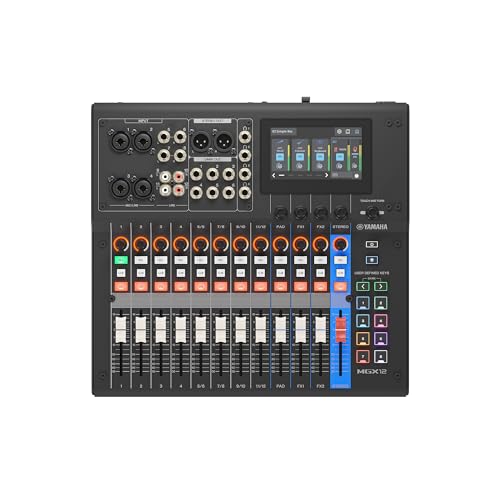
Feature-Rich Choice – Yamaha MGX12 Digital Console
The Yamaha MGX12 is a capable option among digital mixing consoles for live streaming, combining tactile faders, a 4.3-inch touchscreen, USB-C connectivity, Bluetooth audio, and a USB-HDMI interface with 4K video capture and pass-through. Its DSP, Auto Gain, Clip Safe, and scene recall features can simplify more involved streaming and live-production setups.
Best For: Streamers and live producers who need flexible audio routing plus video connectivity and hands-on control.
Pros:
- 18 channels with versatile XLR, Bluetooth, USB, and microSD-related functionality.
- 4.3-inch touchscreen, five control knobs, and tactile faders support hands-on mixing.
- Built-in DSP enables professional processing and latency-free monitoring.
- USB-HDMI interface supports 4K video capture and pass-through.
Cons:
- At 14.7 pounds, it is less convenient for highly portable setups.
- Its broader feature set may be more than a basic streaming rig needs.
The MGX12 stands out when a streaming workflow needs substantial channel capacity, physical controls, and integrated audio-video connectivity rather than a minimal desktop mixer.
Hands-On Streaming Pick – ALTO TMD16 Digital Mixer
The ALTO TMD16 is a practical choice among digital mixing consoles for live streaming, offering 16 channels, 100mm touch faders, a 7-inch color display, USB recording or livestreaming, and Bluetooth connectivity. Built-in EQ, compression, effects, scene recall, and app control give creators several ways to manage a live mix.
Best For: Small venues, rehearsal spaces, houses of worship, and mobile streamers wanting tactile controls with app-based flexibility.
Pros:
- Ten digital mic preamps and 16 total channels support varied live inputs.
- Touch faders, dedicated encoders, and a 7-inch display reduce dependence on a tablet.
- Includes parametric EQ, compression, a 16-preset FX engine, four aux sends, and four subgroups.
- USB and Bluetooth support recording, livestreaming, and wireless control.
Cons:
- Its 16-channel layout may be more than a simple one- or two-microphone stream requires.
- The supplied notes do not specify software-update support.
With a durable metal chassis and a comparatively portable 5.45-kilogram design, the TMD16 balances physical control and digital convenience for recurring live events.
Budget-Friendly Utility – 16-Channel USB Audio Mixer
This 16-channel audio mixer is a straightforward option among digital mixing consoles for live streaming, with USB computer connectivity, Bluetooth playback, 48V phantom power, headphone monitoring, and onboard gain, EQ, reverb, and delay controls. Its broad input support suits streams that also involve recording, music playback, meetings, or small live performances.
Best For: Users needing many wired inputs and basic streaming, recording, karaoke, podcasting, or small-event mixing features.
Pros:
- Sixteen channels accept XLR and unbalanced 1/4-inch connections.
- USB, Bluetooth, REC/TAPE, and headphone connections support flexible workflows.
- 48V phantom power accommodates compatible condenser microphones.
- Independent channel controls include gain, FX, PFL, 3-band EQ, faders, and peak indicators.
Cons:
- The feature set is more traditional and less display-driven than advanced digital consoles.
- At 6.33 kilograms, it is not the lightest option for frequent transport.
- The supplied notes do not identify a dedicated streaming control app.
This mixer emphasizes connection count and familiar physical controls, making it a sensible fit when reliable input access matters more than touchscreen automation or advanced scene management.
Creator Starter Bundle – TENLAMP G10 Mixer with Mic
The TENLAMP G10 is a compact creator bundle rather than a full venue mixer, pairing a two-channel audio mixer with a condenser microphone and accessories. For digital mixing consoles for live streaming, it focuses on plug-and-play control, noise reduction, voice effects, Bluetooth, and PC, phone, and tablet compatibility.
Best For: Beginners making streams, podcasts, gaming content, voice recordings, or live singing performances.
Pros:
- Includes a mixer, condenser microphone, and essential accessories in one setup.
- Supports bass, treble, reverb, pitch, voice changing, and sound effects.
- Follow Singing Mode lets the performer monitor the original track while the audience hears the mixed output.
- Works with Windows, Mac, iOS, and Android without requiring drivers.
Cons:
- Only two channels, so it is not suited to larger multi-microphone productions.
- Its 70 dB noise level specification may not appeal to users seeking a more advanced studio-oriented system.
- Battery-powered operation may require more attention to power management during long sessions.
The G10 is best viewed as an accessible all-in-one creator kit: it reduces setup complexity and adds interactive effects, while its limited channel count keeps it aimed at solo creators.
Compact Bluetooth Mixer – XTUGA CT60
For creators comparing digital mixing consoles for live streaming, the XTUGA CT60 combines six-channel input flexibility with Bluetooth, USB audio, and direct MP3 playback. Its 48V phantom power, balanced XLR inputs, and three-band EQ make it suitable for handling microphones, instruments, and playback sources in a compact setup.
Best For: Live streamers, podcasters, DJs, karaoke users, and mobile performers who want wireless playback and basic recording features.
Pros:
- Bluetooth connectivity supports wireless audio streaming from phones, tablets, and computers.
- Balanced XLR inputs, insert points, and 48V phantom power support microphones and cleaner signal handling.
- USB audio interface, MP3/WAV/WMA playback, and built-in recording add useful computer-based workflow options.
- Slim chassis with sealed rotary knobs is suited to portable streaming and performance setups.
Cons:
- Six channels may be limiting for larger productions with many microphones or instruments.
- The listed dimensions appear inconsistent, so verify the physical size before purchasing.
- Advanced software support is not specified in the supplied details.
The CT60 is a practical all-in-one choice when Bluetooth playback, USB recording, and a compact footprint matter more than extensive channel expansion.
High-Resolution Streaming Mixer – Zenolix RM04
The Zenolix RM04 is a compact option for shoppers seeking digital mixing consoles for live streaming with more detailed routing and monitoring control. It offers two XLR/6.35 mm combo inputs, a stereo line input, USB-C connectivity, loopback, and 24-bit/192 kHz USB audio operation for compatible streaming or recording software.
Best For: Podcasters, gaming streamers, home studios, singer-songwriters, and small events needing effects, loopback, and flexible headphone monitoring.
Pros:
- Two combo microphone/instrument inputs include 48V phantom power, while channel 1 adds HI-Z support.
- High-resolution 24-bit/192 kHz USB audio interface includes loopback for streaming workflows.
- Each channel provides EQ, PAN, FX send, mute, and other hands-on controls.
- Built-in Bluetooth, USB playback and recording, 99 reverb effects, and dual headphone outputs expand its flexibility.
Cons:
- Four channels provide less input capacity than larger mixers for group performances.
- Warranty information directs buyers to contact the seller for support.
- Compatibility with specific recording and streaming software is not detailed.
Choose the RM04 if you want a small mixer with unusually strong digital connectivity and effects control, particularly for a computer-centered streaming or recording rig.
Eight-Channel Live Sound Console – Professional 8-Channel Mixer
For live streamers who need more inputs, this eight-channel console is a versatile entry in the digital mixing consoles for live streaming category. It combines eight microphone inputs with USB and Bluetooth playback, direct USB recording, headphone monitoring, three-band EQ, and built-in reverb and delay controls.
Best For: Multi-microphone livestreams, small bands, karaoke, weddings, podcasts, stage performances, and online meetings.
Pros:
- Eight channels accommodate multiple microphones and instruments using XLR or unbalanced 1/4-inch connections.
- Bluetooth supports wireless music playback from phones, tablets, and computers.
- USB connectivity supports computer mixing and recording, with recording to a USB flash drive also available.
- Per-channel gain, FX, PFL, three-band EQ, faders, and peak indicators provide hands-on control.
Cons:
- The supplied details do not specify a USB sample rate or bit depth.
- Its larger eight-channel layout may be more mixer than a simple solo streaming setup requires.
- Software update support is not specified.
This mixer is a sensible fit when input count and straightforward physical controls are priorities, especially for live shows or streams involving several audio sources.
Best Beginner Pick – BOMGE 6-Channel Digital Mixer
For shoppers comparing digital mixing consoles for live streaming, the BOMGE 6-channel mixer combines flexible inputs with USB recording, Bluetooth playback, and a built-in sound card. Its compact feature set is suited to creators who want one console for streaming, podcasting, karaoke, and basic recording.
Best For: Beginners, home studios, YouTube creators, podcasters, and small karaoke or streaming setups.
Pros:
- Six input channels include four XLR/line combo inputs for microphones and instruments.
- USB sound-card functions support computer recording and live-streaming applications.
- Includes Bluetooth streaming, USB playback and recording, and 16 built-in DSP effects.
- Offers 48V phantom power plus main XLR, 1/4-inch, and RCA outputs.
Cons:
- Bluetooth range is listed at approximately 15 feet.
- The feature set is aimed more at beginner and studio applications than advanced professional control.
This is a practical all-in-one option when easy computer connectivity and media playback matter more than extensive channel count or advanced routing.
Most Versatile Control – 8-Channel Mixer with 99 DSP Effects
Among digital mixing consoles for live streaming, this 8-channel model stands out for its channel-level control and routing flexibility. It adds compressors, dual AUX sends, a 7-band graphic EQ, metering, and monitoring features for users who need more precise sound shaping in live or studio environments.
Best For: Live performers, DJs, small production setups, and streamers who need detailed channel control.
Pros:
- Eight channels provide room for microphones, instruments, and other audio sources.
- Each channel includes 3-band EQ and a dedicated compressor control.
- Offers 99 DSP presets, a 7-band graphic EQ, and dual AUX sends.
- Includes Bluetooth, USB playback and recording, PAD switches, 48V phantom power, metering, and headphone monitoring.
Cons:
- At 4.9 pounds, it is heavier than the compact mixers in this roundup.
- Its broader control set may be more than beginners need.
Choose this mixer if you expect to grow beyond basic streaming and want onboard dynamics control, effects, and routing options in one console.
Best Compact Option – BOMGE BM-05 5-Channel Mixer
For buyers seeking compact digital mixing consoles for live streaming, the BOMGE BM-05 offers essential connectivity in a small format. It supports microphones, instruments, computers, USB media, and Bluetooth sources, while adding headphone monitoring and simple echo and delay effects for streaming and podcast work.
Best For: Small streaming desks, podcasters, online presenters, meetings, and compact karaoke or music setups.
Pros:
- Five channels include three XLR inputs plus stereo 1/4-inch and RCA inputs.
- USB-B supports computer, phone, or tablet mixing and recording with the appropriate OTG adapter.
- USB-A enables MP3 playback and recording to a flash drive.
- Provides headphone monitoring, 48V phantom power, and echo or delay effects.
Cons:
- Bluetooth range is listed at approximately 1.5 feet.
- Bluetooth, USB, and 4/5-channel functions cannot be used simultaneously.
- It has a simpler 2-band EQ and fewer channels than the larger options.
The BM-05 makes sense when desk space and straightforward connectivity are priorities, but its short Bluetooth range and shared-function limitations should be considered before purchase.
How We Picked the Best Digital Mixing Consoles for Live Streaming
We focused on mixers that can handle common streaming tasks without requiring a complicated studio setup. Key considerations included USB audio connectivity, XLR inputs, phantom power for condenser microphones, Bluetooth support, built-in effects, monitoring controls, and the number of simultaneous sources each console can accommodate.
Because product specifications and included accessories can vary, verify the listing before purchase—especially when you need a microphone, software bundle, or a particular USB connector. A mixer labeled “digital” may still offer very different levels of routing, automation, and control.
Quick Comparison
| Best For | Look For | Recommended Configuration |
|---|---|---|
| Solo streamers | Simple USB interface, one or two mic inputs, compact controls | 4–6 channels |
| Podcasts and interviews | Multiple XLR inputs, headphone monitoring, phantom power | 6–8 channels |
| Music streams | More inputs, balanced connections, EQ, effects, and reliable routing | 8–16 channels |
| Live bands or larger productions | High channel count, flexible buses, advanced processing, and expansion options | 12–18 channels |
Key Buying Factors for Digital Mixing Consoles for Live Streaming
Inputs and Channel Capacity
Count every source you plan to use: microphones, instruments, playback devices, phones, and guest feeds. Leave a few spare channels for future expansion. XLR/TRS combo inputs are useful when you switch between microphones and line-level equipment.
USB Connectivity and Computer Compatibility
A USB audio interface lets the mixer send audio to streaming software and often receive computer playback. Check whether the connection is USB-C or USB-A, whether the mixer supports your operating system, and whether it provides separate channels or only a stereo mix.
Phantom Power, Monitoring, and Effects
48V phantom power is important for many condenser microphones, while dedicated headphone monitoring helps you catch distortion or background noise before viewers do. Built-in reverb, delay, compression, and EQ can simplify vocal and music processing, but physical control and clean routing matter more than a long effects list.
Build, Controls, and Workflow
Choose a layout you can operate quickly while live. Faders, mute buttons, gain controls, and clear meters are valuable during a broadcast. Bluetooth is convenient for background audio, but it should complement—not replace—a dependable wired connection.
Who Should Buy Which Digital Mixing Consoles for Live Streaming?
Choose a compact four- to six-channel model if you are a solo creator with one microphone, computer audio, and occasional music playback. A creator bundle can be convenient when you are starting from scratch and need a microphone included.
For podcasts, interviews, and two-person streams, prioritize several XLR inputs, 48V phantom power, and independent monitoring. Choose an eight-channel mixer when you use multiple microphones, instruments, or playback sources. Larger 12- to 18-channel consoles make the most sense for bands, event streams, karaoke systems, and productions that need room to grow.
Finally, match the mixer to your software and connection needs before focusing on extra effects. The best Digital Mixing Consoles for Live Streaming are the ones that provide enough inputs, dependable computer integration, and controls you can use confidently while broadcasting.
